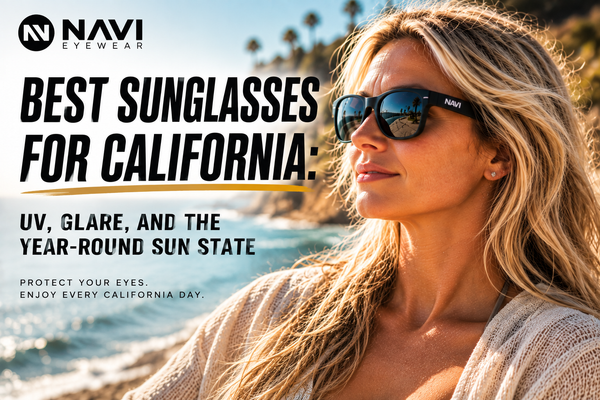

Best Sunglasses for California: UV, Glare, and the Year-Round Sun State
California is one of the highest-UV states in the continental US — not just in summer, but year-round. The combination of Mediterranean climate (300+ sunny days annually in Southern California), high coastal UV amplified by ocean reflection, Central Valley exposure with no shade and intense agricultural worker UV, and Sierra Nevada altitude that increases UV 10–12% per 1,000 meters creates a UV environment that demands consistent, year-round UV400 protection. California residents who treat sunglasses as a summer accessory are misunderstanding their UV exposure profile. This guide covers California's specific UV environments and the right lens setup for each.

1. California's UV Profile: More Demanding Than You Think
Southern California: The Year-Round High-UV Zone
Los Angeles, San Diego, Orange County, and the Inland Empire sit between 32–34 degrees north latitude — close enough to the equator to receive meaningfully higher baseline UV than most of the US. UV index in LA and San Diego averages 6–8 in winter months and 10–13 in summer — there is no low-UV season in Southern California the way there is in the Midwest or Northeast. A January afternoon in San Diego involves UV index 5–6 — adequate to drive cumulative UV accumulation for residents who are outdoors daily without protection.
The coastal geography amplifies this further. Ocean water reflects 25–80% of UV depending on sun angle — coastal Southern California residents, surfers, beach walkers, and coastal highway drivers face the combination of direct UV plus significant water reflection UV. The Pacific Coast Highway drive from Santa Monica to Malibu on a clear day involves direct sun plus ocean reflection on the driver's left side — a sustained UV exposure scenario that a car pair of gray polarized UV400 in the center console addresses completely.
Northern California: The Bay Area's Deceptive UV
San Francisco's fog creates a local microclimate that can suppress direct UV intensity — but UV penetrates cloud cover at 30–50% of clear-sky intensity, and the Bay Area's frequent afternoon clearing means outdoor UV exposure is significant throughout the day even on apparently overcast mornings. San Francisco at UV index 4–6 on a partly cloudy October afternoon is sufficient for meaningful UV accumulation. The thermal inversion that produces Bay Area fog also creates some of California's most reflective outdoor conditions when the fog clears — the marine layer's moisture increases atmospheric clarity above it, producing intense solar radiation at the surface level when the sun breaks through.
Central Valley: Agricultural UV and Heat
The Central Valley — Fresno, Bakersfield, Stockton, Sacramento — combines high UV index (8–12 in summer) with the outdoor occupational exposure of agricultural workers, construction, and transportation industries. Central Valley UV without shade or cloud moderation is among the most intense sustained occupational UV exposure in California. For outdoor workers in the Central Valley, UV400 eye and skin protection is an occupational health requirement, not a lifestyle preference. The Central Valley's flat, exposed terrain also means there is no terrain shading — no mountains or buildings reducing solar angles — for the extended midday UV window.
Sierra Nevada and Mountain California: Altitude UV
Lake Tahoe sits at approximately 6,200 feet. Yosemite Valley is at 4,000 feet, with High Sierra terrain above 12,000 feet. Mt. Whitney at 14,505 feet. At 6,000 feet, UV intensity is approximately 60–70% higher than at sea level — the same sun angle produces dramatically more UV at altitude because less atmosphere filters it. Snow at Tahoe, Mammoth, and Sierra ski resorts reflects 80% of UV, doubling the effective UV dose at ski and snowshoe venues. A Tahoe ski day involves the highest UV dose most California residents experience all year — exceeded only by backcountry skiing above treeline where both altitude and snow combine at maximum effect.
2. California UV by Activity and Location
Beach and Coastal Southern California
Santa Monica, Venice, Huntington Beach, La Jolla, Mission Beach — California's coastal culture concentrates UV exposure at beaches that combine peak UV index (10–13 in summer) with ocean reflection. Copper Cat 3 polarized UV400 polycarbonate for California beach use — copper's strong blue absorption addresses the blue-toned ocean reflection more completely than amber, and Cat 3 for the sustained peak UV of afternoon beach sessions. The Buy 1, Get 2 Free at $85 for three pairs makes having a dedicated beach pair alongside everyday and car pairs economically practical.
Driving in Southern California
LA car culture means Southern California residents spend more daily time in vehicles than almost any US population. The I-10 westbound at 5pm, the 405 at noon, PCH heading south in the afternoon — driving in SoCal consistently involves direct or oblique sun exposure through side windows that transmit UV-A. Gray Cat 2 polarized UV400 in the center console, always — the non-negotiable SoCal car pair. Road surface glare on LA's freeways and city streets is among the most sustained urban road glare in the US; polarization eliminates it completely.
Hiking and Outdoor Recreation
Angeles National Forest, Joshua Tree, Zion (nearby), Yosemite, Point Reyes, Marin Headlands — California's outdoor recreation venues span desert, coastal, forest, and alpine UV environments. Amber Cat 2–3 polarized UV400 for trail hiking and outdoor recreation across most California terrain — amber's contrast enhancement for trail surfaces, terrain features, and variable light conditions that characterize California's diverse hiking landscapes. Cat 3 for desert hiking (Joshua Tree UV index 10–13 in summer, no shade, highly reflective sand and rock) and alpine hiking above 8,000 feet.
Skiing and Snowboarding
Mammoth Mountain, Tahoe resorts (Heavenly, Palisades, Northstar), Big Bear — California ski venues combine altitude UV amplification with snow reflection (80% UV reflectance) for the highest UV dose scenarios California residents encounter. Amber Cat 3 polarized UV400 for California ski days — amber for snow terrain contrast and variable cloud conditions, Cat 3 for the peak UV of midday ski hours at altitude with snow amplification.
Cycling — Road and Mountain
California's cycling culture — road cycling in Marin, mountain biking in the Santa Monica Mountains, criterium racing in Ventura County — involves sustained outdoor UV at exercise pace with road surface glare. Amber Cat 2 polarized UV400 in a sport frame for California cycling — contrast enhancement for road hazards on California's varied road surfaces, polarization for road and trail surface glare.
3. California-Specific UV Considerations
The Inland Empire and Desert Communities
Palm Springs, Coachella Valley, Riverside, and the broader Inland Empire experience some of the most intense UV in California — desert terrain with minimal cloud cover, high reflectance from sand and rock surfaces, and summer UV indexes that regularly exceed 12. Desert UV reflection from sand and light-colored rock surfaces is not as efficiently polarized as water reflection, but the combination of direct UV plus desert surface diffuse reflection produces effective UV doses significantly above the UV index alone.
California's Wildfires and Smoke UV
California wildfire smoke creates a UV dynamic worth understanding. Heavy smoke significantly reduces UV-B (the shorter wavelength, more efficiently scattered by particles) while allowing more UV-A to pass through. The result: on heavy smoke days, UV-B is reduced but not UV-A — the UV index may read low but UV-A exposure continues. UV400 sunglasses that block both UV-A and UV-B maintain complete protection on smoke days; "it looks overcast, I don't need sunglasses" is an incorrect interpretation of smoke-reduced UV index readings.
Year-Round UV: The California Mistake
The most common UV protection mistake California residents make is treating sunglasses as a summer item. December in San Diego involves UV index 5–6 on clear days; January in Palm Springs involves UV index 5–7. These are not zero UV days — they are meaningful UV accumulation days for California's year-round outdoor culture. The resident who walks, cycles, and surfs year-round accumulates significant winter UV that the resident who wears sunglasses only May through September misses entirely. Year-round car pair + bag pair is the California minimum.
4. California Lens Recommendation by Context
| California Context | Recommended Tint | Category | Notes |
|---|---|---|---|
| SoCal beach and coastal | Copper polarized | Cat 3 | Ocean reflection; peak UV |
| LA/SoCal freeway driving | Gray polarized | Cat 2 | Color accuracy; road glare |
| Desert (Joshua Tree, Palm Springs) | Copper or amber polarized | Cat 3 | Extreme UV; sand reflection |
| Sierra Nevada hiking | Amber polarized | Cat 2–3 | Altitude UV; terrain contrast |
| Tahoe and ski resorts | Amber polarized | Cat 3 | Snow + altitude UV |
| Bay Area everyday | Gray polarized | Cat 2 | Variable fog/sun; urban |
| Central Valley outdoor work | Amber polarized | Cat 3 | Sustained occupational UV |
| California cycling | Amber polarized | Cat 2 | Road contrast; sport frame |
| Surfing (NorCal and SoCal) | Copper polarized | Cat 3 | Ocean UV; retention strap |
| Year-round everyday SoCal | Gray polarized | Cat 2 | Versatile for daily UV accumulation |
5. The California Multi-Pair Strategy
California's UV diversity — coastal, urban, desert, mountain — across a single state means a single pair of sunglasses is an inadequate coverage strategy for residents who move across these environments. The three-pair setup for California residents:
- Car pair: gray Cat 2 polarized UV400 — center console, covers daily driving and commuting across all California roads
- Everyday bag pair: gray or amber Cat 2 polarized UV400 — bag pair for walking, transit, lunch breaks, and all non-driving daily UV
- Activity pair: copper Cat 3 polarized UV400 for beach/water use or amber Cat 3 polarized UV400 for hiking/skiing/sport — dedicated to the high-UV activity contexts that California's outdoor culture creates
Navi Eyewear's Buy 1, Get 2 Free — $85 for three pairs — covers the complete California three-pair setup at the full UV400 polycarbonate polarized specification for approximately $28 per pair.
Frequently Asked Questions
What UV index is California year-round?
Southern California (LA, San Diego) averages UV index 5–7 in winter months and 10–13 in summer. The Bay Area averages 3–5 in winter and 8–10 in summer. The Central Valley and Inland Empire average 4–7 in winter and 10–13+ in summer. Desert communities (Palm Springs, Coachella) average 5–8 in winter and 12–14 in summer. There is no truly low-UV season in California — even winter months produce meaningful daily UV accumulation for outdoor-active residents.
Do I need sunglasses year-round in California?
Yes — California's mild winters and outdoor culture mean year-round outdoor UV accumulation at levels that are meaningful for long-term eye health. The mistake of treating sunglasses as a May–September accessory leaves 4–5 months of winter UV accumulation unprotected. Year-round car pair and bag pair placement closes this gap without requiring any seasonal behavioral switching.
What are the best sunglasses for LA?
Gray Cat 2 polarized UV400 polycarbonate for everyday LA use — driving, walking, outdoor dining, errands. Copper Cat 3 polarized for beach and coastal use. Amber Cat 2–3 polarized sport frame for hiking in Angeles National Forest, cycling in Griffith Park or Malibu, and outdoor sport. The gray everyday pair handles the broad range of LA daily UV contexts; the activity pair handles the high-UV specialised contexts.
Is California UV worse than Florida or Hawaii?
Hawaii is higher — tropical latitude (20–22 degrees north) produces higher baseline UV than Southern California. Florida in summer is comparable to SoCal. However, California's altitude environments (Sierra Nevada skiing, high desert hiking) produce higher UV than either Florida or coastal Hawaii — Tahoe ski days and Whitney Portal hiking days can exceed UV indexes achievable at sea level anywhere in the US.
Do surfers in California need special sunglasses?
Yes — copper Cat 3 polarized UV400 with anti-saltwater coating, TR90 wraparound frame, stainless steel hinges, and a retention strap. California surfers at breaks from Santa Cruz to San Diego face the combination of ocean UV reflection, coastal UV amplification, and the physical demands of surfing that require water-specific frame retention. California surfers have documented elevated pterygium rates — "surfer's eye" — that wraparound UV protection specifically addresses.
The Bottom Line
California is a year-round UV state with one of the most diverse UV environment profiles in the US — coastal ocean reflection, desert extreme UV, Sierra altitude amplification, and 300+ sunny days annually in the south. Gray Cat 2 polarized UV400 for everyday driving and commuting; copper Cat 3 for beach and ocean use; amber Cat 2–3 for desert hiking, skiing, and sport. Three-pair coverage at three locations eliminates the availability gaps that California's active outdoor lifestyle creates. navieyewear.com/collections/polarized — Buy 1, Get 2 Free for $85.
Related Reading
- Best Sunglasses for Arizona and the Desert Southwest | Navi Eyewear
- Best Sunglasses for Hawaii | Navi Eyewear
- Sunglasses for Desert and Arid Environments | Navi Eyewear
- Sunglasses for Surfing | Navi Eyewear
- The Complete Water Sports Sunglasses Guide | Navi Eyewear
- Sunglasses by Season: The Complete Year-Round UV Guide | Navi Eyewear
- The Complete Sunglass Buyer's Guide | Navi Eyewear
- Shop Polarized UV400 Sunglasses | Navi Eyewear
Sources & Citations
[1] WHO. "Global solar UV index: a practical guide." World Health Organization, 2002. View source →
[2] Sliney DH. "Ocular exposure to environmental light and ultraviolet." Journal of AAPOS, 2014. View source →
[3] Diffey BL. "Sources and measurement of ultraviolet radiation." Methods, 2002. View source →
[4] Taylor HR, et al. "Effect of ultraviolet radiation on cataract formation." New England Journal of Medicine, 1988. View source →
[5] Threlfall TJ and English DR. "Sun exposure and pterygium of the eye: a dose-response curve." American Journal of Ophthalmology, 1999. View source →
[6] Dain SJ. "Sunglasses and sunglass standards." Clinical and Experimental Optometry, 2003. View source →