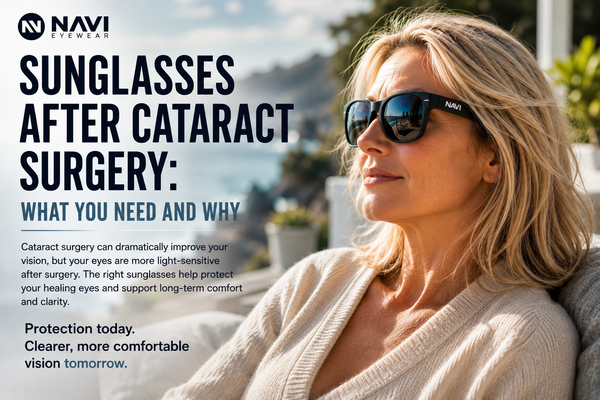

Sunglasses After Cataract Surgery: What You Need and Why
Cataract surgery replaces the eye's natural crystalline lens — which absorbs UV as part of its normal function — with an artificial intraocular lens (IOL). Whether the IOL provides equivalent UV protection depends entirely on which IOL was implanted. Most modern IOLs in the US include UV-blocking material; some do not. Beyond the IOL question, the immediate post-operative period involves photophobia, healing corneal surfaces, and dilating drops that make UV400 sunglasses a practical necessity for outdoor activity. This guide covers what cataract surgery patients actually need from sunglasses — immediately post-operatively and long-term. For the broader medical context, see the complete guide to sunglasses for light sensitivity and medical conditions.

1. What Cataract Surgery Does to the Eye's UV System
The Natural Lens as a UV Filter
The crystalline lens of the healthy adult eye absorbs nearly all UV-B and most UV-A before it reaches the retina. This UV filtering function is a byproduct of the lens's chemical composition — the lens proteins and chromophores that accumulate with aging absorb UV progressively, making the mature adult lens a more complete UV filter than the young, clear pediatric lens. The cataractous lens, despite its optical cloudiness, continues to provide UV filtering — the proteins that scatter visible light still absorb UV.
When cataract surgery removes the natural lens, the eye temporarily loses its UV filtering capability at the lens level. If the replacement IOL does not include UV-blocking material, the retina is exposed to UV that the natural lens previously absorbed — a significant change in the eye's UV management that has implications for long-term retinal UV protection.
IOL Types and UV Protection
Three IOL categories with different UV characteristics:
- UV-blocking IOLs (most modern IOLs): contain UV-absorbing chromophores that block UV-A and UV-B up to approximately 400nm — providing UV protection equivalent to the natural adult lens. The majority of IOLs implanted in the US and Europe today include UV blocking as standard. Patients with UV-blocking IOLs have adequate retinal UV protection from the IOL itself, making sunglasses a periorbital and external eye UV protection tool rather than a retinal UV protection necessity.
- UV and blue-light-filtering IOLs: block UV and additionally filter blue wavelengths (400–450nm) — intended to provide additional macular protection through blue light filtering. The clinical benefit of the blue light filtering component for AMD prevention is debated; UV blocking is the unambiguous protective feature.
- Clear (non-UV-blocking) IOLs: some specialty IOLs, older designs, and certain accommodating lens implants may not include UV-blocking material. Patients with these IOLs have unprotected retinas from a UV standpoint — the retina receives UV that the natural lens would have absorbed. UV400 sunglasses are particularly important for these patients as the only UV filtering mechanism remaining between the outdoor environment and the retina.
How to Know Which IOL You Have
The IOL type is documented in the surgical record. Patients can ask their ophthalmologist directly: "Does my IOL block UV?" Most cataract surgeons can confirm the UV-blocking status of the IOL from the operative note. Patients who cannot confirm their IOL type should assume a conservative approach and wear UV400 sunglasses for all outdoor time — the cost of unnecessary UV protection is zero; the cost of inadequate UV protection for a clear IOL patient is ongoing retinal UV accumulation.
2. Immediate Post-Operative Period: The First 4 Weeks
Why the Post-Operative Eye Needs Special Attention
In the immediate post-operative period after cataract surgery, several factors make UV protection and light management particularly important:
- Dilating drops: post-operative management typically includes dilating drops (cycloplegics and mydriatics) used during the procedure that continue to affect pupillary dilation for hours to days. A dilated pupil allows maximum light and UV to enter the eye — the pupillary defense against bright light is temporarily disabled. UV400 sunglasses compensate for the dilated pupil's inability to constrict by providing external light and UV management.
- Post-operative photophobia: the eye adjusts to the new IOL optical system and the temporary effects of surgical manipulation — the cornea is touched, the iris is manipulated, and the eye adjusts to the new optics. Photophobia in the first days to weeks post-operatively is near-universal and ranges from mild to significant. UV400 Cat 2–3 sunglasses are the practical management tool for outdoor photophobia during this adjustment period.
- Healing corneal incisions: phacoemulsification cataract surgery uses small corneal incisions (typically 2–3mm) that heal over weeks. The healing corneal wound is UV-sensitive — UV exposure during the healing period may affect wound healing quality. UV400 protection during the incision healing window reduces UV exposure to healing corneal tissue.
- Posterior capsule integrity: the posterior lens capsule is preserved during cataract surgery to support IOL positioning. In the immediate post-operative period, the intact posterior capsule is important for the IOL's position and the eye's compartmentalization. UV400 protection during this period reduces any UV-driven inflammatory responses that might affect the healing environment.
Post-Operative Sunglass Specification
UV400 polycarbonate Cat 2–3 polarized in a wraparound frame for the immediate post-operative period:
- Cat 3 for peak UV outdoor conditions and for the first week when photophobia is most severe and dilating drops are still active
- Cat 2 as photophobia diminishes through weeks 2–4
- Wraparound for peripheral UV coverage of the healing corneal incisions and the dilated pupil that allows UV from lateral angles
- Polarized for the glare sensitivity that is part of post-operative photophobia — polarization eliminates reflected surface glare that is the most photophobically activating component of outdoor light
Browse UV400 polarized wraparound options at navieyewear.com.
3. Long-Term Post-Cataract UV Protection
For UV-Blocking IOL Patients
Patients with UV-blocking IOLs have retinal UV protection from the IOL. Long-term UV400 sunglasses are still appropriate for:
- Corneal and conjunctival UV protection — the IOL protects the retina but not the anterior ocular surface structures (cornea, conjunctiva) or the periorbital skin
- Pterygium prevention — UV-driven conjunctival growth is not addressed by retinal UV protection from the IOL
- Periorbital skin UV protection — eyelid skin cancer risk remains regardless of IOL UV-blocking status
- Glare management — cataract removal often dramatically improves visual quality, but some patients experience new types of visual disturbance with their IOL (halos, starbursts) that are worsened by glare; polarized sunglasses reduce surface glare that exacerbates these phenomena
For Non-UV-Blocking IOL Patients
Patients with clear (non-UV-blocking) IOLs have unprotected retinas — the complete UV filtering of the natural lens is absent, and UV reaches the photoreceptors and RPE directly. For these patients, UV400 sunglasses are the only UV filtering mechanism between the outdoor environment and the retina. UV400 for all outdoor time, every day, indefinitely — the urgency is significantly higher than for UV-blocking IOL patients.
The AMD risk for non-UV-blocking IOL patients is a specific concern — the macular UV exposure that the natural lens would have blocked now reaches the macula directly. Given that many cataract surgery patients are in the AMD risk age range (60s–70s+), retinal UV protection via UV400 sunglasses takes on added clinical importance for those with clear IOLs.
4. IOL-Related Visual Phenomena and Sunglass Solutions
Halos and Starbursts
Some IOL designs — particularly multifocal and extended-depth-of-focus (EDOF) IOLs — produce halos around point light sources (headlights, streetlights) and starbursts from high-luminance sources. These phenomena are caused by the diffractive optics of multifocal IOL designs and are generally more prominent in dim or dark conditions than in bright conditions. Sunglasses do not directly address these optical phenomena (which are properties of the IOL design rather than of incident light); however, polarized sunglasses reduce the bright reflected glare that can create the high-luminance conditions where halo and starburst perception is most distracting in outdoor settings.
Dysphotopsia
Dysphotopsia — arc-shaped or crescent-shaped light phenomena in the peripheral visual field — affects some cataract surgery patients and is related to light interactions at the IOL edge. Positive dysphotopsia (bright arc in the temporal field) is more common and typically resolves within weeks to months as neural adaptation occurs. Negative dysphotopsia (dark shadow in the temporal field) is less common but more persistent. Sunglasses do not resolve dysphotopsia but can reduce the ambient light conditions under which it is most prominent during the adaptation period.
Posterior Capsule Opacification (PCO)
Posterior capsule opacification — "secondary cataract" — occurs in 20–40% of cataract surgery patients within 5 years of the procedure, as residual lens epithelial cells proliferate on the posterior capsule and cause visual cloudiness. PCO produces symptoms similar to the original cataract: reduced contrast sensitivity and increased glare sensitivity. Polarized UV400 sunglasses reduce the outdoor glare that exacerbates PCO-related visual symptoms until YAG laser capsulotomy (a brief, effective laser procedure) resolves the PCO.
5. Preparing for Cataract Surgery: Pre-Operative Planning
Have UV400 Sunglasses Ready Before Surgery
Cataract surgery is a planned procedure — patients know their surgery date weeks in advance. Having UV400 polarized sunglasses ready before the surgery date means they are available immediately post-operatively without requiring a shopping trip while recovering from surgery. The immediate post-operative period involves photophobia and reduced visual acuity that make online shopping or store visits challenging.
Navi Eyewear's Buy 1, Get 2 Free at $85 for three pairs allows pre-surgical UV400 placement at the car, everyday bag, and home entry simultaneously — so consistent UV400 coverage across all departure points is in place from day one of post-operative recovery. At $85 for three pairs, the practical multi-location coverage is economically accessible pre-surgery.
Discussing IOL Choice and UV Protection with the Surgeon
Before cataract surgery, asking the surgeon about IOL UV-blocking status is straightforward — "Does the IOL you're recommending block UV?" Most surgeons immediately confirm yes for standard modern IOLs. If considering specialty IOLs (accommodating, extended-depth-of-focus, toric), specifically confirming UV-blocking status is worth doing — some specialty designs have different lens chemistries than standard IOLs. The answer determines the long-term UV protection priority for the operated eye.
Frequently Asked Questions
Do I need sunglasses after cataract surgery?
In the immediate post-operative period: yes, unambiguously — dilating drops, photophobia, and healing corneal incisions all make UV400 sunglasses a clinical necessity for outdoor activity. Long-term: yes for all outdoor time regardless of IOL type — the cornea, conjunctiva, eyelid skin, and periorbital area remain UV-sensitive regardless of IOL UV-blocking status, and glare management from polarized lenses addresses IOL-related visual phenomena that can persist.
How long do I need to wear sunglasses after cataract surgery?
The surgical team will provide specific guidance. Typically: all outdoor time for the first month, with gradually reducing restriction as photophobia resolves. Long-term UV400 protection for all outdoor time is the ongoing recommendation — not as an acute post-operative requirement but as a standard UV protection practice that is particularly important for any cataract surgery patient with a non-UV-blocking IOL.
What are the best sunglasses after cataract surgery?
UV400 polycarbonate Cat 2–3 polarized in a wraparound frame for the post-operative period. Cat 3 for the first week when photophobia is most severe; Cat 2 as vision stabilizes. Polarized for the glare sensitivity and potential IOL-related optical phenomena. Wraparound for peripheral UV coverage of the healing corneal incisions. Long-term: UV400 polarized Cat 2 for everyday use; Cat 3 for peak UV outdoor conditions.
Will my IOL protect my eyes from UV?
Most modern IOLs include UV-blocking material — ask your surgeon to confirm. If your IOL blocks UV (which the majority do), your retina has UV protection from the IOL itself, and sunglasses provide UV protection for the cornea, conjunctiva, and periorbital skin. If your IOL does not block UV, sunglasses are the only UV protection for your retina and should be worn for all outdoor time without exception.
Can I drive after cataract surgery?
Driving after cataract surgery is typically cleared by the surgical team at the first post-operative visit (usually 1 day after surgery) once visual acuity meets the legal driving standard. Gray polarized UV400 sunglasses for all daytime driving post-cataract — gray for color accuracy at traffic signals, polarized for road surface glare elimination, UV400 for complete UV protection. Many patients find that daytime driving is significantly more comfortable post-cataract surgery due to improved contrast sensitivity, but glare sensitivity in the early post-operative period makes polarized lenses particularly valuable during this window.
I had cataract surgery years ago — should I still wear sunglasses?
Yes — the corneal, conjunctival, and periorbital UV protection case applies regardless of how long ago surgery occurred. Additionally, confirm with your ophthalmologist whether your IOL blocks UV. If it does not (older IOL designs were more variable on UV blocking), UV400 sunglasses are the only UV protection for your retina. If it does, ongoing UV400 use addresses anterior eye and periorbital protection that the IOL does not provide.
The Bottom Line
Cataract surgery removes the eye's natural UV filter and replaces it with an IOL whose UV-blocking properties depend on the specific lens implanted. In the immediate post-operative period, UV400 polarized sunglasses are a practical necessity for managing photophobia, dilating drops, and healing corneal incisions. Long-term, UV400 protection remains important for all outdoor time — more urgently so for patients with non-UV-blocking IOLs, who have no internal retinal UV protection, and meaningfully for all patients for corneal, conjunctival, and periorbital UV management. Have your UV400 sunglasses ready before your surgery date. navieyewear.com/collections/polarized — Buy 1, Get 2 Free for $85.
Related Reading
- Sunglasses for Light Sensitivity and Medical Conditions | Navi Eyewear
- Sunglasses After LASIK and Eye Surgery | Navi Eyewear
- UV and Cataracts: Prevention and Research | Navi Eyewear
- Macular Degeneration and UV | Navi Eyewear
- Eye Health and Aging: UV Protection After 50 | Navi Eyewear
- UV and Eye Disease: The Complete Guide | Navi Eyewear
- Best Sunglasses for Driving | Navi Eyewear
- Shop Polarized UV400 Sunglasses | Navi Eyewear
Sources & Citations
[1] Taylor HR, et al. "Effect of ultraviolet radiation on cataract formation." New England Journal of Medicine, 1988. View source →
[2] Sliney DH. "Ocular exposure to environmental light and ultraviolet." Journal of AAPOS, 2014. View source →
[3] West SK, et al. "Exposure to sunlight and other risk factors for age-related macular degeneration." Archives of Ophthalmology, 1989. View source →
[4] Leaming DV. "Practice styles and preferences of ASCRS members — IOL survey." Journal of Cataract and Refractive Surgery, 2004. View source →
[5] Dain SJ. "Sunglasses and sunglass standards." Clinical and Experimental Optometry, 2003. View source →
[6] WHO. "Global solar UV index: a practical guide." World Health Organization, 2002. View source →
[7] AREDS2 Research Group. "Lutein/zeaxanthin for the treatment of age-related macular degeneration." JAMA Ophthalmology, 2013. View source →