
Sunglasses for Dry Eye Disease: Frame Geometry, Wind Protection, and UV
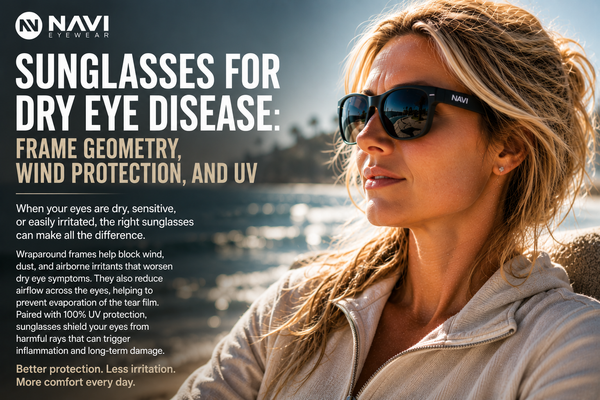
Dry eye disease affects an estimated 16 million Americans and is one of the most common reasons people visit eye care providers. It is also one of the conditions most directly and practically helped by the right sunglasses — not primarily through lens tint, but through frame geometry. Wind is one of the primary accelerants of dry eye symptoms outdoors; a wraparound frame that reduces airflow to the ocular surface is the most immediately practical sunglass intervention for dry eye sufferers. UV-driven ocular surface inflammation is a secondary but meaningful contributor to the dry eye inflammatory cycle that UV400 lenses address. This guide covers the complete sunglass approach for dry eye disease. For the broader medical conditions context, see the complete guide to sunglasses for light sensitivity and medical conditions.

1. What Dry Eye Disease Actually Is
The Two Types
Dry eye disease (DED) has two primary subtypes with different primary causes but overlapping symptoms:
- Aqueous-deficient dry eye: insufficient tear production from the lacrimal glands — the eye simply does not produce enough aqueous tear volume to maintain adequate lubrication. More common in older women and in Sjögren's syndrome.
- Evaporative dry eye: adequate tear production but excessive tear evaporation — typically caused by meibomian gland dysfunction (MGD), where the oil-producing glands in the eyelids fail to produce adequate meibum, the oily layer that retards evaporation from the aqueous tear surface. The most common form of dry eye in the general population.
Both types share the symptom profile: dryness, burning, grittiness, intermittent blurred vision that clears with blinking, light sensitivity, and paradoxical tearing (reflex tearing triggered by the dry, irritated surface). Both are worsened by environmental factors that increase tear evaporation — wind, low humidity, air conditioning, and UV-driven ocular surface inflammation.
The Inflammatory Cycle
Dry eye disease is not simply a water shortage problem — it is an inflammatory cycle in which ocular surface dryness triggers inflammation, inflammation damages the ocular surface and lacrimal glands, damaged glands produce less or lower-quality tears, which leads to more dryness and more inflammation. Breaking this cycle is the goal of dry eye treatment. Sunglasses contribute to cycle interruption by reducing the environmental triggers (wind, UV) that drive the inflammatory component of the cycle.
2. Why Frame Geometry Is the Primary Dry Eye Sunglass Factor
Wind and Tear Evaporation: The Physics
Tear evaporation rate from the ocular surface is directly proportional to airflow velocity across the surface — the higher the airflow, the faster tears evaporate, the faster the tear film destabilizes, and the sooner dry eye symptoms appear. In outdoor environments, wind is the primary driver of elevated airflow across the ocular surface. Even a gentle 5–10 mph breeze significantly accelerates tear film breakup time compared to still air conditions.
A flat-lens lifestyle sunglass frame sits close to the face centrally (at the nose bridge and temple contact points) but has gaps between the lens edge and the face at the temporal, inferior, and superior margins. These gaps allow airflow to channel between the lens and the face and reach the ocular surface — reducing but not eliminating wind exposure. A close-fitting wraparound frame that curves around the temporal area of the face and fits more snugly at all margins significantly reduces the airflow channel between lens and face, slowing tear evaporation more effectively than a flat-lens frame.
Moisture-Seal Frames: The Maximum Wind Protection Option
Moisture-seal frames — a specialized design with a soft foam or silicone gasket that creates a seal between the frame and the face — provide the most complete wind protection for dry eye. The gasket eliminates the gap between frame and face entirely, creating a humid microenvironment around the eye that dramatically reduces tear evaporation. These frames are specifically marketed for dry eye management and are available through optical providers who specialize in dry eye products.
Moisture-seal frames are bulkier and less cosmetically conventional than standard sunglasses — they look more like protective eyewear than fashion sunglasses. For severe evaporative dry eye, the functional benefit justifies the aesthetic trade-off. For mild to moderate dry eye, a standard close-fitting wraparound sport frame provides meaningful wind protection without the bulk of moisture-seal designs.
Wraparound Sport Frames as the Practical Middle Ground
For most dry eye sufferers, a close-fitting TR90 wraparound sport frame provides practical and meaningful wind protection that standard lifestyle frames do not. The temporal wrap of a sport frame reduces the primary airflow channel — the gap at the lateral frame margin where wind enters most directly during forward-facing outdoor activity. Rubber grip contacts that keep the frame sitting snugly against the nasal bridge reduce the inferior gap through which wind channels below the lens. Browse close-fitting UV400 polarized options at navieyewear.com.
3. UV and Dry Eye: The Inflammatory Connection
UV-Driven Ocular Surface Inflammation
UV radiation — particularly UV-B — triggers inflammatory responses in the corneal epithelium and conjunctiva that worsen dry eye disease through several mechanisms:
- Corneal epithelial disruption: UV-B damages corneal epithelial cells, reducing the density and quality of the protective epithelial barrier. Damaged epithelium is more susceptible to tear film instability and desiccation stress than healthy epithelium.
- Inflammatory mediator upregulation: UV exposure upregulates inflammatory cytokines (IL-1β, TNF-α, IL-6) in the ocular surface — the same mediators that drive the inflammatory component of dry eye disease. UV-driven cytokine upregulation adds to the inflammatory load of the dry eye cycle.
- Conjunctival goblet cell damage: goblet cells in the conjunctiva produce mucin — a key component of the tear film that allows it to adhere to the ocular surface. UV exposure damages goblet cells, reducing mucin production and worsening tear film instability in ways that compound evaporative dry eye.
- Meibomian gland UV effects: some evidence suggests that chronic UV exposure to the eyelid skin affects meibomian gland function over time — contributing to the meibomian gland dysfunction (MGD) that drives evaporative dry eye.
UV400 Lenses for Dry Eye: Addressing the Inflammatory Input
UV400 polycarbonate lenses block the UV-B and UV-A that drive ocular surface inflammation. For dry eye sufferers, UV400 protection reduces one of the environmental inputs driving the inflammatory component of the dry eye cycle. This does not replace other dry eye treatments (artificial tears, warm compresses, omega-3 supplements, prescription anti-inflammatory drops) but complements them by reducing UV-driven inflammation in the outdoor environment where wind and UV combine to produce the worst dry eye symptom conditions.
4. Lens Tint for Dry Eye
Tint Selection Is Secondary to Frame Geometry for Dry Eye
For dry eye specifically, frame geometry matters more than tint — the wind protection benefit of a close-fitting wraparound frame exceeds the dry eye benefit of any particular tint choice. That said, some tint considerations apply:
- Amber or copper for outdoor activity: warm tints that absorb blue wavelengths reduce the light sensitivity component of dry eye photophobia — dry eye sufferers often have elevated light sensitivity from the inflamed corneal surface, and warm tint blue-wavelength absorption provides some photophobia relief alongside UV400 protection.
- Gray for driving: color accuracy for driving remains the primary consideration; the photophobia benefit of warm tints is secondary to the driving safety argument for gray.
- Cat 2 for most conditions: Cat 2 is the appropriate category for everyday outdoor dry eye management — adequate brightness reduction without being too dark for shade transitions and indoor-outdoor movement that is frequent for most dry eye sufferers.
- Cat 3 for high-UV, high-wind outdoor activity: beach, desert, and high-altitude environments combine peak UV with wind — the worst dry eye environments — where Cat 3 and maximum wraparound coverage are appropriate.
5. Other Dry Eye Management Strategies That Work With Sunglasses
Artificial Tears
Lubricating eye drops (artificial tears) are the first-line management for dry eye symptoms — they supplement the inadequate or low-quality natural tear film. Preservative-free artificial tears are preferred for frequent use (more than 4 times daily) to avoid the preservative-driven ocular surface toxicity that can worsen dry eye with regular preserved drop use. Using artificial tears before outdoor activity provides a lubrication buffer for the wind and UV conditions that accelerate tear film instability.
Warm Compresses and Lid Hygiene
For evaporative dry eye from meibomian gland dysfunction, warm compresses (applied to closed eyelids for 5–10 minutes) melt thickened meibum and improve meibomian gland outflow. Combined with lid massage and lid scrubs to clear the gland openings, warm compresses address the root cause of evaporative dry eye at the meibomian gland level. This treatment directly improves the oily layer of the tear film that sunglasses protect by reducing wind evaporation.
Omega-3 Fatty Acids
Oral omega-3 fatty acid supplementation — fish oil or algae-based omega-3 — has evidence supporting reduction of evaporative dry eye symptoms through improvement of meibomian gland lipid quality. The DREAM study (Dry Eye Assessment and Management) provided the most rigorous evidence, finding that omega-3 supplementation was not significantly superior to olive oil placebo in a large randomized trial — a finding that tempered earlier enthusiasm but didn't eliminate the biological plausibility of omega-3 for meibomian gland health.
Humidifier Use
Indoor dry environments — heated offices in winter, air-conditioned spaces in summer — accelerate tear evaporation through low humidity. A room humidifier that maintains indoor humidity at 40–50% reduces indoor evaporative dry eye symptoms. This addresses the indoor component of dry eye that sunglasses (an outdoor tool) do not address.
6. Dry Eye on the Move: Activity-Specific Recommendations
Cycling: The Highest Wind Exposure Activity
Cycling generates the highest sustained airflow across the ocular surface of any common outdoor activity — at 15–20 mph cycling speed, the airstream across the face is strong enough to rapidly dry the tear film even in a non-dry-eye eye. For dry eye cyclists, close-fitting wraparound frames with temporal wind coverage are mandatory rather than recommended — standard sport frames may still leave enough airflow gap to cause significant dryness at cycling speed. Foam gasket additions to standard sport frames are available as aftermarket accessories that partially replicate the moisture-seal benefit without requiring a dedicated moisture-seal frame purchase.
Running: Moderate Wind Exposure
Running at 6–9 mph generates meaningful airflow but less than cycling. Wraparound sport frames provide adequate wind protection for most dry eye runners at standard running pace. The forward-facing position of running concentrates wind directly on the ocular surface — wraparound temporal coverage helps, but some forward airflow is unavoidable without a moisture-seal design.
Beach and Coastal Environments
Beach environments combine natural wind, salt spray, UV amplification from water and sand reflection, and low-humidity air — the most hostile combination of dry eye triggers of any common recreational environment. For dry eye sufferers, beach environments are the highest-priority sunglass use context: close-fitting wraparound UV400 frames with anti-saltwater coating, amber or copper Cat 3 polarized for UV management, and pre-activity artificial tears to maximize the tear film buffer before wind and UV exposure begins.
Frequently Asked Questions
Do sunglasses help with dry eyes?
Yes — through two mechanisms. Wraparound frame geometry reduces wind exposure to the ocular surface, slowing tear evaporation and extending tear film stability. UV400 lenses reduce UV-driven ocular surface inflammation that contributes to the inflammatory cycle of dry eye disease. The frame geometry benefit is typically more immediately noticeable — dry eye sufferers who switch from flat-lens lifestyle frames to close-fitting wraparound frames often report meaningful reduction in outdoor dry eye symptoms within the first session of use.
What type of sunglasses are best for dry eyes?
Close-fitting wraparound TR90 sport frame with UV400 polarized lenses — the frame geometry provides wind protection, the UV400 addresses UV-driven inflammation, and the polarization reduces reflected glare that exacerbates the light sensitivity component of dry eye photophobia. For severe evaporative dry eye where wraparound sport frames provide insufficient relief, moisture-seal frames with foam gaskets are the next step — available through specialty optical and dry eye management providers.
Can dry eye cause light sensitivity?
Yes — the inflamed corneal surface of dry eye disease sensitizes corneal nociceptors (pain receptors) that respond to light stimulation as well as mechanical and chemical stimulation. The light sensitivity of dry eye is a symptom of corneal surface inflammation rather than a primary neurological photophobia — it improves as the underlying dry eye is managed. Sunglasses reduce the light stimulus that activates these sensitized receptors, providing comfort relief alongside the wind and UV protection benefits.
Should I use preservative-free drops before wearing sunglasses outdoors?
Using preservative-free artificial tears before extended outdoor activity — particularly in wind, sun, or low-humidity conditions — provides a lubrication buffer that extends tear film stability during the outdoor session. The combination of pre-activity artificial tears and wraparound UV400 sunglasses addresses both the internal tear film supply (drops) and the external tear film loss rate (wind protection from frame geometry) simultaneously.
Do polarized lenses specifically help dry eye?
Polarized lenses address the photophobia component of dry eye — the light sensitivity from inflamed corneal nociceptors is exacerbated by high-luminance reflected glare (from water, road surfaces, car hoods) that polarization specifically eliminates. Non-polarized lenses of the same darkness reduce overall brightness but leave the high-luminance transient glare events that are most photophobically activating for sensitized corneal surfaces. For dry eye with significant outdoor light sensitivity, polarized UV400 is preferable to non-polarized UV400 for this comfort reason.
Can I wear contact lenses and use sunglasses for dry eye management?
Contact lens wear is itself a significant dry eye aggravating factor — contact lenses disrupt the tear film, reduce corneal sensation, and contribute to the evaporative dry eye cycle. For moderate to severe dry eye, contact lens wear reduction or elimination is often recommended by eye care providers. When contact lenses are worn, preservative-free lubricating drops compatible with contact lens wear and wraparound UV400 sunglasses provide the best available outdoor dry eye management alongside the lenses.
The Bottom Line
Dry eye disease is one of the conditions most directly and practically addressed by sunglasses — but the frame matters as much as the lens. Close-fitting wraparound geometry that reduces wind access to the ocular surface is the primary dry eye sunglass intervention; UV400 lenses address the UV-driven inflammatory component. The combination of wraparound TR90 sport frame, UV400 polycarbonate polarized lenses, and pre-activity artificial tears covers the primary outdoor dry eye triggers simultaneously. For severe evaporative dry eye, moisture-seal frames that create a humid microenvironment around the eye are the next step beyond standard wraparound designs. navieyewear.com/collections/polarized — Buy 1, Get 2 Free for $85.
Related Reading
- Sunglasses for Light Sensitivity and Medical Conditions | Navi Eyewear
- Sunglasses for Migraine and Photophobia | Navi Eyewear
- Sunglass Lens Coatings Explained | Navi Eyewear
- Sunglass Frame Technology and Materials | Navi Eyewear
- UV and Eye Disease: The Complete Guide | Navi Eyewear
- Sunglasses for Outdoor Exercise | Navi Eyewear
- The Complete Cycling Sunglasses Guide | Navi Eyewear
- Shop Polarized UV400 Sunglasses | Navi Eyewear
Sources & Citations
[1] Craig JP, et al. "TFOS DEWS II Definition and Classification Report." Ocular Surface, 2017. View source →
[2] Lemp MA, et al. "Distribution of aqueous-deficient and evaporative dry eye in a clinic-based patient cohort." Cornea, 2012. View source →
[3] Sliney DH. "Ocular exposure to environmental light and ultraviolet." Journal of AAPOS, 2014. View source →
[4] Dry Eye Assessment and Management Study Research Group. "n-3 Fatty acid supplementation for the treatment of dry eye disease." New England Journal of Medicine, 2018. View source →
[5] Tsubota K and Nakamori K. "Dry eyes and video display terminals." New England Journal of Medicine, 1993. View source →
[6] WHO. "Global solar UV index: a practical guide." World Health Organization, 2002. View source →