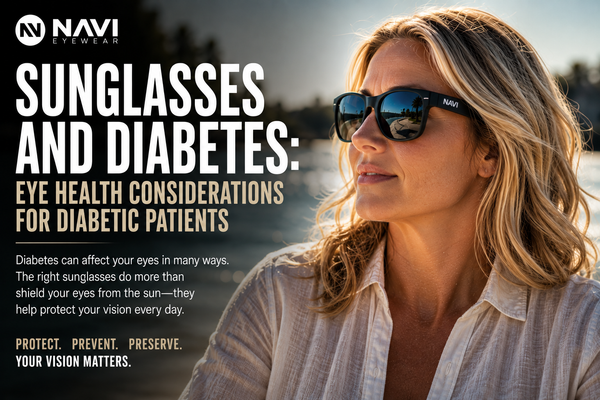

Sunglasses and Diabetes: Eye Health Considerations for Diabetic Patients
Diabetes is the leading cause of new blindness in American adults between 20 and 74, and the eye complications of diabetes — diabetic retinopathy, diabetic macular edema, accelerated cataract, and glaucoma — represent some of the most significant preventable vision loss in modern medicine. UV radiation is not the primary driver of diabetic eye complications, which are fundamentally caused by hyperglycemia-driven microvascular damage. However, UV interacts with diabetic eye disease in several ways that make UV400 protection more important for diabetic patients than for the general population — not less. For the complete medical conditions overview, see the complete guide to sunglasses for light sensitivity and medical conditions.

1. How Diabetes Affects the Eye
Diabetic Retinopathy
Diabetic retinopathy is the most common and most vision-threatening complication of diabetes — caused by hyperglycemia-driven damage to the small blood vessels supplying the retina. In non-proliferative diabetic retinopathy (NPDR), weakened capillaries leak fluid and blood into the retina. In proliferative diabetic retinopathy (PDR), the ischemic retina stimulates growth of abnormal new blood vessels (neovascularization) that bleed easily, causing severe vision loss. Diabetic macular edema — fluid accumulation in the macula from leaky capillaries — is the most common cause of vision loss in diabetic retinopathy.
UV is not a direct cause of diabetic retinopathy, which is driven by the metabolic consequences of chronic hyperglycemia. However, the oxidative stress environment of diabetic retinopathy may be worsened by UV-driven oxidative stress — UV generates reactive oxygen species (ROS) that add to the oxidative burden already elevated in diabetic retinal tissue. UV400 protection reduces this UV-driven oxidative contribution in an eye that is already operating under elevated oxidative stress.
Accelerated Cataract Formation
Diabetes accelerates cataract formation through a mechanism independent of UV — glycation of lens crystallin proteins by elevated blood glucose produces protein modification that drives cataract formation without UV involvement. Diabetics typically develop cataracts 10–15 years earlier than the general population and at higher rates, and a specific cataract type — "snowflake" or "metabolic" cataract — occurs almost exclusively in diabetics with poor glycemic control.
The UV-cataract connection compounds with the diabetes-cataract connection: UV drives oxidative protein modification in the lens while diabetes drives glycation-based modification. Both pathways produce cataract through different chemical routes in the same lens proteins. A diabetic who also accumulates high UV dose faces both pathways simultaneously — UV protection addresses the UV-driven component of an already elevated cataract risk.
Impaired Pupillary Light Reflex
Autonomic neuropathy — nerve damage from chronic diabetes — can impair the pupillary light reflex, reducing the eye's ability to constrict in response to bright light. The pupil normally constricts in bright conditions to limit the light and UV reaching the lens and retina — this is a primary natural UV management mechanism. A diabetic with impaired pupillary reflex from autonomic neuropathy has a reduced natural UV management response, meaning more UV reaches the lens and retina per unit of ambient UV than in a healthy eye with an intact pupillary reflex.
UV400 sunglasses compensate for the impaired pupillary reflex by providing external light and UV management that the autonomic system cannot fully provide. For diabetics with documented autonomic neuropathy and impaired pupillary response, UV400 sunglasses for all outdoor time are particularly important — they are performing a protective function that the pupillary reflex would normally contribute to.
Increased Glare Sensitivity
Diabetics with early cataract or diabetic macular edema frequently experience increased glare sensitivity — the scattering of light within the cataractous lens or the distorted macular processing of bright light creates disproportionate glare compared to a healthy eye at the same ambient light level. Polarized sunglasses reduce the surface glare component that adds most disruptively to total glare burden, providing functional visual improvement for diabetics with glare sensitivity that non-polarized dark lenses of the same category do not match.
2. UV and Diabetic Eye Complications: The Interaction
Oxidative Stress: The Common Pathway
Both diabetes and UV exposure generate oxidative stress in ocular tissues — hyperglycemia through advanced glycation end-products (AGEs) and increased mitochondrial ROS production; UV through photochemical ROS generation in lens, RPE, and corneal cells. In a healthy eye, antioxidant systems (glutathione, superoxide dismutase, catalase) manage the baseline oxidative load. In a diabetic eye, these antioxidant systems are often depleted by chronic metabolic oxidative stress, leaving less antioxidant capacity to manage UV-generated ROS on top of the metabolic load.
The practical implication: UV-generated oxidative stress has a greater net impact on the diabetic eye than on the healthy eye — the same UV exposure produces more unmanaged oxidative damage in a depleted antioxidant environment than in a replete one. UV400 protection reduces UV-generated ROS production in an eye that is less able to manage additional oxidative stress.
Diabetic Retinopathy and Phototoxicity
The ischemic retina of diabetic retinopathy is more vulnerable to phototoxic damage than healthy retinal tissue — reduced vascular supply limits the metabolic support available for photoreceptor repair and antioxidant replenishment. While UV does not directly cause diabetic retinopathy, UV-driven phototoxicity in an ischemic retinal environment may accelerate progression of existing diabetic retinal disease beyond what the microvascular damage alone would produce.
3. Post-Diabetic-Eye-Treatment UV Considerations
After Laser Photocoagulation
Laser photocoagulation — used for proliferative diabetic retinopathy and diabetic macular edema — creates retinal burns that form scar tissue, sealing leaking blood vessels. The treated retina has disrupted photoreceptors and RPE cells in the treatment areas, and the treated areas are more sensitive to light in the immediate post-treatment period. UV400 sunglasses for all outdoor time in the weeks following laser treatment protect the treated retinal areas during the healing period.
After Anti-VEGF Injections
Anti-VEGF intravitreal injections (bevacizumab, ranibizumab, aflibercept) for diabetic macular edema and proliferative retinopathy are not associated with specific UV sensitivity changes. Standard UV400 protection recommendations apply — the same as for the general diabetic population. Injections do cause transient photophobia from the procedure itself (dilating drops used during injection preparation) that resolves within hours of the procedure.
After Cataract Surgery in Diabetics
Diabetics have higher rates of post-cataract surgery complications, including posterior capsule opacification (PCO), diabetic macular edema exacerbation, and wound healing complications. The post-operative UV protection requirements for diabetics after cataract surgery follow the same principles as for non-diabetics (see post-cataract surgery guide) with the additional context that the diabetic eye's elevated baseline oxidative stress makes UV protection during the healing period more important.
4. Practical UV Protection for Diabetics
The Urgency Argument
For diabetics, UV400 protection is not merely a general health recommendation — it is a specific adjunctive strategy for an eye that faces elevated cataract risk through two independent pathways, oxidative stress management capacity that is compromised by chronic metabolic disease, a potentially impaired natural UV management system (pupillary reflex), and a retina that may be more vulnerable to phototoxic damage than a healthy retina. The case for consistent UV400 protection is stronger for diabetics than for the general population.
The Multi-Pair Availability Strategy
The availability argument for multi-pair UV protection (see how many pairs do you need) applies with particular force for diabetics — the UV exposure gaps from inconsistent single-pair availability add to an already elevated ocular risk profile. Four pairs at the four primary outdoor departure points (car, bag, sport kit, home entry) ensures UV400 coverage at every outdoor moment without requiring deliberate daily retrieval. Browse UV400 polarized options at navieyewear.com — Buy 1, Get 3 Free for $119.
Recommended Specification for Diabetic Patients
- UV400 polycarbonate: complete UV blocking — the most important single specification for all the UV-interaction mechanisms described above
- Polarized: eliminates surface glare that is disproportionately disruptive for diabetics with cataract or macular edema-related glare sensitivity
- Cat 2 for everyday use: appropriate for the range of daily outdoor conditions; Cat 3 for peak UV summer conditions and high-UV locations
- Gray tint for driving: color accuracy for the traffic signal and road sign discrimination that is particularly important for diabetics managing driving safety alongside visual complications
- Wraparound geometry: more complete peripheral UV protection for eyes with impaired pupillary reflex that benefits from external UV management across all light angles
5. Diabetes, UV, and the Cumulative Damage Model
Earlier Onset, Longer Exposure Period
Type 1 diabetes diagnoses in childhood and young adulthood mean a lifetime of elevated cataract and retinal UV risk that begins at an age when lifetime UV accumulation is just starting. A Type 1 diabetic who develops consistent UV400 protection habits in their teens and maintains them through adulthood reduces lifetime UV-driven cataract contribution across the entire high-accumulation period. The magnitude of UV-driven cataract risk reduction over a 50-year UV protection habit in a Type 1 diabetic is significant — the UV-attributable component of cataract is entirely prevented while the diabetes-driven component remains, but removing one of two pathways to accelerated cataract formation is clinically meaningful.
The Glycemic Control and UV Protection Partnership
Glycemic control — maintaining near-normal blood glucose through diet, medication, and lifestyle management — is the primary intervention for reducing all diabetic eye complications. UV protection is an adjunctive strategy that addresses the UV-driven component of complications that glycemic control doesn't address. The two strategies are complementary: tight glycemic control reduces the metabolic pathway to diabetic cataract and retinopathy; UV400 protection reduces the UV pathway to cataract and UV-driven oxidative stress in the retina. Neither substitutes for the other.
Frequently Asked Questions
Should diabetics wear sunglasses more than non-diabetics?
Yes — for several independent reasons. Accelerated cataract risk from diabetes is compounded by UV-driven cataract, making UV protection more urgent. Compromised antioxidant capacity in diabetic ocular tissue makes UV-generated oxidative stress more damaging. Potential impaired pupillary reflex from autonomic neuropathy reduces natural UV management, making external UV400 protection a more important compensatory mechanism. Consistent UV400 protection addresses the UV-driven component of elevated diabetic ocular disease risk.
Does UV cause diabetic retinopathy?
No — diabetic retinopathy is caused by hyperglycemia-driven microvascular damage, not by UV. UV contributes through the oxidative stress pathway that may worsen existing retinal disease, but is not a direct cause. The primary management of diabetic retinopathy is glycemic control, blood pressure management, and ophthalmological monitoring — UV protection is an adjunctive measure, not a primary intervention for retinopathy.
What sunglasses are best for someone with diabetic eye disease?
UV400 polycarbonate polarized Cat 2 for everyday use, Cat 3 for peak UV conditions. Gray for driving (color accuracy for signal discrimination). Polarized for the glare sensitivity that cataract and macular edema produce. Wraparound frame for more complete peripheral UV coverage. The multi-pair placement strategy — car, bag, home entry — ensures consistent availability across the daily outdoor contexts where UV accumulates.
Can diabetics wear contact lenses with UV blocking instead of sunglasses?
UV-blocking contact lenses provide some UV protection at the corneal surface but do not cover the conjunctiva, eyelid skin, or periorbital area. They are not a substitute for sunglasses. For diabetics who wear contact lenses, UV-blocking contacts plus UV400 sunglasses provide more complete UV protection than either alone — the contacts address the corneal surface UV while the sunglasses address the full ocular and periorbital UV exposure.
How does cataract surgery affect UV sensitivity in diabetics?
Cataract surgery in diabetics removes the clouded natural lens and replaces it with an IOL. Modern UV-blocking IOLs provide retinal UV protection equivalent to the natural lens. However, diabetics have higher post-cataract complication rates, and the post-operative healing period in a diabetic eye requires the same UV400 protection as for any post-cataract patient, with the additional context of elevated oxidative stress. Follow the surgical team's specific post-operative UV protection guidance.
Should I tell my ophthalmologist I'm using UV sunglasses for eye protection?
UV protection is a standard recommendation from ophthalmologists for diabetic patients — it does not need to be disclosed as a treatment. However, any new or worsening visual symptoms, changes in light sensitivity, or concerns about diabetic eye disease should prompt ophthalmological evaluation. Annual dilated fundus examination is the standard of care for diabetic retinopathy monitoring — UV protection is an adjunctive lifestyle measure, not a substitute for regular ophthalmological care.
The Bottom Line
Diabetes creates multiple interactions with UV exposure that make UV400 protection more urgently important for diabetic patients than for the general population: accelerated cataract through two independent pathways, compromised antioxidant capacity that makes UV-generated oxidative stress more damaging, potential impaired pupillary reflex that reduces natural UV management, and a retinal environment that may be more vulnerable to phototoxic damage. Consistent UV400 polarized protection across all outdoor contexts — through the multi-pair placement strategy that eliminates availability gaps — is the practical implementation of this elevated UV protection priority. navieyewear.com/collections/polarized — Buy 1, Get 3 Free for $119.
Related Reading
- Sunglasses for Light Sensitivity and Medical Conditions | Navi Eyewear
- UV and Cataracts: Prevention and Research | Navi Eyewear
- Macular Degeneration and UV | Navi Eyewear
- Eye Health and Aging: UV Protection After 50 | Navi Eyewear
- Sunglasses After Cataract Surgery | Navi Eyewear
- UV and Eye Disease: The Complete Guide | Navi Eyewear
- How Many Pairs of Sunglasses Do You Actually Need? | Navi Eyewear
- Shop Polarized UV400 Sunglasses | Navi Eyewear
Sources & Citations
[1] Taylor HR, et al. "Effect of ultraviolet radiation on cataract formation." New England Journal of Medicine, 1988. View source →
[2] West SK, et al. "Exposure to sunlight and other risk factors for age-related macular degeneration." Archives of Ophthalmology, 1989. View source →
[3] Sliney DH. "Ocular exposure to environmental light and ultraviolet." Journal of AAPOS, 2014. View source →
[4] Klein BE, et al. "Sunlight and age-related eye disease." Archives of Ophthalmology, 1993. View source →
[5] WHO. "Global solar UV index: a practical guide." World Health Organization, 2002. View source →
[6] Dain SJ. "Sunglasses and sunglass standards." Clinical and Experimental Optometry, 2003. View source →
[7] American Diabetes Association. "Standards of Medical Care in Diabetes." Diabetes Care, 2023. View source →