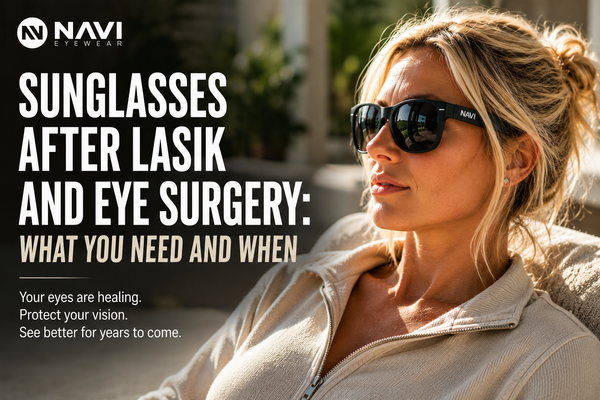

Sunglasses After LASIK and Eye Surgery: What You Need and When
Eye surgery alters the eye's structure, healing status, and UV sensitivity in ways that make post-operative sunglass use a clinical requirement rather than a personal preference. The specific requirements vary by procedure — LASIK flap healing has different needs than cataract IOL implantation, and PRK surface ablation requires different timing than corneal transplant. What is consistent across most anterior segment procedures: UV400 sunglasses for all outdoor time in the post-operative window, with the duration and lens category specified by the surgical team. This guide covers the post-operative sunglass requirements for the most common eye procedures. For the complete medical conditions and light sensitivity context, see the complete guide to sunglasses for light sensitivity and medical conditions.

1. LASIK: Flap Healing and UV Sensitivity
What LASIK Does to the Cornea
LASIK (Laser-Assisted In Situ Keratomileusis) creates a thin corneal flap using a microkeratome or femtosecond laser, lifts the flap, applies an excimer laser to reshape the corneal stroma underneath, and repositions the flap. The flap heals by adhesion rather than scarring — it is not sutured and relies on epithelial healing at the flap edge to seal. The early post-operative period (first week) is when the flap is most vulnerable to displacement, and the healing cornea is most UV-sensitive.
UV and LASIK Healing: The Clinical Concern
UV exposure during LASIK recovery carries several risks that make UV400 protection a clinical recommendation from virtually all refractive surgeons:
- Corneal haze: UV-B exposure during corneal stromal healing can trigger excessive wound healing responses that produce corneal haze — subepithelial fibrosis that reduces corneal clarity and visual quality. This risk is higher for PRK (where the epithelium is removed entirely) than for LASIK (where the epithelium is preserved in the flap), but UV exposure is discouraged for both procedures during the healing window.
- Flap-related complications: the early post-LASIK cornea is structurally altered — the flap creates a biomechanically weakened zone. UV-driven inflammatory responses in the early healing period can theoretically increase the risk of diffuse lamellar keratitis (DLK), an inflammatory condition under the LASIK flap.
- Photophobia: LASIK patients universally experience photophobia in the first days to weeks post-operatively — the corneal surface is temporarily sensitized, and bright light produces discomfort that UV400 sunglasses significantly reduce.
LASIK Post-Operative Sunglass Timeline
- Days 1–7: UV400 sunglasses for all outdoor time, including brief outdoor excursions. Many surgeons recommend wearing sunglasses even for trips from the car to a building. Wraparound designs preferred to minimize peripheral UV entry to the healing flap edge.
- Weeks 2–4: continued UV400 protection for all outdoor time. Photophobia typically diminishes through this period as the corneal surface stabilizes.
- Months 1–3: UV400 protection for all outdoor time, particularly in high-UV environments. The cornea continues healing through this window and UV protection remains advisable.
- Long-term: UV400 sunglasses for all outdoor time indefinitely — the refractive surgery community consistently recommends lifetime UV protection post-LASIK, as the reshaped cornea and any healing-related changes make UV protection good ongoing practice regardless of the initial recovery period.
Post-LASIK Lens Specification
UV400 polycarbonate Cat 2–3 polarized in a wraparound frame for the post-LASIK outdoor use. Polarization addresses the photophobia component — the polarized glare elimination reduces the transient high-luminance stimuli that drive post-operative light sensitivity. Cat 3 for the immediate post-operative period when photophobia is most severe; Cat 2 as photophobia diminishes through weeks 2–8. Browse UV400 polarized wraparound options at navieyewear.com.
2. PRK: Higher UV Sensitivity Than LASIK
Why PRK Recovery Requires More UV Protection
PRK (Photorefractive Keratectomy) removes the corneal epithelium entirely rather than creating a flap — the epithelium regrows over the reshaped stroma over approximately 5–7 days. This epithelial regeneration phase is when the cornea is most UV-sensitive and when corneal haze formation risk is highest.
UV exposure during PRK epithelial regeneration is a documented risk factor for post-PRK corneal haze — mitomycin-C application during surgery (standard for higher prescriptions and high haze-risk corneas) reduces this risk but does not eliminate it. The post-PRK UV protection recommendation is typically more strict than post-LASIK: UV400 sunglasses for all outdoor time for the full first year post-operatively is a common surgical team recommendation, particularly for procedures without mitomycin-C.
Contact Lens Bandage and UV
Post-PRK management typically involves a bandage contact lens for the first week during epithelial healing. UV-blocking contact lenses used as bandage lenses provide some UV protection at the corneal surface; UV400 sunglasses provide additional protection for the full ocular and periorbital area beyond what the contact lens covers. Both are typically used simultaneously in the early PRK recovery window.
3. Cataract Surgery: IOL Type Determines Requirements
What Cataract Surgery Does to UV Transmission
Cataract surgery removes the natural crystalline lens and replaces it with an artificial intraocular lens (IOL). The natural lens absorbs UV-A and UV-B, protecting the retina from UV. The UV-blocking properties of the IOL depend entirely on the IOL type chosen:
- UV-blocking IOLs (most modern IOLs): the majority of IOLs implanted in the US and Europe include UV-blocking material that blocks UV-A and UV-B similarly to the natural lens. Standard UV-blocking IOLs provide retinal UV protection without requiring additional sunglass UV protection beyond what would be appropriate for anyone.
- Blue-light-filtering IOLs: some IOLs also filter blue light in addition to UV, intended to provide additional macular protection. The clinical benefit of blue-light-filtering IOLs for AMD prevention is debated — the evidence is not conclusive.
- Clear (non-UV-blocking) IOLs: older IOL designs and some specialty IOLs may not include UV blocking — patients with non-UV-blocking IOLs have reduced retinal UV protection compared to a natural lens and require UV400 sunglasses for all outdoor use to provide the UV protection their IOL does not.
Post-Cataract UV Sensitivity and Photophobia
The first weeks after cataract surgery typically involve photophobia — the dilating drops used during surgery persist for hours to days, and the eye adjusts to the changed optical system of the new IOL. UV400 sunglasses are standard recommendations for all outdoor use in the early post-operative period for both comfort (photophobia management) and UV protection (corneal healing).
After the immediate recovery period, cataract patients with UV-blocking IOLs have retinal UV protection from the IOL — but the cornea, conjunctiva, and periorbital skin remain UV-sensitive and UV-unprotected without sunglasses. UV400 sunglasses for ongoing outdoor use after cataract surgery remain appropriate regardless of IOL UV-blocking status. See the complete post-cataract surgery guide.
4. Corneal Transplant: Longest UV Protection Window
Corneal Transplant Recovery
Corneal transplant procedures — full-thickness penetrating keratoplasty (PKP) or partial-thickness procedures (DSAEK, DMEK) — involve healing at the host-graft junction that takes months to years. The transplanted corneal tissue is immunologically foreign and requires ongoing immunosuppressive treatment; the healing wound is UV-sensitive for an extended post-operative period.
UV400 sunglasses for all outdoor time is the standard recommendation for corneal transplant patients for the duration of the healing period — often one to two years post-operatively — and continued UV protection thereafter as a general ocular health practice. The transplanted cornea's wound healing response can be adversely affected by UV exposure during the healing period, and the immunosuppressive treatment required post-transplant may increase UV sensitivity.
5. Retinal Procedures: Specific Considerations
Vitrectomy and Retinal Detachment Repair
Posterior segment procedures — vitrectomy, retinal detachment repair, macular hole surgery — do not typically alter the corneal UV sensitivity or create the same early post-operative photophobia as anterior segment procedures. UV protection recommendations after posterior segment surgery are the same as for anyone — UV400 sunglasses for all outdoor time as a general retinal protective measure.
Gas bubble tamponade used in some vitrectomy procedures has a specific light sensitivity implication: the gas bubble in the vitreous cavity can create light scattering effects and visual disturbances in bright conditions. UV400 Cat 3 tinted sunglasses for the duration of the gas bubble period (typically 1–8 weeks depending on gas type) reduce the light entering the eye that interacts with the gas bubble.
6. General Post-Surgical Sunglass Principles
The Wraparound Requirement
For all post-operative sunglass use: wraparound frames are preferable to flat-lens lifestyle frames. The peripheral UV that flat-lens frames allow around the frame edges reaches the healing corneal and conjunctival surfaces from angles that standard overhead shading doesn't address. Close-fitting wraparound geometry that minimizes the gap between lens edge and face provides the most complete UV protection for healing ocular surfaces. This is a functional requirement in the post-operative setting, not a style preference.
Following Surgical Team Guidance
Post-operative sunglass recommendations vary by surgeon, procedure, and individual patient factors. The guidance in this article represents general clinical principles — specific post-operative instructions from the surgical team take precedence. If the surgical team provides more stringent recommendations (longer duration, darker category, specific frame requirements), follow the surgical team's guidance rather than general guidelines.
Practical Multi-Pair Preparation
Eye surgery is a planned procedure — preparing UV400 polarized sunglasses before the procedure date ensures availability on day one post-operatively. Navi Eyewear's Buy 1, Get 3 Free at $119 for four pairs allows equipping the car, everyday bag, and home entry with UV400 protection before the surgery date, so post-operative UV protection coverage across all departure points is in place from day one of recovery.
Frequently Asked Questions
How long do I need to wear sunglasses after LASIK?
The surgical team will provide specific guidance, but general recommendations are: all outdoor time for the first month post-operatively at minimum, continued UV400 protection for high-UV outdoor environments thereafter, and UV400 sunglasses for all outdoor time indefinitely as a long-term practice. The healing cornea is most UV-sensitive in the first 1–3 months; the long-term recommendation reflects good ongoing ocular health practice rather than an acute healing requirement.
What sunglasses should I wear after cataract surgery?
UV400 Cat 2–3 polarized polycarbonate in the immediate post-operative period — Cat 3 for peak sun outdoor time, Cat 2 for variable conditions. Wraparound design for the most complete UV coverage of the healing eye and periorbital area. After the immediate recovery period, UV400 polarized sunglasses for ongoing outdoor use — the same specification appropriate for anyone seeking complete UV protection.
Can I wear contacts and sunglasses after LASIK?
Contact lens use after LASIK is generally discouraged until the corneal surface has stabilized and the surgical team clears contact lens use — typically several months to a year post-operatively. Sunglasses alone (without contact lenses) are the standard post-LASIK eye protection approach during the healing period.
Do I need polarized sunglasses specifically after eye surgery?
Polarized lenses are not a medical requirement after eye surgery — UV400 is the primary clinical requirement. However, polarization provides meaningful comfort benefit for post-operative photophobia by eliminating the transient high-luminance reflected glare that is often the most photophobically triggering element of outdoor light exposure. For patients with significant post-operative photophobia, polarized UV400 is preferable to non-polarized UV400 for this comfort reason.
What happens if I don't wear sunglasses after LASIK?
In the immediate post-operative period: increased risk of corneal haze formation from UV exposure during healing, increased photophobic discomfort from the sensitized post-operative corneal surface, and theoretically increased risk of inflammatory healing complications. In the long-term: the same risks as anyone without UV400 protection — UV-driven cataract acceleration (in the opposite eye if the treated eye has been corrected), AMD risk contribution, and pterygium risk. The immediate post-operative risks are the most acute; the long-term risks are the same as for the general population without UV protection.
Should I wear wraparound sunglasses after eye surgery or are regular frames fine?
Wraparound designs are preferable for the post-operative period — peripheral UV entry around flat-lens frames reaches the healing corneal surface at angles that overhead shade does not address. For the ongoing long-term use after the immediate healing period, standard lifestyle frames with UV400 are adequate for most outdoor contexts. The wraparound requirement is most important in the early healing window when the corneal surface is most UV-sensitive and when peripheral UV entry is a clinically relevant concern.
The Bottom Line
Eye surgery — LASIK, PRK, cataract surgery, corneal transplant — creates a healing ocular surface that is more UV-sensitive than the pre-operative eye, and photophobia is a near-universal post-operative experience. UV400 polarized sunglasses for all outdoor time during the healing period are a clinical recommendation from surgical teams for virtually all anterior segment procedures. The specific duration and lens category vary by procedure and surgeon — follow your surgical team's guidance. UV400 wraparound coverage is appropriate for the healing window; UV400 protection for all outdoor time is appropriate for life. navieyewear.com/collections/polarized — Buy 1, Get 3 Free for $119.
Related Reading
- Sunglasses for Light Sensitivity and Medical Conditions | Navi Eyewear
- Sunglasses After Cataract Surgery | Navi Eyewear
- UV and Cataracts: Prevention and Research | Navi Eyewear
- UV and Eye Disease: The Complete Guide | Navi Eyewear
- Photokeratitis and Snow Blindness | Navi Eyewear
- How to Read Sunglass Specs | Navi Eyewear
- Eye Health and Aging: UV Protection After 50 | Navi Eyewear
- Shop Polarized UV400 Sunglasses | Navi Eyewear
Sources & Citations
[1] Sliney DH. "Ocular exposure to environmental light and ultraviolet." Journal of AAPOS, 2014. View source →
[2] Toda I, et al. "Dry eye after laser in situ keratomileusis." American Journal of Ophthalmology, 1996. View source →
[3] Moilanen JAO, et al. "Corneal recovery after LASIK." Investigative Ophthalmology and Visual Science, 2003. View source →
[4] Taylor HR, et al. "Effect of ultraviolet radiation on cataract formation." New England Journal of Medicine, 1988. View source →
[5] Dain SJ. "Sunglasses and sunglass standards." Clinical and Experimental Optometry, 2003. View source →
[6] WHO. "Global solar UV index: a practical guide." World Health Organization, 2002. View source →
[7] ISO 12312-1:2013. "Eye and face protection — Sunglasses and related eyewear." International Organization for Standardization. View source →