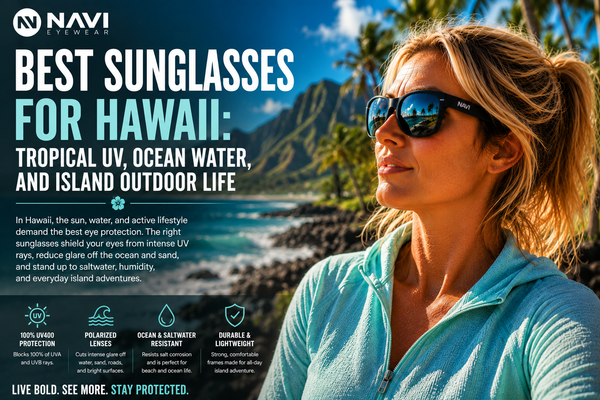

Best Sunglasses for Hawaii: Tropical UV, Ocean Water, and Island Outdoor Life
Hawaii is the most UV-intense state in the US. Sitting at 19–22 degrees north latitude — more than 10 degrees closer to the equator than Southern California — Hawaii receives tropical solar UV year-round. Honolulu's winter UV index of 8–10 exceeds Miami's summer peak for much of the year. The combination of tropical latitude, crystal-clear Pacific Ocean reflection, volcanic altitude that amplifies UV dramatically on Maui and the Big Island, and an island outdoor lifestyle that puts residents and visitors outdoors year-round makes Hawaii the most demanding UV state in the country for eye protection. This guide covers each major island's UV environment and the right lens setup for Hawaii's specific outdoor contexts.

1. Hawaii's UV Profile: The Most UV-Intense US State
Tropical Latitude: The Primary Driver
Hawaii's position at 19–22 degrees north latitude places it well within the tropics — Honolulu at 21 degrees north is at the same latitude as Mexico City, Ho Chi Minh City, and the Saharan interior. At these latitudes, the sun reaches near-vertical angles at solar noon during summer months, meaning UV passes through a minimal column of atmosphere before reaching the surface. Winter sun angles in Hawaii are higher than summer sun angles in Seattle. There is no season in Hawaii where solar elevation drops to the low angles that characterize winter UV in the continental US — year-round high sun angles produce year-round high UV.
Year-Round UV Index
Honolulu: UV index 8–10 in winter (December–February), 12–14 in summer. Maui (Kahului sea level): UV index 8–10 in winter, 12–14 in summer. Big Island (Kona): UV index 9–11 in winter, 12–14 in summer. Kauai: UV index 8–10 in winter, 12–13 in summer. Hawaii's lowest UV month (December) exceeds the summer UV peak of most northern continental US states. There is no month in Hawaii where UV protection can responsibly be deprioritized for outdoor-active residents and visitors.
Ocean Reflection Amplification
Hawaii is surrounded by the Pacific Ocean — all outdoor activity on Hawaii's coasts involves the UV amplification of tropical Pacific reflection. The clear, shallow water of Hawaii's reef systems (Hanauma Bay, Molokini Crater, the North Shore reef platforms) reflects UV with high efficiency from the white coral sand bottom visible through the water column. Hawaii's coastal UV — combining tropical sun UV with Pacific Ocean reflection — represents the highest UV environment available in the US without altitude amplification. With altitude amplification, it is the most extreme UV environment in the US by a significant margin.
2. Hawaii Island-by-Island UV Context
Oahu: Honolulu, Waikiki, and the North Shore
Oahu is the most visited Hawaiian island and the primary gateway for mainland visitors. Waikiki Beach, Diamond Head, the North Shore surf breaks, and Hanauma Bay define Oahu's outdoor UV environment. Waikiki's south-facing beach receives direct sun from morning to late afternoon with Pacific Ocean reflection from the south — sustained tropical beach UV across the full active beach day. The North Shore — Banzai Pipeline, Sunset Beach, Waimea Bay — adds the specific UV challenges of a surf culture environment: wave impact, salt spray, sun from above and water reflection from below.
For Oahu visitors: copper Cat 3 polarized UV400 with anti-saltwater coating and retention strap for beach and surf use; gray Cat 2 polarized for Honolulu urban driving and everyday use. The transition from Honolulu's urban environment to the North Shore in an afternoon means carrying both or having the bag pair handle the urban context while the beach pair handles the water environment. Browse UV400 polarized options at navieyewear.com.
Maui: Sea-Level Beach and 10,023-Foot Haleakala
Maui's UV environment spans the most extreme range of any Hawaiian island. At sea level — Kaanapali, Wailea, and the Maui beach resorts — UV index 12–14 in summer with Pacific reflection. At Haleakala summit (10,023 feet), UV index reaches 16–18 in summer — the highest UV environment in the United States accessible by road. The Haleakala sunrise experience, one of Maui's most popular activities, involves watching the sun rise above the clouds at 10,000 feet with the sun at low angles that are near-perpendicular to east-facing observers — significant UV at high altitude from the moment of sunrise.
Haleakala hikers and summit visitors need amber Cat 3 polarized UV400 — the altitude UV at 10,000 feet makes this the most UV-intense accessible outdoor location in the US. The cinder desert terrain of Haleakala crater (the "House of the Sun") reflects diffuse UV from the reddish volcanic cinder in all directions. Amber for the warm terrain contrast of the volcanic landscape; Cat 3 for the extreme altitude UV; UV400 for complete blocking at the highest UV environment in the US accessible without mountaineering.
The Big Island: Volcanic Landscapes and Mauna Kea
Hawaii Island (the Big Island) has the most extreme UV range of any US landmass — from sea-level tropical beaches at Kona and Kohala Coast to the summit of Mauna Kea at 13,796 feet, where UV index in summer exceeds 20 (off the standard UV index scale). Mauna Kea summit access requires a permit and high-clearance 4WD; the extreme UV and altitude there approaches the conditions of Himalayan trekking. The Kilauea volcano area in Hawaii Volcanoes National Park (4,000 feet) adds volcanic gas considerations alongside the altitude UV — volcanic SO₂ emissions can cause eye irritation that makes UV protection even more important for the already-sensitized corneal surface.
For Big Island visitors: copper Cat 3 for Kona and Kohala coast beach and ocean activities; amber Cat 3 for Mauna Kea and highland hikes on the Saddle Road corridor; amber Cat 2 for Hawaii Volcanoes National Park where the volcanic landscape's variable light and moderate altitude combine.
Kauai: The Garden Isle's Hiking and Beach UV
Kauai's lush landscape results from its higher rainfall — the north and east shores receive significantly more cloud cover than Maui or the Big Island, which moderates UV somewhat on Kauai's wetter sides. The south shore (Poipu Beach) and west side (Polihale) are drier and receive more direct sun. The Na Pali Coast hiking (Kalalau Trail) involves sustained outdoor UV at trail elevations up to 4,000 feet with cliff-side Pacific exposure. Kauai's outdoor lifestyle is hiking and beach dominant — amber Cat 2–3 for Na Pali trail hiking, copper Cat 3 for beach and ocean activities on the south shore.
3. Hawaii Activity-Specific UV Recommendations
Snorkeling and Reef Activities
Hawaii's snorkeling environments — Hanauma Bay, Molokini Crater, Honolua Bay, Captain Cook Monument — involve the most dramatic sub-surface visibility benefit of copper polarized lenses of any US location. Hawaii's clear tropical Pacific water with coral and sand substrate at shallow depths shows the full capability of copper polarization for sub-surface viewing. Copper Cat 3 polarized for all Hawaii reef activities; the combination of copper's blue absorption and polarization removes the surface reflection that hides the coral and marine life that Hawaii snorkeling is famous for. Note: as with open water swimming, tinted swim goggles handle the in-water portion; copper UV400 sunglasses handle the beach, boat, and pre/post-water time.
Surfing in Hawaii
Hawaii's surf breaks — from Waikiki's gentle rollers to Pipeline's world-famous hollow barrels — involve the most UV-intense and saltwater-demanding sunglass conditions in the US. Copper Cat 3 polarized UV400 with anti-saltwater coating, TR90 frame, stainless steel hardware, and retention strap for Hawaii surf use. The "surfer's eye" pterygium documented in mainland California surfers is even more prevalent in Hawaii's surf culture — the higher UV, the consistent saltwater exposure, and the wind combine to make wraparound UV protection for Hawaiian surfers a genuine medical priority.
Hiking: Trails from Sea Level to Volcano Summit
Hawaii's hiking spans sea-level coastal walks to 13,796-foot Mauna Kea — the world's tallest mountain when measured from its ocean base. Trail UV varies accordingly. For most Hawaii hiking at moderate elevation (Diamond Head at 761 feet, Koko Head at 1,208 feet, Aiea Loop at 1,400 feet): copper or amber Cat 2–3 polarized UV400. For high-elevation hikes (Haleakala at 10,023 feet, Mauna Kea above 9,000 feet): amber Cat 3 polarized UV400 is the minimum specification; the altitude UV at these elevations is genuinely extreme.
Whale Watching and Ocean Tours
Maui's humpback whale watching (November–April), Big Island manta ray night snorkels, and inter-island boating all involve sustained open ocean UV exposure on the water. Copper Cat 3 polarized UV400 for all Hawaii boat-based ocean activities — the tropical Pacific's deep blue UV reflection combines with peak-latitude UV for the highest sun-on-water UV exposure available in the US. Retention straps for any Hawaii boat activity where frame loss overboard in the Pacific is a realistic risk.
4. Hawaii Lens Recommendations by Island and Activity
| Hawaii Context | Recommended Tint | Category | Key Requirement |
|---|---|---|---|
| Waikiki and Oahu beaches | Copper polarized | Cat 3 | Tropical Pacific reflection; anti-saltwater |
| North Shore surf (Oahu) | Copper polarized | Cat 3 | Retention strap; anti-saltwater; wraparound |
| Maui beach resorts (Kaanapali, Wailea) | Copper polarized | Cat 3 | Highest UV beach environment in US |
| Haleakala summit hike (10,023 ft) | Amber polarized | Cat 3 | UV index 16–18; extreme altitude UV |
| Big Island Kona and Kohala coast | Copper polarized | Cat 3 | Tropical sea-level UV; Pacific reflection |
| Hawaii Volcanoes National Park | Amber polarized | Cat 2–3 | Volcanic terrain; 4,000 ft; variable light |
| Kauai Na Pali hiking | Amber polarized | Cat 2–3 | Cliff trail; altitude; Pacific coastal exposure |
| Snorkeling (all islands) | Copper polarized | Cat 3 | Maximum sub-surface reef visibility; pre/post water |
| Whale watching and ocean tours | Copper polarized | Cat 3 | Open Pacific UV; retention strap |
| Honolulu urban and driving | Gray polarized | Cat 2 | Color accuracy; urban navigation; daily UV |
5. Practical Hawaii Sunglass Considerations
Packing for a Hawaii Trip: What to Bring
For a Hawaii vacation, the minimum two-pair setup:
- Copper Cat 3 polarized UV400 with anti-saltwater coating: for all beach, ocean, snorkeling, and water activities — the primary pair for the majority of Hawaii vacation outdoor time
- Gray Cat 2 polarized UV400: for driving, Honolulu urban exploration, shopping, and indoor-outdoor transitions where Cat 3 is unnecessarily dark
For a Big Island or Maui trip that includes summit hiking (Haleakala, Mauna Kea high slopes): add amber Cat 3 as the altitude hiking pair. The three-pair setup at Navi Eyewear's Buy 1, Get 2 Free — $85 for three pairs — covers the complete Hawaii vacation UV kit at $28 per pair.
Salt and Humidity: Coating Requirements
Hawaii's saltwater environment and tropical humidity create coating demands comparable to Florida — anti-saltwater, hydrophobic, and oleophobic coatings are functional requirements for lenses that maintain optical quality through a Hawaii vacation. Post-beach sessions: rinse with fresh water before any salt deposits dry. Hawaii's fresh water is available at most beach parks for exactly this purpose — use it before wiping the lens to avoid salt crystal abrasion.
Altitude Transitions on Maui and the Big Island
A common Maui itinerary moves from sea-level beach in the morning to Haleakala summit in the afternoon — a transition from UV index 12 to UV index 16–18 within a few hours of driving. The lens that is appropriate for Cat 2 morning beach relaxation is inadequate for Haleakala's UV. Carrying both the beach Cat 3 pair and having it available for the summit — or having an amber Cat 3 dedicated to the altitude portion — addresses the extreme UV transition of Maui's geography.
Frequently Asked Questions
Is Hawaii UV really higher than the continental US?
Yes — at sea level, Hawaii's tropical latitude produces UV index 12–14 in summer and 8–10 in winter, exceeding peak summer UV in the continental US for most of the year. At altitude (Haleakala at 10,023 feet, Mauna Kea above 13,000 feet), Hawaii UV exceeds any continental US UV measurement. Hawaii is definitively the highest UV state in the US both at sea level and at altitude.
What are the best sunglasses for a Hawaii vacation?
Copper Cat 3 polarized UV400 with anti-saltwater coating for beach, ocean, and snorkeling use. Gray Cat 2 polarized for driving and urban exploration. Amber Cat 3 if the itinerary includes Haleakala or Big Island altitude hiking. The three-pair Hawaii vacation kit covers all UV contexts at the Buy 1, Get 2 Free price of $85.
Do I need special sunglasses for Haleakala sunrise?
Yes — Haleakala summit at 10,023 feet has UV index 16–18 in summer and is one of the most UV-intense accessible locations in the US. Amber Cat 3 polarized UV400 is the minimum specification for Haleakala sunrise viewing and summit hiking. The low sun angles of sunrise mean the UV is initially lower than midday, but as the sun rises above the cloud layer the UV ramps rapidly. Most Haleakala sunrise visitors arrive in the pre-dawn dark and stay through the full sunrise — by the time the experience concludes, UV is at full altitude intensity.
Are polarized lenses worth it in Hawaii?
Absolutely — the Pacific Ocean's clear tropical water at shallow reef depth shows the sub-surface visibility benefit of copper polarized lenses more dramatically than virtually any other US location. Non-polarized lenses render Hawaii's famous reef water as a bright reflective surface obscuring the coral, fish, and marine life below; copper polarized lenses make the entire underwater environment visible from above the surface. The polarization benefit for Hawaii ocean activities is one of the most immediately and consistently appreciated optical improvements any visitor makes.
How does UV protection interact with reef-safe sunscreen requirements in Hawaii?
Hawaii's reef protection laws (effective January 1, 2021) ban the sale of sunscreens containing oxybenzone and octinoxate — chemical UV filters that damage coral reef ecosystems. Mineral sunscreens (zinc oxide, titanium dioxide) are the reef-safe alternatives. For eye protection, UV400 sunglasses provide the UV blocking that the banned chemical sunscreen ingredients would otherwise contribute to the periorbital area — UV400 lenses and reef-safe mineral sunscreen are complementary and fully compatible. The oleophobic coating that repels sunscreen residue from lens surfaces is particularly valuable in Hawaii where mineral sunscreen's thicker consistency can be harder to remove from lenses than chemical sunscreen formulations.
The Bottom Line
Hawaii is the most UV-intense state in the US — tropical latitude, year-round high UV index, Pacific Ocean reflection, and volcanic altitude that reaches UV levels off the standard scale combine to make Hawaii the most demanding UV environment available to US residents. Copper Cat 3 polarized UV400 for all Hawaii beach, ocean, and coastal activities; amber Cat 3 for Haleakala and altitude hiking; gray Cat 2 for urban and driving use. Anti-saltwater, hydrophobic, and oleophobic coatings are functional requirements for Hawaii's salt and humidity environment. The three-pair Hawaii vacation kit covers every UV context the islands present. navieyewear.com/collections/polarized — Buy 1, Get 2 Free for $85.
Related Reading
- Best Sunglasses for California | Navi Eyewear
- Best Sunglasses for Florida | Navi Eyewear
- Best Sunglasses for Arizona | Navi Eyewear
- The Complete Water Sports Sunglasses Guide | Navi Eyewear
- Sunglasses for Surfing | Navi Eyewear
- Sunglasses for High-Altitude Mountain UV | Navi Eyewear
- The Traveler's Complete Sunglasses Guide | Navi Eyewear
- Shop Polarized UV400 Sunglasses | Navi Eyewear
Sources & Citations
[1] WHO. "Global solar UV index: a practical guide." World Health Organization, 2002. View source →
[2] Diffey BL. "Sources and measurement of ultraviolet radiation." Methods, 2002. View source →
[3] Sliney DH. "Ocular exposure to environmental light and ultraviolet." Journal of AAPOS, 2014. View source →
[4] Taylor HR, et al. "Effect of ultraviolet radiation on cataract formation." New England Journal of Medicine, 1988. View source →
[5] Threlfall TJ and English DR. "Sun exposure and pterygium of the eye: a dose-response curve." American Journal of Ophthalmology, 1999. View source →
[6] Dain SJ. "Sunglasses and sunglass standards." Clinical and Experimental Optometry, 2003. View source →