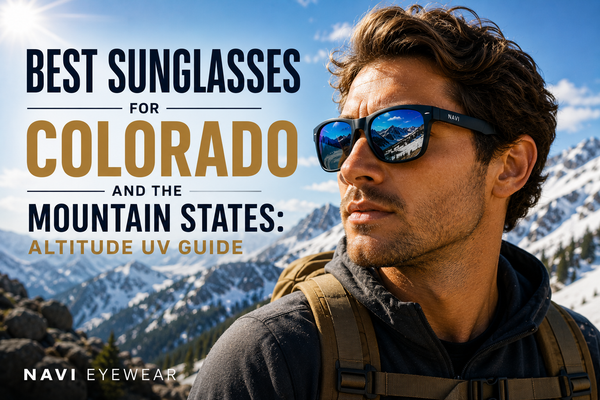

Best Sunglasses for Colorado and the Mountain States: Altitude UV Guide
Colorado is the highest-elevation state in the continental US — with an average elevation of 6,800 feet, higher than any other state's average. Denver sits at 5,280 feet ("the Mile High City"), Colorado ski resorts operate between 8,000 and 12,000 feet, and Colorado's 58 fourteeners (peaks exceeding 14,000 feet) attract hundreds of thousands of hikers annually. Every 1,000 feet of elevation increases UV intensity by approximately 10–12% — Denver's altitude alone gives it 25–30% more UV than a sea-level city at the same latitude. Add the Mountain West's summer thunderstorm season that forces outdoor activity into the peak UV morning window, and the snow reflection that doubles effective UV at ski resorts in winter and spring, and Colorado's UV profile is among the most demanding in the continental US. This guide covers the right lens specification for every major Colorado and Mountain West outdoor context.

1. The Altitude UV Factor: Why Colorado Is Different
The 10–12% Per 1,000 Feet Rule
UV intensity increases approximately 10–12% for every 1,000 feet of elevation gain. The mechanism: at higher elevation, the column of atmosphere between the sun and the observer is shorter, meaning less UV is absorbed and scattered before reaching the surface. The practical implications for Colorado:
- Denver (5,280 feet): approximately 25–30% higher UV than a sea-level city at the same latitude (approximately 39 degrees north)
- Breckenridge base (9,600 feet): approximately 90–100% higher UV than sea level at equivalent latitude — nearly double the sea-level UV at the same sun angle
- Vail Mountain summit (11,570 feet): approximately 110–130% higher than sea level — more than double
- Colorado fourteener summit (14,000 feet): approximately 130–150% higher than sea level — consistently some of the highest UV exposures achievable in the continental US
Denver's Everyday UV Reality
Denver residents experience UV that is meaningfully higher than equivalent-latitude cities — Boston at 42 degrees north sea level vs Denver at 39 degrees north at 5,280 feet results in Denver having significantly higher UV despite being at lower latitude. The combination of higher latitude compensation from altitude makes Denver's actual UV more comparable to subtropical sea-level cities than to the northern Great Plains cities at the same latitude. Denver's 300+ sunny days per year (comparable to Southern California) combined with altitude amplification means the city's outdoor culture — running along Cherry Creek, cycling the High Line Canal, outdoor dining on 16th Street Mall — accumulates UV at rates that residents accustomed to sea-level thinking systematically underestimate.
The Mountain West Beyond Colorado
Utah (Salt Lake City at 4,226 feet; Park City at 7,000 feet), Montana (higher latitude moderates the altitude effect), Wyoming (Yellowstone at 7,733 feet), Idaho (Sun Valley at 5,920 feet), and New Mexico (Santa Fe at 7,199 feet, Albuquerque at 5,312 feet) all share the altitude UV amplification that defines the Mountain West UV profile. The Mountain West as a region has systematically higher UV than residents accustomed to sea-level UV expectations understand.
2. Colorado Environments and UV Context
Denver and Front Range Urban UV
Denver's outdoor culture is genuine and year-round — running on trails from Washington Park to South Platte River, cycling the Cherry Creek Trail and surrounding network, outdoor dining on Larimer Square, and the Rockies and Broncos stadium culture that puts 50,000+ people outdoors for summer and fall afternoon games. Denver's UV at 5,280 feet is elevated relative to sea-level expectations, and the Front Range's west-facing orientation means afternoon outdoor time often faces the Rockies as a backdrop to westward sun exposure. Gray Cat 2 polarized UV400 for Denver everyday driving and urban use; amber Cat 2 for the running and cycling culture of Denver's outdoor fitness scene.
Colorado Ski Resorts: Snow Plus Altitude
The combination of snow reflection (80% UV) and resort altitude (8,500–12,000 feet operating terrain) creates the highest UV environment most Colorado residents regularly encounter. A ski day at Breckenridge, Vail, or Telluride involves UV intensity that may be 150–200% of sea-level UV at equivalent sun angles — before snow amplification. With snow, effective UV reaching the face and eyes can approach 300% of sea-level equivalent. This is not hyperbole; it is the photobiological consequence of altitude and snow reflection operating simultaneously.
Ski goggle use during active skiing addresses the worst of this UV exposure through goggle lens UV blocking and the physical coverage of the goggle frame. However, lift rides, lunch breaks, slope-side lounging, and the après-ski outdoor time that Colorado ski culture celebrates all involve open-face UV exposure where sunglass protection matters. Amber Cat 3 polarized UV400 for ski resort non-goggle outdoor time — amber for snow terrain contrast in variable cloud and sun conditions, Cat 3 for the extreme altitude and snow-reflected UV. Browse amber polarized UV400 options at navieyewear.com.
Rocky Mountain National Park and Colorado Hiking
Rocky Mountain National Park's Trail Ridge Road reaches 12,183 feet — the highest continuously paved road in the US. RMNP hikers regularly access terrain above 11,000 feet on day hikes from Bear Lake, Glacier Gorge, and Wild Basin trailheads. Alpine tundra hiking above treeline at 11,500+ feet is among the most UV-intense hiking available to the general public in the continental US — no tree cover, no shade, reflective alpine terrain, and altitude UV amplification operating at maximum effect.
Amber Cat 3 polarized UV400 for Rocky Mountain National Park and above-treeline Colorado hiking. At these altitudes, the UV is genuinely extreme — the same UV protection that is adequate for a beach day is inadequate for a full alpine day above 12,000 feet. The alpine tundra environment's reflective low vegetation and rock surfaces add diffuse UV reflection to the direct altitude-amplified overhead UV.
Colorado Fourteeners: The Most UV-Intense Continental US Day Hike
Hiking a Colorado fourteener — one of the state's 58 peaks exceeding 14,000 feet — involves sustained UV exposure at the highest altitudes accessible by trail in the continental US. A full fourteener day (pre-dawn start at the trailhead, summit by 11am before afternoon thunderstorms, descent through mid-afternoon) spans the complete morning UV ramp at altitude. The combination of 14,000+ feet UV amplification, potential snow fields on north-facing slopes reflecting UV from below, and the alpine environment's minimal UV moderation makes fourteeners the highest UV day hike available in the continental US.
Amber Cat 3 polarized UV400 for fourteener hiking — with particular attention to the wide-brim hat and wraparound coverage that address the UV from multiple angles at alpine altitude. The start of a fourteener at a typical trailhead (10,000–11,000 feet) at 4:30am involves UV index 0–1 in the dark; by summit at 9:30–10am, UV index may be 12–15 or higher depending on season. The UV transition from pre-dawn to alpine summit is one of the most dramatic UV exposure ramps in any single outdoor activity.
Mountain Biking: Colorado's Summer Sport
Crested Butte, Durango, Steamboat Springs, Vail, Moab (Utah) — Colorado and the Mountain West's mountain biking culture involves sustained outdoor exercise at altitude under full sky exposure with minimal shade at higher elevations. Amber Cat 2 polarized UV400 in a sport frame for Mountain West mountain biking — amber for trail and terrain contrast in the variable light of mountain terrain, Cat 2 for the variable cloud and sun conditions of mountain afternoons, sport frame for the retention requirements of technical trail riding.
Fly Fishing: Colorado's Rivers and Mountain Lakes
The Fryingpan, Arkansas, Gunnison, Colorado River, and South Platte are world-class fly fishing rivers. Colorado's mountain rivers combine freshwater UV at altitude — the altitude amplification that applies to all Colorado outdoor activities also applies to a day on the Fryingpan — with the sub-surface visibility benefit of polarized lenses for reading water and spotting fish in Colorado's clear mountain rivers. Amber Cat 2 polarized UV400 for Colorado river fishing — amber for freshwater visibility and contrast in the clear, somewhat turbid mountain rivers; Cat 2 for the variable mountain light of a river canyon day. See the complete fishing sunglasses guide.
3. Seasonal UV in Colorado
Summer: Thunderstorm Season and the Morning UV Window
Colorado's summer thunderstorm pattern — reliable afternoon thunderstorms that develop over the mountains from noon to 4pm — concentrates outdoor activity into the morning UV window (5am–noon). Colorado hikers, cyclists, and outdoor enthusiasts begin activities at dawn specifically to complete their outdoor plans before afternoon storms. The morning UV window at Colorado altitudes (7am UV index 4–6 at Denver; 7am UV index 6–8 at resort altitudes) is the primary UV accumulation window for Colorado's summer outdoor culture — earlier than the peak UV hours that sea-level UV warnings focus on.
Spring: Snow Plus High UV
Colorado spring (March–May) is the combination of lingering snow at altitude and rapidly increasing UV index as the sun angle rises. Spring skiing — often in warm, sunny conditions that make sun protection feel unnecessary while UV is at its seasonal peak — is one of the highest UV ski seasons. The high sun angle of April and May at altitude, combined with spring snow that still reflects 70–80% of UV, produces UV conditions that exceed winter peak-UV with the low sun angles of December and January. Spring is often the highest UV skiing month despite feeling like "warm weather" skiing.
Winter: Lower Angle But Snow Amplification
Colorado winter (December–February) has lower solar angles that reduce UV index compared to summer — but snow reflection compensates significantly. A Denver winter at UV index 3 on a clear day is not dramatically different from a summer UV index 6 day at sea level. At ski resort altitudes in winter, the altitude and snow combination maintains significant UV despite the lower sun angles. Year-round UV protection at Colorado altitudes is appropriate — the winter UV index may be lower than summer but the altitude and snow factors keep it meaningful.
4. Colorado and Mountain West Lens Recommendations
| Colorado / Mountain West Context | Recommended Tint | Category | Key Requirement |
|---|---|---|---|
| Denver everyday and driving | Gray polarized | Cat 2 | Year-round altitude UV; road glare |
| Denver running and cycling | Amber polarized | Cat 2 | Trail contrast; sport frame; altitude UV |
| Ski resorts (non-goggle time) | Amber polarized | Cat 3 | Snow + altitude; terrain contrast |
| RMNP and above-treeline hiking | Amber polarized | Cat 3 | 11,000+ ft extreme UV; alpine tundra |
| Colorado fourteeners | Amber polarized | Cat 3 | 14,000 ft; highest continental US day hike UV |
| Mountain biking (Crested Butte, Moab) | Amber polarized | Cat 2 | Trail contrast; sport frame; variable mountain light |
| Colorado fly fishing | Amber polarized | Cat 2 | Freshwater river visibility; altitude UV |
| Spring skiing | Amber polarized | Cat 3 | Peak annual UV at ski resorts; snow reflection |
| Utah skiing (Park City, Alta, Snowbird) | Amber polarized | Cat 3 | 7,000–11,000 ft; Utah's light dry snow |
| Santa Fe and New Mexico high desert | Amber polarized | Cat 2–3 | 7,199 ft altitude; dry air UV amplification |
5. The Mountain West Multi-Pair Strategy
Colorado's lifestyle spans urban Denver commuting, ski resort weekends, summer fourteener and trail hiking, mountain biking, and river fishing — each with different UV and optical requirements. Three pairs cover the primary contexts:
- Car pair: gray Cat 2 polarized UV400 — center console, covers Denver daily commuting and all Front Range driving at altitude-elevated UV
- Everyday/bag pair: gray or amber Cat 2 polarized UV400 — bag pair for Denver outdoor life, walking, lunch runs, and everyday altitude UV
- Alpine activity pair: amber Cat 3 polarized UV400 in a sport frame — ski resort non-goggle time, fourteeners, RMNP hiking, mountain biking, and all high-altitude outdoor activity
Navi Eyewear's Buy 1, Get 2 Free — $85 for three pairs — covers the complete Colorado lifestyle UV kit at approximately $28 per pair.
Frequently Asked Questions
How much more UV is there in Denver vs sea level?
Denver at 5,280 feet receives approximately 25–30% more UV than a sea-level city at the same latitude. At Colorado ski resorts (9,000–12,000 feet), UV is 90–130% higher than sea-level equivalents. At fourteener summits, UV is 130–150% higher than sea level. The practical implication: the UV protection habits appropriate for sea-level cities are inadequate for Colorado without adjustment for altitude amplification.
What sunglasses are best for skiing in Colorado?
For goggle-free time at ski resorts (lift rides, lunch, après-ski): amber Cat 3 polarized UV400. Amber for snow terrain contrast in variable alpine light; Cat 3 for the extreme UV of altitude plus snow reflection. For in-goggle time during active skiing: ski goggles are the appropriate eye protection with their own UV-blocking lens category. The sunglass and goggle often alternate during a ski day — goggles for active runs, sunglasses for lifts and terrain-reading from the slope side.
Do I need sunglasses for hiking a fourteener?
Yes — emphatically. Colorado fourteeners involve the highest sustained UV available to the general public on a day hike in the continental US. Amber Cat 3 polarized UV400 is the minimum specification for fourteener summiting. The pre-dawn start conditions don't require UV protection initially, but by summit time (typically 9–11am) UV is at full altitude intensity. Wide-brimmed hat plus Cat 3 amber polarized UV400 is the recommended sun protection combination for sustained fourteener hiking.
Is Denver UV really that high year-round?
Yes — Denver's altitude creates a baseline UV elevation that makes year-round UV protection more important than sea-level cities at 39 degrees north latitude would suggest. Denver winter UV (UV index 3–5 on clear days) is elevated relative to sea-level expectations, and Denver's 300+ sunny days per year means the accumulated annual UV dose for outdoor-active Denver residents exceeds what latitude alone would predict. Year-round UV400 car pair and bag pair is appropriate for Denver's outdoor lifestyle.
What's the best lens tint for Colorado mountain hiking?
Amber polarized Cat 3 UV400 — amber for the terrain contrast that makes Colorado's diverse trail surfaces (granite, tundra, scree, snow) more visually distinct, Cat 3 for the altitude UV that exceeds what Cat 2 is designed for above 10,000 feet. Gray provides equal UV protection but without the contrast enhancement that genuinely improves trail safety at altitude where footing precision matters on exposed terrain.
Should I bring different sunglasses for skiing and hiking in Colorado?
Ideally yes — a ski goggle for active skiing runs and amber Cat 3 polarized sunglasses for all other resort time; the same amber Cat 3 sunglasses for summer hiking above treeline. Amber Cat 3 polarized UV400 serves both contexts (lift rides and après-ski in winter; trail hiking in summer) well. The Car pair (gray Cat 2) covers the drive to the resort or trailhead. One sport pair and one car pair addresses the practical Colorado outdoor lifestyle effectively.
The Bottom Line
Colorado and the Mountain West have a UV profile unlike any other continental US region — altitude amplification raises UV 25–150% above sea-level equivalents depending on elevation, snow adds a second amplifier in winter and spring, and 300+ sunny days per year means consistent UV accumulation across all seasons. Amber Cat 3 polarized UV400 is the alpine activity standard for ski resorts, RMNP, and fourteener hiking; gray Cat 2 polarized for Denver daily driving and urban life; amber Cat 2 for lower-elevation running, cycling, and freshwater fishing. The three-pair Mountain West setup at Buy 1, Get 2 Free covers every Colorado UV context. navieyewear.com/collections/polarized — Buy 1, Get 2 Free for $85.
Related Reading
- Best Sunglasses for California | Navi Eyewear
- Best Sunglasses for Arizona | Navi Eyewear
- Sunglasses for High-Altitude Mountain UV | Navi Eyewear
- Photokeratitis and Snow Blindness | Navi Eyewear
- The Complete Fishing Sunglasses Guide | Navi Eyewear
- Sunglasses by Season: The Complete Year-Round UV Guide | Navi Eyewear
- UV and Eye Disease: The Complete Guide | Navi Eyewear
- Shop Polarized UV400 Sunglasses | Navi Eyewear
Sources & Citations
[1] WHO. "Global solar UV index: a practical guide." World Health Organization, 2002. View source →
[2] Diffey BL. "Sources and measurement of ultraviolet radiation." Methods, 2002. View source →
[3] Sliney DH. "Ocular exposure to environmental light and ultraviolet." Journal of AAPOS, 2014. View source →
[4] Taylor HR, et al. "Effect of ultraviolet radiation on cataract formation." New England Journal of Medicine, 1988. View source →
[5] Dain SJ. "Sunglasses and sunglass standards." Clinical and Experimental Optometry, 2003. View source →
[6] NOAA. "Climate data for Colorado stations." National Oceanic and Atmospheric Administration. View source →