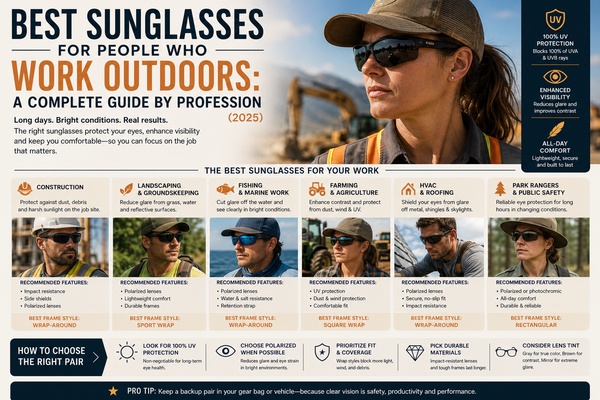

Best Sunglasses for People Who Work Outdoors: A Complete Guide by Profession
Most sunglass content is written for leisure. The person on holiday at the beach. The weekend runner. The festival-goer. It is written for people who choose when they go outside and for how long. It is almost never written for the person whose job puts them outdoors for eight hours a day, five days a week, in whatever weather condition the season delivers.
That person — the construction worker, the farmer, the lorry driver, the golf professional, the landscaper, the delivery driver, the roofer, the groundskeeper — is accumulating UV eye damage at a rate that makes every leisure-use recommendation look conservative. National Institute for Occupational Safety and Health (NIOSH) data and multiple occupational UV studies consistently show that outdoor workers accumulate five to ten times more annual ocular UV than office workers. Over a 30-year career, this is a dramatically different lifetime UV exposure profile with proportionally higher cataract and AMD risk.
Heritage sunglass brands do not publish occupational guides. They publish style guides, celebrity endorsements, and seasonal collections. This guide does what the market does not: a profession-by-profession analysis of the specific UV exposure, the specific visual demands, the specific environmental conditions, and the specific sunglass specification that each outdoor occupation requires.
This is the C17 Professions & Occupations pillar post. The supporting guides cover specific professions in depth:sunglasses for truck drivers and long-haul drivers,sunglasses for construction workers and tradespeople,sunglasses for golfers: contrast, glare and course performance,sunglasses for surfers: UV, salt and wave performance, andsunglasses for teachers, coaches and people who work with kids outdoors.
Quick Answer
For all outdoor workers: UV400 certified polycarbonate (mandatory — not optional), polarized to eliminate surface glare (non-negotiable for driving, water, and reflective work environments), Category 2–3 depending on the UV intensity of the specific work environment, TR90 nylon frames with rubberised grip for secure all-day wear, and stainless hardware to resist sweat and weather corrosion. The profession-specific detail is in the lens tint and the frame geometry requirements that each job’s specific visual demands create.

Table of Contents
Part 1: The Occupational UV Exposure Problem — The Numbers
How Outdoor Workers Compare to Office Workers
The most striking data point in occupational UV research is the exposure multiplier. Office workers in developed countries receive approximately 3–5% of their total available solar UV annually — the fraction that comes through windows and during brief outdoor transitions. Full-time outdoor workers in the same geography receive approximately 30–60% of total available solar UV annually. The ratio: outdoor workers accumulate 5–10 times the annual ocular UV of their office-based counterparts.
Gies et al. (1995) measured UV exposures across three groups of outdoor workers on the Sunshine Coast, Australia — one of the highest-UV environments in the developed world. The study found that outdoor workers received UV doses equivalent to the maximum recommended annual recreational exposure in a single working week during summer. A 30-year career at these exposure levels produces a lifetime ocular UV accumulation that is fundamentally different from any leisure calculation.
The Career Duration Factor
An office worker who takes two weeks of beach holiday annually and spends modest time outdoors on weekends might accumulate 1,000–1,500 hours of meaningful ocular UV annually. A full-time outdoor worker in a high-UV environment — construction, agriculture, surfing instruction, groundskeeping — might accumulate 2,000–3,000 hours annually. Over a 30-year career, this translates to a lifetime ocular UV total that is 60,000–90,000 hours vs 30,000–45,000 hours — approximately double the baseline risk multiplier for cataract and AMD.
Reflection Multipliers by Work Environment
The ambient UV index of the work environment is only part of the exposure calculation. Reflected UV from work surfaces adds a second UV vector that is often more intense than the direct overhead component:
Part 2: Why Outdoor Workers Are the Highest-Risk Group
The occupational UV risk is not simply a matter of spending more time outside. It is compounded by several factors specific to working outdoors:
No Shade Control
Leisure outdoor time can be self-regulated: seek shade at peak UV hours, wear a hat, plan outdoor activity for morning and evening rather than noon. Outdoor workers cannot do this. The job requires being outdoors at noon, in the direction the sun dictates, in the conditions the weather provides. The UV management strategies that reduce leisure UV accumulation are not available.
Upward-Facing Work Postures
Many outdoor occupations involve upward-facing work postures: roofers looking up at the work surface above, electricians working on overhead cables, painters working on elevated surfaces, window cleaners. These postures direct the face upward, eliminating the brow ridge protection that normally reduces overhead UV reaching the eye and increasing direct retinal UV exposure.
Reflective Work Surfaces
Many outdoor work environments involve high-reflectance surfaces as described above. Construction on concrete, agricultural work over pale soil, marine work over water, turf management over grass — all add a reflected UV component that compounds the direct overhead exposure and reaches the eye at angles that standard sun protection does not address.
Duration and Regularity
Occupational exposure is daily, year-round, and decades-long. There is no off-season. A farmer plants in spring, maintains in summer, harvests in autumn, and performs maintenance in winter. A truck driver is outdoors entering and exiting the vehicle, making deliveries, and loading during every working day of every year of their career. The cumulative effect of this regularity over decades is qualitatively different from the periodic leisure exposure that UV recommendations typically address.
The UV disease science behind these risk factors is inUV and eye disease: the complete guide.
Part 3: The Occupational Sunglass Specification — What Every Worker Needs
Occupational sunglasses share a core specification that addresses the elevated UV exposure and physical demands of outdoor work. This specification is not optional or aspirational — it is the minimum that outdoor work conditions require:
Part 4: Drivers — Long-Haul, Delivery and Professional Transport
Professional drivers represent one of the largest outdoor worker populations in developed economies. Long-haul HGV drivers, delivery drivers, taxi and private hire drivers, bus and coach drivers — all spend the majority of their working hours behind glass in conditions where UV exposure is significant and glare is a daily safety factor.
The Driving UV Reality
Laminated windshield glass blocks most UVB but transmits a substantial proportion of UVA. Side windows in most commercial and private vehicles are not laminated and transmit UV freely. A professional driver spending 8–10 hours per day behind the wheel accumulates daily ocular UV exposure that, over a 30-year career, represents one of the highest occupational UV totals of any non-agricultural profession.
Gray Polarized UV400 Category 2 — The Professional Driver Specification
Gray polarized UV400 at Category 2 is the universal professional driver recommendation. Gray maintains colour accuracy for traffic signals and road signage — a safety requirement, not an aesthetic preference. Polarization eliminates horizontal road surface reflection that creates the most dangerous low-visibility driving events: post-rain road shimmer, low-angle sun on wet surfaces, oncoming vehicle windshield reflection. Category 2 handles the full range from sustained motorway sun to overcast urban conditions without creating the tunnel-vision effect of Category 3 in variable light.
Glare as a Fatigue Factor
Professional drivers who operate without adequate glare management accumulate visual fatigue from sustained squinting and glare accommodation that compounds their general driving fatigue. Multiple studies in occupational health have found that glare-related visual fatigue contributes to reduced reaction time and decision-making performance in professional drivers, particularly toward the end of long shifts. Polarized lenses reduce this visual fatigue load alongside providing UV protection.
The complete professional driver sunglass guide is inbest sunglasses for truck drivers and long-haul drivers.

Part 5: Construction, Trades and Physical Outdoor Work
Construction workers, roofers, scaffolders, electricians, plumbers working outdoors, painters, carpenters working on-site, and all physical tradespeople working in outdoor or semi-outdoor environments share several UV and visual characteristics that make their sunglass requirements specific.
The Construction UV Environment
Construction sites combine direct overhead UV with significant reflected UV from concrete, pale aggregate, painted surfaces, and glass. The average construction worker in the UK or northern US is estimated to receive 5–7 times the annual ocular UV of an office worker in the same geography. In high-UV climates (southern US, Australia, Mediterranean), this multiplier increases further.
Upward Work Postures and Overhead UV
Roofing, electrical work on overhead installations, scaffolding assembly, and painting on elevated surfaces all involve sustained upward-facing work postures that eliminate the brow ridge’s protective effect on overhead UV. Workers in these postures are receiving direct retinal UV from the overhead UV field without the natural protection that normal head posture provides. This is a specific occupational risk factor that leisure UV recommendations do not address.
Impact Resistance: The Safety Specification
Construction sites generate debris — grit, dust, small particles, nail fragments, cable offcuts. Polycarbonate lens impact resistance is not just a comfort feature in this environment; it is the specification that prevents lens fragmentation from site debris from creating a secondary eye injury. FDA-cleared polycarbonate is the occupational safety standard for lens material in any debris-generating work environment.
Amber or Gray Polarized UV400 Category 2–3
Amber polarized for most construction work — the blue-scatter filtering of amber enhances contrast of edges, surfaces, and terrain features in the outdoor site environment. Gray polarized for workers whose job involves traffic awareness or driving vehicles on site. Category 2–3 depending on the specific UV intensity of the site.
The detailed construction worker guide is inbest sunglasses for construction workers and tradespeople.
Part 6: Golf, Sport Coaching and Course Professionals
Golf professionals, golf coaches, course rangers, greenkeepers, grounds supervisors, and sports coaches working on outdoor courts and pitches all share extended outdoor exposure in environments with specific visual demands.
Golf’s UV Profile
A round of golf requires 3–5 hours of continuous outdoor exposure. Professional golfers, caddies, and coaches may play or observe multiple rounds per day across the playing season. The cumulative annual UV of a full-time golf professional — 300–400 rounds per year in some cases — represents one of the highest sustained outdoor UV totals of any sporting occupation.
Amber for Course Performance
Amber polarized UV400 at Category 2 is the standard golf professional recommendation. Amber’s blue-scatter filtering enhances the contrast between the ball and sky, between fairway surfaces and rough, and between the flag and the course background. This is not merely aesthetic — for teaching professionals whose job requires precise ball observation and shot analysis, contrast enhancement is a performance tool. The detailed golf guide is inbest sunglasses for golfers: contrast, glare and course performance.
Part 7: Surfing, Watersports and Marine Work
Surf instructors, lifeguards, marine engineers, commercial fishermen, sailing instructors, harbour workers, and anyone whose occupation puts them at the water interface face the highest UV environment of any outdoor profession outside of high-altitude work.
The Marine UV Environment
Marine environments combine direct overhead UV with up to 20% UV reflection from the water surface. The reflected UV reaches the eye from below and at eye level — bypassing the brow’s protection and hitting the retina at angles that even well-specified sunglasses may not fully block without adequate coverage geometry. Marine workers also contend with salt spray, which accelerates lens surface degradation if the lens specification does not include anti-saltwater protection.
Anti-Saltwater Coating: Mandatory in Marine Work
For any worker whose occupation regularly involves salt water contact with their eyewear — surf instructors, marine engineers, harbour workers, commercial fishermen — anti-saltwater coating is not a premium feature. It is the coating that prevents the progressive salt crystal abrasion of the lens surface that occurs when salt-contaminated lenses are wiped in the field without fresh water rinsing.
Gray or Copper Polarized UV400 Category 3
Gray polarized at Category 3 for high-sun marine environments. Copper polarized for surf and fishing instruction where sub-surface water visibility matters. Anti-saltwater coating mandatory. The detailed surfing guide is inbest sunglasses for surfers: UV, salt and wave performance.
Part 8: Farming, Agriculture and Land Management
Farmers, agricultural workers, market gardeners, vineyard workers, fruit pickers, and land managers represent one of the most chronically UV-exposed worker populations in any economy. Agricultural work is year-round, typically during peak UV hours, in open unshaded terrain.
Agricultural UV — The Career-Length Exposure
A farmer beginning work at 18 and retiring at 65 accumulates approximately 47 years of daily outdoor UV exposure. Even at temperate latitudes, this represents a lifetime ocular UV total that dwarfs virtually any other population group. The prevalence of cataract in agricultural worker populations is consistently higher than in matched urban populations in multiple international studies, with UV exposure as the primary modifiable factor identified.
Durability and Replacement Cycle
Agricultural workers need sunglasses that survive the physical realities of farm work: tools, equipment, vehicle cabs, outdoor storage. At $119 for four Navi pairs with free replacements, the agricultural worker model is the same as any rotation model: four UV400 pairs providing consistent coverage with the practical acceptance that some will be lost, damaged, or left in the wrong location. The rotation protects against the unprotected exposure gaps that a single pair creates.
Amber Polarized UV400 Category 2–3
Amber polarized for most agricultural work — terrain contrast and surface definition in field environments. Category 2 for variable conditions; Category 3 for high-UV summer field work. Anti-saltwater coating for workers in irrigated environments or coastal agricultural land.
Part 9: Landscaping, Grounds and Outdoor Maintenance
Landscapers, groundskeepers, garden contractors, parks maintenance workers, road maintenance crews, and utility workers operating outdoors share the sustained outdoor exposure of agricultural workers with the additional physical hazard of machinery and equipment debris.
Grass cutting and hedge trimming generate debris that presents specific risk to unprotected eyes. The polycarbonate impact resistance specification for outdoor maintenance workers is both a UV protection requirement and a safety requirement. UV400 polarized polycarbonate in a wraparound or close-fitting frame provides both: the UV protection of sustained outdoor work and the debris resistance of the safety lens material.
Amber polarized UV400 for most landscaping and grounds maintenance. Gray polarized for workers operating machinery on road environments. Category 2 as the versatile everyday choice; Category 3 for sustained peak-summer outdoor work.
Part 10: Teachers, Sports Coaches and Outdoor Education Professionals
PE teachers, sports coaches, outdoor education instructors, nursery and primary school teachers who supervise outdoor play, holiday camp counsellors, and after-school activity supervisors all share a distinctive occupational UV profile: sustained outdoor exposure during the school day, often during the highest-UV midday hours, in environments (school playgrounds, sports pitches, outdoor education sites) where there is often no shade.
The Midday School UV Problem
School lunch hours and PE lessons often fall between 11am and 2pm — the peak UV index window of the day. Teachers and coaches who supervise outdoor activities during these hours receive concentrated UV exposure during the most intense part of the UV day, repeatedly, throughout the academic year.
The Professional Visibility Requirement
Teachers and coaches in professional contact with students, parents, and colleagues face an implicit appearance standard that most outdoor occupations do not. The sunglass choice needs to be both UV-protective and contextually appropriate for a professional in daily public view. Classic aviators in gray polarized UV400 provide both: the complete UV specification and the professional register that suits educational and coaching contexts.
The complete guide for teachers, coaches, and outdoor education professionals is inbest sunglasses for teachers, coaches and people who work with kids outdoors.
Part 11: Emergency Services and Outdoor Response
Police officers, firefighters, paramedics, mountain rescue personnel, coastguard and RNLI crew, and other outdoor emergency responders face a specific combination of requirements: UV protection in highly variable and sometimes extreme UV environments, the impact resistance needed in physically demanding emergency contexts, and the operational awareness requirements of situations where peripheral vision and contrast are safety-critical.
Gray polarized UV400 at Category 2 is the primary recommendation for most emergency service outdoor work — it maintains colour accuracy needed for visual assessment, provides polarization that reduces surface glare in variable environments, and the Category 2 darkness level functions across the full range from bright summer outdoor to overcast winter conditions without the adaptation time of Category 3. For mountain rescue, ski patrol, and winter alpine emergency work, the reflected UV from snow surfaces requires Category 3 or specialist high-altitude lens specifications.
Part 12: The Workplace UV Protection Case for Employers
In most jurisdictions, employers have statutory health and safety obligations to assess and mitigate workplace hazards, including UV exposure for outdoor workers. The UK’s Health and Safety Executive, NIOSH in the US, and equivalent bodies in Australia, Canada, and the EU identify solar UV as a significant occupational health hazard for outdoor workers and recommend eye protection as part of a comprehensive UV management strategy.
The occupational health argument for employer-provided or employer-subsidised UV400 sunglasses for outdoor workers is compelling: the cost of four Navi pairs at $119 is negligible against the occupational health liability of a workforce developing accelerated cataract and AMD from preventable UV accumulation over 30-year careers. Eye health monitoring, UV protection provision, and worker education are all components of a responsible outdoor employer’s occupational UV health programme.
✨ NAVI EYEWEAR — SPECIFICATION-GRADE UV400 FOR OUTDOOR WORKERS.UV400 certified polycarbonate. FDA-cleared impact resistance. Polarized. Anti-saltwater coating. TR90 nylon. Stainless 5-barrel hinges. Built for all-day outdoor wear in any profession. Buy 1, Get Any 3 Pairs Free — $119 for four pairs (~$30 each). Free shipping. Free replacements. |
Part 13: Occupation-by-Occupation Quick Reference Table
|
Occupation |
Primary UV Risk |
Lens Tint |
Category |
Key Spec |
|
Long-haul driver |
Window UV + road glare; 8-10 hrs daily |
Gray polarized |
Cat 2 |
Colour accuracy; no Cat 4 |
|
Delivery driver |
In/out UV; road glare; variable conditions |
Gray polarized |
Cat 2 |
Versatile; polarized essential |
|
Construction worker |
Direct + reflected concrete UV; debris |
Amber or gray polarized |
Cat 2–3 |
Polycarbonate impact resistance |
|
Roofer / scaffolder |
Overhead posture; extreme direct UV |
Amber polarized |
Cat 3 |
Maximum UV; wraparound coverage |
|
Electrician (outdoor) |
Overhead posture; variable site UV |
Amber polarized |
Cat 2–3 |
Impact resistance; secure fit |
|
Farmer |
Year-round sustained; open terrain |
Amber polarized |
Cat 2–3 |
Durability; rotation model |
|
Landscaper / groundskeeper |
Sustained outdoor; machinery debris |
Amber polarized |
Cat 2 |
Impact resistance + UV400 |
|
Golf professional / coach |
3-5 hrs per round; turf reflection |
Amber polarized |
Cat 2 |
Contrast for ball tracking |
|
Surf instructor |
Overhead + 20% water reflection; salt |
Gray or copper polarized |
Cat 3 |
Anti-saltwater coating mandatory |
|
Commercial fisher |
Marine UV + reflection; salt |
Gray polarized |
Cat 3 |
Anti-saltwater; corrosion-resistant |
|
Lifeguard |
Beach UV; water reflection; sustained |
Amber or gray polarized |
Cat 3 |
Anti-saltwater; full coverage |
|
Teacher / PE coach |
Midday school UV; professional register |
Gray or amber polarized |
Cat 2 |
Professional aesthetic; UV400 |
|
Mountain / ski worker |
High altitude; snow reflection up to 90% |
Gray polarized |
Cat 3–4 |
Maximum UV at altitude |
|
Emergency responder |
Variable extreme conditions; impact risk |
Gray polarized |
Cat 2 |
Colour accuracy; impact resistance |
Part 14: Best For
Gray Polarized UV400 Category 2 — Best For:
Amber Polarized UV400 Category 2–3 — Best For:
Gray or Copper Polarized UV400 Category 3 + Anti-Saltwater — Best For:
Part 15: Who This Is Not For
Part 16: Common Mistakes Outdoor Workers Make
Bottom Line
Outdoor workers are the highest UV-risk group in any population. They work in the UV, not through it. They have no shade option, no schedule flexibility around peak UV hours, and no ability to limit their exposure when conditions are demanding. The cumulative UV they accumulate over a 30-year career is fundamentally different from any leisure or occasional outdoor exposure, and the resulting cataract and AMD risk is proportionally elevated.
The specification that addresses this risk is not complicated: UV400 polycarbonate, polarized, Category 2–3 depending on the specific work environment, TR90 frames with stainless hardware, rubberised fit elements for secure all-day wear. The profession-specific detail — gray for drivers and teachers, amber for construction and agriculture, copper for marine work, anti-saltwater for anyone working at the water interface — is the adjustment within this framework that each job demands.
At $119 for four Navi pairs with free replacements, the rotation model that protects consistently against the exposure gaps of a lost or damaged pair is accessible. Every outdoor worker deserves the same UV protection standard as the most conscientious weekend runner.
Browse the full collection atnavieyewear.com/collections/polarized. Add 4 pairs — Buy 1, Get Any 3 Free auto-applies. Free shipping. Free replacements.
Frequently Asked Questions
How much more UV do outdoor workers get than office workers?
Approximately 5–10 times more annual ocular UV than their office-based counterparts in the same geography. Gies et al. found that outdoor workers in high-UV environments received UV doses equivalent to the maximum recommended annual recreational exposure in a single working week. Over a 30-year career, this compounds into a fundamentally different lifetime UV accumulation with proportionally elevated cataract and AMD risk. The full science is inUV and eye disease: the complete guide.
What sunglasses should construction workers wear?
UV400 polycarbonate (mandatory for impact resistance and inherent UV protection), amber polarized at Category 2–3, TR90 frames with secure rubberised fit, stainless hardware. The full construction worker guide is inbest sunglasses for construction workers and tradespeople.
Do truck drivers need special sunglasses?
Yes — specifically gray polarized UV400 at Category 2. Gray for traffic colour accuracy (safety requirement). Polarized for road surface glare elimination (the primary driving vision hazard). Category 2 for the full range of driving conditions from bright motorway sun to overcast urban. The full truck driver guide is inbest sunglasses for truck drivers and long-haul drivers.
What are the best sunglasses for farmers?
UV400 polycarbonate, amber polarized at Category 2–3, TR90 frames with stainless hardware for durability across the work environment. Farmers need a rotation of multiple pairs — one in each work location (cab, workshop, house) — because the single pair model creates consistent exposure gaps when the glasses are in the wrong place. Four pairs at $119 with free replacements solves this.
Are there sunglasses specifically for water sports workers?
Gray or copper polarized UV400 at Category 3 with anti-saltwater coating and close-fitting or wraparound frame geometry. Anti-saltwater coating is mandatory for any worker whose occupation regularly involves salt water contact with their eyewear. The full marine and surfing guide is inbest sunglasses for surfers: UV, salt and wave performance.
Should employers provide sunglasses for outdoor workers?
The occupational health case is strong and in many jurisdictions there are statutory obligations to assess and mitigate UV hazards for outdoor workers. The cost of four UV400 pairs per worker at $119 is negligible against the long-term occupational health liability of a workforce accumulating preventable UV-driven cataract and AMD over 30-year careers. Many organisations already provide safety eyewear — extending this to UV400 sunglasses for outdoor workers is a low-cost, high-impact health measure.
What lens category is safe for outdoor workers who also drive?
Category 2 (18–43% VLT) is the correct all-conditions working lens for outdoor workers who drive. Category 3 is appropriate for sustained high-UV outdoor work but too dark for driving in variable or overcast conditions. Category 4 is not safe for driving or operating moving machinery in any jurisdiction. Category 2 gray polarized UV400 is the universal solution for workers who move between outdoor sites and driving.
Do teachers and coaches need UV sunglasses for outdoor work?
Yes. Teachers and sports coaches who supervise outdoor activities during school hours are often exposed to midday UV — the highest-UV window of the day — repeatedly throughout the school year. UV400 polarized at Category 2 in a professionally appropriate frame provides complete protection. The complete guide for education professionals is inbest sunglasses for teachers, coaches and people who work with kids outdoors.
Supporting Articles
SPECIFICATION-GRADE UV400. FOR THE PEOPLE WHO WORK OUTSIDE.UV400 • FDA-Cleared Polycarbonate • Polarized • Oleophobic • Anti-Saltwater • TR90 • Stainless Hinges Built for the job. Priced for a rotation. Four pairs so the right lens is always accessible. Buy 1, Get Any 3 Pairs Free — $119 for four pairs. Free shipping. Free replacements. |
SOURCES & CITATIONS[1] Gies HP, Roy CR, Toomey S, et al..“Solar UVR exposures of three groups of outdoor workers on the Sunshine Coast, Queensland.”Health Physics, 1995.View source [2] Sliney DH.“UV radiation ocular exposure dosimetry.”Documenta Ophthalmologica, 1994.View source [3] Taylor HR, West SK, Rosenthal FS, et al..“Effect of ultraviolet radiation on cataract formation.”New England Journal of Medicine, 1988.View source [4] Cruickshanks KJ, Klein R, Klein BE.“Sunlight and age-related macular degeneration: the Beaver Dam Eye Study.”Archives of Ophthalmology, 1993.View source [5] Dain SJ.“Sunglasses and sunglass standards.”Clinical and Experimental Optometry, 2003.View source [6] Rosenthal FS, Bakalian AE, Lou CQ, Taylor HR.“The effect of sunglasses on ocular exposure to ultraviolet radiation.”American Journal of Public Health, 1988.View source [7] World Health Organization.“Solar ultraviolet radiation: global burden of disease from solar ultraviolet radiation.”WHO Environmental Burden of Disease Series, 2006.View source [8] National Institute for Occupational Safety and Health (NIOSH).“Occupational exposure to solar radiation.”NIOSH Publication, 2014.View source |