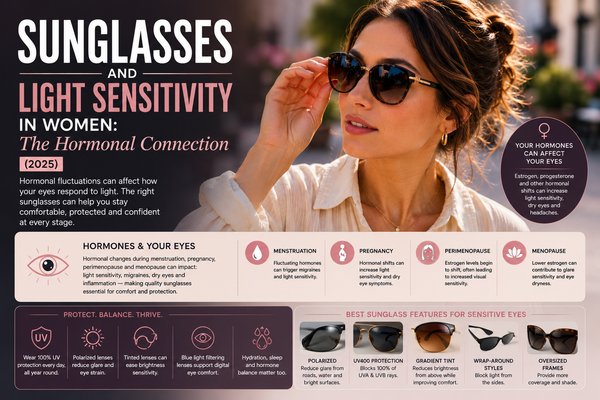

Sunglasses and Light Sensitivity in Women: The Hormonal Connection
Women experience photophobia — abnormal sensitivity to light — at significantly higher rates than men. This is not a matter of personal preference or low pain tolerance. It has a documented biological basis rooted in hormonal physiology, and it affects a substantial proportion of women in ways that range from occasional outdoor discomfort to debilitating migraine attacks triggered by bright light.
This guide covers the science: what hormones do to light sensitivity, how the menstrual cycle creates predictable fluctuations in photophobia, why women experience migraine at three times the rate of men, what dry eye has to do with light sensitivity, and how menopause changes the picture. Then the practical implications: what sunglasses can and cannot do for hormonal light sensitivity, which specifications matter most, and how to build a practical approach that addresses both the UV protection need and the comfort need simultaneously.
This is a C16 Women’s Sunglasses supporting post. It links back to the cluster pillar atthe complete guide to women’s sunglasses. For the broader migraine and light sensitivity guide covering all readers, seesunglasses and migraines: how light sensitivity triggers attacks.
Quick Answer
Women experience higher rates of light sensitivity than men primarily because oestrogen and progesterone fluctuations lower neural pain thresholds, making light-processing pathways more reactive. Migraine — which affects three times as many women as men and is primarily hormonally driven — has photophobia as a core feature. UV400 polarized lenses address light sensitivity in two ways: UV400 reduces the intensity of harmful short-wavelength light, and polarization eliminates the horizontal surface glare that is one of the most discomfort-producing outdoor visual stimuli. Neither is a cure for hormonal light sensitivity, but both reduce the daily burden meaningfully.

Table of Contents
Part 1: What Is Photophobia and How Common Is It in Women
Photophobia is defined clinically as an abnormal sensitivity to light, causing discomfort, pain, or the urge to avoid light sources. It ranges from mild outdoor discomfort in bright conditions to severe intolerance that makes any ambient light painful. The most debilitating forms are associated with neurological conditions — most notably migraine — where light can be both a trigger for attacks and a symptom during them.
Population studies consistently find that women report photophobia at higher rates than men across multiple contexts: chronic photophobia, episodic photophobia linked to migraine, and the intermittent light sensitivity associated with hormonal fluctuations. The International Headache Society and multiple epidemiological studies confirm that women are disproportionately affected across the photophobia spectrum.
For most women, the light sensitivity they experience is not at the severe clinical end of the spectrum. It manifests as squinting discomfort in bright outdoor conditions, headache onset after extended time in bright light, difficulty recovering from glare events (such as oncoming headlights or sun reflections off water), and general fatigue from bright outdoor environments. These are not dramatic symptoms, but they affect daily comfort and outdoor quality of life in measurable ways.
Part 2: Oestrogen, Progesterone and the Neural Pain Threshold
The connection between female sex hormones and pain sensitivity — including light sensitivity — operates through the nervous system’s pain processing pathways. Oestrogen and progesterone are not simply reproductive hormones. They are neuroactive compounds that modulate the excitability of neurons throughout the central nervous system, including the trigeminal pain pathway that processes sensory information from the face, eyes, and cranial structures.
Oestrogen generally sensitises these pain pathways — it lowers the threshold at which stimuli are perceived as painful or uncomfortable. When oestrogen levels are relatively high, the nervous system is more reactive to sensory input including light. Progesterone has a more complex and sometimes modulating effect. The critical period for light sensitivity is not when hormone levels are high but when they fall sharply — the late luteal phase of the menstrual cycle (the days before menstruation), when both oestrogen and progesterone drop to their monthly low.
This drop in oestrogen is associated with increased neurological excitability — the nervous system becomes more reactive to stimuli, including light, sound, and smell. This is the biological mechanism underlying the premenstrual sensitivity that many women recognise: heightened reactivity to sensory input in the days before menstruation.
Part 3: The Menstrual Cycle and Light Sensitivity Patterns
Light sensitivity is not uniform across the menstrual cycle. It follows a predictable pattern linked to hormonal fluctuations:
|
Cycle Phase |
Approximate Days |
Hormonal State |
Typical Light Sensitivity |
|
Menstrual |
Days 1–5 |
Low oestrogen, low progesterone |
High — peak sensitivity for many women |
|
Follicular |
Days 6–13 |
Rising oestrogen |
Moderate — improving through this phase |
|
Ovulatory |
Around day 14 |
Oestrogen peak |
Low — often the most comfortable outdoor days |
|
Luteal (early) |
Days 15–22 |
High progesterone, moderate oestrogen |
Low to moderate |
|
Luteal (late) |
Days 23–28 |
Falling oestrogen and progesterone |
Increasing — approaching menstrual peak |
This pattern is not universal — individual variation is significant. But the late luteal and menstrual phases are consistently identified in research as the highest-sensitivity window for women who experience cyclical photophobia.
The practical implication: women who notice that outdoor discomfort, squinting, and headache sensitivity are worse at predictable points in the month are experiencing a documented physiological phenomenon, not a subjective variation in pain tolerance. Planning for heightened photosensitivity during these phases — including consistent UV400 polarized lens use — is a rational response to a predictable pattern.
Part 4: Migraine — Why Women Experience It Three Times More
Migraine is the neurological condition most strongly associated with severe photophobia. During a migraine attack, photophobia is present in approximately 80–90% of cases and is one of the diagnostic criteria for migraine with aura. But for many migraine sufferers, photophobia also acts as a trigger: bright light, glare, and visual pattern stimulation can initiate a migraine episode, not just accompany one.
Women experience migraine at approximately three times the rate of men in adulthood. This ratio is not present before puberty (migraine affects boys and girls roughly equally in childhood) and narrows again after menopause. The sharp divergence during reproductive years — and the narrowing post-menopause — is strong epidemiological evidence that the sex hormone environment is the primary driver of the gender ratio in migraine prevalence.
Menstrual migraine — attacks that occur specifically in the late luteal or menstrual phase, triggered by the sharp oestrogen drop — is a recognised clinical subtype. These attacks are often more severe and longer-lasting than non-menstrual migraines, and they occur when ambient light sensitivity is already elevated from the same hormonal mechanism.
For women with migraine, light sensitivity is both a premonitory symptom (warning that an attack is developing), an accompaniment of the attack itself, and sometimes a post-attack residual sensitivity (the ‘allodynia’ phase where normal stimuli remain uncomfortable). UV400 polarized sunglasses are not a migraine treatment. But reducing ambient light intensity and eliminating high-contrast glare events — which are documented migraine triggers — is a practical daily management strategy.
The full migraine and light sensitivity science including FL-41 tint research is insunglasses and migraines: how light sensitivity triggers attacks.

Part 5: Pregnancy and Light Sensitivity
Pregnancy creates a dramatically altered hormonal environment: oestrogen and progesterone levels rise substantially, reaching levels far above any point in the normal menstrual cycle. The sensory sensitivity changes associated with pregnancy — heightened smell, nausea, food aversions, sound sensitivity — reflect the same neuroactive hormone mechanism that affects light sensitivity.
Many pregnant women report increased light sensitivity, particularly in the first trimester when hormonal changes are most rapid and when morning sickness (which has a close neurological relationship with sensory sensitivity) is at its most intense. Migraine patterns typically change during pregnancy: some women with pre-existing migraine find their attacks improve significantly during pregnancy (particularly in the second and third trimesters when oestrogen levels stabilise at high values); others find their migraine pattern worsens, particularly in the first trimester.
UV400 polarized sunglasses are appropriate and safe during pregnancy. The lens specification provides the same UV protection and glare reduction during pregnancy as at any other time. For women with morning sickness who find bright outdoor light increases nausea and sensory overload, polarized lenses that eliminate the glare component of outdoor light can provide meaningful daily comfort improvement during this period.
Part 6: Perimenopause, Menopause and Changing Light Sensitivity
Perimenopause — the transition period leading to menopause — is characterised by increasingly irregular and eventually absent menstrual cycles, with highly variable oestrogen levels that can fluctuate dramatically from week to week. This hormonal volatility is associated with a range of neurological symptoms including hot flushes, mood changes, sleep disruption, and in many women, changes in migraine and light sensitivity patterns.
For women who have experienced migraine throughout their reproductive years, perimenopause can be a particularly challenging period: the irregular oestrogen fluctuations can increase migraine frequency and intensity before the post-menopausal improvement that many women experience. Migraine prevalence typically decreases significantly after natural menopause, when oestrogen levels stabilise (at low values) and the hormone fluctuations that drive migraine attacks reduce.
Menopause and Dry Eye: A New Light Sensitivity Factor
Post-menopausal decline in oestrogen is strongly associated with dry eye syndrome. Oestrogen has anti-inflammatory effects on the ocular surface and meibomian glands (which produce the oil layer of the tear film). As oestrogen levels decline, meibomian gland function can deteriorate, producing an unstable tear film that evaporates too rapidly.
Dry eye is itself a significant cause of light sensitivity. An unstable tear film disrupts the smooth optical surface of the eye, scattering incoming light and increasing the discomfort from bright outdoor conditions. Women with dry eye frequently report that outdoor environments — particularly on bright or windy days — are more uncomfortable than those without dry eye.
UV400 polarized lenses reduce ambient light intensity and eliminate the glare component of outdoor light, reducing two of the primary discomfort triggers for dry-eye-associated light sensitivity. Wraparound or close-fitting frame geometry also provides some protection from wind exposure, which accelerates tear film evaporation and worsens dry eye symptoms outdoors.
The complete guide to sunglasses for women over 50 including the dry eye and UV connection is inbest sunglasses for women over 50.
Part 7: Dry Eye — The Overlooked Link to Light Sensitivity
Dry eye syndrome affects approximately twice as many women as men, with the gender ratio increasing significantly after menopause. The underlying mechanisms include the hormonal effects on tear film quality described above, but also autoimmune conditions (such as Sjögren’s syndrome) that disproportionately affect women.
The light sensitivity mechanism in dry eye is distinct from the central neural mechanism in migraine. In dry eye, the unstable tear film creates an irregular refracting surface at the cornea. This surface scatters incoming light rather than focusing it cleanly, producing visual discomfort from ordinary light levels that a healthy tear film would tolerate comfortably. The discomfort is concentrated at the corneal surface rather than centrally.
Polarized lenses help dry-eye-associated light sensitivity by reducing the most discomfort-producing element of outdoor light — the horizontal surface glare from reflective outdoor surfaces. This is not a treatment for dry eye itself, but it addresses the most acutely uncomfortable visual input that dry eye sufferers encounter in outdoor environments. Combined with UV400 protection that reduces overall UV load on the ocular surface, polarized UV400 lenses provide a meaningful daily comfort improvement for women with dry eye.
Part 8: What Sunglasses Can Do for Light-Sensitive Women
It is important to be precise about what sunglasses can and cannot do for hormonal light sensitivity. Sunglasses are not a treatment for migraine, dry eye syndrome, or the underlying hormonal fluctuations that drive cyclical photophobia. Women with significant light-sensitive conditions should work with their healthcare providers for appropriate treatment.
What UV400 polarized sunglasses do:
What sunglasses cannot do:replace medical treatment for migraine, resolve dry eye syndrome, or eliminate the underlying hormonal fluctuations that drive cyclical light sensitivity.
Part 9: Which Lens Specification Matters Most for Light-Sensitive Women
Polarization: The Most Important Feature
For women with light sensitivity from any cause — hormonal, migraine-related, dry-eye-related — polarization is the most functionally important lens feature. The horizontal surface glare that polarized lenses eliminate is disproportionately represented in the outdoor light stimuli that trigger photophobic discomfort. A non-polarized Category 3 lens reduces overall brightness but does not address the high-contrast glare events that are the specific triggers. A polarized Category 2 lens both reduces brightness to a comfortable level and eliminates the specific glare triggers.
UV400: The Baseline Protection
UV400 polycarbonate provides the foundation: complete UV protection inherent throughout the lens material. For women with light sensitivity, this also reduces the contribution of UV exposure to ocular surface inflammation that can worsen dry eye symptoms. Full UV400 science:what does UV400 actually mean.
Lens Category for Light-Sensitive Women
Category 2 (18–43% VLT) is the correct everyday lens for most light-sensitive women. It reduces brightness sufficiently for comfort in variable outdoor conditions while remaining functional in the range of conditions that everyday life involves. Category 3 is appropriate for specific high-UV outdoor use (beach, sustained summer sun) but is too dark for variable conditions and can cause uncomfortable adaptation when moving indoors.
The FL-41 Tint Question
FL-41 is a rose-tinted lens developed specifically for migraine and photophobia management. Research from the University of Utah and elsewhere has found that FL-41 tinted lenses reduce the frequency and intensity of light-triggered migraine attacks in clinical populations. FL-41 filters specifically the green wavelengths (around 480–520nm) that research suggests are most activating for migraine photoreceptors.
FL-41 is available in prescription form through some optometrists and in non-prescription form through specialist photophobia lens providers. It is not the same as a standard rose or copper tint. For women with significant migraine-associated photophobia, FL-41 is worth discussing with a neurologist or optometrist who specialises in headache. For women with moderate hormonal light sensitivity, a standard polarized UV400 lens at Category 2 provides meaningful daily benefit without the need for a specialist tint.
✨ NAVI EYEWEAR — UV400 POLARIZED FOR LIGHT-SENSITIVE WOMEN.UV400 polycarbonate. Quality-controlled polarized lenses — eliminating horizontal glare that triggers discomfort. Oleophobic and anti-saltwater coating. TR90 frames. Stainless 5-barrel hinges. Buy 1, Get Any 3 Pairs Free — $119 for four pairs (~$30 each). Free shipping. Free replacements. |
Part 10: Frame Considerations for Light-Sensitive Women
For women with significant light sensitivity, frame geometry matters beyond face-shape aesthetics.
Close-Fitting Frames
Frames that sit close to the face and reduce peripheral light entry from the sides, above, and below the lens provide better light management than frames that sit away from the face with large gaps. For women with migraine photophobia or significant dry-eye light sensitivity, close-fitting frames reduce the peripheral light that standard-fitting frames admit.
Wraparound Geometry
Wraparound frames provide the most complete light management geometry, blocking peripheral light from all sides. They are the correct choice for women with severe photophobia who require maximum light reduction. For everyday professional and social use, wraparound frames may have a more active/sport aesthetic than is appropriate, but for outdoor activities and driving during high-sensitivity periods, they provide the most complete light management.
Tinted or Photochromic Options
Photochromic lenses — which darken automatically in UV light and return to clear indoors — can be useful for women with variable light sensitivity, as the lens adapts to the environment without requiring a frame change. The limitation: photochromic lenses are slower to clear than to darken, meaning indoor adaptation after outdoor exposure takes time. They also do not darken in cars (windshield glass blocks the UV that triggers the photochromic reaction). For driving, a dedicated polarized lens remains more effective.
Part 11: Comparison Table — Lens Specifications for Light-Sensitive Women
|
Specification |
Benefit for Light Sensitivity |
Priority Level |
|
UV400 |
Removes UV component; reduces ocular surface inflammation |
Essential — baseline |
|
Polarization |
Eliminates horizontal glare triggers; reduces overall discomfort |
Essential — highest functional impact |
|
Category 2 (18–43% VLT) |
Reduces brightness to comfortable level while remaining functional |
Recommended for most everyday use |
|
Category 3 (8–18% VLT) |
Maximum brightness reduction for high-sun conditions |
For beach, summer driving, high UV exposure |
|
Close-fitting frame geometry |
Reduces peripheral light entry |
Beneficial for significant photophobia |
|
Wraparound geometry |
Maximum light exclusion |
For severe photophobia or high-glare environments |
|
FL-41 tint |
Reduces green wavelength that drives migraine photoreceptors |
Specialist option — discuss with neurologist/optometrist |
|
Photochromic lens |
Adapts to variable indoor/outdoor light automatically |
Useful for variable sensitivity; limitations in cars |
Part 12: Best For
UV400 Polarized Category 2 — Best For:
UV400 Polarized Category 3 + Close-Fitting Frame — Best For:
Part 13: Common Questions
Can sunglasses prevent migraines?
Sunglasses cannot prevent migraines, but they can reduce some of the environmental light triggers that contribute to migraine onset in light-sensitive individuals. Polarized UV400 lenses eliminate the horizontal glare events that are documented migraine triggers for many sufferers. They also reduce overall light intensity, lowering the baseline activation of the sensitised trigeminal pathways involved in migraine.
Should light-sensitive women always wear sunglasses outdoors?
Yes — consistent outdoor UV400 polarized wear is recommended for all women, including and especially those with light sensitivity. The argument for light-sensitive women is even stronger than the general UV protection case: the combination of UV protection and glare elimination addresses both the long-term health need and the daily comfort need simultaneously. Sunglasses are not a crutch that worsens light sensitivity (a common concern) — there is no evidence that outdoor sunglass use increases indoor light sensitivity.
What about wearing sunglasses indoors for migraine?
Indoor sunglass wear during a migraine attack — where photophobia is severe — can reduce the most acute light-sensitivity symptoms. There is debate in the headache medicine literature about whether habitual indoor sunglass wear between attacks worsens light sensitivity through neural adaptation; most headache specialists recommend against wearing sunglasses indoors as a routine management strategy between attacks. Outdoors, consistent polarized UV400 wear is universally appropriate.
Bottom Line
The higher rate of light sensitivity in women is not a mystery or a personal quirk. It is a predictable consequence of oestrogen’s effects on neural pain thresholds, the hormonal drive behind the three-to-one female-to-male migraine ratio, the dry eye epidemic in post-menopausal women, and the cyclical nature of hormonal fluctuations across the menstrual cycle.
UV400 polarized sunglasses address two of the most significant outdoor light sensitivity triggers simultaneously: UV400 removes the short-wavelength UV component that contributes to ocular surface inflammation, and polarization eliminates the horizontal surface glare that is a documented trigger for photophobic discomfort and migraine. They do not replace medical treatment for migraine or dry eye. They provide meaningful daily environmental management for the outdoor conditions that light-sensitive women navigate every day.
Category 2 gray polarized UV400 is the everyday recommendation. Close-fitting or wraparound geometry for higher-sensitivity phases or severe photophobia. FL-41 tint for women with diagnosed migraine photophobia in consultation with a neurologist or optometrist.
Browse UV400 polarized options atnavieyewear.com/collections/polarized. Add 4 pairs — Buy 1, Get Any 3 Free auto-applies. Free shipping. Free replacements.

Frequently Asked Questions
Why are women more sensitive to light than men?
The primary driver is hormonal. Oestrogen and progesterone modulate neural pain pathways throughout the central nervous system. Oestrogen sensitises the trigeminal pain pathway — lowering the threshold at which light is perceived as uncomfortable. The sharp drop in oestrogen during the late luteal and menstrual phases creates peak light sensitivity. Additionally, migraine — which has photophobia as a core symptom — affects women at three times the rate of men, driven primarily by hormonal factors.
Does light sensitivity change across the menstrual cycle?
Yes, for many women. Light sensitivity tends to be highest during the late luteal phase (the days before menstruation) and the menstrual phase itself, when oestrogen and progesterone drop to their monthly low. Sensitivity is typically lowest around ovulation, when oestrogen peaks. This pattern is not universal but is consistent enough that women who notice cyclical photophobia are experiencing a documented physiological phenomenon.
Can hormonal changes cause migraine?
Yes. The hormonal drop at the end of the menstrual cycle — particularly the late luteal decline in oestrogen — is a documented migraine trigger. Menstrual migraine (attacks specifically associated with the premenstrual or menstrual phase) is a recognised clinical subtype that tends to be more severe and longer-lasting than non-menstrual attacks. The three-to-one female-to-male migraine ratio in adults, which disappears before puberty and narrows after menopause, is strong evidence for hormonal driving.
Do sunglasses help with hormonal light sensitivity?
Yes, specifically UV400 polarized lenses. Polarization eliminates horizontal surface glare — the high-contrast outdoor light events that are disproportionately represented among photophobia triggers. UV400 removes the UV component that contributes to ocular surface inflammation. Category 2 reduces overall light intensity to a comfortable level. None of these replace treatment for migraine or dry eye, but they provide meaningful daily environmental management for the outdoor light that light-sensitive women navigate.
What lens tint is best for light-sensitive women?
Gray polarized UV400 at Category 2 for everyday use: neutral colour rendering, maximum glare reduction, functional brightness level. Category 3 for high-sun outdoor conditions during peak sensitivity phases. For women with diagnosed migraine photophobia, FL-41 (a specialist rose tint that filters migraine-activating green wavelengths) is worth discussing with a neurologist or optometrist. A standard rose or copper tint is not the same as FL-41 and does not provide the same clinical benefit.
Does menopause change light sensitivity?
Yes, in two opposing ways. Post-menopausal women often experience improvement in migraine frequency as the hormonal fluctuations that drive attacks stabilise. However, post-menopausal decline in oestrogen is associated with dry eye syndrome, which independently increases light sensitivity through an unstable tear film. The net effect varies by individual: some women find overall light sensitivity improves after menopause; others develop new dry-eye-driven photophobia.
Can wearing sunglasses outdoors make indoor light sensitivity worse?
This is a common concern, but the evidence does not support it for outdoor sunglass use. The clinical debate in headache medicine concerns habitual indoor sunglass wear between migraine attacks, which some specialists believe may maintain neural sensitisation. Outdoor sunglass use in appropriate ambient light conditions does not carry the same concern. UV400 polarized wear outdoors is appropriate and recommended for all women, including those with light sensitivity.
Are there sunglasses designed specifically for migraine?
FL-41 tinted lenses are the most evidence-based sunglass specification for migraine photophobia. Research from the University of Utah found that FL-41 reduced migraine frequency in children and adults with photophobia-associated migraine. FL-41 is available through some optometrists and specialist providers in prescription and non-prescription form. It is a rose/amber tint that specifically filters the 480–520nm green range. Standard UV400 polarized lenses provide meaningful glare reduction and light management even without the FL-41 tint.
Supporting Articles
UV400 POLARIZED. FOR EVERY DAY. ESPECIALLY THE HARD DAYS.UV400 polycarbonate. Quality-controlled polarized lenses. Oleophobic and anti-saltwater coating. Glare-free outdoors. Every session, every commute, every day. Buy 1, Get Any 3 Pairs Free — $119 for four pairs. Free shipping. Free replacements. |
SOURCES & CITATIONS[1] Lipton RB, Stewart WF, Diamond S, et al..“Prevalence and burden of migraine in the United States: data from the American Migraine Study II.”Headache, 2001.View source [2] Marcus DA, Bernstein C, Sullivan EA, et al..“A prospective comparison of the effects of oral contraceptives on migraine frequency in menstrually related migraine with aura.”Headache, 2005.View source [3] Noseda R, Burstein R.“Migraine pathophysiology: anatomy of the trigeminovascular pathway and associated neurological symptoms, CSD, sensitization and modulation of pain.”Pain, 2013.View source [4] Katz BJ, Digre KB.“Diagnosis, pathophysiology, and treatment of photophobia.”Survey of Ophthalmology, 2016.View source [5] Wilkins AJ, Sihra N, Myers A.“How precise do spectral filters for headache need to be?.”Ophthalmic and Physiological Optics, 2005.View source [6] Rosenthal FS, Bakalian AE, Lou CQ, Taylor HR.“The effect of sunglasses on ocular exposure to ultraviolet radiation.”American Journal of Public Health, 1988.View source [7] Sullivan DA, Rocha EM, Aragona P, et al..“TFOS DEWS II sex, gender, and hormones report.”The Ocular Surface, 2017.View source [8] American Academy of Ophthalmology.“Sunglasses: choosing the right pair for UV protection.”AAO EyeSmart, 2023.View source |