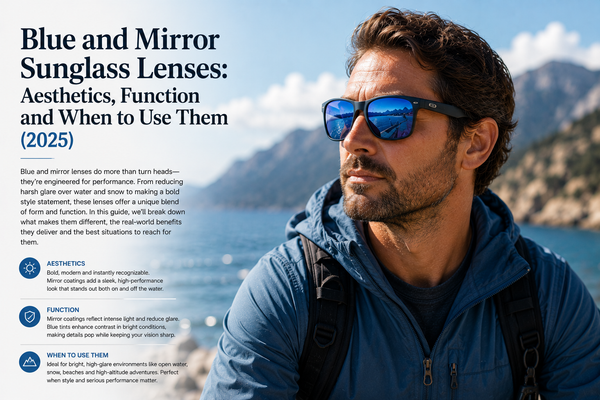

Blue and Mirror Sunglass Lenses: Aesthetics, Function and When to Use Them
Blue lenses and mirror coatings occupy the aesthetic end of the sunglass lens spectrum. They make sunglasses look bold and distinctive. They communicate a specific visual identity. They are chosen, more often than any other lens type, for how they appear rather than what they do to light.
That is not a criticism. Aesthetics are a legitimate reason to choose a lens color. The problem is when buyers expect blue lenses or mirror coatings to deliver functional optical benefits that they do not actually provide — or when they assume that a mirror coating replaces the UV and polarization specification that sits beneath it. This guide covers what blue lenses and mirror coatings actually do, the one functional benefit mirror coatings provide (additional brightness reduction), the cases where mirror serves a genuine purpose, and the things that must be verified inside any blue or mirror lens regardless of how it looks.
This is the final C18 Lens Color Deep Dives supporting post. It links back to the cluster pillar atthe complete sunglass lens color guide. For the performance tint comparisons, seegray sunglass lenses: why neutral is the smartest everyday choice andbrown and amber sunglass lenses: contrast, depth and outdoor performance.
Quick Answer
Blue lenses transmit blue wavelengths preferentially while absorbing red and green, producing a cooler visual scene with reduced contrast compared to gray or amber. They are primarily an aesthetic choice. Mirror coatings are reflective surface layers that reduce the amount of visible light entering the lens by reflecting some back — functionally adding darkness to the base tint, aesthetically creating the distinctive reflective lens appearance. Both can be UV400 polycarbonate and polarized if correctly specified. Neither provides contrast enhancement. The functional optical work is done by the base tint and the UV/polarization specification inside the mirror, not by the mirror or blue tint itself.

Table of Contents
Part 1: How Blue Lenses Filter Light
Blue lenses transmit blue wavelengths (400–500nm) preferentially while absorbing red (620–700nm) and green (500–570nm) wavelengths more heavily. This is the opposite of amber: where amber emphasizes the warm long wavelengths and suppresses the cool short ones, blue does the reverse.
The optical consequence of absorbing red and green wavelengths: the blue component of the visual scene is proportionally more represented in the transmitted light. The sky appears more intensely blue. Green vegetation appears darker and less saturated. Red objects appear darker. The overall visual scene has a cool, blue-dominated tone.
From a contrast perspective, blue lenses do not enhance outdoor contrast in the way amber and green do. Blue light is the scattered component of outdoor light — the haze that reduces contrast between objects and backgrounds. Blue lenses transmit this scattered component preferentially rather than filtering it. The net effect on outdoor contrast: neutral to slightly reduced compared to gray.
Part 2: The Visual Experience Through Blue
Through a blue lens, the outdoor world appears cool, slightly surreal, and vivid in a specific way — the blue and blue-green components of the scene are intensified, while warm colors are suppressed. Some wearers find this visually striking and appealing. The aesthetic quality of a blue lens is immediately distinctive.
In terms of visual comfort, blue lenses are not the most comfortable choice for extended outdoor wear. The blue-heavy color shift can increase the apparent intensity of certain environmental light sources and alter depth perception cues that rely on warm-cool color contrast. Some wearers experience mild visual fatigue from sustained blue lens wear in bright outdoor conditions.
In terms of practical outdoor function, blue does not outperform gray for any common outdoor task. It does not provide the contrast enhancement of amber. It does not provide the all-round versatility of gray. It does not provide the specific low-light performance of yellow. Blue is the aesthetic tint — chosen for how it looks from the outside and the distinctive visual quality it creates through the lens.
Part 3: The Functional Case for Blue — and Its Limits
The HEV Blue Light Concern
High-energy visible (HEV) light in the 400–500nm blue wavelength range has received increasing attention as a potential contributor to retinal oxidative stress. The clinical evidence for HEV damage from sunglass-level ambient light exposure is weaker than the evidence for UV damage, but the concern has generated a market for “blue light filtering” products.
Blue lenses, ironically, do not filter blue light — they transmit it preferentially. If HEV blue light filtering is the goal, amber and brown lenses are the correct choice: their aggressive blue absorption is what filters this wavelength range. A blue lens that transmits blue wavelengths is doing the opposite of filtering them.
The Glare Argument for Blue in Specific Conditions
Some winter sport and high-altitude applications use blue or blue-mirror lenses for their ability to reduce the specific glare of snow and ice in bright overhead sun at altitude. Snow reflects broadly across the visible spectrum, and the blue-filtered view through a blue lens can reduce the perceived harshness of snow glare in specific high-altitude conditions. This is a niche application and is typically served by other tints (gray Cat 3–4) more completely.
Part 4: When Blue Lenses Are the Right Choice
Blue lenses are the right choice when the primary motivation is aesthetic — the distinctive look of a blue-tinted lens and the visual style identity it communicates. This is a legitimate and common sunglass buying motivation. Not every purchasing decision is about optical performance. When the goal is a specific visual identity, blue delivers it.
The correct specification for aesthetic blue lenses: UV400 polycarbonate, polarized if used for outdoor activity, appropriate lens category for the conditions. A blue lens that is UV400 polycarbonate and polarized delivers complete UV protection and glare elimination with the aesthetic quality of blue tint. The aesthetic choice does not require sacrificing the protective specification.
Blue lenses are also commonly used in fashion eyewear for indoor and transitional use where UV protection is the primary goal and outdoor visual performance is secondary. A light blue Category 1 UV400 lens on a fashion frame provides UV protection in casual outdoor and indoor-outdoor transitional contexts with a distinctive aesthetic.
Part 5: What Mirror Coatings Actually Are
Mirror coatings are thin metallic oxide layers applied to the outer surface of sunglass lenses through vacuum deposition. The coating creates a partially reflective surface — reflecting a portion of incoming light away from the lens while allowing the rest to transmit through to the wearer’s eye. From outside, the lens appears reflective and opaque. From inside, the wearer sees through the lens normally (through the base tint beneath the coating).
The reflective appearance of mirror lenses is the mirror coating. The visual experience through the lens is determined by the base tint — typically gray, brown, amber, or less commonly blue or green. The mirror coating and the base tint are two separate components that can be combined in many combinations.
Mirror coatings are distinguished by their color — which is the color of the reflected light, not the transmitted light. A silver mirror lens reflects silver-white light. A gold mirror lens reflects golden light. A blue mirror lens reflects blue light. The color seen by someone looking at the wearer is the mirror color; the color seen by the wearer through the lens is the base tint color.
Part 6: What Mirror Coatings Do to Light
A mirror coating reduces the total amount of visible light that enters the lens by reflecting a portion back. The practical effect: a mirror coating adds effective darkness to the base tint. A Cat 2 gray base with a silver mirror coating may function at an effective Cat 3 darkness level. The mirror coating is, functionally, a darkness multiplier.
Mirror coatings do not change the wavelength filtering properties of the base tint. A silver mirror on a gray base transmits the same color of light as the gray base — just less of it. A gold mirror on an amber base transmits the same warm contrast-enhanced light as the amber base — just less of it. The tint character of the visual experience comes from the base; the darkness level is modified by the mirror.
The practical implication: when evaluating mirror lenses, the important optical question is not the mirror color but the base tint and the UV/polarization specification. The mirror is a surface modifier; the base is the functional optical component.
Part 7: Mirror Colors — Silver, Gold, Red, Blue and Flash
Silver Mirror
Silver mirror on a gray or dark gray base is the most functionally useful mirror combination. It adds brightness reduction to a color-accurate base, producing a versatile Cat 3 effective darkness without the color alteration of amber. Silver mirror on gray provides maximum brightness reduction with neutral color rendering — appropriate for high-UV beach, snow, and sustained bright outdoor conditions. The silver mirror also has the most visually neutral aesthetic, reading as classic and considered rather than fashion-forward.
Gold Mirror
Gold mirror on an amber or brown base is the second most functionally coherent mirror combination. It adds brightness reduction to an already contrast-enhancing base, producing maximum brightness and maximum contrast enhancement simultaneously. Gold mirror amber is the lens for extreme high-UV outdoor sport conditions — high-altitude golf, open-water sailing, equatorial beach — where both maximum darkness and maximum contrast are simultaneously needed. Aesthetically, gold mirror reads as warm and premium.
Blue Mirror
Blue mirror is primarily an aesthetic choice. The blue reflective surface creates a distinctive, striking appearance. The base tint beneath a blue mirror is typically gray or amber. If gray, the visual experience through the lens is color-accurate (the base tint determines the visual experience, not the mirror). Blue mirror on gray is therefore a functional gray lens with an aesthetic blue exterior — the correct UV and polarization specification inside can make it a complete everyday or sport lens with a fashion exterior.
Flash and Color Mirror Coatings
Flash mirror coatings in vivid colors — red, orange, green, purple — are primarily aesthetic statements. The flash color is the exterior reflective color; the visual experience inside is determined by the base tint. Flash mirrors with a gray or amber base and UV400 polycarbonate polarized specification are functionally complete lenses wearing an aesthetic surface. Flash mirrors without verified UV400 specification are fashion accessories with incomplete protection.
Part 8: When Mirror Adds Genuine Function
High-UV Environments Requiring Maximum Brightness Reduction
In the highest UV environments — tropical beach, snow and ice, high-altitude outdoor sport, glacier crossing — a mirror coating adds effective darkness beyond what the base tint alone provides. A Cat 2 amber base with a gold mirror may provide effective Cat 3–4 brightness reduction while maintaining the contrast enhancement of the amber base. This combination of maximum brightness reduction and maximum contrast is the specific functional case for mirror.
Privacy and Eye Contact Management
Mirror lenses prevent others from seeing the wearer’s eyes — a practical feature for some professional contexts, competitive sport where eye direction is tactically significant (poker, poker-adjacent card games, some racquet sports where opponent eye tracking is used), and personal preference for not having eye contact visible to others. This is a genuine functional benefit of mirror coatings distinct from their optical properties.
Glare Reduction from a Second Surface
Mirror coatings reduce the secondary back-reflection from the inner lens surface that can occur in bright conditions when light enters the frame sides or from above and reflects off the inner lens surface toward the eye. This secondary glare is more relevant in Cat 2 lenses where the lens is not fully dark. A mirror coating on the outer surface reduces the incoming light sufficiently to reduce this secondary internal reflection. This is a minor but real functional benefit in specific high-brightness conditions.
Part 9: When Mirror Is Purely Aesthetic
In the vast majority of everyday sunglass use, mirror coatings are aesthetic rather than functional additions. In standard Cat 2 conditions — typical everyday outdoor use, commuting, casual outdoor activities — the base tint and polarization specification provide all the functional optical benefit required. The mirror coating adds the visual identity of a reflective lens without adding meaningful additional visual performance.
This is not a reason to avoid mirror lenses. Aesthetic motivation is legitimate and common. The point is that a buyer who chooses mirror for functional reasons — expecting better contrast, better UV protection, or better glare management from the mirror specifically — is attributing functional benefits to the mirror that belong to the base tint and UV/polarization specification.
Part 10: The Specification Inside the Mirror
This is the most important single point about mirror lenses:the mirror coating is the surface; the specification is inside.
UV400 protection:comes from the lens material (polycarbonate) and UV-absorbing compounds in the base, not from the mirror coating. A non-UV400 lens with a mirror coating provides no UV protection. A UV400 polycarbonate lens with a mirror coating provides complete UV protection.
Polarization:the PVA polarizing filter is embedded within the lens material, beneath the mirror coating. A polarized lens with a mirror coating is both polarized (from the embedded filter) and mirror-coated (from the surface layer). A non-polarized lens with a mirror coating is still not polarized — the mirror does not add polarization.
The mirror coating is the last thing applied to the lens. Everything functional comes before it. When buying mirror lenses, verify: UV400 certification of the base lens material, polarization if outdoor glare management is needed, and lens category appropriate for the conditions.
The UV400 verification guide is inhow to verify UV400 certification on any pair of sunglasses.
✨ NAVI EYEWEAR — UV400 POLARIZED. THE SPECIFICATION BEHIND THE STYLE.Every Navi lens: UV400 polycarbonate. Quality-controlled polarization. Oleophobic and anti-saltwater coating. Gray, amber, or mirror — the specification is consistent. The style choice is yours. Buy 1, Get Any 3 Pairs Free — $119 for four pairs (~$30 each). Free shipping. Free replacements. |
Part 11: Blue and Mirror Together
Blue mirror is the most commonly encountered combination of the two topics in this guide. A blue mirror lens has a blue reflective coating on the outer surface and typically a gray or occasionally amber base tint. From the outside, it appears as a vivid reflective blue. From the inside, the wearer sees through the gray or amber base.
A blue mirror on a gray UV400 polarized base is a fully functional everyday and outdoor lens with a bold aesthetic exterior. The blue mirror adds a small amount of effective darkness to the Cat 2 gray base and creates the striking blue exterior appearance. All the functional optical properties — UV400, polarization, color accuracy from the gray base — are intact.
A blue mirror on an amber UV400 polarized base provides contrast enhancement from the amber base plus the brightness reduction of the mirror, with a blue aesthetic exterior. This is the combination for outdoor sport users who want the performance of amber with a bolder visual style.
In both cases, the functional specification comes from the base and UV/polarization components. The blue mirror is the aesthetic surface layer on top of a complete functional specification.
Part 12: Comparison Table — Blue and Mirror Options
|
Lens Type |
What It Does |
What It Doesn’t Do |
Verdict |
|
Blue tint on gray base |
Adds blue aesthetic; base provides color accuracy |
Enhance contrast; filter blue HEV |
Aesthetic choice; full function from base |
|
Blue tint on amber base |
Adds blue aesthetic; amber base provides contrast |
Same as above; color less accurate than gray base |
Unusual; aesthetic with contrast base |
|
Silver mirror on gray |
Adds darkness (effective Cat +1); neutral aesthetic |
Change base color accuracy |
Functional darkness increase; versatile |
|
Gold mirror on amber |
Adds darkness + amber contrast; premium aesthetic |
Replace UV or polarization specification |
Maximum brightness + contrast for extreme conditions |
|
Blue mirror on gray |
Blue aesthetic; gray base provides color accuracy; slight darkness |
Enhance contrast; filter HEV |
Bold aesthetic; functional gray underneath |
|
Flash mirror (any color) on gray |
Aesthetic surface; gray base provides function |
Any additional optical function |
Aesthetic; verify UV400 and polarization in base |
|
Blue tint — non-UV400 |
Blue aesthetic |
UV protection; contrast |
Avoid — no protection |
|
Mirror — non-UV400 base |
Mirror aesthetic |
UV protection; contrast |
Avoid — verify UV400 |
Part 13: Best For
Silver Mirror on Gray UV400 Polarized — Best For:
Gold Mirror on Amber UV400 Polarized — Best For:
Blue Mirror or Blue Tint on Any UV400 Polarized Base — Best For:
Part 14: Common Mistakes
Bottom Line
Blue lenses and mirror coatings are primarily aesthetic choices, and that is a legitimate reason to choose them. The distinctive cool quality of blue and the bold reflective statement of mirror are real visual design elements that many buyers value.
The functional positions are specific and limited. Mirror coatings add effective darkness — useful in high-brightness environments. Silver mirror on gray provides the most functionally coherent brightness-plus-accuracy combination. Gold mirror on amber provides maximum brightness plus maximum contrast for extreme outdoor conditions. Blue tint provides a distinctive aesthetic without contrast enhancement or HEV filtering.
The non-negotiable: UV400 polycarbonate and polarization must be verified in the base lens regardless of what mirror coating or blue tint sits on the surface. The mirror is the last thing applied. Everything that protects and performs is inside it.
Browse UV400 polarized options atnavieyewear.com/collections/polarized. Add 4 pairs — Buy 1, Get Any 3 Free auto-applies. Free shipping. Free replacements.
Frequently Asked Questions
What do blue sunglass lenses do?
Blue lenses transmit blue wavelengths preferentially while absorbing red and green wavelengths. The visual result is a cool, blue-dominated scene with a distinctive aesthetic quality. Blue does not enhance contrast — it transmits the blue scatter that reduces contrast rather than filtering it. Blue is primarily an aesthetic choice. If UV400 polycarbonate and polarized, a blue lens provides complete UV protection and glare elimination with the blue visual aesthetic.
What is a mirror coating on sunglasses?
A mirror coating is a thin metallic oxide layer on the outer lens surface that reflects a portion of incoming visible light away from the lens, adding effective darkness to the base tint. From outside, the lens appears reflective. From inside, the wearer sees through the base tint normally. The mirror color (silver, gold, blue, etc.) is the color of the reflected light; the visual experience through the lens is determined by the base tint beneath the mirror.
Do mirror sunglasses provide better UV protection?
No. UV protection comes from the lens material (polycarbonate) and UV-absorbing compounds in the base lens, not from the mirror coating. A mirror coating on a non-UV400 lens provides no UV protection. A UV400 polycarbonate lens with a mirror coating provides complete UV protection — from the base, not the mirror. Always verify UV400 certification of the base lens in any mirror sunglass purchase.
Do mirror sunglasses reduce glare better than regular lenses?
Marginally, through two mechanisms: the mirror reflects some incoming light before it enters the lens (reducing overall brightness), and it reduces secondary internal back-reflections. But the primary glare management tool is polarization — which eliminates horizontal surface reflection specifically. A polarized non-mirror lens outperforms a mirror non-polarized lens for glare in almost all outdoor conditions. The combination of polarized UV400 base with mirror coating is the most complete specification.
Are blue lenses good for driving?
Blue lenses on a gray base provide approximately color-accurate driving vision since the visual experience is determined by the gray base. However, blue lenses on their own (without a gray base) can slightly alter color perception and are not the recommended driving specification. Gray polarized UV400 is the correct driving lens. If blue is the aesthetic preference, blue mirror on a gray polarized UV400 base provides the blue exterior with a gray functional interior.
Do blue lenses filter blue light?
No — the opposite. Blue lenses transmit blue wavelengths preferentially while absorbing red and green. If the goal is filtering blue (HEV) wavelengths, amber and brown lenses are the correct choice. Their blue-wavelength absorption is the primary optical property that defines them. Blue lenses are the wrong tool for blue light filtering despite the association between “blue lenses” and “blue light” in some marketing.
What is the difference between silver and gold mirror sunglasses?
Silver mirror is typically applied on a gray base, providing color-accurate vision with additional darkness reduction. Gold mirror is typically applied on an amber or brown base, providing contrast-enhanced vision with additional darkness reduction. Silver mirror gray is the most versatile high-brightness option; gold mirror amber is the maximum-performance option for outdoor sport in extreme UV conditions. Both are aesthetically distinct — silver reads as cooler and more classic, gold as warmer and more premium.
Are mirror sunglasses better for beach use?
Silver mirror on gray UV400 polarized at effective Cat 3 is excellent for beach use — providing maximum brightness reduction for high UV and sand/water glare, color accuracy, and polarization to eliminate horizontal glare from the water and sand surface. The mirror adds the darkness increase appropriate for sustained beach sun exposure. The specification must include UV400 polycarbonate and polarization in the base to provide complete beach performance.
Supporting Articles
BOLD STYLE. COMPLETE SPECIFICATION. UV400 UNDERNEATH.UV400 polycarbonate. Polarized. Oleophobic and anti-saltwater coating. TR90. Stainless hinges. Mirror or color tint — the specification is what protects. The style is what you wear. Buy 1, Get Any 3 Pairs Free — $119 for four pairs. Free shipping. Free replacements. |
SOURCES & CITATIONS[1] Dain SJ.“Sunglasses and sunglass standards.”Clinical and Experimental Optometry, 2003.View source [2] Rosenthal FS, Bakalian AE, Lou CQ, Taylor HR.“The effect of sunglasses on ocular exposure to ultraviolet radiation.”American Journal of Public Health, 1988.View source [3] De Faber JT, Naeser K, Kessing SV.“Polarized light and contrast sensitivity under glare conditions.”Ophthalmic Research, 2013.View source [4] American Academy of Ophthalmology.“Sunglasses: choosing the right pair for UV protection.”AAO EyeSmart, 2023.View source |