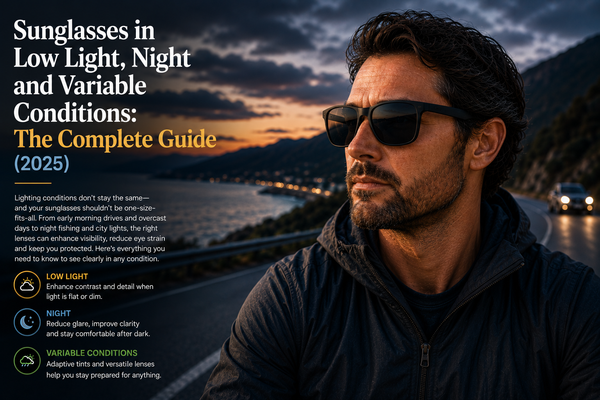

Sunglasses in Low Light, Night and Variable Conditions: The Complete Guide
The question most sunglass guides never answer honestly: when should you take your sunglasses off? Every brand sells sunglasses as something you wear. None of them tells you when wearing them is the wrong decision. This guide does.
Light conditions change across the day, across weather systems, and across seasons in ways that require a sunglass decision at each transition: bright midday sun to overcast cloud cover, full afternoon sun to late-afternoon golden hour, clear sky to tunnel entry, open road to shaded lane. Each transition has a correct response. Getting it wrong — too dark in low light, too light in bright sun, wrong tint for the visual task — reduces visual performance and, in driving contexts, reduces safety.
This guide covers every light condition across the day and through weather variation, what the correct sunglass decision is at each point, the specific driving scenarios that create the most dangerous light transitions, the definitive position on night driving glasses, and the lens specifications that handle variable conditions most effectively.
This is the C19 Night, Low Light & Variable pillar. The supporting posts cover specific topics in depth:are yellow glasses for night driving actually safe? the truth,do you need sunglasses on overcast days? the UV science,photochromic vs polarized: which is better for variable light?,sunglasses for dawn and dusk driving: the low-angle glare problem, andshould you wear sunglasses on a cloudy day? the UV science.
Quick Answer
Category 2 (18–43% VLT) gray polarized UV400 handles the widest range of conditions of any single lens. It manages bright sun, covers variable overcast-to-bright transitions, and handles the full driving day from morning commute to late afternoon. Category 3 for sustained high-UV conditions. Never wear any tinted lens at night. Overcast days still require UV400. Dawn and dusk driving create specific low-angle glare events that polarized gray addresses effectively. The variable light problem is primarily solved by choosing Category 2 as the default and keeping lenses clean and unscratched.

Table of Contents
Part 1: How Light Changes Across the Day
Solar UV intensity follows a predictable daily arc. It rises from zero at sunrise, peaks between 11am and 2pm (the exact peak varies by latitude, season, and local conditions), and declines to zero at sunset. The total UV available at any point in the day is determined by the sun’s angle above the horizon — the lower the sun, the more atmosphere the UV must pass through, the more it is attenuated.
Visible light intensity broadly follows the same arc, but the relationship between visible brightness and UV intensity is not linear and varies across the day and across weather conditions. This is the critical disconnect that most people misunderstand: bright light does not mean high UV, and overcast conditions do not mean low UV.
Early morning and late afternoon sun can be extremely visually bright in terms of luminance — particularly when the sun is at a low angle and glare is intense — while UV intensity is moderate because the low sun angle means more atmospheric UV filtration. Midday overcast conditions can feel visually dim while UV intensity is 50–80% of clear-sky midday because clouds scatter rather than block UV.
The implication for sunglass decisions: choosing lens darkness based on perceived brightness is a flawed approach. The correct approach matches lens category to UV intensity (for UV protection decisions) and to visual comfort needs (for glare and brightness management decisions) — which are related but not identical.
Part 2: The UV Index and Why It Does Not Track Brightness
The UV Index is a scale developed by the WHO to quantify the UV intensity at ground level. It runs from 0 (no UV) to 11+ (extreme UV). In practice, most temperate mid-latitude locations reach UV Index 3–5 in summer and 1–2 in winter on clear days. High-UV environments (tropical, high altitude, reflective snow or water) can reach UV Index 8–11+.
The UV Index does not track perceived brightness. On a uniform overcast day in summer, the UV Index may reach 4–5 while the sky appears uniformly pale and visually unthreatening. On a winter afternoon with brilliant low-angle sun and high visible brightness, the UV Index may be 2–3. The sun’s low angle in winter and late afternoon reduces UV more than it reduces visible luminance, because UV and visible light are attenuated at different rates by the atmosphere.
UV400 sunglasses worn on overcast days provide meaningful UV protection even when the sky does not look like it demands sunglasses. This is not about comfort — it is about the UV dose that is reaching the eye regardless of what the sky looks like. The habit of wearing UV400 sunglasses outdoors in all daylight conditions, not just when it is bright, is the correct UV protection behavior.
The full UV overcast guide is indo you need sunglasses on overcast days? the UV science.
Part 3: The Lens Category System for Variable Conditions
|
Category |
VLT Range |
Typical Conditions |
Variable Condition Suitability |
|
Cat 0 |
80–100% |
Indoor; night; negligible UV |
Not for outdoor UV protection; night use |
|
Cat 1 |
43–80% |
Overcast; low UV; early morning |
UK/northern winter; transitional; overcast only |
|
Cat 2 |
18–43% |
Variable; everyday outdoor |
The variable conditions standard — handles everything |
|
Cat 3 |
8–18% |
Bright sun; beach; sustained UV |
Bright summer sun; NOT for highly variable conditions |
|
Cat 4 |
3–8% |
Extreme UV: alpine, glacier |
Not for driving; specialist high-altitude only |
Category 2 is the answer to the variable conditions question. It handles the full range from overcast summer conditions to variable mixed sun and cloud to moderate bright sun. It does not require removal in most indoor-outdoor transitions. It provides adequate UV protection in all meaningful outdoor UV conditions. It is the lens that makes the variable conditions problem go away for most people most of the time.
Part 4: Bright Midday Sun — The Category 3 Case
Category 3 is appropriate for sustained bright conditions: midday summer sun in high-UV climates, beach and coastal use, sustained outdoor activity in full summer sun. In these conditions, Cat 3’s 8–18% VLT provides the darkness level that makes prolonged outdoor exposure comfortable and reduces visual fatigue from sustained high-luminance outdoor environments.
The limitation of Cat 3 for variable conditions: it is too dark for rapid transitions to lower light. Moving from full summer sun into a shaded area or a building, entering a tunnel, or experiencing the rapid cloud cover that characterises British and northern European weather creates a period of significant visual under-performance in Cat 3 lenses. The lens is too dark for the new light level; the eye’s adaptation has not caught up. This is not just uncomfortable — in driving contexts, it can briefly eliminate the visual information needed for safe driving.
The practical solution: Cat 3 as a dedicated high-UV lens for conditions where UV intensity justifies it, with Cat 2 as the all-conditions everyday lens. Two pairs from the Navi $119 four-pair purchase covers both.
Part 5: Variable Conditions — Why Category 2 Is the Default
The daily outdoor experience for most people in temperate climates is variable rather than uniformly bright. A commute that starts in morning grey and ends in midday sun. An outdoor lunch in mixed cloud and sunshine. A golf round that starts clear and clouds over on the back nine. An evening drive into a dropping sun. These are the conditions that most buyers actually face most of the time.
Category 2 manages these conditions by sitting in the middle of the darkness range: dark enough for moderate-to-bright sun conditions, light enough for overcast and variable conditions without the visual penalty of Cat 3. The 18–43% VLT range is wide enough to be useful across the full variable outdoor spectrum.
The argument for Cat 2 as the default lens is not that it is perfect for any specific condition — it is that it is the least-wrong choice across the widest range of conditions. For the person who wants one pair that handles everything without requiring a lens change or removal, Cat 2 gray polarized UV400 is the answer.
Part 6: Overcast and Cloudy Conditions
The most common reason people remove their sunglasses outdoors is because the sky looks overcast and wearing sunglasses in the grey seems unnecessary or performative. This is the correct instinct about visual comfort (overcast conditions do not require sunglasses for comfort in the way that bright sun does) but the wrong conclusion about UV protection.
Clouds scatter UV rather than blocking it. The extent of UV reduction depends on cloud type and density: light clouds reduce UV by 10–20%; moderate overcast reduces UV by 20–50%; heavy overcast reduces UV by 50–80%. On a typical overcast summer day, UV intensity at ground level may be 50–70% of the equivalent clear-sky UV. The WHO UV Index on an overcast UK summer day can reach 3–4, which is in the “moderate” UV risk category that the WHO recommends eye protection for.
Category 1 lenses (43–80% VLT) are designed for these conditions. A light Cat 1 amber or gray lens provides UV400 protection with minimal brightness reduction — appropriate for overcast conditions where comfort is not the issue but UV protection is still the goal. For users in consistently overcast climates (Pacific Northwest, UK, northern Europe), Cat 1 UV400 sunglasses are the correct everyday lens.
For users with Cat 2 lenses, overcast conditions are adequately handled. Cat 2’s 18–43% VLT range includes levels that are comfortable in overcast conditions — most Cat 2 lenses at the lighter end of the range (around 35–43% VLT) are barely noticeable in overcast conditions while still providing UV400 protection.
The complete overcast UV science is inshould you wear sunglasses on a cloudy day? the UV science.
Part 7: Dawn and Dusk — The Low-Angle Glare Problem
Dawn and dusk create the most specifically challenging light conditions for driving and outdoor activity. The sun at a low angle produces intense horizontal glare from road surfaces, water, car hoods, and building facades that is distinct from the overhead brightness of midday sun. The low-angle glare is horizontally polarized, directional, and affects the specific visual field (forward and lateral) that driving and outdoor movement depend on.
Polarized lenses are specifically effective for low-angle glare because the horizontal polarization of reflected low-angle sun matches the orientation that PVA polarizing filters are designed to block. A polarized Cat 2 gray lens at dawn or dusk eliminates the road surface glare that reduces lane marking visibility and hazard detection, while maintaining adequate brightness for the lower ambient light level of these transitional periods.
Non-polarized lenses at dawn and dusk reduce overall brightness without addressing the specific horizontal reflection that creates the most visual disruption. Cat 3 non-polarized at dusk is darker than comfortable but still does not address the glare specifically. Cat 2 polarized is the correct specification for dawn and dusk conditions.
The complete dawn and dusk driving guide is insunglasses for dawn and dusk driving: the low-angle glare problem.
Part 8: Tunnel Entry — The Rapid Adaptation Challenge
Tunnel entry is the most extreme rapid light transition most drivers experience regularly. Moving from bright outdoor sun to tunnel darkness in seconds requires the eye’s photoreceptors to adapt across many orders of magnitude of luminance change. The dark adaptation time required is typically 5–20 seconds for meaningful visual performance, and several minutes for full dark adaptation.
Wearing Cat 3 lenses into a tunnel effectively makes the adaptation problem worse. The eye has pre-adapted to the dark environment of the Cat 3 lens interior (the lens has been reducing brightness to Cat 3 levels for the surrounding outdoor scene) and then encounters the tunnel darkness without the light — the adaptation starting point is further from the dark endpoint. Cat 2 lenses adapt faster because the pre-adaptation state is less extreme.
The correct procedure for tunnel entry: if wearing Cat 3, remove sunglasses before tunnel entry. If wearing Cat 2, no removal is typically required for tunnels under 500m in length, though very long tunnels in Cat 2 may still benefit from removal. Cat 4 should never be worn for driving and absolutely not through tunnels.
For frequent tunnel users — alpine drivers, drivers on motorway networks with many short tunnels — Cat 2 as the primary driving lens is particularly important for managing the adaptation events.
Part 9: Night Driving — The Non-Negotiable Position
No tinted sunglass lens is appropriate for night driving. This is not a safety guideline with nuance or edge cases. It is the unambiguous position of every road safety authority, optometry body, and driving standard in every jurisdiction.
Night driving requires maximum available light to reach the retina. The eye operates in scotopic (rod-dominant) vision at night, which requires the maximum light input available. Any reduction in light transmission — even a Cat 0 very light tint — reduces the total light available to the night-adapted visual system and reduces visual performance at exactly the time when visual performance is most critical.
Yellow “night driving glasses” are the most prominent product in this category and the most thoroughly debunked. A 2019 JAMA Ophthalmology study by Hwang et al. found that yellow night driving glasses did not improve hazard detection in nighttime driving simulations compared to control conditions. Rod photoreceptors are maximally sensitive to the blue-green wavelengths (around 498nm) that yellow lenses absorb — reducing exactly the wavelengths that night vision depends on.
The correct specification for night driving: no sunglasses. If glare from oncoming headlights is the specific concern, anti-reflective coatings on prescription eyewear address the optical source of glare without reducing light transmission. Clear photochromic lenses that have fully cleared (to Cat 0) indoors before the drive are acceptable.
The complete night driving glasses myth-busting guide is inare yellow glasses for night driving actually safe? the truth.
Part 10: Seasonal Variation
Summer
Peak UV. Peak glare. Cat 2 for everyday and driving. Cat 3 for beach, coastal, sustained outdoor. Highest polarization benefit from road surface and water reflection. Most consistent case for all-day sunglass use.
Autumn
Declining UV but significant low-angle glare as the sun moves lower in the sky. Cat 2 handles the variable autumn conditions well. The harvest moon low sun angle creates intense forward glare for commuters in the northern hemisphere. Polarized Cat 2 is specifically valuable for this seasonal glare pattern.
Winter
Lower UV in temperate climates but significant low-angle glare on clear days. Snow-covered environments produce intense reflected UV that can make UV exposure in winter higher than expected. Cat 1–2 for temperate winter. Cat 3–4 for snow environments. The low winter sun angle means polarized lenses are frequently effective for winter driving even at lower absolute UV levels.
Spring
Rising UV from the March equinox onward. Often the season where UV exposure catches people unaware because the temperatures are mild and the sun does not feel intensely hot. UV intensity in March–May can be comparable to August in many temperate climates. Cat 2 as the spring default. Polarized for the clear spring days with low humidity and intense glare.
Part 11: Weather Events — Rain, Haze and Fog
Rain
Driving in rain creates intense horizontal road surface reflection from the water film on the road. This is the weather condition where polarized lenses provide the most dramatic improvement in road surface legibility. The wet road shimmer from rain is predominantly horizontally polarized. A polarized Cat 2 lens eliminates this reflection completely; a non-polarized lens merely dims it. For rain driving specifically, polarized is the safety-critical lens property.
Haze and Smog
Atmospheric haze and smog scatter light in ways that reduce contrast and visibility. Amber and brown lenses improve contrast in hazy conditions by filtering some of the scattered blue component of hazy light. Gray Cat 2 polarized handles most haze situations adequately; amber is the upgrade for sustained hazy outdoor activity.
Fog
Fog scatters light intensely and reduces contrast dramatically. Yellow lenses (Cat 0–1) provide their maximum contrast benefit in fog conditions, which is why yellow fog lights are standard on vehicles. For pedestrian activity in fog, a Cat 0–1 yellow lens is the most contrast-enhancing option. For driving in fog, reducing total light transmission below Cat 0–1 is counterproductive.
Part 12: Indoor-Outdoor Transitions
Every sunglass wearer who enters and exits buildings throughout the day faces the indoor-outdoor transition challenge. Cat 3 lenses require 3–5+ seconds of adaptation on each transition from indoor to outdoor — not long enough to be hazardous in most pedestrian contexts but significant for the regular building-to-street transition that urban daily life involves.
Cat 2 lenses manage most indoor-outdoor transitions comfortably. The moderate darkness of Cat 2 means the indoor environment (typically lit to a fraction of outdoor luminance) is still visible without full adaptation. For users who move between indoor and outdoor environments frequently throughout the day, Cat 2 provides the best all-day wearability.
Photochromic lenses address this transition automatically but with a lag: they darken quickly in UV (5–60 seconds to full dark) but clear slowly from dark (2–5 minutes). The clearing lag means photochromic lenses are not always ideal for frequent indoor-outdoor cycling. A fixed Cat 2 lens often provides better continuous wear performance than a photochromic lens in rapid-transition urban environments.
Part 13: Photochromic vs Fixed Tint for Variable Conditions
The photochromic vs fixed tint question for variable conditions is covered in depth inphotochromic vs polarized: which is better for variable light?. The summary positions:
|
Property |
Photochromic |
Fixed Cat 2 |
|
Variable light response |
Automatic |
Manual (choose the category) |
|
Car driving |
Does not darken (windshield blocks UV activation) |
Full Cat 2 function in all conditions |
|
Indoor-outdoor transitions |
Clearing lag (2–5 min) |
No adaptation delay at Cat 2 |
|
Polarization |
Available in some; check specification |
Fully polarized options available |
|
UV protection |
UV400 when specified |
UV400 when specified |
|
Cost |
Higher per lens |
Lower per lens |
|
Replacement |
Replace whole lens when worn |
Replace whole pair at $30/pair (Navi model) |
|
Best for |
Varied outdoor/indoor cycling without driving |
All-day use including driving; most consistent performance |
Part 14: The Polarization Advantage in Variable Light
Polarization’s benefit in variable light conditions is often underappreciated. Most discussions of polarization focus on its glare elimination benefit in bright sunny conditions. But polarization is specifically effective in variable conditions because the horizontal surface reflections it eliminates are present across all light levels, not only in bright sun.
A wet road on an overcast day still produces horizontally polarized surface reflection that reduces road marking contrast. A lake under cloudy skies still produces horizontally polarized water surface reflection. Low-angle winter sun still produces intense horizontally polarized road glare. Polarized lenses address these reflections in all of these conditions. The benefit is not conditional on bright sun — it is conditional on the presence of horizontal reflective surfaces, which are present in all weather.
For variable condition use, polarized Cat 2 is consistently better than non-polarized Cat 2 for driving because the road surface glare that polarization addresses is a variable-condition problem, not only a bright-sun problem. The rainy overcast morning commute benefits from polarization specifically, even though it does not feel like “sunglasses weather.”
Part 15: Tint Choice for Variable Conditions
Gray polarized UV400 at Category 2 is the tint-and-specification recommendation for variable conditions, primarily because:
Amber polarized UV400 at Category 2 is the alternative for outdoor-activity-primary users who accept the color accuracy compromise in exchange for contrast enhancement. Amber handles variable outdoor conditions excellently and is preferable to gray for trail running, golf, and outdoor sport in variable weather.
✨ NAVI EYEWEAR — CATEGORY 2 GRAY POLARIZED UV400. VARIABLE CONDITIONS SOLVED.UV400 polycarbonate. Gray polarized — color-accurate across all light levels. Category 2 for all-day versatility. Oleophobic coating. Anti-saltwater coating. TR90. Stainless hinges. Buy 1, Get Any 3 Pairs Free — $119 for four pairs (~$30 each). Free shipping. Free replacements. |
Part 16: The Driving Decision Guide
|
Driving Condition |
Recommended Lens |
Notes |
|
Clear bright sun — midday |
Gray polarized Cat 2–3 |
Cat 3 for sustained high-UV; Cat 2 if variable |
|
Overcast — diffuse light |
Gray polarized Cat 2 |
UV400 still needed; Cat 2 handles overcast |
|
Variable cloud and sun |
Gray polarized Cat 2 |
The default all-conditions choice |
|
Dawn/dusk — low-angle sun |
Gray polarized Cat 2 |
Polarization addresses horizontal glare specifically |
|
Post-rain wet roads |
Gray polarized Cat 2 |
Polarization eliminates wet road shimmer |
|
Tunnel approach |
Gray polarized Cat 2 or remove Cat 3 |
Cat 2 adapts adequately; remove Cat 3 |
|
Winter clear day |
Gray polarized Cat 1–2 |
Low UV but significant low-angle glare |
|
Night |
No sunglasses |
Never wear tinted lenses at night |
|
Fog |
No sunglasses or Cat 0–1 clear/yellow |
Reduced visibility requires maximum light |
|
Snow-covered roads |
Gray polarized Cat 3 |
Snow UV reflection is extreme; Cat 3 appropriate |
Part 17: Comparison Table — Lens Categories for Light Conditions
|
Light Condition |
Cat 1 |
Cat 2 |
Cat 3 |
Cat 4 |
No Glasses |
|
Bright midday sun |
Too light |
Good |
Best |
Too dark |
No UV protection |
|
Variable cloud/sun |
Good |
Best |
Too dark for transitions |
Never |
No UV protection |
|
Overcast summer |
Good |
Good |
Too dark |
Never |
Acceptable but UV present |
|
Low-angle dawn/dusk |
Acceptable |
Best (with polarized) |
Too dark |
Never |
No glare management |
|
Post-rain road |
Acceptable |
Best (with polarized) |
OK in bright |
Never |
No glare management |
|
Winter clear day |
Good |
Good |
Too dark usually |
Never |
Acceptable at low UV |
|
Night |
Never |
Never |
Never |
Never |
Correct |
|
Tunnel |
Never |
Best |
Remove before entry |
Never |
Correct for long tunnels |
|
Snow/ice outdoor |
Too light |
Marginal |
Good |
Best (non-driving) |
No UV protection |
Part 18: Best For
Gray Polarized UV400 Category 2 — Best For:
Amber Polarized UV400 Category 2 — Best For:
Part 19: Common Mistakes
Bottom Line
Variable light conditions are the normal condition. The constant bright sun that many sunglass guides implicitly assume is the exception rather than the rule for most daily lives. The correct response to variable conditions is Category 2 gray polarized UV400 — the lens that handles the widest range of light levels without requiring removal, provides complete UV protection even when the sky does not look threatening, eliminates horizontal surface glare in all weather including rain, and maintains color accuracy for traffic and outdoor navigation.
The specific exceptions are well-defined: Cat 3 for sustained high-UV bright conditions, Cat 1 for overcast-only climates, and no lens at all for night driving. Yellow at Cat 0–1 for flat-light specialist applications. Everything else: Cat 2 gray polarized UV400, worn consistently.
Browse UV400 polarized options atnavieyewear.com/collections/polarized. Add 4 pairs — Buy 1, Get Any 3 Free auto-applies. Free shipping. Free replacements.
Frequently Asked Questions
What lens category is best for variable light conditions?
Category 2 (18–43% VLT) gray polarized UV400. It handles the full range from overcast to moderate bright sun, adapts more comfortably to rapid light transitions than Cat 3, and provides UV protection in all outdoor daylight conditions. It is the correct default for any outdoor use involving variable light.
Should you wear sunglasses on overcast days?
Yes. Clouds scatter UV rather than blocking it. Moderate overcast still transmits 50–70% of clear-sky UV. UV400 sunglasses provide meaningful UV eye protection on overcast days even when they are not needed for comfort. A UV400 Cat 2 lens in overcast conditions provides protection without visual impairment. The full overcast UV science is indo you need sunglasses on overcast days? the UV science.
Are sunglasses safe for dawn and dusk driving?
Gray polarized Cat 2 is recommended for dawn and dusk driving. The low-angle sun at these times creates intense horizontal glare from road surfaces — which polarized lenses specifically eliminate. Cat 2 provides the right darkness level for transitional light conditions. Cat 3 is too dark for dawn and dusk and should be removed. The full guide is insunglasses for dawn and dusk driving: the low-angle glare problem.
Can you wear sunglasses for night driving?
No. No tinted sunglass lens is appropriate for night driving. Night vision requires maximum light transmission; any tint reduces the total light available to the dark-adapted visual system. Yellow night driving glasses are not effective — research shows they do not improve and may reduce nighttime driving performance. The complete guide is inare yellow glasses for night driving actually safe? the truth.
What happens if you wear Cat 3 sunglasses into a tunnel?
Cat 3’s 8–18% VLT in tunnel darkness creates significant visual under-performance during the adaptation period. The eye has pre-adapted to the Cat 3 darkness level (making the pre-adaptation state already dimmer than normal) and then encounters tunnel darkness. The visual impairment during adaptation is greater than without sunglasses. Remove Cat 3 before tunnel entry, or use Cat 2 as the primary driving lens.
Do polarized lenses help in overcast conditions?
Yes. Horizontal surface reflections from roads, water, and reflective surfaces are present in all weather conditions, not only in bright sun. A wet road on an overcast day still produces the horizontally polarized surface reflection that reduces road marking contrast. Polarized Cat 2 lenses eliminate this reflection in all weather including overcast and rain.
What is the difference between Category 2 and Category 3 sunglasses?
Category 2 transmits 18–43% of visible light (medium darkness). Category 3 transmits 8–18% (dark). Cat 2 handles variable conditions, overcast, and most everyday outdoor use without the adaptation penalties of Cat 3. Cat 3 is appropriate for sustained high-UV conditions but too dark for variable conditions, tunnel entry, and indoor-outdoor transitions. For most everyday use, Cat 2 is the correct choice.
Are photochromic lenses better than fixed tints for variable conditions?
For most use cases including driving, fixed Cat 2 gray polarized outperforms photochromic. Photochromic lenses do not darken inside vehicles (windshield glass blocks the UV that triggers the reaction) and have a clearing lag of 2–5 minutes that creates visual over-darkness during frequent indoor-outdoor transitions. Fixed Cat 2 is consistent in all conditions including driving. The full comparison is inphotochromic vs polarized: which is better for variable light?.
Supporting Articles
CATEGORY 2 GRAY POLARIZED UV400. VARIABLE CONDITIONS SOLVED.UV400 polycarbonate. Gray polarized — color-accurate in every light level. Category 2 for all-day versatility. From overcast commute to midday sun. From post-rain shimmer to golden-hour glare. Buy 1, Get Any 3 Pairs Free — $119 for four pairs. Free shipping. Free replacements. |
SOURCES & CITATIONS[1] Dain SJ.“Sunglasses and sunglass standards.”Clinical and Experimental Optometry, 2003.View source [2] Hwang Y, Kim J, Kim BJ, et al..“Effects of night-driving glasses on simulated nighttime driving performance.”JAMA Ophthalmology, 2019.View source [3] World Health Organization.“Global solar UV index: a practical guide.”WHO/SDE/OEH/02.2, 2002.View source [4] Rosenthal FS, Bakalian AE, Lou CQ, Taylor HR.“The effect of sunglasses on ocular exposure to ultraviolet radiation.”American Journal of Public Health, 1988.View source [5] De Faber JT, Naeser K, Kessing SV.“Polarized light and contrast sensitivity under glare conditions.”Ophthalmic Research, 2013.View source [6] Sliney DH.“UV radiation ocular exposure dosimetry.”Documenta Ophthalmologica, 1994.View source [7] American Academy of Ophthalmology.“Sunglasses: choosing the right pair for UV protection.”AAO EyeSmart, 2023.View source |