
Are Yellow Glasses for Night Driving Actually Safe? The Truth
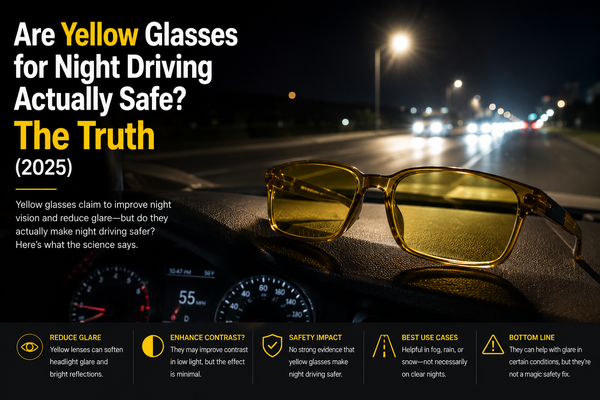
If you search for “night driving glasses”, you will find hundreds of products on Amazon, at gas stations, and in pharmacy displays. Most are yellow-tinted. Most make some version of the same claim: they reduce glare, sharpen contrast, improve visibility in the dark, and make night driving safer. Many carry pseudo-professional branding — references to HD vision, anti-glare technology, night enhancement optics.
The research says something different. Multiple independent studies over the past two decades have tested whether yellow night driving glasses improve nighttime driving performance. The consistent finding: they do not improve hazard detection, and there is evidence they may reduce it. The 2019 JAMA Ophthalmology study by Hwang et al. — the most widely cited recent research on this question — found that yellow-tinted night driving glasses did not improve performance on a nighttime driving simulation task compared to no glasses at all.
This guide covers exactly what yellow lenses do to light, why the physiology of night vision makes yellow lenses counterproductive, what the research actually measured and found, why the subjective feeling of improvement does not match objective performance, and what actually does help with nighttime glare from headlights.
This is a C19 Night, Low Light & Variable supporting post. It links back to the cluster pillar atsunglasses in low light, night and variable conditions: the complete guide.
Quick Answer
Yellow night driving glasses do not improve nighttime driving performance. Research including a 2019 JAMA Ophthalmology randomized trial found no meaningful improvement in hazard detection compared to no glasses. The physiology explains why: night vision depends on rod photoreceptors maximally sensitive to blue-green wavelengths (498nm) — precisely the wavelengths yellow lenses absorb. Any tinted lens reduces total light transmission in conditions where the visual system is already light-limited. The correct answer to nighttime driving glare from oncoming headlights is anti-reflective coating on prescription eyewear, not tinted glasses.

Table of Contents
Part 1: The Product and the Claim
Yellow night driving glasses are typically sold as Category 0 or Category 1 lenses (80–100% or 43–80% visible light transmission) with a yellow tint. The yellow color comes from a blue-wavelength-absorbing pigment in the lens material. The typical marketing claims:
These claims are built on a plausible-sounding mechanism: yellow lenses filter blue light, blue light causes scatter and glare, therefore yellow lenses reduce scatter and improve contrast. The mechanism is real — yellow lenses do filter blue light and do improve contrast in specific low-light, flat-light, daytime conditions like overcast skies and clay target shooting. The error is applying daytime contrast physics to nighttime vision, which operates through a completely different physiological mechanism.
Part 2: How Night Vision Works — Rod Physiology
Human vision operates through two distinct photoreceptor systems: cones (for color, detail, and daylight vision) and rods (for low-light and night vision). At light levels below approximately 0.001 candelas per square meter — a threshold that roughly corresponds to starlight or deep twilight — the visual system transitions from cone-dominant (photopic) to rod-dominant (scotopic) vision.
Night driving operates in a mixed range: too dark for pure photopic vision, too bright for pure scotopic vision. The technical term is mesopic vision — the transition range where both rods and cones contribute. In mesopic conditions, the relative sensitivity of the visual system shifts toward shorter (bluer) wavelengths compared to bright daylight. Rods are maximally sensitive to light at approximately 498nm — a blue-green wavelength. This is why the night sky appears blue-shifted; it is not purely psychological.
The practical implication: in mesopic driving conditions, blue and blue-green wavelengths are proportionally more important to visual performance than in bright daylight. The visual system is operating with its greatest sensitivity in the blue-green range. Filtering these wavelengths — which is what yellow lenses do — removes light from the exact wavelength range where the mesopic visual system is most sensitive.
Part 3: Why Yellow Is the Wrong Wavelength Filter for Night
Yellow lenses absorb blue wavelengths in the 400–500nm range. The absorption is not perfectly limited to this range, but the dominant filter effect is blue absorption. The rod photoreceptor’s peak sensitivity at 498nm sits directly within the primary absorption band of a yellow lens.
The contrast-enhancing effect of yellow in daytime overcast conditions works because the visual system in daylight is cone-dominant, and the blue scatter that yellow filters is the primary quality problem in flat-light daytime conditions. In daylight, reducing blue scatter improves contrast by reducing the diffuse luminance that washes out object-background differences.
At night, the visual quality problem is not blue scatter from a bright sky — it is total light deficiency. The visual system is light-starved. Every photon matters. The rod photoreceptors are operating near their sensitivity threshold, extracting visual information from the minimum available light. Removing light from the wavelength range where rods are most sensitive is categorically counterproductive in this context.
The yellow lens daytime contrast mechanism (filter blue scatter to improve relative contrast) does not transfer to the nighttime context. The nighttime context requires maximum light transmission, not selective wavelength filtering. Yellow lenses provide selective wavelength filtering that reduces total light transmission — the wrong intervention for the wrong problem.
Part 4: The Research — What Studies Have Actually Found
The scientific literature on yellow night driving glasses is consistent in its findings over multiple decades of research. The key studies:
Wood and Colleagues — 2002
A series of studies by Joanne Wood and colleagues at the Queensland University of Technology examined the effect of tinted lenses on nighttime driving performance. Their findings, published across multiple papers in the early 2000s, consistently found that yellow-tinted lenses did not improve nighttime driving performance on standardized visual tasks, including hazard detection and pedestrian recognition. Some conditions showed marginal performance decrements with yellow lenses.
Schieber and Goodspeed — 1997
An earlier study by Schieber and Goodspeed examined the effect of tinted visors on nighttime driving performance in a controlled setting. Yellow-tinted visors did not improve hazard response times compared to clear visors. The study concluded that yellow-tinted products for nighttime driving were not supported by the evidence.
Hwang et al. — 2019 (JAMA Ophthalmology)
The most widely cited recent study. Hwang et al. (2019) in JAMA Ophthalmology conducted a randomized, crossover trial in which participants performed a standardized nighttime driving simulation task under three conditions: no glasses, clear lenses, and yellow night driving glasses. The primary outcome was pedestrian detection time. Finding: yellow night driving glasses did not improve pedestrian detection performance compared to no glasses or clear lenses. The study concluded that there was no clinically meaningful benefit of yellow night driving glasses for nighttime driving. The study was conducted at Perelman School of Medicine, University of Pennsylvania and published in a peer-reviewed ophthalmology journal.

Part 5: The 2019 JAMA Ophthalmology Study in Detail
Study Design
The Hwang et al. study used a randomized crossover design: each participant drove under each of the three lens conditions (no glasses, clear lenses, yellow-tinted night driving glasses) in a standardized order, with the order randomized across participants. This design controls for individual differences and practice effects.
The Primary Outcome
The primary outcome was response time to pedestrian detection — the time from when a pedestrian became visible in the simulated night driving environment to when the participant activated a response. Pedestrian detection is a proxy for the real-world safety-critical task of detecting vulnerable road users in low-light driving conditions.
The Finding
Yellow night driving glasses did not improve pedestrian detection response time compared to no glasses. There was no statistically significant improvement in hazard detection performance. The effect size was not clinically meaningful. The authors concluded that there was no evidence that yellow night driving glasses improve nighttime driving performance.
The Implication
The study does not only show that yellow glasses are ineffective. It shows that the claim is not supported by evidence in the most direct test available: a randomized controlled trial of the primary safety-relevant visual task in night driving. Products sold for night driving that make claims about improved visibility and safety are making claims that are not supported by this evidence.
Part 6: Why Yellow Glasses Feel Like They Help
The most common objection to the research finding is the subjective experience: many people who wear yellow night driving glasses report that they feel like they help. Glare seems reduced. The road seems clearer. Oncoming headlights seem less blinding. These subjective reports are real experiences, not fabricated. The disconnect between subjective experience and objective performance is worth explaining.
The Warmth Effect
Yellow lenses create a warm, golden visual experience that is often perceived as “cleaner” or “sharper” than the unfiltered visual scene. This is a color rendering effect, not a clarity effect. The warm color cast of yellow changes the perceived tone of the visual scene in a way that some wearers experience as visually comfortable or as improved contrast. The subjective impression of sharpness does not correspond to measurable improvement in hazard detection.
Placebo and Expectation
Products marketed as improving night vision create an expectation of improvement. Expectation effects in perceptual tasks are well-documented in psychology research. A person who puts on “night driving glasses” and expects to see better is likely to report that they see better, independent of any objective change in visual performance. The Hwang et al. study’s randomized design partially controls for this by comparing against both no glasses and clear lenses.
Comfort vs Performance
The warm color rendering of yellow lenses may genuinely make the driving experience feel more comfortable for some users — reducing the perceived harshness of oncoming headlight glare in a perceptual sense. Reduced perceptual discomfort is a real experience. It is not the same as improved hazard detection performance. A driver can feel more comfortable while detecting hazards less reliably if the comfort improvement comes at the cost of reduced light transmission.
Part 7: The Subjective vs Objective Performance Gap
The gap between how yellow glasses feel and what they do to objective performance is the central issue in this topic. It is not unique to yellow driving glasses — the same gap exists across many consumer products in the vision and performance space. But the night driving context makes the gap specifically consequential: the safety-critical outcome is detecting hazards, not feeling comfortable.
The research paradigm used by Hwang et al. and the Wood studies measures the objective outcome: how quickly and reliably do participants detect hazards? This is the correct measurement for a safety claim. Subjective reports of perceived comfort, perceived sharpness, or perceived glare reduction are not the correct measurement for a safety claim because they do not predict the safety-critical outcome.
For buyers considering night driving glasses: the question is not “do they make night driving feel better?” but “do they help you see and react to hazards faster?” The research answers the second question with a consistent “no.”
Part 8: What Causes Nighttime Driving Glare
Understanding the actual optical mechanism of nighttime headlight glare helps clarify why yellow lenses cannot address it. Oncoming headlights produce glare in two ways:
Direct Disability Glare
High-intensity light sources (headlights, street lights) within the driver’s visual field produce direct disability glare when their luminance significantly exceeds the background luminance. The bright headlight source temporarily overwhelms the photoreceptors in the area of the retina that is viewing it, reducing sensitivity in that retinal zone for a brief recovery period.
Yellow lenses do not address direct disability glare because reducing total light transmission by 20–60% (Cat 0–1) does not change the relative luminance difference between the glare source and the dark background. The headlight remains the brightest object in the scene by a large margin. The absolute luminance is reduced, but the contrast between headlight and background — which is what produces disability glare — is not significantly changed.
Veiling Luminance (Halo and Scatter Glare)
Light from bright sources scatters within the eye (intraocular scatter) and creates a diffuse veil of luminance across the retinal image, reducing the contrast of objects in the peripheral field. This scatter is increased by corneal and lens imperfections, and increases significantly with age as the natural crystalline lens develops more scatter.
Yellow lenses do not address intraocular scatter because the scatter occurs after the light has entered the eye through the cornea and lens. A lens filter on the outside of the eye cannot reduce intraocular scatter. Anti-reflective coating on prescription eyewear reduces the secondary reflections between lens surfaces that add to veiling luminance from external sources — this is why anti-reflective coating is the clinically recommended intervention for headlight glare.
Part 9: What Actually Helps with Night Driving Glare
Anti-Reflective (AR) Coating on Prescription Eyewear
Anti-reflective coating eliminates the secondary reflections between the front and rear surfaces of prescription eyeglass lenses that create ghost images and add to veiling luminance from bright sources. For drivers who wear prescription eyeglasses, AR coating is the single most evidence-supported intervention for headlight glare. It does not filter wavelengths; it eliminates unwanted reflections. The result is a cleaner, lower-glare visual image from bright sources.
Adequate Rest and Health Maintenance
Night driving performance degrades significantly with fatigue. The mesopic visual system is particularly sensitive to fatigue effects because the rod and cone systems are operating near their sensitivity limits. Adequate sleep before night driving is a more significant safety intervention than any optical product.
Clean Windshield
A dirty or scratched windshield scatters headlight and street light glare across the entire forward visual field. A clean, unscratched windshield dramatically reduces veiling luminance from external light sources. For many drivers, cleaning the windshield inside and out provides more improvement in nighttime visual quality than any lens product.
Regular Eye Examinations
Age-related increases in lens scatter and early cataract formation significantly worsen nighttime driving vision. Regular eye examinations that monitor lens clarity and optical health are the preventive intervention for the progressive deterioration of nighttime driving vision that occurs with aging.
Proper Headlight Alignment and Maintenance
Misaligned or dirty headlights create more oncoming glare than correctly aimed, clean headlights. Vehicle maintenance that keeps headlights clean and properly aimed reduces the glare that other drivers experience from your vehicle.
Part 10: When Yellow Lenses Are Genuinely Useful
Yellow lenses are not useless — they are simply not useful for night driving. Their genuine performance window is daytime low-contrast conditions:
The common element in all genuine yellow lens applications: the visual problem is blue scatter in adequate-to-bright light, not total light deficiency. Night driving has neither of these properties.
Part 11: The Broader Rule — No Tinted Lens at Night
The yellow night driving glasses finding is not an exception to a general rule that tinted lenses are safe at night. It is an illustration of the general rule: no tinted lens is appropriate for night driving, for any tint and any category.
Category 0 (clear) is the only appropriate lens for night driving. Cat 0 transmits 80–100% of visible light. Any tint below Cat 0 reduces total light transmission in conditions where the visual system is operating near its sensitivity limits. The reduced light reaching the retina reduces photoreceptor activation, which reduces the visual system’s ability to detect hazards.
This applies to yellow, gray, amber, brown, rose, green, blue, and mirror coatings. The mechanism is the same for all: reduced total light transmission in light-limited conditions. Yellow is the most commonly marketed night driving lens because its daytime contrast-enhancement mechanism sounds applicable at night. It is not. The mechanism does not transfer.
The complete variable light conditions guide is insunglasses in low light, night and variable conditions: the complete guide.
✨ NAVI EYEWEAR — UV400 POLARIZED. FOR DAYLIGHT. NOT NIGHT.Every Navi lens: UV400 polycarbonate. Quality-controlled polarization. Category 2 for daylight driving. Gray polarized for daytime and dawn/dusk. No tinted lens for night driving — ever. Buy 1, Get Any 3 Pairs Free — $119 for four pairs (~$30 each). Free shipping. Free replacements. |
Part 12: Comparison Table — Night Driving Interventions
|
Intervention |
Evidence Base |
Effect on Hazard Detection |
Recommended? |
|
Yellow night driving glasses |
Multiple RCTs; negative |
No improvement vs no glasses (Hwang 2019) |
No — not supported by evidence |
|
Clear (Cat 0) glasses/goggles |
No filtering; standard |
No reduction in visual performance |
Neutral — appropriate if needed for eye protection |
|
AR coating on prescription glasses |
Strong clinical evidence |
Reduces headlight glare reflections |
Yes — the evidence-supported intervention |
|
Clean windshield |
Common sense; effective |
Reduces scatter from all external light sources |
Yes — highly effective, often neglected |
|
Adequate sleep before night driving |
Strong fatigue research |
Significantly reduces reaction time degradation |
Yes — most important overall intervention |
|
Regular eye exams |
Preventive medicine |
Identifies and manages factors that worsen night vision |
Yes — preventive standard |
|
Any other tinted lens at night |
No evidence of benefit |
Reduces total light in light-limited conditions |
No — contraindicated |
Part 13: Common Mistakes
Bottom Line
Yellow night driving glasses do not work for their primary marketed purpose. The research is not ambiguous. A randomized controlled trial published in JAMA Ophthalmology found no improvement in pedestrian detection performance with yellow night driving glasses. The physiology explains why: night vision depends on rod photoreceptors maximally sensitive to the blue-green wavelengths that yellow lenses absorb. Filtering these wavelengths in light-limited conditions is the wrong intervention.
The subjective experience of improved comfort with yellow glasses is real but not the same as improved safety performance. Comfort and hazard detection are different outcomes. Products sold for night driving safety should be evaluated on hazard detection evidence, not comfort reports.
The correct answers to nighttime driving vision: no tinted lens, clean windshield, AR coating on prescription eyewear, adequate rest, regular eye examinations. None of these are sold at a gas station display.
For daytime driving and variable light conditions, the correct specification is gray polarized UV400 at Category 2 —browse at navieyewear.com/collections/polarized.
Frequently Asked Questions
Do yellow night driving glasses actually work?
No. A 2019 randomized controlled trial published in JAMA Ophthalmology (Hwang et al.) found that yellow night driving glasses did not improve pedestrian detection performance in a nighttime driving simulation compared to no glasses. Earlier studies by Wood and colleagues reached the same conclusion. The physiology explains the finding: rod photoreceptors that dominate night vision are maximally sensitive to blue-green wavelengths — exactly what yellow lenses absorb.
Are yellow glasses legal for night driving?
In most jurisdictions, yellow Category 0–1 glasses are not specifically prohibited for night driving because their light transmission is high enough that no legal threshold is crossed. However, being legally permissible is not the same as being safe or effective. Road safety authorities and ophthalmology bodies do not recommend any tinted lens for night driving. Legal permissibility and safety evidence are separate questions.
What do yellow night driving glasses actually do?
They reduce total light transmission by a modest amount (Cat 0–1, typically 80–95% VLT), create a warm yellow color cast that is perceived by some users as making the scene look cleaner, and filter blue wavelengths that contribute to scatter in daylight conditions. In nighttime conditions, where the primary visual challenge is light deficiency rather than blue scatter, these effects do not translate to performance improvement.
What is the best way to reduce glare when driving at night?
The evidence-supported interventions in order of effectiveness: AR (anti-reflective) coating on prescription eyeglasses if you wear prescription lenses; clean windshield (inside and out); adequate sleep before driving; regular eye examinations to monitor for age-related lens changes. No tinted lens product is evidence-supported for nighttime glare reduction.
Why do yellow glasses feel like they help even if they don’t?
Two mechanisms: the warm color cast of yellow creates a perceptual impression of sharpness or cleanness that is not the same as improved hazard detection performance. And expectation effects — products marketed as improving night vision create an expectation of improvement that influences subjective perception. Feeling more comfortable and detecting hazards faster are different outcomes. The research measures the latter; marketing appeals to the former.
Are any tinted glasses safe for night driving?
No. Any tinted lens reduces total light transmission in conditions where the visual system is already light-limited. This applies to yellow, gray, amber, brown, rose, green, blue, and mirror coatings. No tinted lens is recommended or evidence-supported for night driving. The correct night driving lens is no lens, or clear Cat 0 if eye protection is needed (e.g., motorcycle riders).
What causes headlight glare when driving at night?
Two mechanisms: direct disability glare from the high luminance of headlight sources relative to the dark background, and intraocular scatter (within the eye) that creates a diffuse veil of luminance across the retinal image. The first is addressed by reducing the relative luminance of headlights (not achievable with lens filters). The second is addressed by AR coating on prescription eyewear (which reduces external reflections adding to the scatter) and by regular eye examination to monitor lens clarity.
Can polarized sunglasses be worn at night?
No. Polarized lenses are tinted (typically Category 2–3) and would further reduce light transmission in already light-limited conditions. Polarization is a daytime tool for eliminating horizontal surface reflection in outdoor environments. It does not address nighttime glare from headlights and should not be worn at night.
Supporting Articles
DAYTIME UV400. NOT NIGHT.Gray polarized UV400 Category 2 — the correct daytime driving lens. Not for night. UV400 polycarbonate. Polarized. Oleophobic coating. TR90. Stainless hinges. Buy 1, Get Any 3 Pairs Free — $119 for four pairs. Free shipping. Free replacements. |
SOURCES & CITATIONS[1] Hwang Y, Kim J, Kim BJ, et al..“Effects of night-driving glasses on simulated nighttime driving performance.”JAMA Ophthalmology, 2019.View source [2] Wood JM, Tyrrell RA, Carberry TP.“Limitations in drivers’ ability to recognize pedestrians at night.”Human Factors, 2005.View source [3] Schieber F, Goodspeed C.“The effects of tinted spectacle lens filters on visual performance under nighttime driving conditions.”Optometry and Vision Science, 1997.View source [4] Leibowitz HW, Owens DA.“Night myopia and the intermediate dark focus of accommodation.”Journal of the Optical Society of America, 1975.View source [5] Dain SJ.“Sunglasses and sunglass standards.”Clinical and Experimental Optometry, 2003.View source [6] American Academy of Ophthalmology.“Sunglasses: choosing the right pair for UV protection.”AAO EyeSmart, 2023.View source |