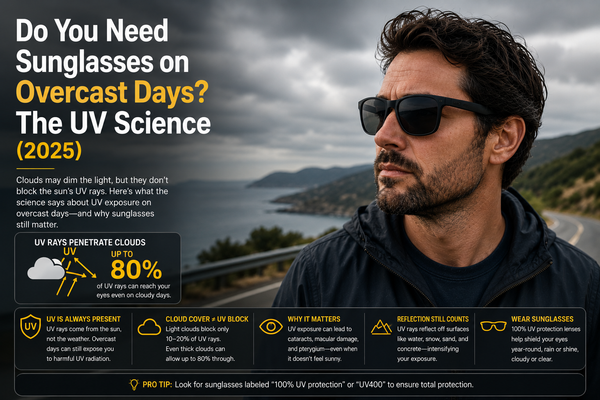

Do You Need Sunglasses on Overcast Days? The UV Science
The most common reason people leave their sunglasses at home is an overcast sky. If it does not look sunny, it does not feel like a sunglasses day. This is a reasonable intuition about visual comfort — overcast skies genuinely do not produce the squinting, glare-intensive visual experience that drives sunglass use in bright sun. But the UV protection reasoning is completely different from the comfort reasoning, and confusing them leads to a consistent pattern of unprotected ocular UV exposure on the many days that most people in temperate climates spend outdoors.
This guide covers the UV science of overcast conditions: how much UV actually penetrates cloud cover, how cloud type affects UV transmission, why the UV Index on many overcast summer days still warrants eye protection, and the lens specification that provides UV protection on overcast days without the visual impairment of wearing dark lenses in low light.
This is a C19 Night, Low Light & Variable supporting post. It links back to the cluster pillar atsunglasses in low light, night and variable conditions: the complete guide. For the more detailed cloudy-day UV science, see alsoshould you wear sunglasses on a cloudy day? the UV science.
Quick Answer
Yes. Clouds scatter UV rather than blocking it. Moderate overcast still transmits 50–70% of clear-sky UV. On a typical overcast UK or northern European summer day, the UV Index can reach 3–5 — the “moderate” to “high” range where WHO guidance recommends eye and skin protection. UV400 Category 1 or Category 2 lenses provide complete UV protection on overcast days without the visual penalty of darker lenses. The habit of daily UV400 sunglass use regardless of sky appearance is the correct UV protection behavior.

Table of Contents
Part 1: The Clouds-Scatter-UV Mechanism
Clouds are composed of water droplets and ice crystals that scatter incoming solar radiation in all directions. The scattering effect is wavelength-dependent: UV and visible light scatter differently through cloud media. Visible light (which determines perceived brightness) is scattered more completely by thick clouds than UV, which means that overcast skies often appear darker than the UV intensity warrants.
The key distinction: clouds reduce visible light by scattering it in all directions, which makes the sky appear dimmer and diffuse. UV, particularly longer-wavelength UVA (320–400nm), is scattered but not as completely absorbed by cloud droplets as visible light. A thick overcast cloud deck that reduces visible sky brightness to 20–30% of clear-sky levels may only reduce UVA to 40–60% of clear-sky levels. The perceived dimness of an overcast sky is not a reliable proxy for the UV dose being delivered to the eye.
This physical reality — that UV and visible light behave differently in cloudy conditions — is the scientific foundation of the overcast sunglass recommendation. The sky can appear dark and non-threatening while the UV dose reaching the eye is at levels that would warrant eye protection on clear-sky common sense grounds.
Part 2: How Much UV Penetrates Different Cloud Types
|
Cloud Condition |
UV Reduction vs Clear Sky |
Typical UV Index (summer, mid-lat) |
Recommendation |
|
Clear sky |
0% reduction (baseline) |
UV Index 4–8 |
UV400 essential |
|
Thin cloud / cirrus |
5–10% reduction |
UV Index 3.5–7 |
UV400 strongly recommended |
|
Partial cloud (scattered) |
10–25% reduction |
UV Index 3–6 |
UV400 strongly recommended |
|
Moderate overcast (altostratus) |
20–50% reduction |
UV Index 2–5 |
UV400 recommended |
|
Heavy overcast (stratus) |
50–80% reduction |
UV Index 1–3 |
UV400 advisable in summer |
|
Thick storm clouds (nimbostratus) |
80–95% reduction |
UV Index 0.5–1.5 |
UV400 discretionary |
The most commonly experienced overcast condition in temperate climates is moderate overcast with thin-to-moderate cloud cover — the middle rows of this table. At this cloud density, UV is reduced by 20–50% compared to a clear sky, leaving 50–80% of clear-sky UV reaching the eye. On a clear summer day in the UK or northern US with a UV Index of 5, a moderate overcast day may still deliver UV Index 3–4 to the eye. The WHO classifies UV Index 3 as the threshold for recommending eye and skin protection.
Part 3: The UV Index on Overcast Days
The WHO UV Index is a globally standardised measure of UV intensity at ground level. The scale runs from 0 to 11+, with categories: low (0–2), moderate (3–5), high (6–7), very high (8–10), and extreme (11+). WHO guidance recommends wearing sunglasses from UV Index 3 (moderate) onward.
On a typical summer day in London (July), the clear-sky midday UV Index reaches approximately 5–6. Under moderate overcast with 40% UV reduction, the surface UV Index is approximately 3–4. Under heavy overcast with 70% UV reduction, the surface UV Index is approximately 1.5–2. The heavy overcast day is below the WHO threshold for sunglass recommendation; the moderate overcast day is not.
In higher UV regions — southern US, Mediterranean, Australia — the base UV Index is higher. A clear July day in Los Angeles may reach UV Index 9–10. Under moderate overcast with 40% UV reduction, the surface UV Index is still 5–6 — in the “high” category. In these climates, overcast conditions almost never reduce UV below the moderate threshold. UV400 eye protection on all outdoor days is the appropriate default.
UV Index data by location is available from NOAA UV Index forecasts and the WHO UV resources athttps://www.who.int/news-room/q-a-detail/radiation-the-ultraviolet-(uv)-index.
Part 4: Cumulative UV — Why Overcast Days Add Up
Ocular UV damage is cumulative. The eye does not recover from UV exposure in the way skin tans and then fades. UV-induced changes to the crystalline lens (contributing to cataract formation) and to the retinal pigment epithelium (contributing to AMD risk) accumulate throughout life without meaningful reversal. Each unprotected outdoor exposure event adds to a running total.
For people who live in temperate climates with frequent overcast, the overcast days represent a substantial proportion of their total annual outdoor UV exposure. A person in London who wears sunglasses only on sunny days protects their eyes on perhaps 40–60 days per year (the approximately sunny days in a London summer). They are unprotected for all the overcast summer days that still deliver meaningful UV.
If moderate overcast days deliver 50–70% of clear-sky UV, and a person in London spends outdoor time on 150 days per year with only 50 of those being clearly sunny, the overcast days represent a disproportionate share of their total annual UV exposure. Protecting only on sunny days misses the majority of UV days.
The complete cumulative UV disease science is inUV and eye disease: the complete guide.
Part 5: The Comfort vs Protection Distinction
This is the core of the overcast sunglass question. Two separate questions are often conflated:
The instinct to remove sunglasses when the sky looks overcast is correct for comfort reasons and incorrect for UV protection reasons. Both questions are valid, but they have different answers. The solution is a lens specification that provides UV protection without the visual penalty of wearing dark lenses in low light — Category 1 or the lighter end of Category 2.
Part 6: Who Is Most Exposed on Overcast Days
Outdoor Workers in Overcast Climates
Construction workers, agricultural workers, and all outdoor workers in temperate climates spend the majority of their working days in overcast or variable conditions. These workers may accumulate more total annual UV exposure from overcast days than from sunny days, simply because overcast days are more frequent. The occupational UV protection case for overcast day sunglass use is compelling for workers whose jobs keep them outdoors in any weather.
Recreational Outdoor Users in Northern Latitudes
Hikers, cyclists, runners, and outdoor sport participants in the UK, northern Europe, the Pacific Northwest, and other frequently overcast regions spend substantial outdoor time in non-sunny conditions that still deliver meaningful UV. Many of these users do not wear sunglasses in overcast conditions, having associated sunglasses with bright sun.
Children
Children’s crystalline lenses transmit more UV than adult lenses, making their retinas more vulnerable to UV exposure at any light level. Children who play outside on overcast summer days — and overcast days are the majority in many temperate climates — are accumulating UV exposure that contributes to their lifetime total at a time when the lens is most permeable to UV. The complete children’s UV guide is inthe complete guide to sunglasses for kids and teenagers.
Part 7: The Lens Specification for Overcast Conditions
UV400 — Non-Negotiable Regardless of Category
UV400 certification means the lens material blocks 100% of UV to 400nm. This protection is a property of the polycarbonate lens material and UV-absorbing compounds, completely independent of the lens’ darkness category. A Category 1 UV400 lens provides the same UV protection as a Category 3 UV400 lens. The category only affects how much visible light is transmitted.
This means UV protection on overcast days does not require dark lenses. A light Category 1 UV400 lens with 43–80% visible light transmission provides complete UV protection without reducing visual brightness in conditions where reduced brightness would be uncomfortable.
Category 1 for Overcast Primary Use
Category 1 (43–80% VLT) is designed for overcast and low-UV conditions. It provides complete UV400 protection with minimal brightness reduction — the lens is barely perceptible in visual terms on an overcast day. For users in consistently overcast climates (UK, Pacific Northwest, northern Europe), Category 1 UV400 sunglasses are the appropriate everyday outdoor lens.
Category 2 for Variable Conditions
Category 2 (18–43% VLT) handles overcast days adequately and also covers variable-to-bright conditions. For users who face both overcast and bright outdoor conditions across their outdoor week, Category 2 is the practical all-conditions choice. The lighter end of a Cat 2 lens (around 35–40% VLT) is comfortable in overcast conditions while still providing UV400 protection.
Part 8: Category 1 vs Category 2 for Overcast
|
Lens Category |
VLT Range |
Overcast Performance |
Bright Sun Performance |
Best For |
|
Category 1 |
43–80% |
Excellent — minimal visual impact |
Too light for bright sun |
Consistently overcast climates; daily overcast use |
|
Category 2 |
18–43% |
Good — comfortable in overcast at lighter end |
Good for moderate sun |
Variable climates; both overcast and sunny days |
|
Category 3 |
8–18% |
Too dark — over-darkens overcast scene |
Best for bright sustained sun |
High-UV conditions only; not for overcast |
For buyers in the UK or similar overcast climates: Category 1 UV400 for an overcast-primary lens, or Category 2 UV400 as the versatile all-conditions choice. Category 3 is too dark for overcast conditions. Category 0 (clear) provides no UV protection.
✨ NAVI EYEWEAR — UV400 EVERY DAY. OVERCAST INCLUDED.UV400 polycarbonate. Polarized. Category 2 for variable conditions — overcast to moderate sun. Oleophobic coating. Anti-saltwater coating. TR90. Stainless hinges. Buy 1, Get Any 3 Pairs Free — $119 for four pairs (~$30 each). Free shipping. Free replacements. |
Part 9: The Overcast Driving Context
Overcast driving presents a specific lens category question. The driver needs UV protection (overcast still delivers meaningful UV), adequate brightness for visual performance, and color accuracy for traffic signals. Category 2 gray polarized UV400 is the correct specification for overcast driving for the same reasons it is the correct specification for variable driving conditions generally.
The polarization benefit persists in overcast driving. Wet road surfaces on overcast days produce horizontally polarized surface reflections that reduce road marking contrast and visibility of puddles and water features. Polarized Cat 2 eliminates these reflections on overcast days just as effectively as on sunny ones. The perceived reduction in driving glare from polarized lenses on a grey drizzly morning is immediate and meaningful — the road becomes more readable, puddles and surface water are visible rather than obscured by reflection, and lane markings stand out against the wet surface.
Part 10: Seasonal Overcast — The Spring and Autumn Risk
Spring and autumn are the seasons most affected by the comfort-vs-protection confusion. The temperatures are mild — it does not feel hot and sunny — and the skies are frequently variable or overcast. But UV intensity in spring and autumn is higher than most people intuitively expect.
At mid-latitudes, the March and September equinoxes mark points at which the sun’s angle produces UV intensities comparable to autumn in summer-equivalent latitude terms. A clear day in late April in the UK can produce UV Index 4–5. A partly cloudy day in May can still deliver UV Index 3. The autumn UV problem is symmetric: September and October in the UK maintain meaningful UV intensity well into what feels like the post-summer period.
The people most likely to go unprotected are those who have put their sunglasses away for winter in October and have not yet established the spring sunglass habit in March and April. The spring-to-autumn window during which UV400 eye protection is warranted in temperate climates is longer than the period that “feels like sunglasses weather.”
Part 11: Comparison Table — UV Protection Need by Sky Condition
|
Sky Condition |
UV Protection Needed? |
Comfort Benefit of Sunglasses? |
Correct Lens |
|
Bright clear sun |
Yes — high priority |
Yes — glare and brightness |
Cat 2–3 UV400 polarized |
|
Partial cloud / variable |
Yes — significant UV |
Sometimes — when sun appears |
Cat 2 UV400 polarized |
|
Moderate overcast |
Yes — 50–70% of clear-sky UV |
No — no visible glare |
Cat 1–2 UV400 |
|
Heavy overcast |
Marginal — 20–50% UV remaining |
No |
Cat 1 UV400 or no glasses |
|
Thick storm clouds |
Low |
No |
Discretionary |
|
Dawn / dusk |
Yes — meaningful UV + low-angle glare |
Yes — horizontal glare |
Cat 2 UV400 polarized |
|
Night |
No UV |
No |
No glasses |
Part 12: Best For
Category 1 UV400 — Best For:
Category 2 UV400 Polarized — Best For:
Part 13: Common Mistakes
Bottom Line
Yes, you need UV protection on overcast days — at least on moderate overcast summer days when 50–70% of clear-sky UV is still present and the UV Index may be in the moderate range where WHO guidance recommends protection. The comfort question and the UV protection question have different answers: no, you do not need dark lenses for glare comfort on an overcast day; yes, you benefit from UV400 protection.
The solution is a lens category that decouples the two: Category 1 UV400 for consistently overcast climates, Category 2 UV400 for variable climates. Both provide complete UV protection. Neither over-darkens an overcast scene. The habit of daily UV400 sunglass use regardless of perceived sky brightness is the correct eye health behavior, and it becomes more motivated — not less — for people who live in frequently overcast climates where the temptation to leave sunglasses at home is strongest.
Browse UV400 polarized options atnavieyewear.com/collections/polarized. Add 4 pairs — Buy 1, Get Any 3 Free auto-applies. Free shipping. Free replacements.
Frequently Asked Questions
Do you need sunglasses on an overcast day?
For UV protection, yes on moderate and partial overcast days. Clouds scatter rather than block UV. Moderate overcast transmits 50–70% of clear-sky UV, which on a summer day in temperate climates can reach UV Index 3–4 — the range where WHO recommends eye protection. For visual comfort, not necessarily — overcast skies do not produce the glare that makes sunglasses feel necessary. A Category 1 or 2 UV400 lens provides protection without the visual impairment of dark lenses in low light.
How much UV is there on a cloudy day?
Depends on cloud type and density. Light cirrus cloud reduces UV by 5–10%. Moderate overcast (altostratus) reduces UV by 20–50%, leaving 50–80% of clear-sky UV at ground level. Heavy overcast (stratus) reduces UV by 50–80%. Thick storm clouds may reduce UV by 80–95%. The most commonly experienced moderate overcast in temperate climates transmits roughly half the UV of a clear sky — enough to warrant protection on summer days.
Can UV damage eyes on a cloudy day?
Yes. UV damage to the eyes is cumulative and does not require the visual discomfort of bright sun to occur. UV that penetrates moderate cloud cover causes the same photochemical changes to the crystalline lens and retina as the equivalent UV on a clear day. The accumulated UV dose from many overcast summer days is a meaningful contributor to lifetime ocular UV exposure.
What lens category is best for overcast conditions?
Category 1 (43–80% VLT) for consistently overcast climates — provides complete UV400 protection with minimal visual impact in low-light conditions. Category 2 (18–43% VLT) for variable climates where both overcast and sunny conditions occur — handles the full range adequately. Category 3 is too dark for overcast conditions and will typically be removed, leaving the eyes unprotected.
Should people in the UK wear sunglasses year-round?
For UV protection: from late March through September, yes — the UV Index on moderate overcast summer days warrants protection. Outside this window, the UV is low enough that protection is discretionary on most days. The spring and autumn transition periods are the highest-risk times for unprotected UV exposure because the temperatures are mild but the UV intensity is meaningful, and the habit of wearing sunglasses has not yet been established for the season.
Do clouds increase UV on sunny days?
Yes, in a specific scenario: broken cloud with direct sun exposure can increase ground-level UV above clear-sky levels because clouds can reflect additional UV toward the ground from their sides while the sun shines through a gap. This is the “cloud enhancement” effect that can produce brief UV Index spikes 10–25% above clear-sky values. It is one of the reasons why partial cloud days can be more UV-intensive than uniformly clear days.
What is the UV Index on a typical UK overcast summer day?
On a moderate overcast summer day in the UK (central England, July), the midday UV Index is typically 2–4, compared to a clear-sky midday UV Index of 5–6. At UV Index 3, WHO guidance recommends wearing sunglasses and sun-protective clothing. Overcast UK summer days routinely reach the UV Index threshold for recommended eye protection.
Is polarization useful on overcast days?
For driving and wet surfaces, yes. Wet road surfaces on overcast days produce horizontally polarized surface reflections that reduce road marking contrast. Polarized lenses eliminate these reflections regardless of sky conditions. For general outdoor use on overcast days, polarization is less critical than on sunny days because glare from direct sun is absent — but the wet surface and road glare benefits remain.
Supporting Articles
UV400 EVERY DAY. THE SKY’S COLOR DOESN’T CHANGE THAT.UV400 polycarbonate. Polarized. Category 2 for variable conditions — grey skies included. The habit of daily UV400 use is more important than the habit of sunny-day-only use. Buy 1, Get Any 3 Pairs Free — $119 for four pairs. Free shipping. Free replacements. |
SOURCES & CITATIONS[1] World Health Organization.“Global solar UV index: a practical guide.”WHO/SDE/OEH/02.2, 2002.View source [2] Sliney DH.“UV radiation ocular exposure dosimetry.”Documenta Ophthalmologica, 1994.View source [3] Taylor HR, West SK, Rosenthal FS, et al..“Effect of ultraviolet radiation on cataract formation.”New England Journal of Medicine, 1988.View source [4] Rosenthal FS, Bakalian AE, Lou CQ, Taylor HR.“The effect of sunglasses on ocular exposure to ultraviolet radiation.”American Journal of Public Health, 1988.View source [5] Diffey BL.“Sources and measurement of ultraviolet radiation.”Methods, 2002.View source [6] American Academy of Ophthalmology.“Sunglasses: choosing the right pair for UV protection.”AAO EyeSmart, 2023.View source |