
Photochromic vs Polarized Sunglasses: Which Is Better for Variable Light?
Photochromic lenses — the kind that darken in sunlight and clear indoors — sound like the perfect solution to the variable light problem. One pair, always the right darkness, no manual decision-making. The technology is genuinely useful. It is also genuinely limited in ways that most buyers do not know before purchasing.
Polarized lenses sound like a specific feature for sunny beach days. They are actually the more consistently useful technology for most daily outdoor use, including many conditions where photochromic lenses underperform. Understanding what each technology does — and where each fails — is the basis for making the right choice between them, or for deciding whether a combination of both is the correct answer.
This is a C19 Night, Low Light & Variable supporting post. It links back to the cluster pillar atsunglasses in low light, night and variable conditions: the complete guide. For the complete polarization science, seepolarized vs non-polarized sunglasses: the definitive guide.
Quick Answer
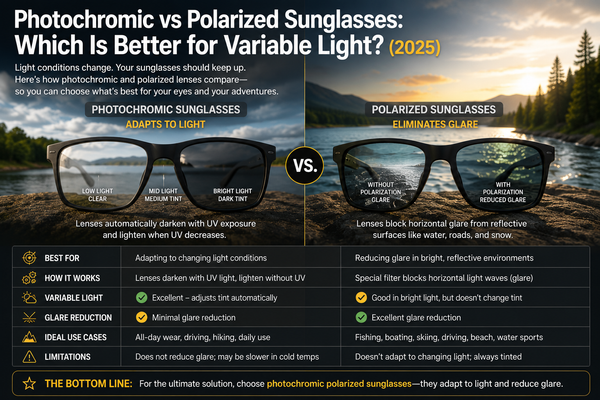
Polarized fixed-tint lenses (UV400, Category 2) outperform photochromic for most daily use including driving, because photochromic lenses do not darken in cars (windshields block the UV trigger), have a clearing lag that creates visual over-darkness in rapid transitions, and vary in effectiveness with temperature. Polarized fixed Cat 2 is consistent in all conditions, eliminates surface glare that photochromic cannot, and is more cost-effective to replace. Photochromic has genuine advantages for pedestrians and outdoor workers who move between sun and shade frequently and do not need driving performance. The best answer for most people: fixed polarized UV400 Cat 2 as the primary lens, with an optional photochromic pair for specific transition-heavy non-driving use.

Table of Contents
Part 1: How Photochromic Lenses Work
Photochromic lenses contain photoreactive molecules (originally silver halide compounds, now more commonly organic photochromic dyes) embedded in the lens material. These molecules undergo a reversible chemical reaction when exposed to ultraviolet radiation — UV causes them to change shape and absorb more visible light, darkening the lens. When UV is removed (indoors, under shade, or at night), the molecules revert to their original state and the lens clears.
The rate of darkening is fast: most modern photochromic lenses reach 80–90% of their full dark state within 30–60 seconds of UV exposure. The rate of clearing is slower: returning from fully dark to a comfortable indoor tint typically takes 2–5 minutes under normal indoor temperatures. Some formulations in warm conditions clear faster; in cold conditions clearing slows significantly.
The depth of darkening is also temperature-dependent. Photochromic molecules react more intensely in cold conditions — cold lenses darken faster and to a darker endpoint. In hot conditions (above 25–30°C), the reaction is less complete — the lenses do not darken as deeply. This means photochromic lenses perform somewhat counterintuitively: they are at their darkest in cold conditions (skiing, winter outdoor) and at their lightest in hot conditions (summer beach), when maximum darkness is most needed.
Part 2: How Polarized Lenses Work
Polarized lenses contain a PVA (polyvinyl alcohol) film with aligned polymer molecules oriented in a vertical direction. Light that is horizontally oscillating — the polarization state of reflected horizontal surface glare from roads, water, and flat surfaces — is blocked by this filter. Light that is vertically oscillating or randomly polarized passes through normally.
The key property: polarization is a fixed function. The lens performs identically in bright sun and in overcast. In a car, on foot, at altitude, or at sea level. In summer and in winter. In the morning and the afternoon. Polarization does not change with ambient conditions. If there is horizontally polarized surface glare to eliminate, the polarized lens eliminates it, regardless of what else is happening with the light.
A fixed-tint polarized lens (say, gray polarized UV400 Category 2) provides consistent darkness, consistent color accuracy, consistent UV protection, and consistent glare elimination in all conditions. It does not adapt automatically to changing light levels. The Category 2 darkness is constant whether the light is bright or overcast.
Part 3: The Car Driving Problem with Photochromic
This is the most important limitation of photochromic lenses for most buyers: they do not darken inside vehicles.
Photochromic lenses are triggered by UV radiation. Modern laminated windshield glass is specifically designed to block UV — it blocks essentially all UVB and most UVA. The photochromic reaction requires UV to initiate. Without UV reaching the lens, the photochromic molecules remain in their clear state.
The practical consequence: a driver who puts on photochromic sunglasses expecting them to manage the bright sun of a summer motorway drive will find that the lenses remain near-clear (or only slightly tinted from residual UV and temperature effects) throughout the drive. The lenses that darkened to Cat 3 while the driver walked from the house to the car will progressively clear as soon as the driver is inside the vehicle.
For drivers who commute by car and want their sunglasses to manage in-car sun exposure, photochromic lenses are a significant disappointment. A fixed-tint polarized Cat 2 lens performs consistently inside and outside the vehicle. This is the single most important functional advantage of fixed polarized over photochromic for driving-primary users.
Part 4: The Clearing Lag Problem
Photochromic lenses darken quickly (30–60 seconds) but clear slowly (2–5 minutes). In most single-transition scenarios — stepping outside, driving into sun — the darkening lag is acceptable. The clearing lag is more consequential.
For users who move between outdoor and indoor environments frequently throughout the day — entering and exiting buildings multiple times, moving between sunlit and shaded outdoor areas, entering underpasses or car parks — the clearing lag means the lens is consistently darker than the new environment warrants for 2–5 minutes after each transition. In a shaded building entrance, a still-darkening photochromic lens that has not fully cleared provides a darker visual experience than necessary.
The clearing lag is most consequential in rapid-transition urban environments: an office worker who goes outside at lunch and returns to a building, a delivery worker who enters and exits commercial premises continuously, a teacher who moves between indoor and outdoor during a school day. For these use patterns, a fixed Cat 2 lens that is optimized for the variable outdoor range without the clearing lag issue provides better continuous performance.
Part 5: Temperature Effects on Photochromic Performance
Photochromic performance varies significantly with temperature, and in ways that work against user expectations:
|
Temperature |
Darkening Speed |
Maximum Dark State |
Clearing Speed |
Impact on Use |
|
Very cold (<0°C) |
Fast |
Very dark (Cat 3–4) |
Slow (5–10 min) |
Can over-darken; slow to clear after exercise |
|
Cold (0–10°C) |
Fast |
Dark (Cat 3) |
Moderate |
Good ski performance; clearing slow indoors |
|
Cool (10–20°C) |
Good |
Cat 2–3 |
Normal (3–5 min) |
Near-ideal performance range |
|
Warm (20–30°C) |
Slower |
Cat 2 |
Normal |
Acceptable everyday performance |
|
Hot (>30°C) |
Slow |
Cat 1–2 only |
Fast |
Under-darkens in hottest conditions when needed most |
The temperature inversion means photochromic lenses are darkest when it is cold (skiing, winter walking) and lightest when it is hot (summer beach, tropical holiday) — the reverse of what intuitively makes sense for UV management in bright hot conditions.
Part 6: Polarization — The Consistent Variable Light Advantage
The polarization advantage in variable light conditions is often underappreciated because polarization is associated with bright sunny beach use. In fact, polarization’s glare elimination benefit persists across all weather:
Photochromic lenses do not address polarized surface glare. A photochromic lens that has darkened appropriately still transmits the horizontal surface reflection that creates road shimmer and water glare. For any use case where surface glare is the primary visual problem — driving, cycling, water activities, outdoor sport — polarization is the functional requirement that photochromic does not fill.
Part 7: Where Photochromic Wins
Frequent Shade-to-Sun Pedestrian Transitions
Urban walking, hiking in dappled forest light, outdoor work that moves continuously between sun and shade. The automatic darkening of photochromic lenses removes the decision-making of putting glasses on and off at each transition. For users who move between sun and shade many times per hour, the automatic adaptation is a genuine convenience.
Outdoor Workers with Prescription Lenses
Outdoor workers who require vision correction and want the convenience of one pair of prescription glasses that functions as both distance correction and sun protection across variable conditions benefit from photochromic prescription lenses. The alternative — separate prescription sunglasses for outdoor work — requires carrying and switching between two pairs.
Winter Outdoor Sport (Non-Driving)
Cold conditions produce photochromic lenses at their best performance: fast, dark, and extreme. Skiing, snowboarding, and winter outdoor sport in cold conditions is where photochromic lenses perform most impressively. The caveat is the slow clearing in cold conditions — entering a mountain restaurant with fully darkened cold-state photochromic lenses requires patience.
General Everyday Non-Driving Outdoor Use
For pedestrians, cyclists (urban, without car transitions), and outdoor users who do not need driving performance and who value the convenience of automatic adaptation, photochromic provides a genuinely useful everyday experience. The clearing lag is manageable for most pedestrian use patterns.
Part 8: Where Fixed Polarized Wins
Car Driving — Comprehensively
Fixed polarized UV400 Cat 2 gray is the correct driving lens specification. It performs inside the vehicle (unlike photochromic which stays clear). It eliminates horizontal road surface glare (which photochromic does not address). It maintains consistent performance in any season or temperature. There is no scenario where photochromic outperforms fixed polarized Cat 2 for car driving.
Beach, Coastal, and Water Activities
Water surface polarized reflection is a constant in any sun condition. Fixed polarized eliminates it. Photochromic manages brightness but not the specific reflection. For beach, fishing, boating, and any water activity, polarized fixed tint is the correct specification.
Outdoor Sport in Variable Weather
Trail running, cycling, golf, and outdoor sport in variable conditions benefit from consistent polarized performance rather than the variable darkness of photochromic. A runner who moves from sun into forest shade and back out does not need the lenses to adapt — they need them to eliminate the road surface reflection and terrain glare that are present throughout.
Any Context Requiring Consistent Optical Performance
Professional drivers, outdoor workers operating vehicles or machinery, and anyone whose job requires consistent visual performance in variable conditions benefit from the predictable, consistent performance of fixed polarized over the variable performance of photochromic.
Part 9: Can You Get Photochromic + Polarized?
Yes. Photochromic polarized lenses combine both technologies in a single lens. They adapt their darkness to ambient UV like standard photochromic lenses and also eliminate horizontal surface glare like polarized lenses. Several major lens manufacturers produce photochromic polarized lenses (Transitions Vantage is the most widely known).
The combination addresses the primary limitation of standard photochromic (no glare elimination) and adds variable darkness adaptation. The limitations remain: the car driving problem persists (no UV through windshield, so the lenses stay clear inside vehicles), and the clearing lag and temperature effects apply.
Photochromic polarized lenses are significantly more expensive than either photochromic alone or standard polarized fixed tint. They are typically prescription-only products through optical retailers. For driving-primary users, the car window UV block still makes them significantly less useful than a fixed polarized pair for in-vehicle use.
Part 10: Cost and Replacement Comparison
Photochromic lenses are typically more expensive than standard fixed-tint lenses. In prescription form, they represent a significant lens upgrade cost. In non-prescription form, photochromic lenses are available but less common and still more expensive than fixed-tint equivalents.
Fixed polarized UV400 Cat 2 lenses are available at a wide range of price points. At Navi’s model of $119 for four pairs, the cost per pair is approximately $30. When one pair is lost or damaged, the free replacement provision replaces it. The four-pair model provides redundancy against the photochromic single-pair model’s vulnerability: one pair is broken, lost, or left at home.
The photochromic lens also has a finite lifespan for the photochromic reaction itself. Over time (typically 2–5 years depending on UV exposure and formulation), the photochromic molecules degrade and the lens darkens less effectively. A prescription photochromic lens that has lost its darkening function requires a complete lens replacement at full optical prescription cost.
✨ NAVI EYEWEAR — FIXED POLARIZED UV400 CAT 2. CONSISTENT EVERY DAY.UV400 polycarbonate. Gray polarized — consistent in every condition, in and out of the car. Eliminates surface glare that photochromic cannot. Works inside vehicles. No clearing lag. Buy 1, Get Any 3 Pairs Free — $119 for four pairs (~$30 each). Free shipping. Free replacements. |
Part 11: The Prescription Dimension
The photochromic vs polarized decision is made in a different context for prescription wearers than for non-prescription buyers.
Non-prescription buyers can choose and replace fixed polarized UV400 sunglasses at $30 per pair. The cost efficiency of fixed polarized is high and the rotation model is accessible. There is rarely a compelling reason to choose photochromic over fixed polarized for non-prescription outdoor sunglass use.
Prescription wearers face a different calculation. A prescription photochromic lens provides distance or reading correction plus variable sun protection in one pair — eliminating the need to switch between prescription glasses and prescription sunglasses. For prescription wearers who frequently lose or forget a second pair, the convenience of one pair that handles both functions has real value. Prescription polarized sunglasses are the alternative — providing consistent polarized performance with prescription correction, but requiring a second pair for indoor use.
For prescription wearers, the correct approach depends on lifestyle: driving-primary users benefit from prescription polarized fixed sunglasses. Non-driving frequent-outdoor users may prefer prescription photochromic for convenience. Both groups may benefit from photochromic primary glasses plus fixed polarized sunglasses as a dedicated outdoor option.
Part 12: Comparison Table — Photochromic vs Polarized Fixed Tint
|
Property |
Photochromic |
Polarized Fixed Cat 2 |
Winner |
|
Car driving performance |
Poor — stays clear (windshield blocks UV) |
Excellent — consistent in all conditions |
Fixed polarized |
|
Surface glare elimination |
No |
Yes — core function |
Fixed polarized |
|
Variable light adaptation |
Automatic |
Manual (choose correct category) |
Photochromic |
|
Clearing lag |
Yes — 2–5 min to clear |
None |
Fixed polarized |
|
Temperature effects |
Yes — underperforms in heat |
None |
Fixed polarized |
|
Pedestrian outdoor transitions |
Excellent |
Good — Cat 2 handles variable range |
Photochromic (slight) |
|
Cost (non-prescription) |
Higher |
Lower — $30/pair at Navi |
Fixed polarized |
|
Replacement cost |
High — photochromic degrades over time |
Low — $30 replacement |
Fixed polarized |
|
Cold weather outdoor sport |
Excellent — darkens deeply in cold |
Good |
Photochromic (slightly) |
|
Beach and water |
Good (darkens in UV) |
Better (eliminates surface reflection) |
Fixed polarized |
|
Night driving |
Neither appropriate |
Neither appropriate |
Tie (both wrong) |
Part 13: Best For
Fixed Polarized UV400 Category 2 — Best For:
Photochromic — Best For:
Both (Photochromic + Fixed Polarized Rotation) — Best For:
Part 14: Common Mistakes
Bottom Line
Photochromic and polarized are solving different problems. Photochromic adapts to changing light levels automatically — useful for pedestrian outdoor transitions, convenient for prescription wearers, performing best in cold conditions. Fixed polarized eliminates horizontal surface glare consistently — essential for driving, water, and surface-glare environments, unaffected by temperature or windshield UV blocking.
For most daily-use scenarios, fixed polarized UV400 Category 2 provides more consistently useful performance: it works in cars, eliminates road and surface glare, has no clearing lag, and is significantly less expensive. Photochromic has a genuine advantage for prescription wearers who want one pair for both correction and sun protection across non-driving variable conditions. The best rotation for many active people: fixed polarized as the primary daily lens, with an optional photochromic for specific use cases.
Browse fixed polarized UV400 options atnavieyewear.com/collections/polarized. Add 4 pairs — Buy 1, Get Any 3 Free auto-applies. Free shipping. Free replacements.
Frequently Asked Questions
Do photochromic lenses work in cars?
No. Modern laminated windshield glass blocks UV, which is the trigger for the photochromic darkening reaction. Photochromic lenses remain near-clear inside vehicles. For in-car sun management, fixed-tint polarized UV400 lenses are the correct specification.
Are polarized or photochromic lenses better?
For most daily use: polarized fixed tint is more consistently useful. It works in cars, eliminates surface glare, has no clearing lag, and performs consistently in all temperatures. Photochromic is better for prescription wearers who want one pair across variable non-driving outdoor conditions and for cold-weather outdoor sport.
Can you get photochromic and polarized in the same lens?
Yes — photochromic polarized lenses combine both technologies. They adapt darkness automatically and eliminate surface glare. The car driving limitation remains (no UV through windshield), and they are significantly more expensive than either technology alone. They are typically available through prescription optical retailers.
How long do photochromic lenses take to clear?
Typically 2–5 minutes at room temperature. In cold conditions, clearing can take longer (5–10 minutes). In warm conditions, clearing is faster. The clearing lag is the primary operational disadvantage of photochromic lenses for users who move frequently between indoor and outdoor environments.
Do photochromic lenses darken less in summer?
Yes. Photochromic darkening is temperature-dependent. In hot conditions (above 25–30°C), the photochromic reaction is less complete and lenses reach only Category 1–2 darkness. This counterintuitive behavior — lighter in hot summer conditions when maximum darkness might be expected — is the primary performance limitation of photochromic in warm climates. Fixed Category 3 lenses provide consistent deep darkness in hot conditions.
What is the difference between polarized and photochromic?
Photochromic adapts lens darkness to ambient UV levels automatically. Polarized eliminates horizontally polarized surface reflections (road, water, glass) consistently regardless of light level. Photochromic is about darkness adaptation; polarized is about glare type elimination. They solve different problems and can be combined in the same lens.
Are transition lenses the same as photochromic?
Transitions is a brand name (owned by EssilorLuxottica) for photochromic lenses. The terms are sometimes used interchangeably but Transitions refers specifically to that brand’s lenses. All Transitions lenses are photochromic; not all photochromic lenses are Transitions. Other manufacturers (Zeiss, Hoya, Rodenstock) produce photochromic lenses under different brand names.
Should I choose photochromic or polarized if I drive and also do outdoor sport?
For this combination: fixed polarized UV400 Cat 2 as your primary lens for driving and most use cases, with an optional photochromic pair for non-driving outdoor sport and pedestrian use if the automatic adaptation convenience is valuable. The fixed polarized handles driving comprehensively. The photochromic handles the non-driving variable transition use that fixed tint manages adequately but not as automatically.
Supporting Articles
FIXED POLARIZED UV400. CONSISTENT EVERY DAY.UV400 polycarbonate. Gray polarized — works in cars, eliminates surface glare, no clearing lag. The consistent choice. No temperature dependency. No windshield limitation. Buy 1, Get Any 3 Pairs Free — $119 for four pairs. Free shipping. Free replacements. |
SOURCES & CITATIONS[1] Dain SJ.“Sunglasses and sunglass standards.”Clinical and Experimental Optometry, 2003.View source [2] De Faber JT, Naeser K, Kessing SV.“Polarized light and contrast sensitivity under glare conditions.”Ophthalmic Research, 2013.View source [3] Rosenthal FS, Bakalian AE, Lou CQ, Taylor HR.“The effect of sunglasses on ocular exposure to ultraviolet radiation.”American Journal of Public Health, 1988.View source [4] American Academy of Ophthalmology.“Sunglasses: choosing the right pair for UV protection.”AAO EyeSmart, 2023.View source |