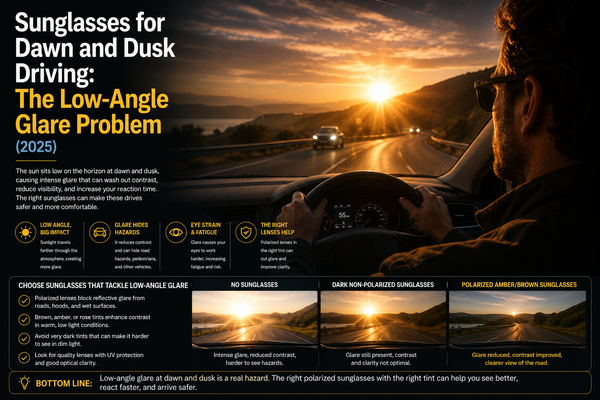

Sunglasses for Dawn and Dusk Driving: The Low-Angle Glare Problem
The morning commute in the fall is one of the most dangerous driving conditions most Americans face regularly. Not because of ice or rain — because of the sun. A low-angle sun rising due east on an eastbound commute in October places the solar disk almost directly in the forward field of vision of the driver. The road surface ahead becomes a near-mirror for that low-angle light. Lane markings disappear into reflected glare. The silhouettes of vehicles, pedestrians, and cyclists ahead are lost in the luminance wash.
This is the low-angle glare problem. It is the specific optical event that makes dawn and dusk driving more visually challenging than midday driving despite the lower absolute UV intensity of those times of day. Midday sun overhead is absorbed by the brow ridge. Low-angle sun at 5–15 degrees above the horizon hits the windshield directly and reflects from road surfaces at exactly the angles that reach the driver's eye.
This guide covers the complete low-angle glare physics, why polarized lenses are specifically effective at these times in ways no other lens property matches, the US commute geography that makes this a seasonal problem for millions of drivers, and the exact specification for the commute pair.
This is a C19 Night, Low Light & Variable supporting post. It links back to the cluster pillar atsunglasses in low light, night and variable conditions: the complete guide.
Quick Answer
Gray polarized UV400 Category 2 is the dawn and dusk driving specification. Gray for color accuracy with traffic signals. Polarized because low-angle road surface glare is horizontally polarized — polarized lenses eliminate it specifically, not just dim it. Category 2 for the lower ambient light of dawn and dusk without over-darkening. The non-polarized alternative only reduces total brightness, leaving the road-surface glare in place. The polarized lens removes the specific optical problem.

Table of Contents
Part 1: The Physics of Low-Angle Glare
When the sun is high overhead, its light strikes horizontal surfaces at a steep angle. Road surfaces scatter this light in multiple directions; the horizontal component reaching driver eye level is a small fraction of the total. The brow ridge and visor intercept much of the direct overhead beam before it reaches the eye.
When the sun is at a low angle — 5–20 degrees above the horizon, as it is during the first and last hours of daylight — the geometry changes completely. Low-angle sunlight strikes road surfaces at a glancing angle. At these angles, road surfaces act as efficient mirrors rather than diffuse scatterers. The reflected light travels at a low angle back toward the driver, hitting the windshield and continuing to the eye with a much higher fraction of the original solar intensity than midday surface reflection.
Simultaneously, the sun’s disk is now within or near the driver’s forward field of view rather than overhead. The driver is looking toward the sun’s azimuth position while also navigating traffic. On eastbound roads in the morning and westbound roads in the evening, the sun is positioned directly ahead.
The combination: direct solar disk glare in the forward field of view, plus maximum road surface reflection from the low-angle geometry. This is the visual environment of the dawn and dusk commute.
Part 2: Why Dawn and Dusk Glare Is Worse Than Midday
Midday sun has higher absolute UV intensity and higher overall luminance. Yet dawn and dusk driving is more visually challenging than midday driving for several compounding reasons:
Part 3: The US Commute Geography Problem
The low-angle glare problem is not uniformly distributed. It is concentrated on east-west oriented commute corridors during the dawn and dusk windows, and it is significantly worse in the fall and spring when the sun’s azimuth at sunrise and sunset aligns most directly with the compass bearings of major highway systems.
Interstate highway systems in the US are extensively east-west oriented: I-10, I-40, I-80, I-90 all run primarily east-west across large sections of their routes. Millions of American commuters drive directly into the sunrise on eastbound I-10 in Southern California, Texas, and Florida on fall mornings; directly into the sunset on westbound I-40 in Arizona, New Mexico, and Tennessee on fall evenings. State highways and city arterials aligned east-west compound this exposure.
The fall and spring equinox windows — roughly September through November and March through May — are the peak periods for low-angle commute glare in the continental US. During these periods, the sunrise and sunset azimuths align closely with due east and due west, placing the solar disk directly ahead for east-west commuters at these times.
In summer, the sun rises north of east and sets north of west, reducing direct forward alignment. In winter, the sun rises south of east and sets south of west, similarly reducing direct alignment. Fall and spring are when the geometry is worst.
Part 4: Why Non-Polarized Lenses Are Inadequate for Dawn and Dusk
A Category 2 or Category 3 non-polarized lens reduces total light transmission proportionally. The sun disk is dimmer. The road surface is dimmer. Everything is dimmer. The problem is that glare does not work by absolute intensity — it works by contrast. The road surface reflection at dawn is intense relative to the surrounding road surface because the specular reflection geometry makes it far brighter than the diffusely lit surroundings. Reducing everything by 50% or 70% leaves the road surface still dramatically brighter than the surrounding lane features.
Lane markings that were invisible in the glare are still invisible at 50% of the original luminance if the surrounding glare is also at 50%. The contrast problem is not solved by proportional reduction. The glare source and the useful visual information are both reduced equally; their relative difference — which determines visibility — remains the same.
This is why drivers frequently report that even dark Category 3 non-polarized sunglasses do not adequately address the dawn and dusk road glare problem. The glasses make everything darker but the lane markings remain washed out relative to the glare.
Part 5: How Polarized Lenses Solve Low-Angle Glare
Road surface reflection in the forward field of view at dawn and dusk is primarily horizontally polarized. When light reflects from a flat horizontal surface at a glancing angle (which is the geometry of low-angle sun on a road surface), the reflected light becomes strongly polarized in the horizontal plane. This is a consequence of Brewster’s Law — the polarization of reflected light from horizontal surfaces is maximized at a specific angle that approximates the low-angle incidence of dawn and dusk sun.
A polarized sunglass lens contains a PVA filter oriented to block horizontally polarized light. The road surface reflection — which is predominantly horizontal in polarization — is blocked by this filter. The direct solar disk’s light, which is unpolarized, is reduced proportionally like any other light source. The road surface in the glare zone goes from near-mirror reflective to visible and readable.
This is not an incremental improvement. Drivers who switch from non-polarized to polarized for the first time on a dawn or dusk commute consistently report a dramatic, immediate difference in road surface legibility. Lane markings that were invisible through the glare become visible. The silhouette of the road ahead is restored. The visual task of driving is fundamentally changed.
The complete polarization science is inpolarized vs non-polarized sunglasses: the definitive guide.
Part 6: Why Gray Is the Correct Tint for Commuting
Traffic signals use red, amber, and green as the primary safety information channel of the road environment. All three colors must be distinguishable and readable at the speed of driving. Amber and brown lenses shift color perception toward warmer values, subtly altering how amber and red signals appear. In normal everyday driving, this alteration is minor. In a complex multi-signal urban intersection during a dawn commute when visual processing is already challenged by glare adaptation, color accuracy matters.
Gray lenses reduce all wavelengths proportionally without shifting color temperature. Red signals are red. Amber signals are amber. Green signals are green. Traffic signal color accuracy is preserved across all light levels. Gray is the universal professional driver specification for this reason, and it is equally the correct commuter specification.
Amber polarized also eliminates road surface glare effectively and is the better choice for outdoor sport and off-road use. But for the commute — mixed traffic, multiple signals, urban and suburban environments — gray polarized is the correct specification.
The complete gray lens guide is ingray sunglass lenses: why neutral is the smartest everyday choice.
Part 7: Lens Category at Dawn and Dusk
Dawn and dusk present a specific lens category challenge:the glare from the sun and road surface is intense, but the overall ambient light level is lower than midday. Category 3 (8–18% VLT)reduces ambient light to a level that can make the darker areas of the visual field — particularly in shade, under bridges, and in tree-lined roads — too dark for comfortable driving.
Category 2 (18–43% VLT) is the correct category for dawn and dusk driving. It reduces the overall brightness to a comfortable level while maintaining adequate light transmission for the lower ambient conditions. In combination with polarization, Category 2 handles the road surface glare specifically without the tunnel-vision risk of Category 3 in transitional light.
Category 1 (43–80% VLT) is too light for direct forward sun and high-intensity glare periods but may be appropriate for the periods 30–60 minutes after sunrise and before sunset when the sun has risen higher and the extreme low-angle geometry has passed.
Part 8: The Fall and Spring Commute Risk
The most dangerous dawn and dusk driving periods in the continental US are the fall and spring equinox windows — roughly September through November and March through May. During these months:
The fall time change is specifically associated with an increase in pedestrian and cyclist fatalities in the US as the evening rush hour suddenly moves into darkness. The morning commute in the same period faces the opposite problem: sudden low-angle sun glare from the shifted commute window. UV400 polarized Cat 2 gray is the intervention that addresses this specific seasonal hazard.
Part 9: Eastbound and Westbound — The Directional Problem
|
Direction |
Dawn (AM) |
Dusk (PM) |
Peak Problem Season |
|
Eastbound |
Worst — direct into sunrise |
Low angle from behind (less direct) |
Sep–Nov, Mar–May |
|
Westbound |
Sun from behind (less direct) |
Worst — direct into sunset |
Sep–Nov, Mar–May |
|
Northbound |
Low-angle glare from east (left side) |
Low-angle glare from west (right side) |
Sep–Nov, Mar–May |
|
Southbound |
Low-angle from east (right side) |
Low-angle from west (left side) |
Sep–Nov, Mar–May |
Eastbound morning commuters face the worst direct glare scenario. Westbound evening commuters face the symmetric worst case. North-south commuters experience lateral low-angle glare from the sun, which can cause glare from windows, vehicles, and buildings to their side — less severe than direct forward glare but still meaningfully addressed by polarized lenses.
Part 10: Post-Rain Dawn and Dusk — Maximum Reflection Conditions
The combination of rain and low-angle sun creates the most intense road surface glare conditions a driver can experience outside of snow and ice. A post-rain dawn on an eastbound freeway presents:
In these conditions, non-polarized sunglasses provide minimal assistance because the reflection intensity swamps the proportional dimming they provide. Polarized lenses eliminate the water-film reflection specifically. The change in road legibility from non-polarized to polarized on a post-rain dawn drive is among the most dramatic optical improvements a driver can experience.
Part 11: Specific Commute Scenarios
|
Commute Scenario |
Primary Glare Source |
Polarized Benefit |
Recommended Spec |
|
Eastbound freeway, clear fall morning |
Direct sun + road surface specular reflection |
Very high — eliminates road mirror effect |
Gray polarized Cat 2 |
|
Westbound freeway, clear fall evening |
Direct sun + road surface reflection |
Very high |
Gray polarized Cat 2 |
|
Post-rain morning drive, wet roads |
Water-film road surface reflection |
Maximum — eliminates wet road shimmer |
Gray polarized Cat 2 |
|
Overcast morning commute |
Low ambient; no direct glare |
Low — but UV protection still relevant |
Gray polarized Cat 2 |
|
Suburban drive with frequent stops |
Traffic signals + variable glare |
High — signal color accuracy critical |
Gray polarized Cat 2 |
|
Highway drive into afternoon sun |
Low-angle sun from southwest (fall/spring) |
High |
Gray polarized Cat 2 |
|
Pre-sunrise drive (dark) |
No sun glare; night conditions |
None — no lens appropriate |
No sunglasses |
✨ NAVI EYEWEAR — GRAY POLARIZED UV400 FOR THE COMMUTE.UV400 polycarbonate. Gray polarized — eliminates road surface glare specifically at dawn and dusk. Traffic signal color-accurate. Category 2 for the transitional light of morning and evening. Buy 1, Get Any 3 Pairs Free — $119 for four pairs (~$30 each). Free shipping. Free replacements. |
Part 12: Comparison Table — Dawn/Dusk Driving Lens Options
|
Lens Option |
Road Surface Glare |
Color Accuracy |
Ambient Light |
Dawn/Dusk Verdict |
|
Gray polarized Cat 2 |
Eliminated specifically |
Excellent |
Adequate |
Best — recommended |
|
Gray non-polarized Cat 2 |
Reduced proportionally only |
Excellent |
Adequate |
Good but incomplete |
|
Gray polarized Cat 3 |
Eliminated specifically |
Excellent |
Too dark for transition |
Not recommended for variable dawn/dusk |
|
Amber polarized Cat 2 |
Eliminated specifically |
Altered (acceptable for rural) |
Adequate |
Good — second choice for rural commutes |
|
No sunglasses |
None |
N/A |
Full brightness |
Inadequate for direct glare phases |
|
Yellow Cat 0–1 |
Minimal — insufficient darkness |
Strongly altered |
Too light for direct sun |
Not appropriate |
Part 13: Best For
Gray Polarized UV400 Category 2 — Best For:
Part 14: Common Mistakes
Bottom Line
Dawn and dusk driving glare is not about the absolute brightness of the sun — it is about the geometry of low-angle incidence creating specular reflection from road surfaces directly in the driver’s line of sight. Non-polarized sunglasses dim but do not address this specific reflection. Polarized lenses eliminate it by blocking the horizontally polarized road surface reflection while preserving the visibility of road features.
Gray polarized UV400 Category 2 is the dawn and dusk driving specification. It eliminates the road surface glare, maintains traffic signal color accuracy, and provides the right darkness level for transitional light conditions. A dedicated pair kept in the car eliminates the commute exposure gap.
The fall morning commute on an eastbound highway is one of the most predictably dangerous glare events in American driving. It happens the same way every clear fall morning, to millions of drivers, on routes where the geometry does not change. Gray polarized Cat 2 is the straightforward solution.
Browse gray polarized UV400 options atnavieyewear.com/collections/polarized. Add 4 pairs — Buy 1, Get Any 3 Free auto-applies. Free shipping. Free replacements.
Frequently Asked Questions
Why is driving at dawn and dusk more dangerous than midday?
Three compounding factors: the sun’s disk is at or near horizon level and within the driver’s forward field of view on aligned routes, road surfaces act as near-mirrors at low-angle incidence producing intense specular reflection in the driver’s line of sight, and vehicle visors are largely ineffective against sun at 5–15 degree elevation. Midday sun overhead is intercepted by the visor and brow ridge; low-angle sun at dawn and dusk is not.
Do polarized lenses actually help with dawn and dusk driving glare?
Yes — specifically. Road surface reflection at dawn and dusk is predominantly horizontally polarized (a consequence of Brewster’s Law at low incidence angles). Polarized lenses block horizontally polarized light, eliminating this reflection. Drivers who switch from non-polarized to polarized for the first time on a dawn commute consistently report that lane markings previously invisible in the glare become visible. The improvement is immediate and significant.
What lens category is best for dawn and dusk driving?
Category 2 (18–43% VLT). Dark enough to manage the intense glare phases during direct sun exposure, light enough to maintain visual performance during the lower-ambient portions of the transitional drive. Category 3 can over-darken shaded sections and create dangerous visual under-performance during rapid light transitions. Category 2 gray polarized handles the full dawn and dusk driving range.
When is dawn and dusk driving glare worst in the US?
Fall and spring — roughly September through November and March through May. During these months, sunrise and sunset azimuths align closely with due east and west, directly targeting east-west oriented freeways and roads. The fall time change is a particularly acute transition period. Fall weather also brings wet roads that compound the reflective intensity.
Does the car visor help with dawn and dusk glare?
Partially, but not for the primary problem. Visors are effective against sun at 20–45 degree elevations. They are largely ineffective against low-angle sun at 5–15 degrees, which comes from below the visor’s geometric coverage zone. Polarized sunglasses address the road surface reflection component that represents the primary visibility hazard at these angles.
Is gray or amber better for dawn and dusk driving?
Gray for all commuting in mixed traffic. Gray maintains traffic signal color accuracy that the commute environment demands. Amber polarized is effective at eliminating road surface glare but subtly alters traffic signal color rendering. For professional drivers and urban/suburban commuters, gray is the correct tint. Amber is appropriate for rural highway driving with minimal signal density.
What about wet roads at dawn?
Post-rain dawn on an eastbound commute is the most extreme road surface glare scenario most drivers regularly face. Water film on the road surface acts as a near-perfect mirror at low-angle incidence. Polarized lenses eliminate this water-film reflection completely. Non-polarized lenses dim the overall scene without addressing the specific reflection. The legibility improvement from polarized lenses on a wet dawn road is among the most dramatic optical differences in everyday driving.
Should I keep sunglasses in my car for the commute?
Yes — a dedicated pair kept in the car permanently is the most reliable solution. The dawn and dusk glare events are predictable: same time, same roads, same geometry, every clear day in fall and spring. Having the correct lens always accessible in the car eliminates the consistent exposure gap of the commuter who left their sunglasses at home or in the office.
Supporting Articles
GRAY POLARIZED UV400. IN THE CAR. EVERY COMMUTE.UV400 polycarbonate. Gray polarized — eliminates road surface glare. Keeps traffic signals color-accurate. Category 2 for the full dawn and dusk driving range. Keep one pair in the car permanently. Buy 1, Get Any 3 Pairs Free — $119 for four pairs. Free shipping. Free replacements. |
SOURCES & CITATIONS[1] De Faber JT, Naeser K, Kessing SV.“Polarized light and contrast sensitivity under glare conditions.”Ophthalmic Research, 2013.View source [2] Dain SJ.“Sunglasses and sunglass standards.”Clinical and Experimental Optometry, 2003.View source [3] Rosenthal FS, Bakalian AE, Lou CQ, Taylor HR.“The effect of sunglasses on ocular exposure to ultraviolet radiation.”American Journal of Public Health, 1988.View source [4] National Highway Traffic Safety Administration.“Traffic safety facts: pedestrians.”NHTSA Publication, 2022.View source [5] American Academy of Ophthalmology.“Sunglasses: choosing the right pair for UV protection.”AAO EyeSmart, 2023.View source |