
Should You Wear Sunglasses on a Cloudy Day? The UV Science
Most Americans associate sunglasses with sun. When the sky turns gray, the sunglasses come off. It feels logical — no sun, no need. The problem is that this logic applies to visual comfort but not to UV eye protection, and the two are not the same thing.
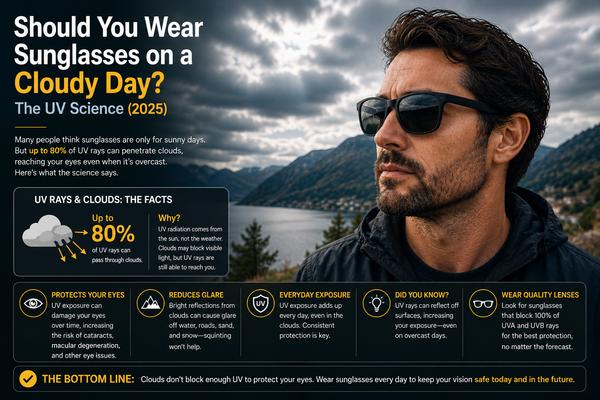
Clouds scatter ultraviolet radiation rather than blocking it. The degree of UV reduction depends on cloud type and density — but even a solidly overcast sky in summer transmits enough UV to meaningfully contribute to the cumulative lifetime ocular UV exposure that drives cataract and macular degeneration risk. And in many parts of the US, cloudy days are the majority of outdoor days for much of the year.
This guide covers the UV science of cloudy days in the US context: how clouds interact with UV radiation, how much UV different cloud conditions transmit at ground level, what the UV Index looks like on overcast days across different US regions, and the specific lens solution that provides UV protection without the visual discomfort of wearing dark lenses on a gray day.
This is the final C19 Night, Low Light & Variable supporting post. It links back to the cluster pillar atsunglasses in low light, night and variable conditions: the complete guide. For the broader overcast UV guide, seedo you need sunglasses on overcast days? the UV science.
Quick Answer
Yes — on most cloudy days, especially in summer and in high-UV regions of the US. Clouds scatter UV, they do not block it. A typical partly cloudy or moderately overcast day transmits 50–80% of clear-sky UV to the ground. In the American Southwest, Florida, or the Gulf Coast, an overcast summer day can still produce UV Index 4–5 — the moderate-to-high range where the CDC and AAO recommend eye protection. A Category 1 or Category 2 UV400 lens provides complete protection without noticeably darkening an already dim sky.

Table of Contents
Part 1: Why Clouds Don’t Block UV
Clouds are made of water droplets and ice crystals suspended in the atmosphere. When sunlight passes through cloud layers, it is scattered in multiple directions — which is what makes the sky look bright white rather than dark under clouds. This scattering reduces the direct beam of solar radiation reaching the ground and distributes it as diffuse radiation from all directions.
The critical physics: UV and visible light scatter differently through cloud media. Visible light (which determines perceived brightness) is scattered and absorbed more completely by dense cloud layers than UV, particularly UVA (320–400nm wavelength). Cloud water droplets do not absorb UV efficiently — they scatter it. Much of the scattered UV still reaches the ground from multiple directions rather than the single overhead beam of a clear sky.
The result: a thick overcast cloud layer that reduces visible sky brightness to 20–30% of clear-sky levels may only reduce ground-level UVA to 40–60% of clear-sky levels. The eye receives UV from the diffuse sky above and from UV reflected off surfaces around it — roads, buildings, water, sand. The perceived dimness of an overcast sky substantially understates the UV dose being delivered to the eye.
Part 2: UV Transmission by Cloud Type
|
Cloud Type |
Altitude |
UV Reduction vs Clear |
UV Transmitted |
Visual Brightness Reduction |
|
Cirrus (thin high) |
20,000–40,000 ft |
5–10% |
90–95% |
Minimal — sky still appears mostly clear |
|
Altocumulus / altostratus |
7,000–20,000 ft |
15–35% |
65–85% |
Moderate — milky or patchy gray sky |
|
Cumulus (fair weather) |
Variable |
10–25% when overhead |
75–90% |
Partial — sun in and out |
|
Stratus (low overcast) |
1,000–6,000 ft |
40–60% |
40–60% |
Significant — uniformly gray |
|
Nimbostratus (rain cloud) |
Surface–10,000 ft |
60–80% |
20–40% |
Heavy — dark and wet |
|
Cumulonimbus (thunderstorm) |
Surface–60,000 ft |
80–95% |
5–20% |
Very dark — storm conditions |
The most common cloud types encountered on typical American “gray days” are stratus and altostratus — the uniform overcast cloud layers that make the whole sky look flat and pale. These clouds transmit 40–60% of clear-sky UV. On a summer day in the Sun Belt with a clear-sky UV Index of 9–10, stratus overcast still delivers UV Index 4–6 to the ground — squarely in the high UV range.
Part 3: The US UV Index on Cloudy Days by Region
UV exposure in the US varies significantly by region, season, and altitude. The base UV Index before cloud attenuation determines how much UV remains after clouds filter it:
|
US Region |
Clear-Sky Summer UV Index (July noon) |
Moderate Overcast UV Index |
Heavy Overcast UV Index |
|
Southwest (AZ, NM, Southern CA) |
UV 9–11 |
UV 5–7 |
UV 2–4 |
|
Sun Belt (FL, TX Gulf Coast) |
UV 9–10 |
UV 5–6 |
UV 2–3 |
|
Southeast (GA, SC, NC) |
UV 8–9 |
UV 4–6 |
UV 2–3 |
|
Mid-Atlantic / Northeast |
UV 7–8 |
UV 4–5 |
UV 1–3 |
|
Pacific Northwest (WA, OR) |
UV 5–7 |
UV 3–4 |
UV 1–2 |
|
Mountain West (CO, UT high altitude) |
UV 10–12+ |
UV 6–8 |
UV 3–4 |
|
Great Plains (KS, NE, SD) |
UV 8–9 |
UV 4–6 |
UV 2–3 |
In the Southwest, Florida, and the Mountain West, moderate overcast conditions still produce UV Index 5–7 — the “high” UV category. At UV Index 5+, the CDC, AAO, and WHO all recommend wearing sunglasses and sun-protective clothing when outdoors. In these regions, “cloudy day” and “no UV protection needed” are never synonymous, regardless of how the sky looks.
Part 4: Why Visual Brightness Is Not a UV Proxy
Human perception of brightness is driven by the visible light reaching the eye, not by UV. The eye has no UV-sensing mechanism — UV is completely invisible to the human visual system. The only way we perceive UV is through its secondary effects: sunburn, tanning, and over time, the eye conditions it causes.
Visible light and UV are attenuated at different rates by clouds, atmosphere, and physical structures. A cloud deck that visually feels like “a dim gray day” may be transmitting UV at 60% of clear-sky levels. A window that provides apparent sun protection transmits UV freely. A shaded outdoor patio under a white awning receives significant scattered UV from the open sky above and below.
The practical implication: making sunglass decisions based on whether the sky “looks bright” systematically underestimates UV exposure on overcast days and in shaded environments. The correct basis for a UV protection decision is the UV Index forecast, not sky appearance. The National Weather Service UV Index forecasts are available by zip code at weather.gov and in most weather apps.
Part 5: The Cumulative UV Case for Cloudy Days
Eye conditions linked to cumulative UV exposure — particularly cortical cataract and AMD — do not require intense UV exposure events to develop. They develop from the accumulated total of UV received over decades of daily life. The individual cloudy days that people spend outdoors without UV protection are not individually significant. Their aggregate over a lifetime is.
Consider a resident of Seattle, Washington, where the annual average is approximately 226 cloudy days per year. If that person wears sunglasses only on the approximately 58 sunny days and goes unprotected on the cloudy and partly cloudy days, they are unprotected for the majority of their outdoor days. If cloudy days deliver 40–60% of clear-sky UV, the unprotected cloudy-day UV exposure may represent more than half their total annual ocular UV dose.
Now consider a resident of Phoenix, Arizona, where the annual average is approximately 299 sunny days per year but where even the 66 cloudy days typically deliver UV Index 4–5. That person’s cloudy-day exposure is lower in duration but higher in intensity per cloudy day. UV400 on all outdoor days makes sense in both contexts, for different reasons.
The full UV accumulation and disease science is inUV and eye disease: the complete guide.
Part 6: The Cloud Enhancement Effect
There is a lesser-known cloud effect that can actually increase ground-level UV above clear-sky values: broken cloud with direct solar gaps. When the sun is visible through gaps in a partially cloudy sky, and white cloud surfaces are present around it, those cloud surfaces can act as reflectors that direct additional scattered UV toward the ground.
Studies have documented ground-level UV Index spikes 10–25% above clear-sky values during broken cloud conditions when the solar beam is direct. The mechanism: direct beam UV plus backscattered UV from surrounding cloud surfaces produces a momentary UV intensity spike. These spikes are brief (seconds to minutes as clouds move) but can produce higher instantaneous UV exposure than an equivalent clear-sky period.
The practical implication: partly cloudy conditions with intermittent sun may not be less UV-intense than clear days — they may be more UV-intense during the sunny gaps. This further undermines the logic of removing sunglasses on “partly cloudy” days.
Part 7: Who Faces the Most Cloudy-Day UV Exposure in the US
Pacific Northwest Residents
Seattle, Portland, and the Pacific Northwest coast average 150–200+ cloudy or mostly cloudy days per year. Residents who do not wear UV protection on cloudy days are unprotected for the majority of their outdoor days. While the base UV Index in the Pacific Northwest is lower than the Sun Belt, cloudy days still deliver meaningful UV during the spring through fall months.
High-Altitude Residents
Colorado, Utah, and other Mountain West states at altitude combine high base UV with significant cloud activity. Denver averages UV Index 8–9 in summer; even stratus overcast in Denver can deliver UV Index 4–5. Mountain hikers and outdoor workers at altitude face a combination of high-base UV and variable cloud cover that makes consistent UV400 use especially important on all outdoor days.
Outdoor Workers Across All Regions
Agricultural workers, construction workers, landscapers, and all outdoor workers who are outside in any weather accumulate UV on every outdoor day regardless of sky conditions. In the Sun Belt and Southwest, year-round outdoor workers face meaningful UV on the majority of their working days whether sunny or overcast.
Children in School
School outdoor time — recess, PE class, after-school activities — occurs on cloudy days as well as sunny ones. Children’s lenses transmit more UV than adult lenses, making their eyes more susceptible at all UV levels. A consistent UV protection habit from childhood builds the eye health foundation that reduces lifetime cataract and AMD risk.
Part 8: The Lens Solution — Category 1 and Category 2
The objection to wearing sunglasses on cloudy days is usually a comfort objection, not a principled UV objection. Dark Category 3 lenses on a gray day genuinely do make the visual environment uncomfortably dark. This is a real and valid concern. The solution is not to go unprotected — it is to choose a lens category that provides UV protection without the visual penalty of inappropriate darkness.
Category 1 (43–80% VLT) for Overcast Primary Use
Category 1 UV400 lenses are barely perceptible in overcast conditions. They transmit 43–80% of visible light — providing a mildly tinted view that reduces UV to zero while leaving visual brightness essentially unchanged from the overcast outdoor environment. For people who spend most outdoor time in overcast or variable conditions, Category 1 UV400 is the purpose-designed lens for this use pattern.
Category 2 (18–43% VLT) for Variable Conditions
Category 2 UV400 handles both overcast and sunny conditions in a single lens. At the lighter end of the Category 2 range (35–43% VLT), the lens is comfortable on overcast days while also managing moderate sun. For people who face both overcast and sunny outdoor days and want one pair, Category 2 is the all-conditions choice.
Part 9: UV400 Is Independent of Lens Darkness
This is the most important structural point in the cloudy-day sunglass argument: UV400 protection has nothing to do with how dark the lens is. UV400 is a property of the lens material — polycarbonate absorbs UV throughout the material, and UV-absorbing compounds can be added to any lens regardless of its visible light transmission.
A clear polycarbonate lens (Category 0, 80–100% VLT) provides UV400 protection. A very dark glass lens without UV absorbers provides zero UV protection. Darkness and UV protection are completely independent. There is no visual-comfort penalty to UV protection if the lens category is chosen appropriately for the conditions.
This matters for cloudy days because it removes the only valid objection to wearing UV protection outdoors: “it will be too dark.” The correct response is to choose a Category 1 or lighter Category 2 UV400 lens for cloudy conditions — not to remove the lens and go unprotected.
✨ NAVI EYEWEAR — UV400 EVERY DAY. GRAY SKY INCLUDED.UV400 polycarbonate. Polarized. Category 2 — complete protection in sun and clouds. UV400 is not about darkness. It’s about the material. Clouds don’t change that. Buy 1, Get Any 3 Pairs Free — $119 for four pairs (~$30 each). Free shipping. Free replacements. |
Part 10: The Cloudy-Day Driving Context
For drivers, cloudy days present a specific lens consideration: UV protection is still relevant (as described above), and polarization remains useful for wet road surface reflections from rain and dew even without direct sun. A Category 2 gray polarized UV400 lens on an overcast rainy morning provides UV protection (meaningful but modest on heavy overcast), glare elimination for the wet road surface reflection (the polarization benefit that persists regardless of sun), and color accuracy for traffic signals.
The driver who puts on their gray polarized Cat 2 sunglasses every time they get in the car — regardless of sky conditions — is protected against UV, optimized for wet road visibility, and has the right lens on when the sun suddenly breaks through cloud cover during a drive. Consistent daily use eliminates the gaps that selective use creates.
Part 11: Children and Cloudy-Day UV
Children spend the bulk of their outdoor time on school days — recess, lunch, PE class, after-school activities — in whatever weather conditions the day delivers. School outdoor time is not suspended for overcast conditions. In most US school districts, outdoor activities continue through partly cloudy and overcast days from late February through October.
Children’s crystalline lenses are more UV-transparent than adult lenses — they transmit a higher proportion of UV to the retina for any given ambient UV level. The WHO estimates that up to 80% of lifetime ocular UV may be accumulated before age 18. A significant portion of that accumulation comes from casual outdoor time on overcast school days when UV protection is not a cultural expectation.
Category 1 UV400 children’s sunglasses are the appropriate everyday school outdoor lens in overcast climates. In high-UV regions, Category 2 UV400 provides better coverage across the variable conditions of outdoor school time.
The complete children’s UV guide is inthe complete guide to sunglasses for kids and teenagers.
Part 12: Comparison Table — Cloudy-Day UV Protection Options
|
Option |
UV Protection |
Visual Comfort on Cloudy Day |
Verdict |
|
No sunglasses |
None — full UV to eye |
Best comfort |
Unprotected; not recommended |
|
Non-UV400 dark lens |
None — dark + no UV block |
Reduced brightness |
Worse than nothing: pupil dilates into unblocked UV |
|
Category 3 UV400 |
Complete |
Too dark — overcast over-darkens |
Over-darkens; not ideal for cloudy use |
|
Category 2 UV400 polarized |
Complete |
Good — lighter end comfortable in overcast |
Best all-conditions choice |
|
Category 1 UV400 |
Complete |
Excellent — barely perceptible in overcast |
Best for overcast-primary use |
|
Clear UV400 polycarbonate (Cat 0) |
Complete |
No darkening at all |
UV protection with zero visual impact |
Part 13: Best For
Category 2 UV400 Polarized — Best For:
Category 1 UV400 — Best For:
Part 14: Common Mistakes
Bottom Line
Yes, you should wear UV protection on cloudy days — on most of them, particularly in summer and in high-UV regions of the US. Clouds scatter UV rather than blocking it. Moderate overcast transmits 40–60% of clear-sky UV. In the Southwest, Sun Belt, and Mountain West, that still puts the cloudy-day UV Index in the moderate-to-high range where the CDC and AAO recommend eye protection.
The comfort objection is solved by choosing the right lens category: Category 1 UV400 for consistently overcast use, Category 2 UV400 for variable conditions. Both provide complete UV400 protection with a light enough tint that overcast days do not feel artificially dark. UV protection is a property of the lens material — not of how dark the lens is.
The most effective single habit change for cumulative UV eye protection:wear UV400 sunglasses whenever you go outside, regardless of what the sky looks like. Not because the sky might change — but because UV is already there even when the sky looks gray.
Browse UV400 polarized options atnavieyewear.com/collections/polarized. Add 4 pairs — Buy 1, Get Any 3 Free auto-applies. Free shipping. Free replacements.
Frequently Asked Questions
Do you need to wear sunglasses on a cloudy day?
For UV protection, yes on most cloudy days, especially in summer and in high-UV regions. Clouds scatter UV — they don’t block it. A typical partly cloudy or moderately overcast summer day transmits 40–80% of clear-sky UV. In the Southwest, Florida, and the Mountain West, moderate overcast still delivers UV Index 4–5. At UV Index 3+, the CDC and AAO recommend wearing sunglasses outdoors. Use a Category 1 or lighter Category 2 UV400 lens to provide protection without over-darkening an already dim sky.
How much UV reaches your eyes on a cloudy day?
Depends on cloud type. Light high cirrus cloud reduces UV by only 5–10%, leaving 90–95% of clear-sky UV at ground level. Moderate overcast (altostratus, stratus) reduces UV by 40–60%, leaving 40–60%. Heavy nimbostratus reduces UV by 60–80%. On a typical American “gray day” with moderate overcast, the eye receives roughly half the UV of a clear-sky day.
Can UV damage your eyes on a cloudy day?
Yes. UV damage to the crystalline lens and retina is cumulative and does not require the intense UV of a clear-sky midday to occur. Each unprotected cloudy-day outdoor session adds to the lifetime UV total that determines cataract and AMD risk. In regions with frequent cloudy days, the aggregate UV from cloudy days over a lifetime may exceed the aggregate from sunny days simply because cloudy days are more numerous.
What sunglasses are best for cloudy days?
Category 1 UV400 (43–80% VLT) for consistently overcast conditions — minimal visible darkening, complete UV protection. Category 2 UV400 polarized (18–43% VLT) for variable conditions where both overcast and sunny days occur. Avoid Category 3 for overcast use — too dark for the ambient light level and likely to be removed.
Does it matter what region of the US you’re in for cloudy-day UV?
Yes. In the Southwest, Sun Belt, and at high altitude, the base UV Index is 9–11+ on clear days. Moderate overcast in these regions still delivers UV Index 5–7 — the high category. In the Pacific Northwest and Northeast, the base UV is lower, but overcast days still deliver meaningful UV in summer. The higher the base UV of your region, the more important consistent UV400 use on cloudy days becomes.
Are sunglasses making my eyes more sensitive to light on cloudy days?
No. There is no evidence that wearing UV400 sunglasses outdoors increases light sensitivity in normal indoor conditions. The concern about “training” the eyes to need sunglasses is not supported by optometry or vision science. The eyes adapt continuously to ambient light levels, and wearing sunglasses outdoors does not produce a lasting change in indoor light sensitivity.
Do polarized lenses help on cloudy days?
Less for glare comfort (no direct sun, less surface glare from most surfaces), more for driving (wet roads still produce horizontally polarized surface reflections). Polarization’s primary benefit in overcast conditions is road surface glare from rain and dew. For general outdoor use on cloudy days, UV400 is the primary functional property and polarization is a secondary (but consistent) benefit.
What is the UV Index on a typical cloudy day in the US?
Varies significantly by region. In the Southwest (Arizona, New Mexico, Southern California), moderate overcast summer days typically produce UV Index 5–7. In Florida and the Gulf Coast, UV Index 4–6. In the Mid-Atlantic and Northeast, UV Index 3–5. In the Pacific Northwest, UV Index 2–4. Real-time UV Index forecasts by zip code are available at weather.gov and in most weather apps.
Supporting Articles
UV400 EVERY TIME. CLOUDY OR CLEAR.UV400 polycarbonate. Polarized. The habit that matters more than the weather forecast. Category 2 — complete protection in sun and clouds. Barely noticeable on gray days. Buy 1, Get Any 3 Pairs Free — $119 for four pairs. Free shipping. Free replacements. |
SOURCES & CITATIONS[1] World Health Organization.“Global solar UV index: a practical guide.”WHO/SDE/OEH/02.2, 2002.View source [2] Diffey BL.“Sources and measurement of ultraviolet radiation.”Methods, 2002.View source [3] Sliney DH.“UV radiation ocular exposure dosimetry.”Documenta Ophthalmologica, 1994.View source [4] Taylor HR, West SK, Rosenthal FS, et al..“Effect of ultraviolet radiation on cataract formation.”New England Journal of Medicine, 1988.View source [5] Centers for Disease Control and Prevention.“Sun safety: protect your eyes from UV radiation.”CDC Health Promotion Resources, 2023.View source [6] American Academy of Ophthalmology.“Sunglasses: choosing the right pair for UV protection.”AAO EyeSmart, 2023.View source |