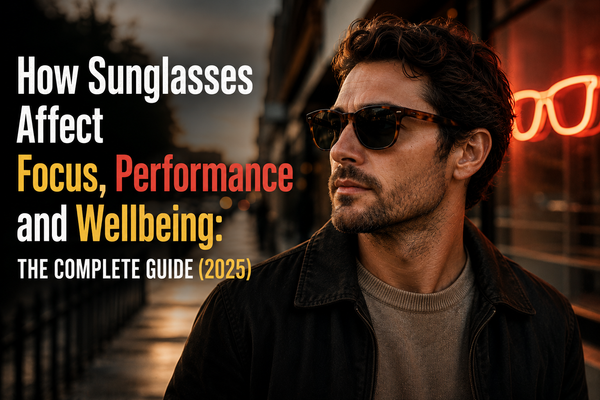

How Sunglasses Affect Focus, Performance and Wellbeing: The Complete Guide
Sunglasses are sold as eye protection. They are discussed as UV blocking devices. They are photographed as fashion accessories. What they are almost never discussed as — in any mainstream context — is cognitive performance tools.
But that is what they are. The visual system is the highest-bandwidth sensory channel the brain uses for navigating the world. Anything that reduces the quality or consistency of visual input — glare, contrast loss, visual fatigue — adds a processing load to the brain that competes with every other cognitive task being performed simultaneously. Reduce that visual load, and you free up cognitive resources for the things you are actually trying to do: focus on work, track athletes, execute a drive, run a trail without stumbling, make decisions at the end of a long shift.
This guide covers the complete relationship between sunglasses and mental performance: the visual fatigue mechanism, the glare-cognition connection, the athletic performance research, the migraine and light sensitivity neurological pathway, the circadian rhythm and sleep dimension, and the psychology of perceived confidence and composure that sunglasses enable. This is the C20 Sunglasses & Mental Performance pillar.
Supporting posts in this cluster:visual fatigue, glare and why your eyes make you tired,sunglasses and migraines: how light sensitivity triggers attacks,sunglasses and athletic performance: what the research says,sunglasses, sleep and circadian rhythm: the blue light and evening connection, andthe psychology of sunglasses: confidence, focus and perception.
Quick Answer
Sunglasses improve focus and performance through five documented mechanisms: reducing visual fatigue by eliminating the sustained effort of squinting against glare; improving contrast and object detection that athletic and cognitive performance depends on; reducing migraine and light sensitivity triggers for the 15–20% of people who experience them; stabilizing circadian rhythm through controlled outdoor light exposure; and providing a psychological composure advantage in high-pressure contexts. UV400 polarized lenses deliver each of these mechanisms simultaneously.

Table of Contents
Part 1: The Visual System’s Cognitive Load
The human brain allocates approximately 30% of its cortex to visual processing — more than any other sensory modality. Visual processing is not passive reception. The brain actively constructs the visual scene from raw photoreceptor signals, applying attention, prediction, and memory at every step of the process. Under degraded visual conditions — high glare, low contrast, flickering light, squinting — this construction process requires more computational effort for the same output quality.
The cognitive load framework in psychology describes how mental tasks compete for shared processing resources. When visual processing consumes more resources than normal — as it does under glare and high-contrast-demand conditions — fewer resources are available for other cognitive tasks: sustained attention, working memory, decision-making, motor planning. The visual system’s demands are not isolated from cognitive performance; they are in direct competition with it.
Reducing the visual system’s processing load through glare elimination and improved contrast returns cognitive resources to higher-level performance tasks. This is the fundamental mechanism through which UV400 polarized lenses affect mental performance — not by adding any cognitive enhancement, but by removing a consistent source of cognitive drain that most people accept as normal.
Part 2: Visual Fatigue — How Glare Depletes Mental Energy
Visual fatigue is the degradation of visual performance and visual comfort that results from sustained visual effort under demanding conditions. It is not simply tired eyes — it is a genuine physiological state with measurable correlates: reduced contrast sensitivity, increased blink rate, decreased accommodative amplitude (the ability to adjust focus), and headache from sustained frontalis and orbicularis oculi muscle activation.
Glare is one of the primary causes of visual fatigue in outdoor environments. Sustained squinting against bright outdoor glare activates the orbicularis oculi muscle (the ring-shaped muscle surrounding the eye) continuously. This muscle activation is metabolically costly and produces the tired, heavy-eye sensation familiar to anyone who has spent hours in bright outdoor sun without adequate eye protection.
The cognitive dimension of visual fatigue is less commonly discussed but well-documented in occupational health research. Studies of workers in visually demanding outdoor environments — driving, surveying, construction supervision, outdoor sport — consistently find that visual fatigue correlates with reduced performance on cognitive tasks including attention, reaction time, and decision accuracy. The fatigue is not purely ocular; it propagates into the general cognitive performance system.
The complete visual fatigue mechanism is invisual fatigue, glare and why your eyes make you tired.
Part 3: The Squinting Mechanism and Sustained Attention
Squinting is the eye’s protective response to uncomfortable light levels. It reduces the pupillary aperture and provides partial shade to the retina from the upper visual field. It is also a sustained muscular effort that competes with attention.
Research in cognitive psychology has established that physical effort — even apparently minor sustained muscular activation — consumes executive function resources. The orbicularis oculi activation of sustained squinting is not free in cognitive terms. It contributes to the global fatigue that accumulates over hours of outdoor activity in bright, unmanaged light conditions.
More directly, squinting reduces the visual field. A squinting eye admits less peripheral visual information than an open eye. In athletic contexts, coaching contexts, and driving, reduced peripheral vision means less situational awareness and more cognitive effort to compensate for the reduced information from the periphery. Polarized lenses that eliminate the primary glare sources allow the eye to remain open and the full visual field to be used.
Part 4: Contrast and Object Detection — The Athletic Performance Connection
Sports performance depends on visual information: the ball’s position, trajectory, and speed; the positions and movements of other players; the terrain; the distance to targets. The quality of this visual information directly determines the quality of the motor response that follows.
Contrast sensitivity — the ability to distinguish objects from their backgrounds — is the visual property most directly connected to sports performance. Ball tracking, court reading, terrain navigation, and player detection all depend on contrast sensitivity. Glare reduces contrast sensitivity by reducing the luminance difference between objects and backgrounds. The ball against a glare-washed sky is harder to track than the ball against a clean sky. The runner on a trail lit by specular surface reflections is harder to navigate safely than on a trail with defined surface features.
Polarized lenses eliminate the horizontal surface glare that represents the primary outdoor contrast-reduction event. By removing this glare selectively, rather than simply dimming everything proportionally, polarized lenses improve contrast sensitivity in outdoor environments in a way that non-polarized lenses of equivalent darkness do not. The practical performance benefit: better ball tracking, faster target detection, more reliable terrain reading.
The complete athletic performance research is insunglasses and athletic performance: what the research says.
Part 5: Glare and Reaction Time in Sports
Reaction time is one of the most studied variables in sports science, and it is highly sensitive to visual input quality. The chain from stimulus to response runs through visual detection, then neural processing, then motor execution. Anything that degrades the detection step extends the overall reaction time.
Glare degrades visual detection by reducing the signal-to-noise ratio in the retinal image. The “signal” is the relevant object (ball, opponent, hazard) and the “noise” is the high-luminance glare from outdoor surfaces. When noise is high relative to signal, detection is slower and less reliable.
Studies comparing reaction time performance under glare versus non-glare conditions consistently find significant differences. Studies specifically examining the effect of polarized lenses on reaction time in outdoor sport and driving have found measurable improvements compared to non-polarized conditions. The mechanism is straightforward: better visual detection leads to faster reaction, directly improving performance in time-critical sports and activities.
Part 6: Migraine, Light Sensitivity and Cognitive Performance
Migraine affects approximately 39 million Americans, with women experiencing it at approximately three times the rate of men. Photophobia — abnormal light sensitivity — is both a symptom during migraine attacks and a trigger for new attacks in many sufferers. The cognitive performance implications of migraine and photophobia are significant and substantially underrecognized in discussions of both conditions.
During a migraine attack, cognitive performance is severely impaired across multiple domains: attention, working memory, processing speed, and executive function. The period immediately preceding an attack (the prodrome) and the period following it (the postdrome) also involve cognitive impairments that can last hours to a day or more. For the 39 million Americans with migraine, these impairment periods represent a substantial fraction of their productive time.
UV400 polarized sunglasses reduce the outdoor light triggers that precipitate attacks in light-sensitive migraine sufferers by two mechanisms: UV400 removes the short-wavelength UV component that contributes to photoreceptor overstimulation, and polarization eliminates the high-contrast glare events that are documented migraine triggers. Consistent outdoor UV400 polarized use is not a migraine treatment, but it is a practical environmental modification that reduces trigger exposure for light-sensitive individuals.
The complete migraine and light sensitivity guide is insunglasses and migraines: how light sensitivity triggers attacks.
Part 7: Sunglasses and Circadian Rhythm
Light is the primary zeitgeber — time-setting signal — for the human circadian clock. The suprachiasmatic nucleus (SCN) in the hypothalamus receives light signals via the retinohypothalamic tract and uses them to synchronize the body’s internal biological clock with the external day-night cycle. Disrupted circadian rhythm is associated with impaired cognitive performance, reduced alertness, mood disturbance, and increased disease risk.
Sunglasses have a nuanced role in circadian light management. Consistent outdoor exposure to natural daylight during daylight hours supports a well-synchronized circadian clock, which is associated with better sleep quality, higher daytime alertness, and more stable mood. UV400 sunglasses allow this outdoor light exposure while eliminating its damaging components.
The specific circadian concern is evening high-intensity light exposure. Blue wavelength light is the primary circadian signal for the SCN. Evening exposure to bright blue-rich light (including screen light and outdoor light in the hours before bed) delays circadian phase and suppresses melatonin, which reduces sleep quality. Amber or blue-blocking lenses worn in the late evening can reduce this circadian disruption. This is a separate application from outdoor UV protection but part of the complete light management picture.
The complete circadian rhythm and sleep science is insunglasses, sleep and circadian rhythm: the blue light and evening connection.
Part 8: The Psychology of Sunglasses — Composure and Confidence
Beyond the physiological mechanisms, sunglasses have a documented psychological dimension. Research in social psychology and performance psychology has found that sunglasses affect both the wearer’s own psychological state and the way others perceive the wearer.
Anonymity and Disinhibition
Research by Zhong, Bohns, and Gino (2010) published in Psychological Science found that wearing sunglasses produced subtle psychological disinhibition — an increased sense of anonymity that influenced behavior and decision-making. The visual barrier that sunglasses create — preventing others from seeing the wearer’s eyes — creates a psychological experience of reduced exposure that can support composed behavior under pressure.
External Focus and Performance
Sports psychology research has consistently found that external focus — attention directed outward at the task rather than inward at the body or self-evaluation — is associated with better performance in skilled motor tasks. Sunglasses that eliminate the visual distractions of glare and surface reflection support external focus by improving the quality of the external visual information available and reducing the effort required to process it.
Perceived Competence
Research on sunglass effects in competitive contexts has found that sunglasses are associated with perceptions of competence, composure, and authority in professional and athletic settings. Athletes in sunglasses are perceived as more skilled and more confident by observers in controlled studies. These perceptions can create self-fulfilling effects: the perceived competence expectation from others influences the wearer’s own performance through expectancy and confidence mechanisms.
The complete psychology research is inthe psychology of sunglasses: confidence, focus and perception.
Part 9: Lens Specification for Performance
The performance benefits described in this guide all require a specific lens specification. A dark lens without UV400 certification, without polarization, and without optical quality control does not provide these benefits. Understanding what each specification element contributes to performance:
Part 10: Tint Choice for Mental Performance Applications
|
Application |
Primary Visual Demand |
Best Tint |
Performance Rationale |
|
Golf |
Ball tracking; green reading; distance judgment |
Amber polarized |
Blue-scatter filtering enhances contrast across all three tasks |
|
Trail running |
Terrain definition; obstacle detection; fall prevention |
Amber polarized |
Surface contrast enhancement reduces trip/stumble risk |
|
Driving (commute) |
Traffic signal accuracy; road legibility; hazard detection |
Gray polarized |
Color accuracy + glare elimination = maximum hazard detection |
|
Team sports (outdoor) |
Ball tracking + player positioning + referee signals |
Amber or green polarized |
Contrast enhancement; color accuracy for signals |
|
Cycling (road) |
Road surface + traffic + distance judgment |
Gray polarized |
Color accuracy for traffic; glare elimination for road surface |
|
Cycling (trail) |
Terrain + surface features |
Amber polarized |
Terrain contrast enhancement |
|
Outdoor work/supervision |
Site features + machinery signals + safety information |
Gray polarized |
Color accuracy for safety-critical color coding |
|
Coaching / officiating |
Player tracking + game awareness + signal legibility |
Gray or amber polarized |
Context-dependent; amber for pure sport environments |
Part 11: The Driver Performance Dimension
Professional driving is perhaps the most performance-critical daily context where sunglasses directly affect safety outcomes. The cognitive demands of driving — continuous hazard scanning, signal interpretation, following distance management, lane tracking, and decision-making under time pressure — are all visual-first tasks. Degrading the visual input quality degrades every downstream cognitive and motor task.
Research on driver performance under glare conditions consistently finds that unmanaged glare increases reaction time, reduces hazard detection reliability, and increases mental workload as the driver compensates for reduced visual information quality. Studies specifically examining polarized versus non-polarized lenses for driving have found that polarized lenses improve road marking visibility, reduce reaction time to hazards in glare conditions, and reduce end-of-shift visual and cognitive fatigue in professional drivers.
The compounding effect over a long shift is significant. A delivery driver who manages uncompensated road surface glare across 8 hours of driving accumulates more visual fatigue and cognitive workload than the same driver with polarized glare elimination. The performance at the end of shift — when most serious accidents occur in professional driving contexts — reflects the accumulated fatigue of the entire shift.
Part 12: The Professional Decision-Making Dimension
Beyond physical performance, sunglasses affect cognitive performance in outdoor professional contexts where decision quality matters. Construction site supervisors, emergency responders, outdoor military personnel, athletic coaches, and sports officials all make consequential decisions in outdoor environments where visual quality directly affects the information available for those decisions.
A construction site supervisor assessing structural safety in bright midday sun is making visual judgments about structural alignment, personnel positioning, and equipment operation under conditions where glare from reflective surfaces may be reducing contrast and detail visibility. A paramedic assessing a patient in outdoor bright conditions needs accurate color information (skin pallor, cyanosis, bruising) that amber lenses would distort. A sports official tracking player positions in afternoon sun needs both contrast (player position detection) and color accuracy (jersey identification, signal interpretation).
The lens specification that serves these decision-making contexts is specific to the color accuracy demands. Gray polarized for all contexts where color accuracy is safety-critical or professionally significant. Amber or brown polarized for purely contrast-dependent outdoor tasks without color-critical decision-making requirements.
Part 13: What Sunglasses Cannot Do
Precision and honesty are important in a guide about performance. Sunglasses can reduce cognitive load from visual fatigue. They cannot improve cognitive ability, working memory capacity, or intelligence. They can reduce migraine trigger exposure. They cannot prevent migraine in individuals with non-light-sensitive migraine. They can support better circadian rhythm. They cannot compensate for chronic sleep deprivation. They can reduce performance-limiting visual fatigue. They cannot substitute for training, preparation, or fitness.
The performance case for sunglasses is a case for removing a consistent performance drag, not for adding a performance enhancement. The correctly specified lens returns the visual system to its baseline performance by eliminating the specific degradation sources — glare, UV, visual fatigue — that reduce it below baseline under outdoor conditions. This is meaningful but bounded. The ceiling is native performance unimpaired by environmental visual stressors.
Part 14: The Performance Specification — What’s Inside the Frame
The frame shape and material affect performance in physical activity contexts through fit, stability, and optical consistency:
✨ NAVI EYEWEAR — PERFORMANCE SPECIFICATION. COMPLETE UV400.UV400 polycarbonate. Quality-controlled polarization. Amber or gray — matched to your performance application. TR90 nylon. Stainless 5-barrel hinges. Rubberised grip. Under 25g. Built for the session. Buy 1, Get Any 3 Pairs Free — $119 for four pairs (~$30 each). Free shipping. Free replacements. |
Part 15: Comparison Table — Sunglass Mechanisms and Performance Outcomes
|
Mechanism |
How Sunglasses Help |
Performance Outcome |
Lens Property |
|
Visual fatigue reduction |
Eliminate glare that drives sustained squinting |
More cognitive resources for task performance |
Polarized UV400 Cat 2 |
|
Contrast enhancement |
Reduce blue scatter; improve object-background separation |
Better ball tracking; faster hazard detection; safer terrain navigation |
Amber polarized |
|
Reaction time |
Improve signal-to-noise in retinal image |
Faster hazard/ball detection; quicker response |
Polarized any tint |
|
Migraine trigger reduction |
Eliminate high-contrast glare events; reduce UV overstimulation |
Fewer attacks; more productive hours; less impairment |
UV400 polarized |
|
Circadian support |
Consistent outdoor light exposure without UV damage |
Better sleep quality; higher daytime alertness |
UV400 daily outdoor use |
|
Composure and confidence |
Anonymity; reduced self-focus; external attention direction |
Composed performance under pressure |
Any well-fitted frame |
|
Color accuracy (driving/professional) |
Preserve traffic signal and safety color coding |
Reliable hazard identification; professional decision quality |
Gray polarized |
|
Eye health long-term |
UV400 protection over decades |
Sustained visual performance capacity as we age |
UV400 polycarbonate |
Part 16: Best For
Amber Polarized UV400 Category 2 — Best For:
Gray Polarized UV400 Category 2 — Best For:
Part 17: Common Mistakes
Bottom Line
The performance case for sunglasses is built on five mechanisms — visual fatigue reduction, contrast enhancement, reaction time improvement, migraine trigger management, and circadian support — plus a documented psychological composure benefit. None of these mechanisms are marketing claims; all have research bases that this guide and the supporting posts in this cluster cover in detail.
The practical conclusion: UV400 polarized lenses in the correct tint for the activity, in a well-fitted frame that stays in place, worn consistently during outdoor activity, deliver measurable performance benefits by removing a consistent source of visual and cognitive drag. They do not make a poor performer good. They allow a performer to operate at their actual capability without the handicap of environmental visual stress.
Gray polarized UV400 for driving and professional outdoor contexts. Amber polarized UV400 for outdoor sport and activity. Both in a lightweight TR90 frame with rubberised grip. This is the complete performance specification.
Browse UV400 polarized options atnavieyewear.com/collections/polarized. Add 4 pairs — Buy 1, Get Any 3 Free auto-applies. Free shipping. Free replacements.
Frequently Asked Questions
Do sunglasses actually improve performance?
Yes, for specific performance outcomes through documented mechanisms. Polarized UV400 lenses reduce visual fatigue by eliminating the squinting effort of sustained glare management, improve contrast sensitivity for ball tracking and terrain navigation, and reduce reaction time to hazards by improving signal-to-noise in the retinal image. These are not enhancement effects — they are load-reduction effects that allow native performance to express itself without the handicap of environmental visual stress.
How do polarized lenses help athletic performance?
Primarily through contrast enhancement. Polarized lenses eliminate horizontal surface glare that reduces the contrast between objects of interest (ball, terrain features, opponents) and their backgrounds. Better contrast means faster detection, more reliable tracking, and better depth judgment. The polarization benefit compounds with the tint benefit: amber polarized provides both surface glare elimination and blue-scatter filtering for maximum outdoor contrast enhancement.
Do sunglasses reduce mental fatigue?
Yes, by reducing the cognitive load imposed by visual processing under glare. Sustained squinting activates the orbicularis oculi muscle continuously, contributing to physical and mental fatigue. Glare forces the visual system to process a higher-noise retinal image, consuming more cognitive resources for the same visual output quality. Polarized UV400 lenses eliminate both sources of this load, releasing cognitive resources for the task at hand.
Which tint is best for sports performance?
Amber polarized UV400 for most outdoor sports — ball tracking, terrain navigation, golf, trail running, cycling. Amber’s blue-scatter filtering enhances the contrast that sports performance depends on. Gray polarized for sports involving traffic, color-coded signals, or referee color systems where color accuracy is required alongside glare elimination.
Can sunglasses help with migraine?
For light-sensitive migraine sufferers, yes — as an environmental management tool, not a treatment. UV400 polarized lenses reduce the outdoor light triggers (high-contrast glare, UV) that precipitate attacks in photophobic individuals. They do not treat the underlying migraine mechanism. The complete migraine and light sensitivity guide is insunglasses and migraines: how light sensitivity triggers attacks.
Do sunglasses affect reaction time?
Yes, in outdoor environments. Reaction time depends on the speed of stimulus detection, which depends on signal-to-noise in the retinal image. Outdoor glare reduces signal-to-noise by adding high-luminance noise to the retinal image that competes with the relevant target signal. Polarized lenses eliminate the primary glare source (horizontal surface reflection), improving signal detection speed and therefore reducing reaction time.
How do sunglasses affect sleep?
Through two mechanisms: consistent outdoor daylight exposure during daytime hours (facilitated by comfortable UV400 outdoor use) supports well-synchronized circadian rhythm, which is associated with better sleep quality. Evening exposure to bright blue-rich light delays circadian phase and suppresses melatonin. Amber or blue-blocking lenses worn in the late evening can reduce this disruption. The complete guide is insunglasses, sleep and circadian rhythm: the blue light and evening connection.
What is the psychological benefit of wearing sunglasses?
Research has found three documented psychological effects: a mild disinhibition effect from the anonymity of having one’s eyes covered (Zhong, Bohns, and Gino 2010, Psychological Science); support for external focus by improving visual quality and reducing visual processing effort; and perceived competence effects in which sunglass wearers are rated as more skilled and confident by observers in competitive contexts. The complete psychology guide is inthe psychology of sunglasses: confidence, focus and perception.
Supporting Articles
PERFORMANCE SPECIFICATION. UV400 POLARIZED.UV400 polycarbonate. Quality-controlled polarization. Amber for sport contrast. Gray for driving accuracy. TR90. Rubberized grip. Stainless hinges. Under 25g. The spec that removes visual drag. Buy 1, Get Any 3 Pairs Free — $119 for four pairs. Free shipping. Free replacements. |
SOURCES & CITATIONS[1] De Faber JT, Naeser K, Kessing SV.“Polarized light and contrast sensitivity under glare conditions.”Ophthalmic Research, 2013.View source [2] Horng CT, Chiang YF, Tsai SC, et al..“Effects of polarized spectacles on visual performance and comfort in outdoor exercise.”Journal of Physical Therapy Science, 2018.View source [3] Zhong CB, Bohns VK, Gino F.“Good lamps are the best police: darkness increases dishonesty and self-interested behavior.”Psychological Science, 2010.View source [4] Lipton RB, Stewart WF, Diamond S, et al..“Prevalence and burden of migraine in the United States.”Headache, 2001.View source [5] Gooley JJ, Chamberlain K, Smith KA, et al..“Exposure to room light before bedtime suppresses melatonin onset and shortens melatonin duration in humans.”Journal of Clinical Endocrinology and Metabolism, 2011.View source [6] Dain SJ.“Sunglasses and sunglass standards.”Clinical and Experimental Optometry, 2003.View source [7] American Academy of Ophthalmology.“Sunglasses: choosing the right pair for UV protection.”AAO EyeSmart, 2023.View source |