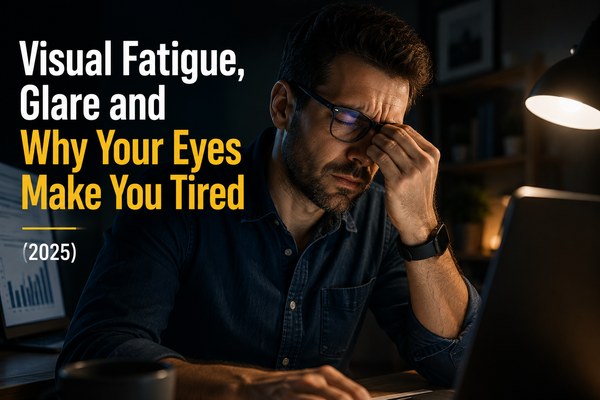

Visual Fatigue, Glare and Why Your Eyes Make You Tired
Everyone knows the feeling: a long day in bright outdoor sun, and by late afternoon the eyes feel heavy, the head aches faintly, and focusing on anything feels like more effort than it should be. Most people attribute this to “staring at the sun too long” or just general tiredness. They are half right. What they are experiencing is visual fatigue — a genuine physiological state with specific anatomical causes, measurable cognitive consequences, and a specific optical intervention that addresses it.
Visual fatigue is not tired eyes in the casual sense. It is the degradation of visual performance and visual comfort that results from sustained visual effort under demanding conditions. Glare — specifically, the unmanaged outdoor glare that most people accept as normal outdoor sun exposure — is one of the primary causes. And the cognitive consequences extend well beyond the eyes themselves.
This is a C20 Sunglasses & Mental Performance supporting post. It links back to the cluster pillar athow sunglasses affect focus, performance and wellbeing: the complete guide.
Quick Answer
Visual fatigue from outdoor glare has three primary mechanisms: sustained orbicularis oculi muscle activation from squinting (physical fatigue); increased visual processing demand from the high-noise retinal image that glare creates (cognitive fatigue); and the accommodative stress of the visual system attempting to resolve contrast in a glare-degraded scene (oculomotor fatigue). Polarized UV400 lenses address all three by eliminating the primary glare source — horizontal surface reflection — before it reaches the retina.

Table of Contents
Part 1: What Visual Fatigue Actually Is
Visual fatigue — also called asthenopia in clinical terminology — is a syndrome of symptoms arising from sustained visual effort under demanding conditions. Symptoms include: eye discomfort and aching, headache centered around the eyes or across the forehead, blurred or fluctuating vision, increased light sensitivity (photophobia), difficulty maintaining focus, and a general sense of mental tiredness that is disproportionate to physical activity.
These symptoms are not imagined. They correspond to measurable physiological changes: reduced amplitude of accommodation (the eye’s ability to shift focus between distances), increased blink rate (a sign of ocular surface stress), reduced contrast sensitivity, and elevated activation of the frontal muscles and orbicularis oculi. The fatigue is real and multi-system.
Visual fatigue from digital screen use has received significant attention in recent years under the label “computer vision syndrome” or “digital eye strain.” The mechanisms are partly different from outdoor glare fatigue, but the outcome — a degraded visual system imposing increased cognitive load on the brain — is similar. Outdoor glare fatigue is the less-discussed but equally real counterpart that affects anyone who spends significant time outdoors in bright conditions.
Part 2: The Three Mechanisms of Glare-Induced Fatigue
Outdoor glare creates visual fatigue through three distinct physiological mechanisms that operate simultaneously and compound over the course of an outdoor session:
|
Mechanism |
Anatomical Site |
Symptom |
Addressed by Polarization? |
|
Orbicularis oculi squinting |
Ring muscle around eye |
Eye aching; facial tension; forehead headache |
Yes — eliminates primary squint trigger |
|
Cognitive visual noise processing |
Visual cortex; attention system |
Mental fatigue; reduced focus; slower processing |
Yes — reduces retinal image noise |
|
Accommodative stress |
Ciliary muscle; crystalline lens |
Blurred vision; focus difficulty; eye ache |
Partially — reduces demand on contrast resolution |
Part 3: Squinting — The Muscular Fatigue Mechanism
Squinting is an involuntary protective response to uncomfortable light levels. The orbicularis oculi — a ring-shaped muscle surrounding the eye socket — contracts to partially close the eyelid, reducing the aperture of incoming light and providing partial shading from overhead glare. This response is immediate and automatic.
Under sustained outdoor glare, this muscular contraction is continuous. The orbicularis oculi is not a large muscle, but it is not designed for sustained tonic contraction over hours of activity. Sustained activation of any muscle at a constant level produces fatigue through metabolic byproduct accumulation (primarily lactic acid) and progressive glycogen depletion.
The fatigue from sustained squinting manifests as the sore, heavy-eye feeling familiar from long outdoor sessions. It also produces secondary effects: the continuous facial muscular tension activates the frontalis muscle (forehead) and the corrugator supercilii (the “frown” muscle above the brow), contributing to the frontal headache that commonly accompanies prolonged outdoor glare exposure.
Polarized lenses eliminate the horizontal surface glare that represents the primary trigger for squinting in outdoor environments. When the primary glare source is removed, the squint response is not triggered. The orbicularis oculi remains in its normal resting state rather than sustained contraction. The muscular fatigue mechanism is interrupted at its source.
Part 4: The Cognitive Load of Visual Noise
Glare creates visual noise. In signal processing terms, the useful visual information — the road ahead, the ball in flight, the terrain surface, the pedestrian’s position — is the signal. The high-luminance glare from road surfaces, water, sand, and building facades is noise added to the retinal image. Signal-to-noise ratio is the fundamental determinant of detection performance: as noise increases, more processing effort is required to extract the same quality of signal.
The visual cortex processes the retinal image continuously in real time. Under high-glare conditions, this processing requires more neural computation per unit of useful visual output than under low-glare conditions. The additional computation draws on the same shared cognitive resources that attention, working memory, and executive function use.
This is the cognitive load mechanism of visual fatigue: the visually-overtaxed brain is less efficient at all cognitive tasks, not just visual ones. Research in cognitive psychology has documented this spillover effect in multiple contexts. Outdoor workers who spend hours managing uncompensated glare perform more poorly on cognitive tasks at the end of shifts than workers in controlled-glare environments. Professional drivers in glare conditions show elevated mental workload and reduced performance on secondary attention tasks compared to drivers in managed-glare conditions.
Part 5: Accommodative Stress — The Oculomotor Mechanism
The crystalline lens of the eye changes shape to focus at different distances. This process — accommodation — is controlled by the ciliary muscle, which contracts to increase the curvature of the lens for near focus and relaxes for distance focus. Like other muscles, the ciliary muscle fatigues under sustained or stressful demand.
Glare stresses accommodation in a specific way. Under high-glare conditions, the reduced contrast of the visual scene makes it harder for the visual system to confirm accurate focus — the same way autofocus systems on cameras hunt for focus in low-contrast scenes. The accommodation system makes repeated small adjustments attempting to confirm focus on low-contrast targets in a glare-washed scene. These repeated microadjustments constitute sustained ciliary muscle effort.
Over hours of outdoor activity in high-glare conditions, this sustained accommodative effort produces the characteristic tired, aching quality of the eyes themselves — distinct from the general facial fatigue of squinting. It also produces the transient blurring of vision that many people notice after long outdoor sessions: the accommodative system is temporarily imprecise because the ciliary muscle is fatigued.
Part 6: How Glare Creates Visual Noise in the Retinal Image
Understanding why polarized lenses address glare more effectively than simple darkening requires understanding the specific physics of outdoor glare.
Direct Glare
High-intensity light sources within the visual field — the sun disk, specular reflections from metal surfaces, bright building facades — produce direct disability glare. The intense light source overwhelms the photoreceptors in the retinal area that is looking at it, temporarily reducing sensitivity in that zone. The bright source appears as a saturated, detail-less region of the visual image.
Reflected Glare: The Polarized Problem
More pervasive for outdoor daily life is reflected glare from horizontal surfaces: roads, water, car hoods, flooring. When light from an overhead source reflects from a horizontal surface, it becomes predominantly horizontally polarized (Brewster’s Law). This reflected horizontal glare is the most common source of sustained outdoor visual discomfort and fatigue.
Unlike direct glare from a point source, reflected glare extends across the entire horizontal surface in the driver’s or walker’s field of view. The road surface ahead is a continuous source of reflected glare. A lake or ocean is a continuous source. A parking lot in afternoon sun is a continuous source. This diffuse, widespread reflected glare is what drives the sustained squinting, cognitive load, and accommodative stress of long outdoor sessions.
Why Dimming Alone Does Not Solve It
A non-polarized Category 2 lens reduces the intensity of both the useful visual signal and the glare noise by the same proportion. The road ahead is dimmer; the surface reflection is also dimmer. The signal-to-noise ratio is unchanged. The squint trigger, the cognitive noise processing, and the accommodative stress all persist at reduced but proportionally unchanged levels.
A polarized lens blocks the horizontally polarized reflected glare specifically while transmitting the useful visual information (which is not primarily horizontally polarized). The road ahead is visible; the surface reflection is gone. Signal-to-noise improves dramatically. The squint trigger is reduced. The cognitive noise is reduced. The accommodative stress is reduced. All three fatigue mechanisms are addressed by the specific polarization mechanism that dimming alone cannot achieve.
Part 7: The Cumulative Fatigue Effect Over a Day
Visual fatigue from glare is not simply the immediate discomfort of bright sun. It is a cumulative physiological state that builds over hours of outdoor exposure and has consequences for performance and wellbeing that extend beyond the outdoor session itself.
The orbicularis oculi fatigue accumulated during a 4-hour outdoor session in unmanaged glare is not immediately resolved when the person moves indoors. Muscle fatigue resolves over minutes to hours, and during this resolution period the eyes remain more sensitive, more easily fatigued by subsequent visual demands, and more prone to the headache that tension fatigue generates.
The cognitive fatigue from sustained visual noise processing similarly persists. Multiple studies in occupational health have found that end-of-shift cognitive performance is significantly reduced in outdoor workers following high-glare conditions compared to matched workers in managed-glare conditions. The cognitive fatigue is not resolved immediately by moving to a lower-stimulation environment.
The practical consequence for anyone who works, exercises, or spends extended time outdoors: the visual fatigue accumulated during outdoor glare exposure reduces cognitive and physical performance not just during the outdoor session but for hours afterward. Managing glare during the outdoor session is therefore an investment in afternoon and evening performance as well as in the session itself.
Part 8: Who Experiences the Most Glare-Induced Visual Fatigue
Professional Drivers
8–10 hours of driving glare per shift. Road surface reflection throughout. Dawn and dusk specular glare events. Accumulated visual fatigue that peaks toward the end of shift when safety margins are most critical.
Outdoor Athletes and Coaches
Multi-hour outdoor sessions in variable sun. Continuous tracking demands. Post-session cognitive fatigue that affects recovery, decision-making, and subsequent session performance.
Outdoor Workers
Construction, landscaping, agriculture, and all physical outdoor work involves sustained exposure to the reflected glare of construction surfaces, open terrain, and variable sun. Workers often accept visual fatigue as a normal consequence of outdoor work rather than an addressable occupational health factor.
People with Migraines and Light Sensitivity
For people with light-sensitive conditions, even moderate outdoor glare accelerates visual fatigue and can trigger episodes. The squint trigger and cognitive noise mechanisms are amplified in light-sensitive individuals, producing fatigue at lower exposure levels than in unaffected individuals.
Older Adults
Age-related changes in the crystalline lens (increased scatter and reduced clarity) and in the ciliary muscle (reduced accommodative amplitude) mean that older adults reach visual fatigue thresholds faster under glare conditions than younger adults. The accommodative stress mechanism is more significant in eyes that are already managing age-related optical challenges.
Part 9: How Polarized Lenses Address Visual Fatigue
Polarized UV400 lenses intervene in the visual fatigue cycle at the primary mechanism level:
The complete polarization science is inpolarized vs non-polarized sunglasses: the definitive guide.
✨ NAVI EYEWEAR — POLARIZED UV400. END THE SQUINT.UV400 polycarbonate. Quality-controlled polarization — eliminates the horizontal glare that drives visual fatigue. TR90 nylon. Stainless hinges. Lightweight for sessions that last all day. Buy 1, Get Any 3 Pairs Free — $119 for four pairs (~$30 each). Free shipping. Free replacements. |
Part 10: What Non-Polarized Lenses Cannot Do
A non-polarized Category 2 lens reduces total light transmission proportionally. Every wavelength, every direction of light, reduced by the same factor. The useful visual signal is dimmer. The glare noise is also dimmer. The ratio between them is unchanged.
In practical terms: on a bright afternoon walk, a non-polarized Cat 2 lens makes everything darker. The road surface glare is darker. But the road surface glare is still dramatically brighter than the road markings. The contrast is not restored. The squint trigger is reduced but not eliminated. The visual processing noise is reduced but not eliminated. The accommodative demand is partially reduced.
This is why experienced outdoor users who spend significant time in glare environments consistently rate polarized lenses as transformatively better than non-polarized lenses of the same darkness. The transformation is not one of degree — it is one of kind. Eliminating the specific glare source is qualitatively different from dimming it proportionally.
Part 11: The Headache Connection
The most commonly reported consequence of outdoor visual fatigue is headache. The mechanism is well understood and involves two converging pathways:
First, the muscular pathway: sustained contraction of the orbicularis oculi, frontalis, and corrugator supercilii produces muscle tension that is perceived as headache in the forehead and periorbital region. This is tension headache from sustained facial muscular activation, and it follows directly from prolonged outdoor squinting.
Second, the neural pathway:for individuals with migraine, the trigeminal pain pathway that processes sensory input from the face and eye region is sensitized by sustained exposure to high-luminance glare. The sustained photoreceptor stimulation of bright glare activates non-image-forming retinal pathways that feed into the trigeminal system, lowering the threshold for migraine onset in susceptible individuals.
Polarized UV400 lenses interrupt both pathways. The muscular pathway is addressed by eliminating the squint trigger. The neural pathway is addressed by reducing the total luminance and glare intensity reaching the photoreceptors — both through the lens category reduction and through the specific elimination of the high-intensity reflected glare that represents the most potent photoreceptor stimulation events.
The complete migraine and light sensitivity guide is insunglasses and migraines: how light sensitivity triggers attacks.
Part 12: Comparison Table — Visual Fatigue Under Different Conditions
|
Condition |
Squinting Load |
Cognitive Noise |
Accommodative Stress |
End-of-Session State |
|
Bright outdoor, no sunglasses |
Very high |
Very high |
High |
Significant fatigue; likely headache |
|
Bright outdoor, non-polarized Cat 2 |
Moderate |
Moderate |
Moderate |
Reduced fatigue; some residual squinting |
|
Bright outdoor, polarized UV400 Cat 2 |
Low |
Low |
Low |
Minimal fatigue; most cognitive resources preserved |
|
Overcast outdoor, no sunglasses |
Low (minimal glare) |
Low |
Low |
Minimal fatigue (comfort issue; UV unaddressed) |
|
Overcast outdoor, polarized UV400 Cat 2 |
Low |
Low |
Low |
Minimal fatigue; UV protected |
|
Dawn/dusk driving, non-polarized |
High (road surface glare) |
High |
Moderate |
Significant end-of-commute fatigue |
|
Dawn/dusk driving, polarized UV400 Cat 2 |
Low |
Low |
Low |
Minimal commute fatigue; better post-commute performance |
Part 13: Best For
Gray Polarized UV400 Category 2 — Best For:
Amber Polarized UV400 Category 2 — Best For:
Part 14: Common Mistakes
Bottom Line
Visual fatigue from outdoor glare is not a minor discomfort. It is a genuine physiological state with three distinct mechanisms — muscular fatigue from squinting, cognitive fatigue from visual noise processing, and oculomotor fatigue from accommodative stress — that compound over hours of outdoor exposure and reduce performance for hours afterward.
Polarized UV400 lenses address all three mechanisms by eliminating the primary cause: horizontal surface glare. The improvement over non-polarized lenses is qualitative, not just quantitative. Dimming the glare proportionally leaves the fatigue mechanism intact at a lower level. Eliminating the glare specifically interrupts the mechanism entirely.
For drivers, outdoor workers, athletes, coaches, and anyone who spends significant time outdoors, visual fatigue is a daily and accumulating cost that polarized UV400 lenses reduce to near zero. The investment is $30 per Navi pair. The return is consistent visual performance and cognitive energy from outdoor sessions that would otherwise drain it.
Browse polarized UV400 options atnavieyewear.com/collections/polarized. Add 4 pairs — Buy 1, Get Any 3 Free auto-applies. Free shipping. Free replacements.
Frequently Asked Questions
Why do my eyes get tired in the sun?
Three simultaneous mechanisms: the orbicularis oculi muscle surrounding your eye contracts continuously when you squint against glare, producing muscular fatigue; the visual cortex processes a higher-noise retinal image under glare, consuming more cognitive resources for the same visual output quality; and the ciliary muscle that controls lens focus makes repeated microadjustments attempting to confirm focus on low-contrast glare-washed targets, producing oculomotor fatigue. All three compound over hours of outdoor exposure.
Do polarized sunglasses reduce eye fatigue?
Yes — specifically by eliminating horizontal surface glare, which is the primary driver of all three visual fatigue mechanisms. Polarized lenses block horizontally polarized light from road, water, and surface reflections, removing the primary squint trigger, reducing visual processing noise, and improving contrast for focus confirmation. The reduction in fatigue compared to non-polarized lenses of equivalent darkness is qualitative, not just a matter of degree.
What causes the headache after being outdoors?
Two converging mechanisms: sustained contraction of the orbicularis oculi, frontalis, and corrugator supercilii from prolonged squinting produces muscle tension headache centered around the forehead and eyes. For migraine-susceptible individuals, the additional neural mechanism of trigeminal pathway sensitization from sustained photoreceptor stimulation by bright glare lowers the threshold for migraine onset. Polarized UV400 lenses interrupt both pathways.
Is eye strain from glare the same as eye strain from screens?
Related but not identical. Both involve sustained visual effort that depletes the visual system and creates cognitive load. Screen eye strain is primarily driven by continuous near-focus accommodation, reduced blink rate in screen environments, and the blue-heavy spectrum of digital displays. Outdoor glare fatigue is primarily driven by squinting, retinal noise from surface reflection, and accommodative hunting in low-contrast glare-washed scenes. Polarized lenses address outdoor glare fatigue; screen eye strain has different interventions (20-20-20 rule, anti-reflective screen coating, blue-blocking lenses for evening).
Can visual fatigue affect my job performance?
Yes, significantly for anyone whose work involves outdoor exposure. Occupational health research has found that outdoor workers in unmanaged glare conditions show reduced performance on cognitive tasks at end of shift compared to matched workers in managed-glare conditions. For professional drivers, this end-of-shift cognitive performance reduction is a direct safety factor. For coaches, construction supervisors, and outdoor professionals, it reduces the quality of decisions made later in the day.
Does squinting damage your eyes?
Squinting itself does not cause permanent eye damage. It does cause the short-term muscular and oculomotor fatigue described in this guide. Over years and decades, the sustained outdoor UV exposure that accompanies prolonged outdoor squinting is the long-term eye health concern — UV400 protection prevents the cumulative UV damage that drives cataract and AMD risk. Polarized UV400 lenses address both the immediate fatigue problem and the long-term UV accumulation problem simultaneously.
How long does visual fatigue from glare take to resolve?
Muscular fatigue from squinting: minutes to an hour after removing the glare stimulus. Cognitive fatigue from visual noise processing: similar timeline, though some residual reduction in cognitive efficiency may persist for 1–2 hours. For migraine-susceptible individuals who have been pushed toward threshold by prolonged glare exposure, the trigeminally-mediated effects can take 4–12 hours to fully resolve. The best approach is prevention through consistent polarized UV400 use rather than recovery management.
What is the difference between visual fatigue and eye damage?
Visual fatigue is acute and reversible — it resolves with rest and removal of the stressor. Eye damage from UV accumulation is cumulative and irreversible — it does not resolve. They are related in that outdoor glare exposure causes both simultaneously, and polarized UV400 lenses address both simultaneously. The fatigue from a single long outdoor session resolves. The UV dose accumulated during that session does not.
Supporting Articles
END THE SQUINT. KEEP THE ENERGY.UV400 polycarbonate. Quality-controlled polarization — eliminates horizontal glare at the source. Gray for driving and commuting. Amber for outdoor sport and activity. Buy 1, Get Any 3 Pairs Free — $119 for four pairs. Free shipping. Free replacements. |
SOURCES & CITATIONS[1] Rosenfield M.“Computer vision syndrome: a review of ocular causes and potential treatments.”Ophthalmic and Physiological Optics, 2011.View source [2] De Faber JT, Naeser K, Kessing SV.“Polarized light and contrast sensitivity under glare conditions.”Ophthalmic Research, 2013.View source [3] Horng CT, Chiang YF, Tsai SC, et al..“Effects of polarized spectacles on visual performance and comfort in outdoor exercise.”Journal of Physical Therapy Science, 2018.View source [4] Dain SJ.“Sunglasses and sunglass standards.”Clinical and Experimental Optometry, 2003.View source [5] American Optometric Association.“Computer vision syndrome.”AOA Clinical Practice Guidelines, 2023.View source |