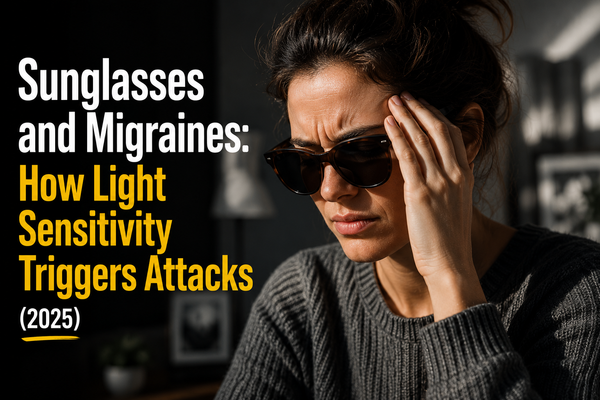

Sunglasses and Migraines: How Light Sensitivity Triggers Attacks
Migraine affects approximately 39 million Americans. For most of them, light is not just uncomfortable — it is a direct physiological trigger for attacks and a debilitating symptom during them. The relationship between light, the visual system, and migraine is not simple photophobia as a side effect. It runs through a specific neurological pathway that connects the eye’s non-image-forming photoreceptors directly to the brain’s pain processing centers.
This guide covers the neuroscience of migraine photophobia, how outdoor light and glare specifically interact with the trigeminovascular pain pathway, what the evidence says about sunglasses as a migraine management tool, the FL-41 clinical tint and its research basis, and the practical outdoor UV400 specification for people managing migraine light sensitivity.
This is a C20 Sunglasses & Mental Performance supporting post. It links back to the cluster pillar athow sunglasses affect focus, performance and wellbeing: the complete guide. For the hormonal dimension of light sensitivity in women, seesunglasses and light sensitivity in women: the hormonal connection.
Quick Answer
Light triggers migraine through the intrinsically photosensitive retinal ganglion cells (ipRGCs) — melanopsin-containing cells that connect the retina directly to the trigeminovascular pain pathway via the posterior thalamus. High-contrast outdoor glare events are particularly potent triggers because they create rapid, intense ipRGC activation. UV400 polarized lenses reduce this activation by eliminating horizontal surface glare (the most intense outdoor glare events) and reducing total short-wavelength light. For the estimated 80–90% of migraine sufferers with photophobia, consistent UV400 polarized outdoor use is a practical trigger-reduction strategy — not a treatment, but a meaningful environmental modification.

Table of Contents
Part 1: The Scale of Migraine in America
Migraine is the third most prevalent disorder worldwide and the second leading cause of disability globally. In the US, approximately 39 million people experience migraine, with women affected at roughly three times the rate of men during reproductive years. The condition is chronically underdiagnosed and undertreated, with many sufferers managing the condition without professional guidance.
The economic burden of migraine in the US is substantial: lost productivity, emergency room visits, medication costs, and the cognitive impairment that affects performance during prodrome, attack, and postdrome phases. For the large majority of migraine sufferers, photophobia — abnormal light sensitivity — is not a peripheral symptom. It is central to the attack experience and to the inter-attack period for those with chronic migraine.
The outdoor world is a high-risk environment for migraine sufferers. Bright sun, surface glare, the rapidly changing luminance of sun-in-shade conditions, and the high-contrast visual patterns of urban environments are all documented migraine triggers. Managing this outdoor light exposure is not a luxury consideration for photophobic migraine sufferers — it is a daily quality-of-life necessity.
Part 2: What Photophobia Actually Is
Photophobia is defined as an abnormal sensitivity to light causing discomfort, pain, or the urge to avoid light. In migraine, photophobia operates at multiple levels:
These three manifestations reflect different aspects of the same underlying pathology: a hypersensitive trigeminovascular pain system that has become sensitized to photic input through the specific retinal-to-pain-center pathway described in the next section.
Part 3: The ipRGC Pathway — How Light Reaches Pain Centers
The mechanism by which light triggers and exacerbates migraine pain was not fully understood until research identified the role of intrinsically photosensitive retinal ganglion cells (ipRGCs). These specialized retinal neurons contain melanopsin, a photopigment sensitive to short-wavelength (blue-green, approximately 480–520nm) light. Unlike the rod and cone photoreceptors responsible for image vision, ipRGCs are primarily involved in non-image functions: circadian rhythm entrainment, the pupillary light reflex, and — critically for migraine — light-mediated pain modulation.
Research by Burstein and colleagues (2010) published in Nature Neuroscience identified the pathway through which ipRGC signals reach pain centers: ipRGCs project via the retinohypothalamic tract to the posterior thalamus, which then connects to the trigeminocervical complex. This creates a direct anatomical link between retinal light input and the trigeminovascular pain processing center. Light activates the pain pathway through this dedicated channel, independent of the visual cortex.
The clinical implication is important: migraine photophobia is not mediated through the visual perception system — it is mediated through a direct retina-to-pain-center pathway. This is why light causes pain in migraineurs even when they are in a dark room with eyes closed — the ipRGC pathway remains active and sensitive. It is also why some blind migraine sufferers still experience light-sensitive migraine attacks.
Part 4: Why Outdoor Glare Is a Specific Migraine Risk
If the ipRGC pathway is maximally sensitive to short-wavelength blue-green light (480–520nm), and if ipRGC activation drives trigeminovascular pain sensitization, then outdoor light sources that are rich in short-wavelength content are specifically risky for migraine sufferers.
Outdoor sky light and surface glare are both relatively rich in shorter wavelengths compared to, for example, incandescent lighting. The sky’s blue color reflects the preferential scattering of shorter wavelengths by the atmosphere (Rayleigh scattering). Surface reflections from water, road, and building facades similarly reflect a disproportionate short-wavelength component.
The combination:outdoor daylight already has a high short-wavelength content relative to artificial light, and the surface reflections that create glare add an intense short-wavelength component at high luminance. For ipRGCs sensitive to this wavelength range, outdoor glare events are among the most potent photic stimuli in daily life.
Part 5: High-Contrast Glare Events and Trigeminovascular Activation
The intensity of trigeminovascular activation from light stimuli depends not only on the absolute brightness but on the rate of change of luminance — how rapidly the light level changes. Rapid luminance transitions are more potent activators of the ipRGC pathway than steady-state bright light at the same average level.
This is why several specific outdoor situations are particularly dangerous triggers for photophobic migraine sufferers:
Part 6: Light as Both Trigger and Symptom
One of the clinically important complexities of migraine photophobia is that light serves as both a trigger for new attacks and a symptom during attacks. This creates a bidirectional relationship between light exposure and migraine that makes management more nuanced than simple avoidance.
For triggers: reducing exposure to the specific outdoor light stimuli that are most potent for a given individual — high-contrast glare, sun-in-shade transitions, specular reflections — reduces the frequency of triggered attacks. This is an environmental management strategy, not a pharmacological intervention.
For symptoms: during an attack, any light is uncomfortable and bright light is severely painful. This is not primarily about UV or glare — it is about the global sensitization of the pain pathway during the attack. Sunglasses of any tint reduce total light input and reduce the pain of ictal photophobia. Dark sunglasses or a dark room are both effective for symptom management during an attack.
The important distinction:for trigger management (preventing attacks), the specific type of light — high-contrast outdoor glare, short wavelength content — matters. UV400 polarized lenses address the trigger profile specifically. For symptom management during an attack (reducing pain), any light reduction helps. Dark lenses or a dark room are appropriate during an attack regardless of polarization or UV specification.
Part 7: What UV400 Polarized Lenses Do for Migraine Sufferers
For people managing migraine with outdoor light sensitivity, UV400 polarized lenses address the trigger profile through two mechanisms:
Polarization Eliminates Specular Glare Events
The specular reflection events from road, water, and building surfaces that represent the most intense rapid-luminance-increase triggers are predominantly horizontally polarized. Polarized lenses block these reflections specifically, eliminating the luminance spikes that are the most potent trigger events. A photophobic migraine sufferer who has experienced the difference between non-polarized and polarized outdoor experience will typically describe the polarized experience as significantly less threatening in terms of trigger exposure.
UV400 Reduces Short-Wavelength Content
UV400 polycarbonate blocks all light to 400nm, removing the UV component that contributes to photoreceptor and ipRGC stimulation below the visible range. While the primary ipRGC sensitivity window (480–520nm) is in the visible range, reducing the total short-wavelength burden at the UV boundary reduces the overall short-wavelength load on the ipRGC system.
Lens Category Reduces Overall Luminance
Category 2 or 3 lenses reduce total luminance, which reduces the magnitude of any luminance event (though not its rate of change specifically). For a sensitized ipRGC pathway operating at reduced threshold, reducing ambient luminance creates a wider buffer between the ambient light level and the activation threshold.
Part 8: The FL-41 Tint — Clinical Evidence
FL-41 is a rose-tinted spectral filter developed specifically for migraine photophobia management. Unlike standard tints that provide general color filtering, FL-41 is precisely specified to absorb light in the 480–520nm wavelength range — the peak sensitivity of melanopsin-containing ipRGCs. The filter is designed to specifically reduce the ipRGC activation that mediates the light-pain connection in migraine.
The Research
Studies by Katz, Digre, and colleagues at the University of Utah found that FL-41 tinted lenses reduced both the frequency and intensity of light-triggered headaches in patients with photophobia-associated migraine. Earlier work by Wilkins and colleagues in the UK identified the specific wavelength range that was most associated with visual discomfort in migraine sufferers, providing the theoretical basis for FL-41’s spectral targeting.
Subsequent Research
Research has extended the FL-41 findings to pediatric migraine populations (Good et al., 2001, finding reduced headache frequency in children with migraine wearing FL-41 lenses) and to other photophobia-associated headache conditions. The evidence base for FL-41 in photophobia management is the most robust of any tint-specific headache intervention.
What FL-41 Is Not
FL-41 is not a standard rose or pink tint. Generic rose-tinted sunglasses do not provide the specific 480–520nm absorption profile of FL-41. The clinical benefit is specific to the precisely characterized spectral filter. FL-41 is available through optometrists and neuro-ophthalmologists who specialize in headache and photophobia management. For people with significant diagnosed migraine photophobia, FL-41 discussed with a headache neurologist or specialist is worth pursuing alongside any standard UV400 outdoor management.
The complete FL-41 guide is inyellow and rose sunglass lenses: low-light performance explained.
Part 9: FL-41 vs Standard UV400 Polarized — When to Use Which
|
Situation |
Recommended Lens |
Rationale |
|
General outdoor UV protection with light sensitivity |
UV400 polarized Cat 2 (gray or amber) |
Complete UV protection + polarization eliminates specular triggers; practical daily use |
|
Diagnosed migraine with significant photophobia |
UV400 polarized + FL-41 (if available) for extreme sensitivity |
FL-41 specifically addresses ipRGC wavelength window; consult neurologist or optometrist |
|
Driving in mixed traffic |
Gray UV400 polarized Cat 2 |
Color accuracy for traffic + glare elimination; FL-41 not needed for color-safe driving |
|
Outdoor sport or exercise with light sensitivity |
Amber UV400 polarized Cat 2 |
Contrast enhancement + glare elimination; trigger management + performance |
|
Severe ictal photophobia during attack |
Dark lens any tint Cat 3 or dark room |
Symptom management; any light reduction helps during active attack |
|
Children with migraine |
UV400 Cat 2; FL-41 if specialist recommends |
Good (2001) research supports FL-41 in pediatric migraine; UV400 as daily standard |
Part 10: Indoor Sunglasses and the Sensitization Risk
A commonly reported behavior in photophobic migraine sufferers is wearing dark sunglasses indoors between attacks as a way of managing interictal photophobia. Headache specialists generally caution against this as a habitual practice.
The concern: the visual system adapts to the lower light level created by wearing dark lenses indoors. Over time, this adaptation may lower the threshold for photic discomfort at normal indoor light levels, effectively increasing photophobia rather than managing it. Paradoxically, the protective behavior may deepen the sensitivity it is trying to address.
The appropriate application of sunglasses for migraine sufferers is outdoor use in the light environments that contain the most potent triggers: direct sun, surface glare, sun-shade transitions. Outdoor UV400 polarized use as a consistent daily practice addresses the trigger profile without the indoor sensitization concern.
For individuals with very severe interictal photophobia whose quality of life indoors is severely affected, specialist guidance from a neurologist or optometrist familiar with headache management is the appropriate resource — not simply darker and darker indoor sunglasses.
Part 11: Hormonal Migraine and Light Sensitivity
For women, hormonal fluctuations across the menstrual cycle create predictable changes in migraine and photophobia susceptibility. The late luteal phase — the days before menstruation, when estrogen and progesterone drop to their monthly low — is associated with peak trigeminal pathway excitability and peak photophobia threshold lowering.
Women in this phase of the cycle are more susceptible to light-triggered migraine attacks from outdoor glare events that would not trigger attacks at other phases. Consistent UV400 polarized outdoor use is particularly valuable during this window — the external trigger reduction compensates somewhat for the internally elevated sensitivity.
The complete guide to hormonal light sensitivity is insunglasses and light sensitivity in women: the hormonal connection.
Part 12: Practical Outdoor Management
For migraine sufferers managing outdoor light sensitivity, the practical recommendations:
✨ NAVI EYEWEAR — UV400 POLARIZED. FOR LIGHT-SENSITIVE DAYS.UV400 polycarbonate. Quality-controlled polarization — eliminates the specular glare events most likely to trigger. Gray or amber polarized. Category 2 for daily outdoor use. Anti-saltwater coating. TR90. Stainless hinges. Buy 1, Get Any 3 Pairs Free — $119 for four pairs (~$30 each). Free shipping. Free replacements. |
Part 13: Comparison Table — Light Exposure and Migraine Risk
|
Light Condition |
ipRGC Activation Level |
Trigger Risk for Photophobic Migraineurs |
Recommended Lens |
|
Direct overhead midday sun, no glasses |
Very high |
High |
UV400 polarized Cat 2–3 |
|
Direct overhead midday sun, UV400 polarized Cat 2 |
Moderate (luminance reduced; glare eliminated) |
Reduced |
Correct specification |
|
Specular glare event (road/water), no glasses |
Very high (rapid onset) |
High — rapid onset most potent |
Polarized eliminates this specifically |
|
Overcast outdoor, no glasses |
Moderate |
Moderate for sensitized individuals |
UV400 Cat 1–2 |
|
Sun-shade transitions, no glasses |
High (rapid changes) |
High — rapid luminance change most triggering |
UV400 Cat 1–2 (lighter for faster adaptation) |
|
Indoor normal lighting, UV400 worn |
Low |
Low |
Remove sunglasses indoors (avoid sensitization) |
|
Active migraine attack, any outdoor light |
Extreme sensitivity |
Severe |
Dark room or Cat 3–4 for symptom management |
Part 14: Best For
Gray Polarized UV400 Category 2 — Best For:
Amber Polarized UV400 Category 2 — Best For:
Part 15: Common Mistakes
Bottom Line
Migraine photophobia is not simply being bothered by bright light. It is a neurologically mediated condition in which specific outdoor light stimuli — primarily high-contrast glare events and short-wavelength-rich light — directly activate the trigeminovascular pain pathway via melanopsin-containing retinal ganglion cells. The research basis for this pathway is well established, and the implications for outdoor light management are specific.
UV400 polarized lenses address the migraine trigger profile by eliminating the horizontal surface glare events most likely to produce rapid ipRGC activation, reducing total luminance and short-wavelength content, and managing the trigger burden that accumulates from prolonged outdoor exposure. They are not a migraine treatment. They are a practical, daily, evidence-informed environmental modification that reduces the trigger exposure of the 39 million Americans who need to manage outdoor light every day of their lives.
Browse UV400 polarized options atnavieyewear.com/collections/polarized. Add 4 pairs — Buy 1, Get Any 3 Free auto-applies. Free shipping. Free replacements.
Frequently Asked Questions
How does light trigger migraines?
Through intrinsically photosensitive retinal ganglion cells (ipRGCs) that contain melanopsin, a photopigment sensitive to blue-green light (480–520nm). These cells project via the posterior thalamus to the trigeminocervical complex — the migraine pain processing center. Outdoor glare events create rapid, intense ipRGC activation that can lower the pain threshold and trigger trigeminovascular activation in susceptible individuals.
Do sunglasses help prevent migraine attacks?
For light-sensitive migraine sufferers, yes — as a trigger-reduction strategy, not a treatment. UV400 polarized lenses eliminate the specular glare events that produce the most potent rapid-luminance ipRGC activation, reduce total short-wavelength light load, and lower overall luminance. Studies of migraine management consistently include light reduction as a behavioral trigger management strategy. Consistent outdoor UV400 polarized use reduces the frequency of light-triggered attacks in photophobic migraine sufferers.
What is FL-41 and does it help migraines?
FL-41 is a precisely specified rose-tinted filter designed to absorb the 480–520nm blue-green wavelength range that is the peak sensitivity of melanopsin ipRGCs. Studies by Katz, Digre, and colleagues at the University of Utah found that FL-41 lenses reduced headache frequency and intensity in photophobia-associated migraine. FL-41 is not a generic rose tint — it is a clinical filter available through optometrists who specialize in headache. For people with diagnosed migraine photophobia, FL-41 is worth discussing with a neurologist or headache specialist.
Are polarized sunglasses better for migraines than regular sunglasses?
Yes, specifically because the specular glare events that polarized lenses eliminate are among the most potent rapid-luminance triggers for photophobic migraine. Non-polarized lenses reduce ambient luminance but do not remove the high-intensity reflection events from road, water, and building surfaces. Polarized lenses eliminate these events before they reach the retina. For migraine sufferers, polarization is not a preference feature — it is a trigger management feature.
Should migraine sufferers wear sunglasses indoors?
Generally not as a habitual practice between attacks. Headache specialists caution that prolonged indoor dark lens use may deepen photophobia through dark adaptation, lowering the threshold for normal indoor light discomfort. For severe ictal photophobia during an active attack, any light reduction helps and dark lenses or a dark room are appropriate. For everyday interictal management, outdoor UV400 polarized use addresses the primary trigger environment without the sensitization risk of indoor use.
What wavelength of light triggers migraines?
The ipRGC (melanopsin) peak sensitivity is at approximately 480–520nm — the blue-green range. Research on FL-41 and migraine photophobia consistently identifies this wavelength range as most associated with migraine photic discomfort. This is also the wavelength range that amber and FL-41 tints preferentially absorb, which provides the rationale for their use in light-sensitive migraine management.
Can outdoor light exposure cause a migraine?
Yes, for photophobic migraine sufferers. Specific outdoor light events — specular glare bursts from vehicles or water, sun-shade transitions on dappled routes, post-rain sun on wet surfaces, and direct overhead midday sun — are documented triggers. The trigger mechanism runs through the ipRGC-to-trigeminovascular pathway described in this guide. Consistent UV400 polarized outdoor use is the daily protective strategy.
Does the time of day affect migraine light sensitivity?
Yes. For menstrual-cycle-associated migraine in women, the late luteal phase (days before menstruation) is the highest-sensitivity period when outdoor glare is most likely to trigger attacks. For circadian-related migraine patterns, the afternoon and early evening — when cumulative photic fatigue from the day has lowered the threshold — can be higher-risk periods. Consistent all-day UV400 polarized use reduces the cumulative trigger burden rather than attempting to manage specific time windows.
Supporting Articles
UV400 POLARIZED. FOR EVERY DAY YOU GO OUTSIDE.UV400 polycarbonate. Quality-controlled polarization — eliminates the specular events that trigger. The daily protective practice for light-sensitive migraine sufferers. Buy 1, Get Any 3 Pairs Free — $119 for four pairs. Free shipping. Free replacements. |
SOURCES & CITATIONS[1] Lipton RB, Stewart WF, Diamond S, et al..“Prevalence and burden of migraine in the United States: data from the American Migraine Study II.”Headache, 2001.View source [2] Noseda R, Burstein R.“Migraine pathophysiology: anatomy of the trigeminovascular pathway and associated neurological symptoms, CSD, sensitization and modulation of pain.”Pain, 2013.View source [3] Katz BJ, Digre KB.“Diagnosis, pathophysiology, and treatment of photophobia.”Survey of Ophthalmology, 2016.View source [4] Wilkins AJ, Sihra N, Myers A.“How precise do spectral filters for headache need to be?.”Ophthalmic and Physiological Optics, 2005.View source [5] Good PA, Taylor RH, Mortimer MJ.“The use of tinted glasses in childhood migraine.”Headache, 1991.View source [6] Hattar S, Liao HW, Takao M, et al..“Melanopsin-containing retinal ganglion cells: architecture, projections, and intrinsic photosensitivity.”Science, 2002.View source [7] American Migraine Foundation.“Understanding migraine: photophobia.”AMF Patient Resources, 2023.View source |