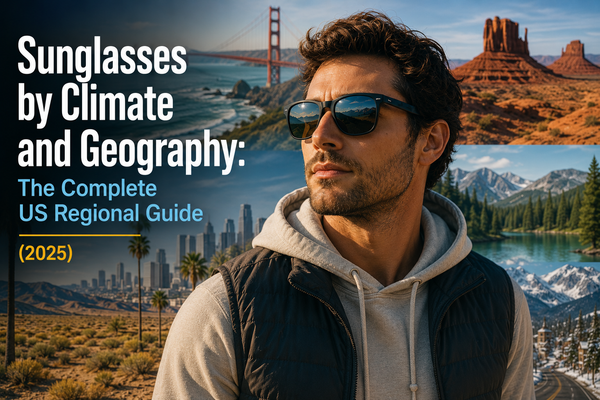

Sunglasses by Climate and Geography: The Complete US Regional Guide
The right sunglass specification is not the same in Phoenix as it is in Seattle. It is not the same on a Colorado ski slope as it is on a Florida beach. Geography, altitude, latitude, humidity, and local reflective surfaces all determine how much UV reaches the eye, how intense the glare is, and what lens category and tint will serve best. Most sunglass buyers pick a pair based on aesthetics and price without ever considering that their climate zone has specific optical requirements.
This guide covers every major US climate zone and the specific sunglass specification each one demands. It uses UV Index data from NOAA and the WHO UV Index framework, regional reflective surface conditions, seasonal variation by region, and the lens properties that matter most in each environment. Whether you live in the Sun Belt, the Mountain West, the Pacific Northwest, the Great Plains, or the humid Southeast, your climate has a specific answer to the question of what goes on your face when you go outside.
This is the C21 Geography & Climate pillar. The supporting posts cover specific regions:sunglasses for hot, sunny climates: the Sun Belt guide,sunglasses in the Pacific Northwest: overcast, rain, and UV you don’t see coming,high altitude sunglasses: UV, snow and mountain conditions,sunglasses for tropical travel: Caribbean, Mexico and Hawaii, andsunglasses in the Great Plains and Midwest: variable UV and open-sky glare.
Quick Answer
Gray polarized UV400 Category 2 handles the full range of US daily conditions from overcast to moderate sun. Cat 3 for the Southwest, high altitude, and sustained beach/coastal use. The Pacific Northwest needs Cat 1–2 UV400 for the frequent overcast days where UV is present but Cat 3 would over-darken. High altitude adds UV intensity that demands Cat 3–4 regardless of air temperature. Humidity, latitude, and reflective surfaces (snow, sand, water) all modify the base UV intensity that latitude alone predicts. The regional guide below provides specific recommendations for each major US climate zone.

Table of Contents
Part 1: How Geography Determines UV Intensity
Solar UV radiation at the Earth’s surface is determined by a combination of factors, the most fundamental of which is the angle of the sun above the horizon. When the sun is overhead, UV passes through a minimum of atmosphere. When the sun is at a low angle (high latitudes, early morning, late afternoon, winter), UV passes through more atmosphere and is attenuated more. This is why UV is highest at low latitudes (near the equator) and in summer (when the sun is highest).
But latitude is only one factor among several. Altitude reduces the atmospheric column that attenuates UV — at 10,000 feet, approximately 25–30% more UV reaches the surface than at sea level in the same latitude. Surface reflectance adds UV bounced upward from snow (85–95% reflection), sand (15–25%), and water (5–15% on average, up to 100% at Brewster’s angle). Low humidity and clean air (common in the Southwest desert) reduce atmospheric scattering that attenuates UV. The combination of these factors means that local UV conditions can vary dramatically within the same latitude band.
The WHO UV Index system quantifies the total effective UV dose at a specific location and time. Index values run from 0 (no UV) to 11+ (extreme). WHO guidance recommends UV eye and skin protection from UV Index 3 (moderate) upward. Current UV Index forecasts by zip code are available from NOAA at weather.gov and from most weather apps.
Part 2: The Five UV Factors
|
Factor |
Effect on UV |
US Examples |
|
Latitude |
Lower latitude = higher UV |
Phoenix (33°N) > Seattle (47°N); Miami (25°N) > Boston (42°N) |
|
Altitude |
+1,000 ft ≈ +3–4% UV |
Denver (5,280 ft) >> Miami (sea level); Breckenridge (9,600 ft) extremely high |
|
Surface reflection |
Snow 85–95%; sand 15–25%; water 5–15% average |
Ski slopes extreme; beaches elevated; open ocean elevated |
|
Humidity / aerosols |
Low humidity = less scatter = more UV |
Sonoran Desert (AZ) very dry = very high UV; Gulf Coast humid = slightly lower |
|
Season |
Summer = highest sun angle = highest UV |
July peak in all regions; UV Index 3+ possible March–October at most US latitudes |
Part 3: The Southwest — Arizona, New Mexico, Southern California, Nevada
UV Profile
The US Southwest produces the highest UV Index values in the continental US. Tucson and Phoenix, Arizona regularly reach UV Index 11+ in June and July — the extreme category. Las Vegas and Albuquerque reach UV Index 9–10. The combination of low latitude, low humidity (dry desert air with minimal UV-scattering aerosols), and high reflectance from desert sand and exposed rock produces UV conditions that are among the most intense in the world outside of high altitude tropical locations.
Year-Round Risk
The Southwest’s mild winters do not mean low UV. Phoenix in January still reaches UV Index 4–5 on clear days — the moderate range. Residents who go without UV protection in the winter months because “it doesn’t feel hot” are still accumulating meaningful UV exposure. Year-round UV400 outdoor use is the correct practice for Southwest residents.
Specification
Part 4: The Sun Belt — Florida, Texas Gulf Coast, Louisiana
UV Profile
The Sun Belt combines the low latitude that produces high UV with the high humidity that provides some UV scattering, resulting in UV Index peaks of 9–11 in summer — high to extreme. Florida is notable: Miami at latitude 25°N has some of the highest UV in the continental US, with UV Index 10–11 common from April through September. The Gulf Coast adds the surface reflection of shallow, clear water across extensive coastal areas.
The Humidity Nuance
Gulf Coast humidity creates more UV-scattering aerosols than the dry Southwest, which provides a small UV reduction compared to a desert environment at the same latitude. However, this reduction is modest and does not significantly change the practical UV protection requirement. UV Index 9–11 in Phoenix and UV Index 9–10 in Miami are both in the extreme-to-very-high range that demands consistent UV400 protection.
Water Reflection
The Gulf of Mexico and Florida’s extensive coast, lakes, and waterways add the water surface reflection component. Open water averages 5–15% UV reflection but can reach much higher at low sun angles. Fishing, boating, beach activities, and outdoor dining in waterfront settings all add the reflected UV component to direct UV.
Specification
Part 5: The Southeast — Georgia, the Carolinas, Alabama, Mississippi
UV Profile
The Southeast sits in the mid-latitude range (30–36°N) and produces UV Index peaks of 8–10 in summer. Atlanta at latitude 33°N reaches UV Index 9–10 in July; Charlotte at 35°N reaches 8–9. The high humidity of the Southeast reduces UV slightly compared to the Southwest at the same latitude, but the peak summer UV is still firmly in the very high to extreme range.
Year-Round Use Window
The Southeast’s long warm season — March through October in most areas, essentially year-round in Georgia and Alabama — means the UV protection window is extended compared to northern states. UV Index 3+ (the WHO recommendation threshold) is achievable in the Southeast from February through November on clear days.
Specification

Part 6: The Mid-Atlantic and Northeast — Virginia Through Maine
UV Profile
The northeast US occupies the 37–47°N latitude band, producing summer UV Index peaks of 7–8 in New York City and 6–7 in Boston. These values are in the high UV range — lower than the Sun Belt but still above the WHO moderate threshold (UV Index 3) from April through September. Winter UV is low but not zero: a clear December day in New York may still reach UV Index 2.
The Four-Season Consideration
The Northeast has the most pronounced seasonal UV variation of any region. Summer requires Cat 2–3 for outdoor use. Winter typically warrants Cat 1–2 for bright clear days. The transition seasons (March–May, September–November) are where UV exposure is often underestimated — spring sunshine feels mild but the UV Index is already in the moderate range.
Specification
Part 7: The Great Lakes Region
UV Profile
The Great Lakes region (Michigan, Wisconsin, Illinois, Indiana, Ohio, western New York) occupies the 40–47°N band and produces summer UV Index peaks of 7–8. The lakes create significant local reflective surface effects: open water across Lake Michigan, Lake Superior, Lake Erie, and Lake Ontario adds UV reflection for shoreline residents and anyone recreating on the lakes.
The Wind and Water Glare Factor
The Great Lakes are consistently windy, and wind on water creates continuous wave action that produces intermittent specular glare from wave surfaces. For sailors, kayakers, and lakefront outdoor users, polarized lenses are specifically effective at managing the horizontal polarized glare from wave action that represents the most fatiguing outdoor glare source in the region.
Specification
Part 8: The Great Plains and Midwest — Kansas, Nebraska, the Dakotas, Iowa
UV Profile
The Great Plains produces UV Index peaks of 8–9 in summer — comparable to the Northeast at similar latitudes but with a significant modifier: open sky. The Great Plains is one of the most open-sky landscapes in North America. Without the tree cover of the East or the terrain shadows of the Mountain West, the sky is 360 degrees of direct and diffuse solar exposure for outdoor users.
The Open-Sky Glare Factor
Flat agricultural landscapes, open prairie, and expansive highway systems produce horizontal glare from paved surfaces, water in irrigation channels and reservoirs, and reflected light from crop surfaces in summer. Polarized lenses are specifically valuable in this environment because the primary glare source — horizontal surface reflection from flat terrain — is exactly what polarization addresses.
Specification
Part 9: The Mountain West — Colorado, Utah, Wyoming, Montana
UV Profile — Altitude Is the Dominant Factor
The Mountain West has a UV profile unlike any other US region: altitude multiplies UV intensity above what latitude alone predicts. Denver at 5,280 feet elevation experiences approximately 15–20% more UV than a sea-level city at the same latitude. Breckenridge, Colorado at 9,600 feet experiences approximately 30–35% more UV than sea level.
In summer, UV Index values at high Mountain West locations can exceed 12 — above the 11+ extreme category. In winter at ski resorts, the combination of high altitude UV plus snow reflection (85–95%) produces UV conditions that can match or exceed summer lowland values despite lower sun angles. A skier at 10,000 feet on fresh snow on a clear Colorado day faces UV conditions that would be considered extreme by any standard.
The Snow Reflection Multiplier
Fresh snow reflects 85–95% of UV. Old snow reflects 50–80%. Even moderate snow cover substantially increases total UV exposure for outdoor users. A mountain hiker or skier receives direct UV from above plus reflected UV from the snow surface below — effectively double-exposure.
Specification
✨ NAVI EYEWEAR — UV400 POLARIZED FOR EVERY US CLIMATE.UV400 polycarbonate. Gray polarized for driving any region. Amber polarized for outdoor recreation. Anti-saltwater coating for coastal use. Oleophobic coating. TR90. Stainless hinges. Buy 1, Get Any 3 Pairs Free — $119 for four pairs (~$30 each). Free shipping. Free replacements. |
Part 10: The Pacific Northwest — Washington, Oregon, Northern California Coast
UV Profile
The Pacific Northwest is the US region most affected by the comfort-vs-protection UV confusion. Seattle at 47°N has lower peak UV than Phoenix (UV Index 5–7 in summer vs 11+), but the critical issue is the cloud cover: Seattle averages approximately 226 cloudy or partly cloudy days per year. On most outdoor days, the sky looks gray and sunglasses do not feel necessary.
However, moderate overcast in Seattle in July still delivers UV Index 3–4 to the ground — the moderate category where WHO recommends eye protection. The annual cumulative UV exposure from consistent overcast outdoor time without protection can be substantial. Pacific Northwest residents who go without UV protection because it never “looks sunny” are accumulating meaningful UV exposure on most outdoor days.
Rain and Wet Surface Glare
The Pacific Northwest’s frequent rain creates wet road conditions on most winter and fall driving days. Polarized lenses are specifically valuable for Pacific Northwest driving because wet road surface reflection — the horizontal polarized shimmer from rain-soaked roads — is the dominant glare source in this region, not direct sun. Gray polarized Cat 2 for Pacific Northwest driving delivers both the UV protection and the wet-road glare elimination that the regional conditions demand.
Specification
Part 11: Southern California (Non-Desert) and Coastal California
UV Profile
Coastal Southern California — Los Angeles, San Diego, Santa Barbara — occupies the latitude range 32–34°N and produces summer UV Index peaks of 9–10. The marine layer — the coastal overcast that blankets much of the Los Angeles basin on summer mornings — reduces visible brightness without proportionally reducing UV. The classic Southern California “June Gloom” produces UV levels that warrant protection despite the grey overcast skies.
The Marine Layer UV Trap
The Southern California marine layer is perhaps the most well-known example of the overcast-UV disconnect in the US. The layer burns off by mid-morning on most summer days, but the period from sunrise to marine-layer-burn-off delivers meaningful UV through a grey sky that does not feel like a sun-protection day. Residents and beach visitors who wait until the sky is clearly blue before applying UV protection miss the morning exposure period.
Specification
Part 12: Hawaii
UV Profile
Hawaii sits at latitude 19–22°N — lower than any continental US state. UV Index peaks in Hawaii reach 11–12+ in summer and 7–9 even in winter. Year-round UV400 protection is non-negotiable for Hawaii residents and visitors. The trade winds that characterize Hawaii’s weather can make the outdoor temperature feel moderate even when UV is in the extreme range — creating the false comfort of not feeling hot while accumulating serious UV exposure.
Tropical Water Reflection
Hawaii’s exceptionally clear tropical water and white sand beaches produce some of the highest combined UV environments in the US. The ocean reflects UV across extensive surfaces, and shallow tropical water allows UV to penetrate and reflect from the sandy bottom. Beach and water outdoor time in Hawaii without UV400 eye protection is a high-exposure event in any season.
Specification
Part 13: Alaska
UV Profile
Alaska’s UV profile is highly variable by region and season. Southcentral Alaska (Anchorage, Juneau) at latitudes 58–60°N has summer UV Index peaks of 4–5 — moderate. Interior Alaska (Fairbanks) at 64°N reaches UV Index 3–4 at peak. However, the extended summer daylight of Alaska — up to 20+ hours per day at the summer solstice in Anchorage — means total daily UV dose can be significant despite the lower intensity per hour.
Snow and Glacier Reflection
Alaska’s extensive glacier and snowfield coverage produces extreme UV reflection for outdoor users in mountain and coastal mountain environments. A glacier hiker in the Alaska Range faces altitude-plus-snow UV conditions that rival Mountain West ski conditions. UV400 Cat 3–4 is appropriate for glacier hiking and Alaska mountain activities even though the latitude-based UV Index alone would suggest moderate conditions.
Specification
Part 14: The Reflective Surface Factor — Snow, Sand, Water
|
Surface |
UV Reflection % |
Effect on Total UV Exposure |
Location Examples |
|
Fresh snow |
85–95% |
Near-doubles total UV exposure (direct + reflected) |
Ski resorts (CO, UT, WY, VT, WA); winter mountain environments |
|
Old/dirty snow |
50–80% |
Significantly increases total exposure |
Urban snow, late-season ski slopes |
|
Sand (beach) |
15–25% |
Elevates total UV 15–25% above direct-only |
Florida, Gulf Coast, California, Hawaii beaches |
|
Ocean / lake surface |
5–15% average; up to 100% at Brewster’s angle |
Variable; highest at low sun angles (dawn/dusk) |
All coastal and lakefront environments |
|
Concrete / pavement |
10–15% |
Modest elevation; significant in urban high-UV settings |
Southwest cities; parking lots; urban outdoor areas |
|
Grass / vegetation |
2–5% |
Minimal reflection; natural ground cover reduces UV |
Parks, lawns, golf courses |
Part 15: Seasonal Variation by Region
|
Region |
Jan UV Index |
April UV Index |
July UV Index |
Oct UV Index |
Year-Round Use? |
|
Southwest (AZ, NV) |
4–5 |
8–9 |
11+ |
7–8 |
Yes |
|
Sun Belt (FL, TX Gulf) |
4–5 |
8–9 |
9–11 |
6–7 |
Yes |
|
Southeast (GA, SC) |
3–4 |
7–8 |
8–9 |
5–6 |
March–November |
|
Mid-Atlantic / Northeast |
1–2 |
5–6 |
7–8 |
3–4 |
April–October |
|
Great Lakes |
1–2 |
4–5 |
7–8 |
3–4 |
April–October |
|
Great Plains (KS, NE) |
2–3 |
5–6 |
8–9 |
4–5 |
March–October |
|
Mountain West (high alt) |
3–5* |
6–8* |
9–12+* |
5–7* |
Year-round at elevation |
|
Pacific Northwest (coast) |
1–2 |
3–4 |
5–7 |
2–3 |
April–September (UV); daily for driving glare |
|
Southern CA coast |
3–4 |
7–8 |
9–10 |
5–6 |
Year-round |
|
Hawaii |
7–9 |
9–10 |
11–12+ |
9–10 |
Yes |
* Mountain West values include altitude adjustment (+15–35% vs sea-level same latitude). Year-round at elevation = Category 3+ appropriate for any mountain outdoor activity throughout the year.
Part 16: Lens Category by Climate Zone
|
Climate Zone |
Summer Category |
Winter Category |
All-Conditions Default |
|
Southwest (AZ, NM, NV) |
Cat 3–4 |
Cat 2–3 |
Cat 3 UV400 polarized |
|
Sun Belt (FL, TX, LA) |
Cat 3 |
Cat 2 |
Cat 2–3 UV400 polarized |
|
Southeast (GA, SC, AL) |
Cat 2–3 |
Cat 1–2 |
Cat 2 UV400 polarized |
|
Mid-Atlantic / Northeast |
Cat 2–3 |
Cat 1 |
Cat 2 UV400 polarized |
|
Great Lakes |
Cat 2–3 |
Cat 1 |
Cat 2 UV400 polarized |
|
Great Plains / Midwest |
Cat 2–3 |
Cat 1–2 |
Cat 2 UV400 polarized |
|
Mountain West (high alt) |
Cat 3–4 |
Cat 3–4 (ski) |
Cat 3 UV400 polarized (adjust by activity) |
|
Pacific Northwest (coast) |
Cat 1–2 |
Cat 1 |
Cat 2 UV400 polarized (driving); Cat 1 for overcast days |
|
Southern CA coast |
Cat 2–3 |
Cat 2 |
Cat 2 UV400 polarized |
|
Hawaii |
Cat 3–4 |
Cat 3 |
Cat 3–4 UV400 polarized |
Part 17: Tint Choice by Activity and Region
|
Activity / Region |
Best Tint |
Reason |
|
Urban driving (all regions) |
Gray polarized |
Color accuracy for traffic signals; glare elimination for road surface |
|
Southwest hiking / desert trail |
Amber polarized |
Contrast enhancement for terrain features in high-UV flat-light desert |
|
Gulf Coast fishing and boating |
Copper polarized |
Enhances sub-surface water visibility through surface reflection elimination |
|
Pacific Northwest driving (rain) |
Gray polarized |
Wet road glare elimination; color accuracy in variable light |
|
Mountain skiing / snow |
Gray polarized (or rose/amber for flat light) |
Color accuracy on slopes; pink/rose for flat-light conditions |
|
Pacific Northwest hiking (overcast forest) |
Amber polarized |
Contrast enhancement in flat-light evergreen forest conditions |
|
Hawaii beach and water |
Gray or copper polarized |
Glare elimination; copper enhances sub-surface clarity |
|
Great Plains open-highway driving |
Gray polarized |
Color accuracy; horizontal surface glare elimination from paved surfaces |
|
Florida coastal outdoor sport |
Amber polarized |
Contrast in high-humidity hazy conditions |
|
Northeast outdoor recreation (forests) |
Amber polarized |
Contrast in dappled light conditions under tree canopy |
Part 18: The Travel Adjustment Problem
One of the most consistent UV exposure errors Americans make is traveling from a low-UV home climate to a high-UV destination without adjusting their sunglass specification. A Seattle resident visiting Phoenix in July is moving from a UV Index 5–7 environment to a UV Index 11+ environment. Their Cat 2 gray polarized Pacific Northwest pair is adequate for driving but insufficient for sustained outdoor activity in Phoenix’s extreme UV.
Similarly, a Florida resident visiting Colorado for skiing may bring beach-appropriate Cat 3 lenses but not account for the tunnel-vision issues and lack of goggle format appropriate for ski conditions. Travel to a new climate zone requires a quick UV assessment of the destination: what is the typical UV Index, what are the dominant reflective surfaces, and does the existing sunglass category match the destination conditions?
The simplest solution: the Navi four-pair purchase provides two or more pairs for rotation across activity and climate types. Amber Cat 2 for desert and mountain recreation, gray Cat 2 for driving, Cat 3 for beach and sustained high-UV outdoor, and a backup pair for the destination bag. The $30 per pair cost makes destination-appropriate rotation accessible.
Part 19: Comparison Table — Regional UV Risk and Specification
|
Region |
Peak UV Index |
Primary Glare Source |
Key Specification Feature |
|
Southwest (AZ, NM) |
11+ (extreme) |
Desert surface; direct sun |
Cat 3–4 UV400 polarized; daily use year-round |
|
Sun Belt coast (FL, TX) |
9–11 (very high–extreme) |
Water reflection; sand |
Cat 3 UV400 polarized; anti-saltwater coating |
|
Southeast (GA, SC) |
8–9 (very high) |
Road surface; variable |
Cat 2–3 UV400 polarized |
|
Northeast (NY, NE) |
7–8 (high) |
Road surface; seasonal water |
Cat 2 UV400 polarized; Cat 3 for beach |
|
Mountain West (CO, UT) |
9–12+ at altitude (extreme) |
Snow reflection; altitude UV |
Cat 3–4 UV400; goggle for ski |
|
Pacific Northwest (WA, OR) |
5–7 summer (moderate–high) |
Wet road surface; overcast UV |
Cat 1–2 UV400 polarized; gray for wet road |
|
Hawaii |
11–12+ (extreme) |
Ocean; sand; tropical water |
Cat 3–4 UV400; anti-saltwater coating |
|
Great Plains (KS, NE) |
8–9 (very high) |
Open-sky horizontal; road |
Cat 2–3 UV400 polarized; gray for driving |
Part 20: Common Mistakes
Bottom Line
The US is not one UV environment. It spans from the extreme UV of the Sonoran Desert to the moderate UV of the Pacific Northwest, from the high-altitude multiplier of the Rockies to the tropical intensity of Hawaii, from the open-sky Great Plains to the canopy-filtered Northeast forests. Each region has a specific sunglass specification that addresses its UV profile, dominant glare sources, and seasonal variation.
The universal constant across all US regions: UV400 polycarbonate and polarization. UV400 because the UV is present in all regions at meaningful levels at least several months of the year. Polarized because every US region has dominant outdoor glare from horizontal surfaces — roads, water, snow, sand, pavement — that polarization specifically addresses. The variable is lens category and tint, which shifts by region and activity from Cat 1 for Pacific Northwest overcast to Cat 4 for Hawaii beach.
Browse UV400 polarized options atnavieyewear.com/collections/polarized. Add 4 pairs — Buy 1, Get Any 3 Free auto-applies. Free shipping. Free replacements.

Frequently Asked Questions
Does where I live affect what sunglasses I need?
Yes, significantly. Latitude, altitude, local reflective surfaces (snow, sand, water), humidity, and seasonal variation all determine the UV Index and glare conditions in your environment. Phoenix residents face UV Index 11+ in summer and need Cat 3–4. Seattle residents face UV Index 5–7 on clear summer days with frequent overcast, and Cat 1–2 UV400 handles most conditions. Hawaii residents face UV Index 11–12+ year-round and need Cat 3–4 consistently.
What sunglasses do I need in the Southwest?
Category 3 UV400 polarized for daily outdoor use, with Category 4 for extended summer outdoor activity at peak UV times. The Southwest’s combination of low latitude, low humidity, and high surface reflectance produces the highest UV in the continental US. Year-round UV protection is appropriate for Southwest residents. The detailed guide is insunglasses for hot, sunny climates: the Sun Belt guide.
Do people in the Pacific Northwest need sunglasses?
Yes. Gray polarized UV400 Cat 2 for driving (wet road surface glare on most driving days) and Cat 1–2 UV400 for outdoor use on overcast days. Moderate overcast in the Pacific Northwest delivers UV Index 3–4, still in the range where UV400 protection is appropriate. The overcast-UV disconnect — the sky looks dim but UV is present — is the primary UV health issue in the Pacific Northwest. The detailed guide is insunglasses in the Pacific Northwest: overcast, rain, and UV you don’t see coming.
How does altitude affect sunglasses?
Every 1,000 feet of altitude increases UV by approximately 3–4% due to reduced atmospheric UV attenuation. At 10,000 feet (common in Colorado and Utah ski resorts), UV is 30–35% higher than at sea level with the same sun angle. Combine this with snow reflection (85–95% UV) and you get UV conditions that can reach extreme levels even in winter. Category 3–4 UV400 is the correct specification for any mountain snow environment. The detailed guide is inhigh altitude sunglasses: UV, snow and mountain conditions.
What sunglasses should I bring to Hawaii?
Category 3–4 UV400 polarized with anti-saltwater coating. Hawaii sits at 19–22°N — lower latitude than any continental US state — and produces UV Index 11–12+ in summer. Year-round UV protection is essential. Copper or gray polarized for water and beach activities. The detailed guide is insunglasses for tropical travel: Caribbean, Mexico and Hawaii.
What lens tint is best for the US climate I live in?
Gray polarized UV400 for driving in all US regions — color accuracy is always the priority for traffic signal reading. Amber polarized for outdoor recreation in contrast-demanding environments (desert, mountain, open plains, forest). Copper polarized for water and fishing activities in coastal and lake environments. The tint is the secondary decision after UV400 and polarization are confirmed.
Does humidity affect UV intensity?
Yes, modestly. High humidity increases UV-scattering aerosols, which reduce the proportion of UV reaching the ground. The dry Southwest desert has less atmospheric UV scattering than the humid Gulf Coast at a similar latitude, contributing to the Southwest’s very high UV. However, the humidity effect is smaller than latitude and altitude effects. A humid Gulf Coast environment still reaches UV Index 9–10 in summer, requiring the same UV400 Category 3 protection as the drier Southwest.
Should I adjust my sunglasses when traveling to a sunnier state?
Yes. A quick UV Index lookup for the destination (weather.gov or any weather app) takes seconds and tells you whether your home-climate lenses are adequate for the destination conditions. A Pacific Northwest resident visiting Phoenix, Miami, or Hawaii should have Cat 3 UV400 polarized for outdoor activity at the destination. The Navi four-pair purchase model makes it practical to own both a Cat 2 all-conditions pair and a Cat 3 high-UV pair without significant additional cost.
Supporting Articles
UV400 FOR YOUR CLIMATE. POLARIZED FOR YOUR GLARE.UV400 polycarbonate. Gray polarized for driving any US region. Amber for outdoor recreation. Cat 2 for daily variable. Cat 3 for Southwest, Hawaii, mountain snow. Buy 1, Get Any 3 Pairs Free — $119 for four pairs. Free shipping. Free replacements. |
SOURCES & CITATIONS[1] World Health Organization.“Global solar UV index: a practical guide.”WHO/SDE/OEH/02.2, 2002.View source [2] National Oceanic and Atmospheric Administration.“UV index forecast by location.”NOAA Weather Service, 2024.View source [3] Sliney DH.“UV radiation ocular exposure dosimetry.”Documenta Ophthalmologica, 1994.View source [4] Taylor HR, West SK, Rosenthal FS, et al..“Effect of ultraviolet radiation on cataract formation.”New England Journal of Medicine, 1988.View source [5] Diffey BL.“Sources and measurement of ultraviolet radiation.”Methods, 2002.View source [6] American Academy of Ophthalmology.“Sunglasses: choosing the right pair for UV protection.”AAO EyeSmart, 2023.View source |