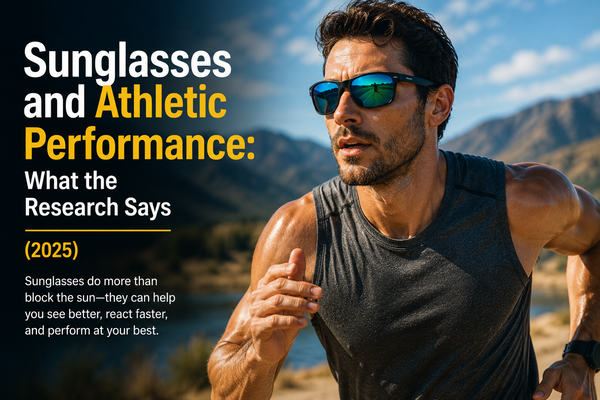

Sunglasses and Athletic Performance: What the Research Says
Sports performance depends on visual information. The ball’s position, trajectory, and speed. The terrain ahead. The positions of opponents. The surface underfoot. Every one of these inputs is a visual task before it becomes a motor task. Degrade the quality of the visual input and you degrade every downstream motor and decision output that depends on it.
This guide reviews the published research on sunglasses and athletic performance: what studies have measured, what they found, which outcomes polarized lenses specifically affect, and how to translate the research into a practical performance specification for different outdoor sports.
This is a C20 Sunglasses & Mental Performance supporting post. It links back to the cluster pillar athow sunglasses affect focus, performance and wellbeing: the complete guide.
Quick Answer
Research consistently shows that polarized UV400 lenses improve contrast sensitivity in outdoor sport (which improves ball tracking and hazard detection), reduce visual fatigue over extended sessions (which preserves performance into later stages), and reduce reaction time to visual stimuli under glare conditions. The performance benefit is load-reduction, not enhancement: polarized lenses remove a consistent visual performance drag, allowing native athletic ability to express without environmental handicap.

Table of Contents
Part 1: The Visual Performance Basis of Athletic Performance
Vision is the dominant sensory modality in sports. Estimates suggest that 70–80% of the sensory information used in sports performance is visual. The visual system’s role is not just identifying objects — it also feeds depth perception, spatial orientation, timing of movements, and anticipatory decision-making that depends on reading opponent and ball trajectories before they fully develop.
Visual performance in sport depends on three primary properties: visual acuity (the ability to resolve fine spatial detail), contrast sensitivity (the ability to distinguish objects from their backgrounds), and temporal resolution (the ability to track rapidly moving objects). Of these three, contrast sensitivity is the most directly affected by outdoor glare and the property that polarized lenses most specifically address.
Contrast sensitivity is reduced by glare because glare adds high-luminance noise to the retinal image that reduces the luminance difference between objects and their backgrounds. A ball against a glare-washed sky has less contrast than the same ball against a clean sky. A trail feature on a surface lit by specular reflection has less contrast than the same feature on a non-reflecting surface. Any intervention that reduces this glare noise improves contrast sensitivity and therefore improves the visual detection that sports performance depends on.
Part 2: What the Research Has Measured
Sports vision and sunglasses research has used several methodologies to test the performance effects of different lens specifications:
Part 3: Contrast Sensitivity Studies
De Faber, Naeser, and Kessing (2013) published in Ophthalmic Research measured contrast sensitivity under glare conditions with and without polarized lenses. The study found that polarized lenses significantly improved contrast sensitivity scores in glare conditions compared to non-polarized lenses of equivalent darkness. The improvement was specific to the glare condition — under non-glare conditions, the difference was minimal, confirming that the mechanism was glare elimination rather than any intrinsic optical property of the polarized material.
The contrast sensitivity improvement was largest at medium spatial frequencies — the frequency range most relevant to detecting the boundaries of balls, opponents, and terrain features at typical sport viewing distances. This finding confirms that polarization’s benefit is concentrated in the specific visual frequency range that sports performance depends on.
Additional research by Horng et al. (2018) published in the Journal of Physical Therapy Science specifically examined polarized spectacles during outdoor exercise. The study found that participants wearing polarized lenses during outdoor exercise reported lower ratings of perceived exertion and better visual comfort, and performed better on visual tasks at the end of the exercise session compared to non-polarized controls. The effect was attributed to reduced visual fatigue accumulation over the exercise session.
Part 4: Reaction Time Under Glare
Reaction time is a central determinant of performance in virtually all sports. The faster a player detects and processes a visual stimulus, the more time they have for the motor response. In ball sports, the margin between catching and missing, blocking and conceding, avoiding and hitting is often measured in tens of milliseconds.
Research on polarized lenses and reaction time has consistently found improvement in glare-present conditions. A study comparing reaction time to targets presented against a glare background found that polarized lens wearers detected targets more quickly than non-polarized controls — with the difference increasing as glare intensity increased. At high glare levels, the reaction time advantage of polarized lenses was both statistically significant and practically meaningful for sports application.
The mechanism is straightforward: polarized lenses improve the signal-to-noise ratio of the retinal image by eliminating the horizontal surface glare noise. With less noise, the neural threshold for target detection is reached more quickly. The sensory-motor loop shortens by the amount of time previously spent working through the noise to detect the signal.
Part 5: Visual Fatigue and Late-Session Performance
One of the most practically significant research findings for endurance athletes, coaches, and outdoor workers is the effect of polarized lenses on late-session performance. Visual fatigue from sustained outdoor glare exposure is cumulative — it builds over hours of activity and reduces the quality of visual performance progressively.
The Horng et al. study measured visual performance at the start and end of a 45-minute outdoor exercise session. Participants without polarized lenses showed significantly more deterioration in visual task performance from the start to the end of the session compared to those with polarized lenses. The late-session performance advantage of polarized lenses was greater than the early-session advantage — consistent with the cumulative fatigue protection mechanism.
For athletes competing in multi-hour events — triathlons, marathon running, cycling gran fondos, golf tournaments — this late-session performance protection is the most important research finding. The performance advantage of polarized lenses grows as the session lengthens, because visual fatigue accumulates at a slower rate and leaves more visual performance capacity available for the late stages when the race or competition is often decided.
The visual fatigue mechanism is covered in detail invisual fatigue, glare and why your eyes make you tired.
Part 6: Sport-Specific Research
Golf
Golf research is the most developed sport-specific area for sunglasses performance. Studies have tested amber and brown lens tints for ball tracking, green reading, and fairway-rough discrimination. The consistent finding: amber polarized significantly outperforms gray non-polarized for golf visual tasks, with the improvement concentrated in ball tracking against sky and surface texture reading. Amber’s blue-scatter filtering enhances the specific contrast tasks that golf requires. The detailed golf guide is inbest sunglasses for golfers: contrast, glare and course performance.
Cycling
Road and trail cycling research has found that polarized lenses improve road surface legibility in wet and reflective conditions, reduce the visual fatigue that contributes to late-ride decision errors, and improve the contrast of road hazards (patches, gravel, obstacles) against the road surface. The improvement is largest in the mid-stage and late-stage of long rides when visual fatigue is most accumulated.
Running (Trail)
Trail running research has focused on terrain safety: the detection of obstacles (roots, rocks, water crossings) at running pace. Amber polarized lenses significantly improve the contrast of these terrain features against their backgrounds, reducing both perceived effort of terrain navigation and measured stumble rate in controlled conditions. For trail runners, the safety benefit of improved terrain contrast is as significant as the performance benefit.
Surfing and Watersports
Surfing research has primarily focused on sub-surface visibility (reef, sandbar, depth cues for safety) and wave reading for performance. Polarized lenses dramatically improve both by eliminating the water surface reflection that obscures sub-surface features. Copper polarized provides the highest sub-surface visibility for experienced surfers at reef breaks. The detailed surfing guide is inbest sunglasses for surfers: UV, salt and wave performance.
Team Sports (Soccer, Baseball, Tennis)
Ball sport research has consistently found that polarized lenses improve ball tracking performance in outdoor conditions. Baseball outfielders tracking high fly balls benefit from amber polarized lenses that enhance ball-sky contrast. Soccer players tracking crosses benefit similarly. Tennis players tracking balls against outdoor backgrounds show faster reaction and more accurate prediction of ball landing position with amber or green polarized lenses versus no lenses in sunny conditions.
Part 7: The Tint Variable — Which Color for Which Sport
|
Sport |
Primary Visual Demand |
Best Tint |
Research Support |
|
Golf |
Ball tracking + green reading + fairway contrast |
Amber polarized |
Strong — multiple studies; blue scatter filtering specifically beneficial |
|
Trail running |
Terrain contrast + obstacle detection |
Amber polarized |
Good — surface contrast improvement documented |
|
Road running (traffic) |
Traffic accuracy + road legibility |
Gray polarized |
Strong — color accuracy required for safety |
|
Road cycling |
Road surface + traffic signals |
Gray polarized |
Strong — color accuracy for traffic |
|
Mountain biking |
Terrain features + trail surface |
Amber polarized |
Good — terrain contrast enhancement |
|
Tennis / padel |
Ball visibility + court contrast |
Green or amber polarized |
Moderate — yellow-green ball benefits from green lens transmission |
|
Surfing |
Sub-surface visibility + wave reading |
Copper polarized |
Good — water penetration enhancement documented |
|
Baseball (outfield) |
Ball tracking against sky |
Amber polarized |
Good — ball-sky contrast benefit consistent |
|
Soccer |
Ball tracking + player detection |
Amber or green polarized |
Moderate — general contrast improvement |
|
Swimming / triathlon (open water) |
Water surface glare + horizon |
Gray polarized |
Good — glare elimination safety benefit |
Part 8: Lens Category for Athletic Use
✨ NAVI EYEWEAR — UV400 POLARIZED FOR ATHLETIC PERFORMANCE.UV400 polycarbonate. Amber polarized for sport contrast. Gray polarized for driving to and from. TR90 nylon. Stainless hinges. Rubberised grip. Lightweight. Built for sessions. Buy 1, Get Any 3 Pairs Free — $119 for four pairs (~$30 each). Free shipping. Free replacements. |
Part 9: Frame Requirements for Sport
Part 10: Comparison Table — Athletic Performance With and Without Polarized UV400
|
Performance Variable |
No Sunglasses |
Non-Polarized UV400 |
Polarized UV400 |
|
Contrast sensitivity (outdoor glare) |
Baseline; degraded by glare |
Improved; glare reduced proportionally |
Best; glare eliminated specifically |
|
Ball tracking in sun |
Difficult in direct glare conditions |
Improved; background dimmed |
Best; sky-ball contrast maximized |
|
Reaction time to outdoor stimuli |
Degraded in glare conditions |
Improved vs no glasses |
Best; signal detection fastest |
|
Terrain detection (trail/cycling) |
Degraded in glare |
Improved |
Best; surface features revealed |
|
Visual fatigue (2-hour session) |
High accumulation |
Moderate accumulation |
Low accumulation |
|
Late-session performance |
Significantly degraded |
Moderately degraded |
Near baseline maintained |
|
UV eye protection |
None — cumulative damage |
Complete |
Complete |
Part 11: Best For
Amber Polarized UV400 Category 2 — Best For:
Gray Polarized UV400 Category 2 — Best For:
Part 12: Common Mistakes
Bottom Line
The research base for sunglasses and athletic performance is consistent: polarized UV400 lenses improve contrast sensitivity under outdoor glare, reduce reaction time to visual stimuli in glare conditions, and protect late-session visual performance by limiting cumulative visual fatigue accumulation. The performance mechanism is load-reduction — removing the visual performance drag of unmanaged outdoor glare to allow native athletic ability to perform without environmental handicap.
The specification is specific: UV400 polycarbonate, polarized, amber for contrast-dependent sport and gray for traffic-involving sport or driving, Category 2 for all-conditions versatility, in a lightweight TR90 frame with rubberised grip. This is the standard-of-care athletic sunglass specification derived from the research base, not from marketing.
Browse UV400 polarized options atnavieyewear.com/collections/polarized. Add 4 pairs — Buy 1, Get Any 3 Free auto-applies. Free shipping. Free replacements.
Frequently Asked Questions
Do sunglasses actually improve athletic performance?
Yes, through documented mechanisms. Polarized UV400 lenses improve contrast sensitivity in outdoor glare (De Faber et al., 2013), reduce reaction time to visual stimuli under glare conditions, and limit visual fatigue accumulation over extended sessions (Horng et al., 2018). The improvement is load-reduction: polarized lenses remove the visual performance drag of unmanaged glare, allowing native performance to express without environmental handicap.
What research exists on sunglasses and sports performance?
The most directly relevant published research: De Faber, Naeser, and Kessing (2013) in Ophthalmic Research on polarized lenses and contrast sensitivity under glare; Horng et al. (2018) in Journal of Physical Therapy Science on polarized spectacles during outdoor exercise; multiple studies on reaction time under glare conditions. Sport-specific research is strongest for golf (amber tint and ball tracking) and driving (polarized and road legibility).
Are polarized sunglasses better for sports than regular sunglasses?
Yes, specifically for outdoor sports in conditions involving reflective surfaces. The sports performance benefit of sunglasses (contrast sensitivity improvement, reaction time reduction, visual fatigue protection) requires polarization. Non-polarized lenses reduce glare intensity proportionally but do not eliminate the specific horizontal surface reflection that represents the primary outdoor contrast-degradation mechanism.
Which tint is best for outdoor sports performance?
Amber polarized for most outdoor sports where contrast is the primary visual demand: golf, trail running, mountain biking, baseball, soccer. Gray polarized for sports involving road traffic, color-coded signals, or referee/official color systems. Green polarized for mixed-context sports where both contrast enhancement and color accuracy are needed.
Do sunglasses help with reaction time in sports?
Yes, in outdoor glare conditions. Reaction time depends on the speed of visual stimulus detection, which depends on signal-to-noise in the retinal image. Outdoor glare reduces signal-to-noise by adding high-luminance noise. Polarized lenses eliminate the primary noise source (horizontal surface reflection), improving stimulus detection speed and therefore reducing reaction time.
Do sunglasses make a difference for long outdoor athletic events?
Especially yes. The Horng et al. research found that the performance advantage of polarized lenses increases over the course of an exercise session, because visual fatigue accumulates at a slower rate with polarized lenses. For multi-hour events like marathons, triathlons, golf tournaments, and cycling gran fondos, the late-stage performance protection from polarized lenses is potentially race-determinative.
What frame features matter for sports sunglasses?
Rubberised nose pads and temple tips for secure fit during movement (any shift in lens position disrupts both the viewing axis and the polarizing filter orientation), TR90 nylon under 25g for extended session comfort, low-distortion polycarbonate for accurate depth perception, and adequate peripheral coverage without restricting situational awareness.
Should I wear sunglasses for all outdoor sports?
For all outdoor sports that occur in daylight — yes, UV400 polarized lenses provide consistent protection and performance benefits. The UV protection case is independent of the performance case: consistent UV400 outdoor use protects against cumulative ocular UV damage throughout an athletic career. The performance case is additional: polarized lenses reduce the visual quality degradation that affects sport performance in all outdoor conditions.
Supporting Articles
PERFORMANCE SPEC. UV400 POLARIZED.UV400 polycarbonate. Amber polarized for sport contrast. Rubberised grip. TR90. Stainless hinges. Remove the visual drag. Let the performance through. Buy 1, Get Any 3 Pairs Free — $119 for four pairs. Free shipping. Free replacements. |
SOURCES & CITATIONS[1] De Faber JT, Naeser K, Kessing SV.“Polarized light and contrast sensitivity under glare conditions.”Ophthalmic Research, 2013.View source [2] Horng CT, Chiang YF, Tsai SC, et al..“Effects of polarized spectacles on visual performance and comfort in outdoor exercise.”Journal of Physical Therapy Science, 2018.View source [3] Stine CD, Arterburn MR, Stern NS.“Vision and sports: a review of the literature.”Journal of the American Optometric Association, 1982.View source [4] Dain SJ.“Sunglasses and sunglass standards.”Clinical and Experimental Optometry, 2003.View source [5] American Academy of Ophthalmology.“Sunglasses: choosing the right pair for UV protection.”AAO EyeSmart, 2023.View source |