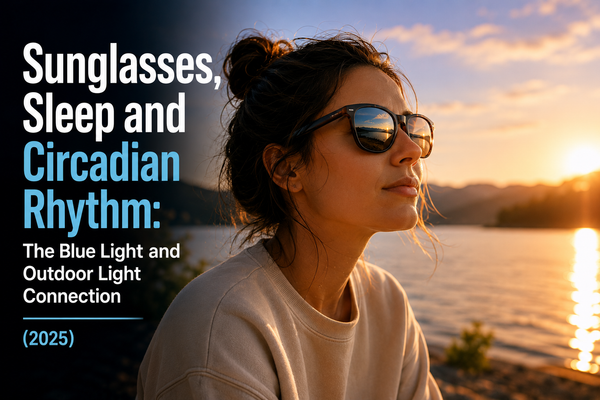

Sunglasses, Sleep and Circadian Rhythm: The Blue Light and Outdoor Light Connection
Light is the most powerful regulator of the human biological clock. The suprachiasmatic nucleus (SCN) in the hypothalamus sets the timing of nearly every physiological process in the body — hormone release, core body temperature, metabolism, alertness, and sleep — by reading light signals from the retina. Get those signals right, and sleep, performance, and health align. Disrupt them, and the downstream consequences accumulate over days, weeks, and years.
Sunglasses sit at an interesting intersection in this story. Outdoor light exposure during the day is one of the most powerful drivers of healthy circadian entrainment — and UV400 sunglasses allow people to spend more time comfortably outdoors, increasing that exposure. Evening blue light exposure from screens and artificial lighting disrupts circadian timing and suppresses melatonin — and amber or blue-blocking lenses worn in the evening can reduce that disruption. The sunglasses question is not simply “do they help or hurt sleep” — it is about understanding which light environments sunglasses optimize for, and when.
This is a C20 Sunglasses & Mental Performance supporting post. It links back to the cluster pillar athow sunglasses affect focus, performance and wellbeing: the complete guide.
Quick Answer
Daytime UV400 outdoor use supports circadian health by enabling more comfortable extended outdoor light exposure, which strengthens the daytime light signal that anchors circadian timing. Evening blue-blocking or amber lenses reduce the short-wavelength light that suppresses melatonin and delays sleep onset. Do not wear UV400 sunglasses in the first 30–60 minutes of morning outdoor light if circadian anchoring is the goal — the SCN needs a clear morning light signal. After that, UV400 polarized use throughout the day, with amber or blue-blocking lenses after sunset or in the 1–2 hours before intended sleep.

Table of Contents
Part 1: The Circadian Clock — How Light Sets It
The human circadian clock runs on an approximately 24-hour cycle driven by an internal pacemaker in the SCN. Without external time cues, this internal clock drifts — free-running at slightly longer than 24 hours in most people. Light exposure — specifically, the timing, intensity, and spectral content of light reaching the retina — is the primary zeitgeber (time-setting signal) that resets the clock to the actual 24-hour day.
Light exposure in the morning (within 1–2 hours of waking) advances the circadian phase: it signals that daytime has begun and anchors the timing of cortisol release, body temperature rise, and alertness onset. Light exposure in the evening delays the circadian phase: it signals that daytime continues, suppresses melatonin release, and delays the timing of sleep readiness.
Disrupted circadian entrainment — from insufficient morning light, excessive evening light, irregular schedules, or shift work — is associated with poor sleep quality, reduced daytime alertness, mood disturbance, metabolic dysfunction, and increased risk of numerous chronic conditions. The light exposure patterns of modern American life — office-based work, artificial indoor lighting, evening screen use — are poorly matched to the circadian system’s needs.
Part 2: The ipRGC Light Pathway and the SCN
The photoreceptors that drive circadian entrainment are not the rods and cones responsible for vision. They are intrinsically photosensitive retinal ganglion cells (ipRGCs) — a specialized population of retinal neurons containing the photopigment melanopsin, maximally sensitive to blue wavelengths around 480nm.
ipRGCs project directly to the SCN via the retinohypothalamic tract. When ipRGCs are activated by blue-rich short-wavelength light, they signal the SCN to update the clock’s phase estimate. The SCN uses this signal to determine what time of day it is and to coordinate the timing of every downstream biological process.
The spectral sensitivity of ipRGCs — peaked at 480nm, falling off at both shorter and longer wavelengths — explains why blue light is the most potent circadian signal. A bright incandescent bulb is much less circadian-active than an equivalent brightness LED with a strong blue component. Natural outdoor skylight has a high blue component (Rayleigh scattering makes the sky blue) and is one of the most potent ipRGC stimulators, which is exactly what the circadian system needs during the day.
Part 3: Morning Light — The Anchor Signal
The single most well-established behavioral intervention for circadian health is morning outdoor light exposure — specifically, direct outdoor light in the first 1–2 hours after waking. Research by Huberman, Czeisler, and others has consistently found that morning outdoor light exposure of 10–30 minutes on a clear day (or longer on overcast days) produces measurable improvements in sleep timing, sleep quality, daytime alertness, and mood.
The mechanism: morning bright light provides a strong, clear ipRGC activation signal that advances the circadian phase, anchoring the clock to the actual sunrise time. This anchoring makes the sleep-wake timing more robust, daytime alertness sharper, and evening melatonin onset more timely.
The critical nuance:for this morning anchor signal to work effectively, the light must reach the ipRGCs at adequate intensity. Outdoor light — even on overcast days — is typically 10,000–100,000 lux. Indoor light is typically 100–500 lux. The intensity difference is enormous, and the ipRGC response is dose-dependent. Even overcast outdoor morning light delivers far more circadian signal than a bright indoor environment.
Part 4: Daytime Outdoor Light — Why More Is Better for Sleep
Research on circadian health consistently finds that people with greater total daytime light exposure sleep better, fall asleep more easily, and have more stable circadian timing. A landmark study by Phillips et al. in Science Translational Medicine found that increasing outdoor light exposure during the day was one of the most effective interventions for improving sleep quality in controlled conditions.
The mechanism works in two directions. Daytime light activates the circadian system and suppresses daytime melatonin (appropriate — melatonin is a nighttime signal), increasing daytime alertness and making the evening contrast between light and dark more distinct. The greater the daytime light-dark contrast the circadian system experiences, the more robust its entrainment and the more timely its evening melatonin release.
People who spend most of their day in artificially lit indoor environments receive a weak, blue-deficient daytime light signal that provides poor circadian anchoring. Their circadian systems are less well-entrained, melatonin onset is less predictable, and sleep quality is poorer on average. Increasing outdoor exposure during the day — even brief outdoor breaks — significantly improves these outcomes.
Part 5: How UV400 Sunglasses Support Daytime Circadian Health
UV400 sunglasses reduce UV and visible light, which might seem to reduce the circadian signal from outdoor light. In practice, their net effect on circadian health is positive for most people, through a specific mechanism: they enable longer, more comfortable outdoor time by eliminating the discomfort of UV exposure and glare.
The limiting factor for most people’s outdoor daytime light exposure is not preference — it is the discomfort of unmanaged outdoor light and the UV risk of extended exposure. People who find outdoor sun uncomfortable without eye protection spend less time outdoors. People who find outdoor sun comfortable with UV400 polarized protection spend more time outdoors. The net circadian light exposure is higher with UV400 sunglasses than without them, because the sunglasses remove the discomfort barrier.
The ipRGC activation that drives circadian entrainment is not significantly reduced by UV400 polarized Category 2 lenses. Category 2 lenses reduce visible light by 57–82%, but the outdoor light levels are so high (10,000–100,000 lux) that the transmitted light through Cat 2 lenses is still far above the threshold for robust ipRGC activation and circadian entrainment. The circadian signal is preserved while the damaging UV is blocked and the discomfort of glare is eliminated.
Part 6: The Evening Blue Light Problem
The circadian problem in modern life is not primarily about daytime light — it is about evening light. Screens (phones, tablets, computers, televisions), LED lighting, and fluorescent office lighting all emit significant blue-wavelength light in the 450–500nm range that activates ipRGCs and signals the SCN that daytime continues.
Evening ipRGC activation suppresses melatonin release from the pineal gland. Melatonin is the body’s chemical signal of darkness and the primary trigger for sleepiness and sleep initiation. When evening light suppresses melatonin, sleep onset is delayed, sleep architecture is disrupted (less slow-wave deep sleep and less REM), and the total restorative effect of sleep is reduced.
The evening blue light problem is compounded in people whose daytime circadian signal was already weak (indoor workers, shift workers, those in northern latitudes in winter). A weak daytime signal and a strong evening signal produce maximally disrupted circadian timing.
Part 7: Melatonin, Blue Light, and Sleep Onset
Gooley et al. (2011) published in the Journal of Clinical Endocrinology and Metabolism found that room-light exposure before bedtime compared to dim light suppressed melatonin onset by approximately 90 minutes and shortened melatonin duration by approximately 90 minutes. The implications for sleep architecture and next-day alertness are substantial.
The spectral sensitivity of melatonin suppression follows the ipRGC response curve: maximally sensitive at 480nm (blue-green), dropping off significantly above 550nm (green-yellow) and essentially absent above 600nm (orange-red). Amber and orange wavelengths do not suppress melatonin meaningfully. Blue-green wavelengths suppress it powerfully.
This spectral dependency is the biological basis for blue-blocking or amber lenses in the evening. By filtering the 450–500nm blue-green wavelengths that drive melatonin suppression, these lenses allow continued light exposure for visual tasks while substantially reducing the circadian disruption of that exposure.
Part 8: Blue-Blocking and Amber Lenses — The Evening Application
Amber and orange-tinted lenses (including blue-blocking glasses marketed specifically for sleep) filter the blue-green wavelengths most responsible for melatonin suppression. The mechanism is the same as amber sunglass tints: the lens absorbs shorter wavelengths (blue) while transmitting longer wavelengths (green, yellow, orange, red).
Evening amber or blue-blocking lens use (typically starting 1–2 hours before intended sleep) reduces the melatonin-suppressing impact of continued light exposure from screens and ambient lighting. The visual task of using a phone or computer is maintained — the amber tint does not eliminate the ability to see; it filters the specific wavelengths driving the circadian disruption.
The practical formats for evening blue-blocking include dedicated non-prescription blue-blocking glasses, clip-on amber filters over prescription glasses, and screen filter software that shifts screen color temperature toward warmer wavelengths (though physical lens filtering is more complete than software filtering). For daytime outdoor use, amber polarized UV400 lenses provide both the sun protection and glare elimination of daytime use and the blue-scatter filtering that has some circadian-supportive properties in the daytime context.
Part 9: The Research on Blue-Blocking Lenses and Sleep
Burkhart and Phelps (2009) published in Chronobiology International conducted a randomized controlled trial in which participants wore blue-blocking glasses (amber-tinted) for 3 hours before bedtime for 2 weeks. The blue-blocking group showed significant improvements in sleep quality scores compared to the control group wearing clear glasses. The improvements included shorter sleep onset latency, better subjective sleep quality, and improved morning alertness.
A 2021 meta-analysis in Sleep Medicine Reviews examined multiple RCTs on blue-blocking glasses and sleep outcomes. The analysis found consistent evidence of improvement in sleep quality and subjective wellbeing with evening blue-blocking lens use, though effect sizes varied and the field would benefit from larger trials. The direction of evidence is consistent: evening blue-blocking reduces melatonin suppression and improves sleep quality outcomes.
The 2015 study by Rahman et al. specifically tested amber versus clear lenses in adults with sleep difficulties. The amber lens group showed increased sleep quality and reduced sleep onset time compared to the clear lens control. The effect was attributed to the reduction in melatonin-suppressing blue-green wavelength exposure during the 2-hour evening protocol.
Part 10: Morning Sunglasses and Circadian Timing — The Nuance
The morning outdoor light recommendation creates a nuance for sunglass use: for the morning anchor signal to work most effectively, the light reaching the ipRGCs needs to be at adequate intensity, and UV400 Category 2 or 3 sunglasses reduce that intensity by 57–90%.
The practical guidance: for the specific purpose of morning circadian anchoring, the first 10–30 minutes of outdoor morning light ideally occurs without sunglasses (or with the lightest available category) to maximize ipRGC activation. After this initial morning signal is received, UV400 polarized use for the rest of the outdoor day is appropriate and supports extended comfortable outdoor time that contributes to total daytime light dose.
This is not a significant daily management burden. A 10–30 minute morning walk or outdoor coffee without sunglasses, followed by UV400 polarized for the rest of the day, captures both the morning circadian anchor and the full-day UV protection benefit. In overcast conditions, even longer morning outdoor exposure without sunglasses is appropriate since the UV risk at low overcast light levels is lower.
Part 11: The Athlete and Shift Worker Dimension
Athletes
Outdoor athletes — runners, cyclists, triathletes, golfers — often train at dawn or in the morning, which provides a powerful daily circadian anchor from outdoor light exposure. UV400 polarized use for the main training session (after the initial morning light window) provides both the UV protection and the performance benefits documented in the athletic performance research. Athletes who train outdoors regularly and who manage evening light with blue-blocking after 9 PM have optimal circadian conditions for sleep quality and recovery.
Shift Workers
Shift workers face disrupted circadian timing as an occupational condition. Night workers need to suppress the morning light signal that would prevent them from sleeping after a night shift — in this context, dark UV400 sunglasses worn during the commute home after a night shift can help prevent the morning light from anchoring the clock to the wrong phase. Evening workers (afternoon to midnight) may benefit from morning outdoor light to anchor daytime alertness. The circadian management for shift workers is complex and individual; UV400 sunglasses are one element of a broader light management strategy.
✨ NAVI EYEWEAR — UV400 FOR THE DAY. PROTECT THE NIGHT TOO.UV400 polarized for daytime outdoor use — comfortable extended outdoor light that supports circadian health. Amber tint for evening use — blue-scatter filtering that supports melatonin timing and sleep quality. Buy 1, Get Any 3 Pairs Free — $119 for four pairs (~$30 each). Free shipping. Free replacements. |
Part 12: Practical Daily Light Management
|
Time of Day |
Recommended Light Behavior |
Sunglass Role |
|
First 30 min after waking |
Get outdoors immediately if possible; direct sky exposure |
No sunglasses or lightest category to maximize ipRGC activation |
|
Morning (post-anchor, rest of morning) |
Continued outdoor exposure during commute, exercise, or outdoor activity |
UV400 polarized Cat 2 — protect and extend comfortable outdoor time |
|
Midday |
Outdoor light most intense; UV peak |
UV400 polarized Cat 2–3 as appropriate for conditions |
|
Afternoon |
Continued outdoor light; UV declining |
UV400 polarized Cat 2 |
|
Evening (2 hrs before sleep target) |
Reduce bright light; reduce screens or filter blue |
Amber or blue-blocking lens indoors if using screens or bright lights |
|
Bedtime |
Darkness; no bright light |
No sunglasses; dark room |
|
Night shift commute home |
Block dawn light to prevent phase anchoring |
Dark UV400 sunglasses to suppress morning light signal |
Part 13: Comparison Table — Lens Types and Circadian Impact
|
Lens / Situation |
Daytime Circadian Effect |
Evening Circadian Effect |
Sleep Quality Impact |
|
No sunglasses outdoors (daytime) |
Maximum ipRGC signal; strong anchor |
N/A |
Positive if morning-timed; UV damage concern |
|
UV400 polarized Cat 2 (daytime) |
Strong ipRGC signal (outdoor lux still high) |
N/A |
Positive — enables extended outdoor time |
|
UV400 Cat 3 (sustained daytime) |
Reduced but still adequate outdoor signal |
N/A |
Positive overall; avoid excessive daytime darkening |
|
Amber/blue-blocking (evening) |
Not for daytime use |
Reduces melatonin suppression; supports sleep onset |
Positive — multiple RCTs show improvement |
|
Clear lens (evening) |
N/A |
No filtering; full melatonin suppression |
No improvement over no glasses |
|
Dark sunglasses in bright indoor |
May reduce daytime signal if worn indoors |
N/A |
Neutral to negative — reduces daytime light dose |
|
Night shift worker UV400 morning commute |
Suppresses unwanted morning anchor |
N/A |
Positive for shift worker sleep timing |
Part 14: Best For
UV400 Polarized Category 2 (Daytime Outdoor) — Best For:
Amber / Blue-Blocking Lenses (Evening Use) — Best For:
Part 15: Common Mistakes
Bottom Line
Sunglasses and sleep are connected through the circadian light system in a specific and nuanced way. Daytime UV400 outdoor use supports circadian health by enabling more comfortable extended outdoor exposure, increasing the daytime light signal that anchors circadian timing, without meaningfully reducing ipRGC activation (because outdoor light levels are so high that even heavily filtered light provides adequate signal). Evening amber or blue-blocking lens use reduces melatonin suppression from evening screen and artificial light, improving sleep onset timing and sleep quality in multiple RCTs.
The practical daily protocol: brief unfiltered morning outdoor light exposure for circadian anchoring, UV400 polarized for the rest of the outdoor day for UV protection and performance, and amber or blue-blocking in the 1–2 hours before sleep for melatonin management. This protocol is grounded in circadian science and requires no disruption to daily activity.
Browse UV400 polarized options atnavieyewear.com/collections/polarized. Add 4 pairs — Buy 1, Get Any 3 Free auto-applies. Free shipping. Free replacements.
Frequently Asked Questions
Do sunglasses affect circadian rhythm?
Yes, through two mechanisms. Daytime UV400 outdoor use enables more comfortable extended outdoor light exposure, increasing the daytime ipRGC activation signal that anchors circadian timing. Evening amber or blue-blocking lenses reduce the melatonin-suppressing blue-green wavelengths from screens and artificial lighting, supporting earlier melatonin onset and better sleep. The net circadian effect of UV400 outdoor use is positive because it enables more outdoor time.
Can wearing sunglasses during the day hurt sleep?
Only if they significantly reduce the morning circadian anchor signal. For the first 10–30 minutes of morning outdoor exposure, delaying UV400 use maximizes ipRGC activation for circadian anchoring. After that, UV400 use throughout the outdoor day is neutral to positive for circadian health — the outdoor light transmitted through Category 2 lenses is still far above the threshold for circadian entrainment.
Do blue-blocking glasses improve sleep?
Multiple RCTs show yes. Burkhart and Phelps (2009, Chronobiology International) found improved sleep quality scores with evening amber lens use. A 2021 meta-analysis in Sleep Medicine Reviews found consistent evidence of improvement across multiple trials. The mechanism is melatonin-suppression reduction by filtering the 480nm blue-green wavelengths that activate ipRGCs in the evening.
What color lens is best for sleep?
Amber or orange-tinted lenses for evening use, filtering blue-green wavelengths (450–500nm) that drive melatonin suppression. Red-orange tints provide even more complete short-wavelength filtering but impair color vision more significantly. Amber provides a practical balance of blue-filtering and color usability for evening screen and indoor use.
Should I get morning light before wearing sunglasses?
Yes, if circadian anchoring is a priority. 10–30 minutes of outdoor morning light without sunglasses provides the most effective daily circadian anchor signal. After this initial morning exposure, UV400 polarized use for the rest of the day protects UV without significantly reducing the circadian signal, because outdoor light levels are so high that the filtered light is still circadian-activating.
What is the connection between outdoor light and sleep quality?
Daytime outdoor light exposure increases ipRGC activation, suppresses daytime melatonin (appropriate — melatonin is a nighttime signal), sharpens daytime alertness, and creates a strong light-dark contrast that makes the circadian system’s timing more robust. People with greater daytime light exposure consistently show better sleep quality, faster sleep onset, and more stable sleep timing. The research by Phillips et al. in Science Translational Medicine and multiple subsequent studies support this relationship strongly.
Are amber lenses the same as blue-blocking glasses?
Amber sunglass tints and blue-blocking glasses marketed for sleep share the same mechanism — blue-wavelength filtration. The practical difference is positioning: amber UV400 polarized lenses are designed for outdoor daytime sport and activity use, providing UV protection and glare elimination alongside blue-scatter filtering. Blue-blocking glasses marketed for sleep are designed for evening indoor use, prioritizing blue-wavelength filtration without necessarily providing UV400 protection. For evening indoor use, a dedicated blue-blocking lens without UV400 specification is often more comfortable (lower tint) and adequate.
Can sunglasses help with jet lag?
Yes, as part of a deliberate light management strategy. Jet lag is circadian disruption from rapid timezone shift. Recovering from jet lag requires strategic light exposure at the destination timezone’s morning and avoidance of light in the destination’s evening. Dark UV400 sunglasses can suppress unwanted light signals during the adjustment period when avoiding light at the wrong phase, while UV400 outdoor use at the correct local morning time accelerates re-entrainment.
Supporting Articles
UV400 FOR THE DAY. SUPPORT THE NIGHT.UV400 polarized — comfortable outdoor light exposure that anchors your circadian clock. Amber tint for evening — blue-filtering that supports melatonin and sleep quality. Buy 1, Get Any 3 Pairs Free — $119 for four pairs. Free shipping. Free replacements. |
SOURCES & CITATIONS[1] Gooley JJ, Chamberlain K, Smith KA, et al..“Exposure to room light before bedtime suppresses melatonin onset and shortens melatonin duration in humans.”Journal of Clinical Endocrinology and Metabolism, 2011.View source [2] Burkhart K, Phelps JR.“Amber lenses to block blue light and improve sleep: a randomized trial.”Chronobiology International, 2009.View source [3] Shechter A, Kim EW, St-Onge MP, Westwood AJ.“Blocking nocturnal blue light for insomnia: a randomized controlled trial.”Journal of Psychiatric Research, 2018.View source [4] Hattar S, Liao HW, Takao M, et al..“Melanopsin-containing retinal ganglion cells: architecture, projections, and intrinsic photosensitivity.”Science, 2002.View source [5] Phillips AJK, Vidafar P, Burns AC, et al..“High sensitivity and interindividual variability in the response of the human circadian system to evening light.”PNAS, 2019.View source [6] Czeisler CA, Duffy JF, Shanahan TL, et al..“Stability, precision, and near-24-hour period of the human circadian pacemaker.”Science, 1999.View source |