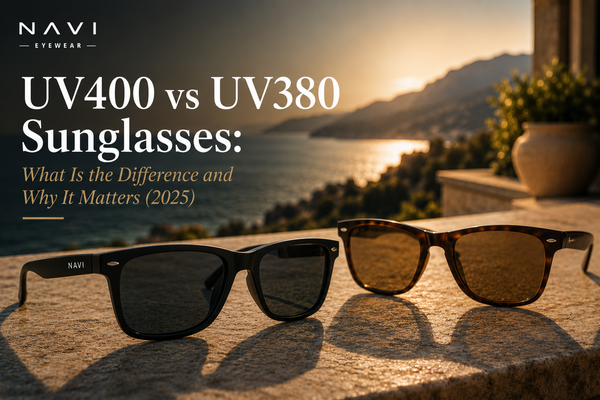

UV400 vs UV380 Sunglasses: What Is the Difference and Why It Matters
Walk into a pharmacy, a tourist shop, or scroll through a budget online retailer and you will find sunglasses labelled with a confusing mix of UV claims. UV400. UV380. “100% UV protection.” “UV-blocking lenses.” Some of these labels mean the same thing. Some do not. And the difference between UV380 and UV400 is not trivial — it is the difference between blocking all ultraviolet radiation that reaches the Earth’s surface and leaving a meaningful window of UV open to reach your eyes.
This guide explains the UV spectrum, what the numbers actually mean, what lives in the gap between 380nm and 400nm, and why UV400 is the only standard worth buying. No jargon for its own sake. Just the science that lets you read a product label and know exactly what you are and are not getting.
This is a C12 Comparison and Best For supporting post. It links back to the C12 cluster pillar atNavi Eyewear vs Ray-Ban: an honest comparison. For the complete UV eye health science including how UV accumulates over a lifetime and the diseases it drives, seeUV and eye disease: the complete guide to cataracts, macular degeneration and more.
Quick Answer
UV400 blocks all ultraviolet radiation from 100–400nm — covering 100% of UVA and UVB that reaches the Earth’s surface. UV380 blocks UV only to 380nm, leaving a 20nm window of UVA (380–400nm) unblocked. That window contains meaningful UVA energy that reaches the retina and contributes to long-term ocular damage. UV400 is the international standard for complete UV eye protection. UV380 is not sufficient. Always buy UV400.

Table of Contents
Part 1: The UV Spectrum — What the Numbers Mean
Ultraviolet Radiation and Wavelength
Electromagnetic radiation is categorized by wavelength, measured in nanometres (nm). Visible light — the light humans can see — occupies roughly 380–700nm. Below 380nm, the radiation becomes ultraviolet: invisible to the human eye but biologically active on living tissue. The shorter the wavelength, the higher the energy per photon, and generally the more damaging the radiation per unit of exposure.
The Three UV Bands
Where Do 380 and 400 Sit on This Spectrum?
Both 380nm and 400nm sit within the UVA band. The visible light spectrum begins at approximately 380nm — the boundary between ultraviolet and the violet end of visible light. So UV380 claims to block UV up to the point where it transitions into visible light. UV400 claims to block UV up to 400nm, which is 20nm deeper into what is technically still the UV spectrum — specifically, the upper end of UVA.
The gap between 380nm and 400nm is entirely within the UVA range. It is UV that reaches the eye from above and from reflective surfaces. It is invisible to the eye but biologically active on the lens and retina. A UV380 lens does not block it. A UV400 lens does.
Part 2: What UV400 Blocks
UV400 certification means the lens blocks all electromagnetic radiation from 100nm to 400nm. In practical terms, this covers:
UV400 is the complete UV protection standard. There is no meaningful UV that reaches Earth’s surface above 400nm — at 400nm, the electromagnetic spectrum transitions into visible violet light. A UV400 lens blocks every photon that qualifies as ultraviolet radiation in any real-world outdoor exposure scenario.
This is the standard referenced by the American Academy of Ophthalmology, the World Health Organization, and every reputable optometric authority when recommending UV protection for the eyes. It is also the standard that Navi Eyewear certifies across every pair in their collection.
Part 3: What UV380 Leaves Unblocked
UV380 blocks radiation up to 380nm. This covers UVC and UVB completely, and covers UVA from 315nm to 380nm. What it does not cover: the 380–400nm UVA window.
This 20nm window is not a rounding error or a technicality. It is a meaningful band of UV radiation that:
The 380–400nm UVA range is also the band that some photochromic lens systems (transition lenses) respond to for their darkening reaction. Its energy is sufficient to trigger photochemical reactions in biological tissue — including the tissue of the human crystalline lens and retina with repeated lifetime exposure.
Why Do UV380 Lenses Exist?
UV380 products exist primarily at the budget end of the market where the UV400 standard is not met but the product wants to carry a UV protection claim. In some cases, the distinction is genuine ignorance of the standard by the manufacturer or retailer. In others, it is a deliberate choice to use cheaper lens material or coating that cannot achieve UV400 specification, while still carrying a UV-protective label that looks reassuring to buyers who do not know to check the number after ‘UV.’
The practical takeaway: if a sunglass product claims ‘UV protection’ without specifying UV400, or specifies UV380, it does not meet the complete standard. Buy UV400 explicitly.
Part 4: What Happens in the 380–400nm Window
The Retina’s UV Vulnerability
The crystalline lens of the eye provides natural UV filtration — but this filtration is not complete at the UV380–400nm range, particularly in younger eyes where the lens is more transparent. Research has consistently shown that UVA in the 380–400nm range reaches the retina in measurable doses in younger adults and children, and that cumulative exposure in this range contributes to the oxidative burden on the retinal pigment epithelium (RPE). The RPE is the cell layer beneath the photoreceptors that provides metabolic support to the retina; its failure over decades is the mechanism of age-related macular degeneration. The full retinal UV science is inUV and eye disease: the complete guide.
The Lens Oxidation Mechanism
UV in the 380–400nm range drives photochemical oxidation reactions in lens proteins — specifically in the crystallin proteins that make up the lens fiber cells. Oxidised crystallin proteins aggregate and scatter light, which is the physical mechanism of cataract formation. Every unblocked UVA photon in the 380–400nm range that reaches the lens adds to this cumulative oxidative burden. Over a lifetime of daily outdoor exposure, the difference between UV380 and UV400 protection accumulates into a meaningful additional UV dose to the lens.
Children Are Most Vulnerable
Children’s crystalline lenses are more transparent to UV than adults’ lenses. A child’s lens transmits a significantly higher proportion of 380–400nm UVA to the retina than an adult’s more yellowed, more UV-absorbing lens. For children especially, UV380 lenses leave a meaningful and disproportionately damaging UV window unblocked. The WHO estimates that up to 80% of lifetime UV dose may be accumulated before age 18. For this reason, UV400 is non-negotiable for children’s sunglasses. The complete guide to children’s UV protection is inthe complete guide to sunglasses for kids and teenagers.
Part 5: How UV Protection Is Built Into a Lens
Polycarbonate — Inherent UV Protection
Polycarbonate is the lens material used in most quality everyday sunglasses, including Navi Eyewear. Polycarbonate inherently absorbs UV radiation throughout the material — the UV protection is structural, not a surface treatment. This means:
CR-39 and Surface UV Coatings
CR-39 (allyl diglycol carbonate) is the most common optical plastic. It does not inherently block UV400 — it requires a UV-absorbing surface coating applied during manufacture. This coating is effective when properly applied, but it sits on the lens surface rather than being embedded throughout the material. Heavy scratching, chemical exposure (acetone, household cleaners), and significant ageing can theoretically degrade a surface UV coating over time, while a polycarbonate lens’ inherent UV protection remains unchanged.
Glass Lenses
Standard optical glass does not block UV400 — it typically transmits UV up to approximately 350–380nm, making raw glass lenses worse than UV380 lenses on the UV protection spectrum. Glass sunglass lenses require UV-absorbing additives mixed into the glass during manufacturing, or surface UV coatings, to achieve UV400. When buying glass-lens sunglasses, UV400 certification should be verified explicitly rather than assumed.
The full material comparison — polycarbonate vs glass vs CR-39 vs Trivex — with the performance trade-offs of each across optical clarity, weight, impact resistance, and UV protection longevity is inpolycarbonate vs glass sunglass lenses: which is better.
Part 6: UV400 vs UV380 — Side-by-Side
|
Feature |
UV400 |
UV380 |
|
UV blocked |
100–400nm (all UVC, UVB, UVA) |
100–380nm (all UVC, UVB, most UVA) |
|
380–400nm UVA window |
Fully blocked |
Unblocked — reaches the lens and retina |
|
International standard |
Yes — AAO, WHO, ISO recommend UV400 |
No — below the recommended standard |
|
Polycarbonate lenses |
Meets UV400 inherently |
Exceeds UV380 (polycarbonate blocks to 400nm+) |
|
CR-39 lenses |
Requires UV400 coating confirmation |
May use cheaper partial-UV coating |
|
Risk to children |
Fully protected |
380–400nm UVA reaches children’s retinas |
|
Marketing language |
UV400 or ‘blocks 100% UVA/UVB to 400nm’ |
Sometimes labelled ‘UV protection’ without specifying 400nm |
|
What to look for |
Explicit ‘UV400’ or ‘100% UVA/UVB to 400nm’ |
Insufficient — require UV400 instead |
Part 7: How to Read a UV Protection Label
Labels That Confirm UV400
Labels That Should Raise Questions
The complete verification guide — including the at-home test using a UV torch and the optician spectrophotometer test that provides definitive UV transmission measurement — is in7 signs your sunglasses are not protecting your eyes.
✨ NAVI EYEWEAR — UV400 ON EVERY SINGLE PAIREvery Navi sunglass is UV400 certified. Polycarbonate lenses block UV inherently throughout the material — not a surface coating. FDA-cleared impact-resistant lenses. Polarized. Oleophobic and anti-saltwater coating. TR90 frames. Buy 1, Get 3 Free — $99 for four pairs (≈$25 each). Free shipping. Free replacements. Add 4 pairs to cart — discount auto-applies. No code needed. |
Part 8: Common Mistakes
Part 9: Best For
UV400 — Best For:
UV380 — Adequate for:
Part 10: Who This Is Not For
Bottom Line
The difference between UV400 and UV380 is 20 nanometres of UVA that either reaches your eyes or does not. That 20nm window contains biologically active UV radiation that contributes to cataract formation and retinal UV burden over a lifetime of outdoor exposure. It is not a rounding error. It is a real gap that UV380 leaves open.
UV400 is the complete standard. It is what the American Academy of Ophthalmology recommends. It is what the WHO recommends. It is what every reputable optometric authority specifies when they tell you to wear sunglasses outdoors. It is also what Navi Eyewear certifies on every pair they sell.
When you are reading a product label, one rule: see the number 400. If you see 380, or ‘UV protection’ without a number, or nothing at all — that is not UV400 and it is not the standard your eyes deserve.
BrowseNavi Eyewear’s UV400 polarized collection. Every pair UV400 certified. Add 4 pairs to cart for the Buy 1, Get 3 Free deal at $99. Free shipping. Free replacements.
Frequently Asked Questions
What is the difference between UV400 and UV380 sunglasses?
UV400 blocks all ultraviolet radiation from 100–400nm — covering 100% of UVC, UVB, and UVA that reaches the Earth’s surface. UV380 blocks UV only to 380nm, leaving a 20nm window of UVA (380–400nm) unblocked. That unblocked UV reaches the lens and retina, contributing to cumulative oxidative damage associated with cataracts and macular degeneration. UV400 is the complete international standard. UV380 is not.
Is UV380 enough protection for everyday use?
No. UV380 leaves a meaningful 20nm window of UVA unblocked — the 380–400nm range that reaches the crystalline lens and retina and contributes to long-term UV damage. The American Academy of Ophthalmology and WHO recommend UV400 as the complete standard for outdoor UV eye protection. UV380 is below this standard and should not be accepted as adequate protection.
Do all polarized sunglasses have UV400 protection?
No — polarization and UV protection are completely independent features. A polarized lens eliminates horizontal surface glare; a UV400 lens blocks ultraviolet radiation. A lens can be polarized without being UV400 certified, and UV400 without being polarized. Always verify both features separately. The full polarization vs UV protection explanation is inpolarized vs non-polarized sunglasses: the definitive guide.
Does lens darkness affect UV protection?
No — lens darkness (visible light transmission) and UV protection are completely separate properties. A very dark lens with no UV certification provides less UV protection than a clear UV400 lens. Darkening a lens without UV certification actually worsens UV exposure by causing pupil dilation in conditions where UV is present but the pupil would normally constrict. Never use lens darkness as a proxy for UV protection. Require UV400 certification explicitly.
How do I know if my sunglasses are UV400?
Look for explicit UV400 labelling on the lens, tag, or product description. In Europe, a legitimate CE mark on sunglasses implies UV400 compliance with EN ISO 12312-1. For at-home testing, a UV torch (widely available for under $10) can help distinguish obvious UV400 from obvious zero UV protection by illuminating a fluorescent surface through the lens. For definitive confirmation, an optician can measure UV transmission in under 60 seconds with a spectrophotometer. The complete verification guide with all methods is in7 signs your sunglasses are not protecting your eyes.
Are Navi Eyewear sunglasses UV400 certified?
Yes — every pair of Navi Eyewear sunglasses is UV400 certified. The lenses are polycarbonate, which inherently blocks UV throughout the material rather than relying on a surface coating. This means the UV400 protection does not degrade with surface scratching or age. Browse the full collection atnavieyewear.com/collections/polarized.
Why do some brands sell UV380 sunglasses?
UV380 products are most common in the budget and unverified segment of the market. The UV380 claim allows a product to carry a UV protection label while using cheaper lens material or coating that cannot achieve UV400. In some cases, brands or retailers are simply unaware of the standard distinction. Regardless of the reason, UV380 is below the recommended standard. The additional manufacturing cost of UV400 polycarbonate versus UV380 alternatives is minimal at production scale — there is no legitimate reason for a quality sunglass brand to produce UV380 rather than UV400.
What UV rating do children’s sunglasses need?
UV400 — non-negotiable. Children’s crystalline lenses are more transparent to UV than adults’, meaning the 380–400nm UVA window left open by UV380 lenses delivers disproportionately more UV to a child’s retina. The WHO estimates that up to 80% of lifetime UV dose may be accumulated before age 18. For children in particular, accepting UV380 over UV400 is accepting a meaningful and avoidable increase in UV retinal exposure during the developmental years when UV damage accumulates most efficiently. The complete children’s UV protection guide is inthe complete guide to sunglasses for kids and teenagers.
UV400. EVERY PAIR. NO EXCEPTIONS.Navi Eyewear certifies UV400 on every sunglass in the collection. Polycarbonate lenses. FDA-cleared impact resistance. Polarized. Oleophobic and anti-saltwater coating. $99 for four pairs — roughly $25 each. Free shipping. Free replacements. Add 4 pairs to your cart. The Buy 1, Get 3 Free discount auto-applies. |
SOURCES & CITATIONS[1] Taylor HR, West SK, Rosenthal FS, et al..“Effect of ultraviolet radiation on cataract formation.”New England Journal of Medicine, 1988.View source [2] Cruickshanks KJ, Klein R, Klein BE.“Sunlight and age-related macular degeneration: the Beaver Dam Eye Study.”Archives of Ophthalmology, 1993.View source [3] Sliney DH.“UV radiation ocular exposure dosimetry.”Documenta Ophthalmologica, 1994.View source [4] Dain SJ.“Sunglasses and sunglass standards.”Clinical and Experimental Optometry, 2003.View source [5] Tanner DF, Kent JS, Jagger JD.“Spectral transmittance characteristics of commercially available UV-protective sunglass lenses.”Optometry and Vision Science, 2007.View source [6] American Academy of Ophthalmology.“Sunglasses: choosing the right pair for UV protection.”AAO EyeSmart, 2023.View source [7] World Health Organization.“Solar ultraviolet radiation: global burden of disease from solar ultraviolet radiation.”WHO Environmental Burden of Disease Series, 2006.View source [8] Rosenthal FS, Bakalian AE, Lou CQ, Taylor HR.“The effect of sunglasses on ocular exposure to ultraviolet radiation.”American Journal of Public Health, 1988.View source |