
Polycarbonate vs Glass Sunglass Lenses: Which Is Actually Better?
The debate between polycarbonate and glass sunglass lenses has been going on since polycarbonate became available for optical use in the 1970s. Glass advocates argue optical clarity. Polycarbonate advocates argue impact resistance and weight. Both sides have legitimate points — and neither is entirely right across every scenario.
The honest answer is that neither material is universally better. They are better in different ways for different priorities. Understanding the actual performance trade-offs — not the marketing version of them — makes the choice straightforward for any specific use case. This guide gives you the complete picture: the materials science, the real-world performance differences, and the scenarios where each wins.
This is a C12 Comparison and Best For supporting post. It links back to the cluster pillar atNavi Eyewear vs Ray-Ban: an honest comparison. For the UV protection implications of lens material choice, seeUV400 vs UV380: what is the difference and why it matters.
Quick Answer
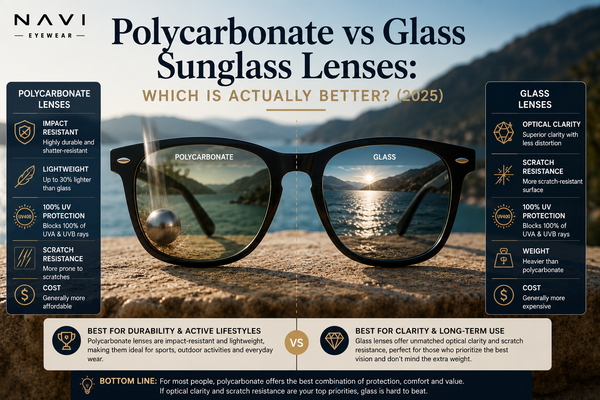
Polycarbonate wins for everyday use, active lifestyles, sport, and any context where impact resistance matters. Glass wins on raw optical clarity and scratch resistance, but is heavier, more fragile, and more expensive. For UV protection: polycarbonate provides inherent UV400 protection throughout the material; glass requires UV-absorbing additives or coatings that must be verified. For most people in most real-world scenarios, polycarbonate is the better practical choice.

Table of Contents
Part 1: What Is Polycarbonate? The Material Behind Performance Eyewear
Polycarbonate is a thermoplastic polymer — a plastic with unique mechanical properties that make it the dominant lens material in performance eyewear, safety glasses, aircraft windows, and bullet-resistant glazing. It was developed by GE and Bayer in the late 1950s and entered optical use in the 1970s.
Why Polycarbonate Became the Performance Standard
Polycarbonate’s adoption in performance eyewear was driven by a single property that no other optical material matched: impact resistance. Polycarbonate absorbs energy under impact by deforming rather than fracturing. Where glass and harder optical plastics shatter, polycarbonate bends. This is the same property that makes it the material of choice for safety glasses in industrial environments, helmet visors in motorsport, and protective lenses in shooting glasses.
Polycarbonate and UV Protection
Polycarbonate inherently absorbs UV radiation throughout the material due to the chemical structure of its polymer chains. A polycarbonate lens provides UV400 protection — blocking all UV to 400nm — without any additional UV coating. This inherent UV protection does not degrade when the lens surface is scratched, aged, or exposed to chemicals, because it is structural rather than surface-applied. This is a meaningful long-term advantage over materials that require UV surface coatings.
Polycarbonate’s Refractive Index and Lens Thinness
Polycarbonate has a refractive index of approximately 1.586, higher than standard CR-39 plastic (1.498) and similar to mid-index glass. The higher refractive index allows lenses to be made thinner for equivalent optical power, contributing to lighter frames and a more modern profile. For sunglass lenses at the plano (non-prescription) powers used in non-prescription sunglasses, the refractive index is less critical than in prescription lenses, but it still contributes to the slim lens profiles of modern performance sunglasses.
Part 2: What Is Glass? The Traditional Optical Standard
Optical glass has been used in eyewear since the 13th century. For most of that history, it was the only practical optical lens material available. Its optical properties — high clarity, excellent scratch resistance, and color neutrality — made it the reference standard against which all subsequent optical materials have been measured.
Crown Glass and High-Index Glass
Standard optical crown glass (soda-lime silicate) has a refractive index of approximately 1.523. High-index glass formulations range from 1.60 to 1.90, allowing much thinner lenses at higher prescriptions. For sunglasses, standard crown glass provides the optical properties that glass advocates value: high Abbe value (a measure of chromatic aberration, discussed below), excellent scratch resistance, and optical clarity.
Glass and UV Protection
Standard optical glass does not inherently block UV400. Raw crown glass transmits UV into the UV-A range, making glass lenses without UV additives or coatings inadequate for eye protection. Glass sunglass lenses require either UV-absorbing additives mixed into the glass melt during manufacturing, or surface UV coatings applied post-production, to achieve UV400. Both approaches are effective when correctly applied, but UV400 certification must be verified explicitly for glass lenses rather than assumed.
Glass Density and Weight
Glass is significantly denser than polycarbonate. Crown glass has a density of approximately 2.5 g/cm³; polycarbonate is approximately 1.2 g/cm³. For sunglass lenses at everyday thicknesses, this density difference translates to a meaningful weight difference that accumulates over hours of continuous wear. For a full day of outdoor activity, frame weight matters for comfort at the nose and temples, and glass lenses are a meaningful contributor to total frame weight.
Part 3: Optical Clarity — The Honest Comparison
Abbe Value: The Chromatic Aberration Measure
Optical clarity in lens materials is measured in part by the Abbe value (also called the V-number or constringence). The Abbe value measures how much a material disperses light into its component wavelengths — a lower Abbe value means more chromatic aberration, producing subtle color fringing at the edges of objects viewed through the lens. Crown glass has an Abbe value of approximately 58–60. Polycarbonate has an Abbe value of approximately 30.
This difference is real and measurable in optical testing. In practical everyday use, the difference is perceptible when looking at high-contrast edges near the periphery of the lens — the edge of a window frame, a telephone wire against a bright sky. For central vision through the lens optical centre, the difference is minimal for most users.
When the Clarity Difference Actually Matters
The glass vs polycarbonate clarity difference matters most for: people with high prescriptions (where the lens periphery is further from plano power and chromatic aberration at the edge is more significant), people with particularly acute sensitivity to chromatic aberration, and direct optical comparisons between the two materials. For non-prescription plano sunglass lenses used at the lens centre for everyday tasks, the Abbe value difference produces a negligible real-world optical experience difference for the vast majority of users.
Manufacturing Quality Matters More Than Material
At quality manufacturing standards, both polycarbonate and glass produce lenses with excellent optical clarity for everyday use. The variability in optical quality within each material category — between premium and budget polycarbonate lenses, and between premium and standard glass lenses — is typically larger than the average difference between well-made polycarbonate and well-made glass at the same quality tier.
Part 4: Impact Resistance — Why This Is the Decisive Factor for Most Buyers
The Safety Reality of Glass Lenses
Glass lenses fracture under impact. The fracture produces sharp fragments — potentially at high velocity if the impact was energetic — in close proximity to the eye. Historical data from industrial eye injury studies consistently shows that glass lens failures in safety eyewear produce significantly more severe eye injuries than lens material failures in alternative materials. This is why ANSI Z87.1 industrial safety eyewear standards moved away from glass decades ago, and why FDA impact resistance requirements for US retail sunglasses effectively require materials with polycarbonate-like impact performance.
Polycarbonate’s Impact Mechanism
Polycarbonate absorbs impact energy through viscoelastic deformation — the material deforms and recovers rather than fracturing catastrophically. A polycarbonate lens that takes a direct hit from road debris, a flying stone, a cricket ball, or a dropped pair of sunglasses hitting a hard floor will typically dent, scratch, or crack without shattering. The absence of sharp high-velocity fragments is the safety property that makes polycarbonate the material of choice for every high-risk eye protection application.
The FDA Impact Resistance Standard
The US FDA requires sunglass lenses sold at retail to meet impact resistance standards (21 CFR Part 801). The basic drop ball test requires lenses to withstand a 1-inch steel ball dropped from 50 inches without fracturing. Polycarbonate exceeds this standard comfortably. Standard glass often does not meet it without specific impact-resistant tempering. The FDA standard is effectively a polycarbonate-friendly specification by design — written to reflect the safety knowledge about glass lens fracture in common use scenarios.
Navi Eyewear explicitly certifies FDA-cleared impact-resistant lenses. For the full context of what FDA-cleared impact resistance means for everyday sunglass purchases, seethe complete sunglasses buying guide.
Part 5: UV Protection — How Each Material Handles UV
Polycarbonate: Inherent UV400
Polycarbonate provides inherent UV400 protection throughout the lens material. This is structural UV blocking built into the polymer chains, not a surface treatment. The UV protection does not degrade with scratching, weathering, or chemical exposure because it is not on the surface. For outdoor use across years of wear, polycarbonate’s structural UV protection maintains its specification reliably.
Glass: Requires UV Additives or Coating
Standard glass does not inherently provide UV400 protection. Glass sunglass lenses require either UV-absorbing dopants mixed into the glass during manufacture or post-production UV surface coatings to meet UV400. When correctly specified and manufactured, glass UV400 lenses are effective. The critical point is verification: a glass sunglass lens cannot be assumed to be UV400 without explicit certification. A glass lens without UV treatment can transmit significant UV400 while appearing identical to a treated lens.
For the full UV400 science including the difference from UV380 and how to verify UV certification on any pair of sunglasses, seeUV400 vs UV380: what is the difference and why it matters andthe complete guide to UV eye protection.
Part 6: Weight and Comfort
Polycarbonate lenses are approximately half the density of glass. For sunglass lenses of equivalent thickness, a polycarbonate lens weighs roughly half what the glass equivalent weighs. This weight advantage is most noticeable in:
For stationary or low-activity use — driving, sitting at a cafe, a casual afternoon walk — the weight difference between glass and polycarbonate lenses in a quality frame is modest and manageable for most wearers. For active lifestyles, polycarbonate’s weight advantage is meaningful and consistent over the duration of a session.
Part 7: Scratch Resistance
This is the one area where glass has a clear and consistent advantage. Glass is significantly harder than polycarbonate by the Mohs scale — glass sits at approximately 5.5, polycarbonate at approximately 3. This hardness translates directly into scratch resistance: glass lenses are harder to scratch with everyday abrasives like dust, fabric, and sand particles, while polycarbonate lenses scratch more easily under the same conditions.
The practical consequence: polycarbonate lenses benefit significantly from anti-scratch coatings applied to the lens surface during manufacture. Most quality polycarbonate sunglass lenses include a hard coat that raises the effective scratch resistance significantly. The hard coat does not fully close the gap between polycarbonate and glass scratch resistance, but it reduces it substantially for everyday use.
The trade-off is worth naming directly: glass scratches less easily than coated polycarbonate in everyday use, but glass shatters on impact while polycarbonate does not. Scratches are cosmetically annoying and eventually reduce optical quality, but they are not a safety event. A shattered glass lens in the face is a safety event. For most buyers choosing between occasional cosmetic scratching and a material that does not shatter, the safety argument decisively favors polycarbonate.
Part 8: Cost
Glass sunglass lenses cost more to produce than polycarbonate at equivalent quality levels. Glass requires more energy to manufacture, is more difficult to shape precisely, is heavier to ship, and has higher breakage rates in production and handling. These costs flow through to retail pricing.
Premium glass lenses from brands like Maui Jim and Serengeti — both of which use glass as a selling point — command a significant price premium over polycarbonate alternatives. Whether that premium is justified depends entirely on whether the specific advantages of glass (marginal clarity improvement, better scratch resistance) are worth the disadvantages (heavier, more fragile, more expensive) for your specific use case.
For buyers who are comparing value across lens materials rather than within a specific premium brand, polycarbonate provides UV400 protection, impact resistance, lighter weight, and excellent optical quality at significantly lower cost. The glass premium buys marginal optical advantages that most everyday users will not reliably perceive.
Part 9: Coatings and Treatments
Polycarbonate Coatings
Glass Coatings
For the full lens coating science — what each coating does, how it is applied, and which coatings matter most for which use cases — seelens coatings explained: anti-reflective, hydrophobic, mirror and more.

Part 10: Side-by-Side Comparison Table
|
Property |
Polycarbonate |
Glass |
|
Impact resistance |
Excellent — deforms without shattering |
Poor — shatters into sharp fragments |
|
FDA impact standard |
Yes — meets and exceeds |
Requires tempering to meet; often does not |
|
UV protection |
Inherent UV400 throughout material |
Requires UV additives or coating (must verify) |
|
Optical clarity (Abbe) |
≈30 — some chromatic aberration at periphery |
≈58 — excellent, lower chromatic aberration |
|
Weight |
Light — ≈1.2 g/cm³ |
Heavy — ≈2.5 g/cm³ |
|
Scratch resistance |
Moderate — benefits from hard coat |
Excellent — inherently harder surface |
|
Cost |
Lower |
Higher |
|
Best use |
Active, everyday, sport, all-around |
Stationary, premium optical clarity use |
|
Navi Eyewear |
Polycarbonate — standard on all pairs |
— |
✨ NAVI EYEWEAR — FDA-CLEARED POLYCARBONATE ON EVERY PAIREvery Navi sunglass uses FDA-cleared impact-resistant polycarbonate lenses with inherent UV400 protection. Oleophobic and anti-saltwater coating. Polarized. TR90 frames with stainless 5-barrel hinges. Buy 1, Get 3 Free — $99 for four pairs (≈$25 each). Free shipping. Free replacements. Add 4 pairs to cart — discount auto-applies. No code needed. |
Part 11: Best For — When Each Material Wins
Polycarbonate — Best For:
Glass — Best For:
Part 12: Who This Is Not For
Part 13: Common Mistakes
Bottom Line
For most people in most everyday scenarios, polycarbonate is the better practical lens material. The impact resistance advantage is decisive for safety in any active use context. The inherent UV400 protection that does not degrade is a meaningful long-term advantage. The weight advantage makes a real difference in all-day wear comfort. The scratch resistance disadvantage is real but manageable with a quality hard coat.
Glass is the right choice for buyers who specifically prioritize optical clarity above safety and weight, who use their sunglasses primarily in low-impact scenarios, and who are comfortable verifying UV400 certification explicitly on a material that does not provide it inherently.
The premium end of the sunglass market features both polycarbonate and glass options from quality brands. Navi Eyewear uses FDA-cleared polycarbonate — the material that meets the complete specification for impact resistance, inherent UV400 protection, light weight, and everyday outdoor performance.
BrowseNavi Eyewear’s UV400 polarized collection. FDA-cleared polycarbonate lenses on every pair. Buy 1, Get 3 Free at $99. Free shipping. Free replacements.
Frequently Asked Questions
Are glass sunglass lenses better than polycarbonate?
Glass provides better optical clarity (higher Abbe value, less chromatic aberration) and better scratch resistance. Polycarbonate provides significantly better impact resistance, lighter weight, inherent UV400 protection, and lower cost. For everyday active use, polycarbonate is the better practical material. For stationary premium use where optical clarity is the priority above all else, glass is the better choice. Neither is universally better — it depends on your priorities and use context.
Do polycarbonate sunglass lenses provide UV protection?
Yes — polycarbonate provides inherent UV400 protection throughout the lens material. The UV blocking is structural, not a surface coating, and does not degrade with scratching or age. This is one of polycarbonate’s most significant advantages over glass, which requires UV additives or coatings to achieve UV400. For the full UV400 science, seeUV400 vs UV380: what is the difference and why it matters.
Can glass sunglass lenses shatter?
Yes — glass lenses fracture under impact and produce sharp fragments. This is the fundamental safety limitation of glass lenses for active use. It is the reason the FDA impact resistance standards for US retail sunglasses favor polycarbonate-class materials, why industrial safety standards moved away from glass decades ago, and why polycarbonate is the material of choice for any high-risk eyewear application. For everyday sedentary use with low impact risk, glass fragility is a manageable concern. For active outdoor use, it is a genuine safety consideration.
Are polycarbonate lenses FDA approved?
The FDA clears polycarbonate sunglass lenses as meeting impact resistance requirements under 21 CFR Part 801. ‘FDA-cleared’ is the accurate term — the lenses meet the federal standard for impact resistance. Navi Eyewear explicitly certifies FDA-cleared impact-resistant lenses across their collection, confirming compliance with this standard.
Do glass lenses scratch less than polycarbonate?
Yes — glass is significantly harder than polycarbonate by the Mohs scale and inherently more scratch-resistant. Polycarbonate lenses are typically fitted with anti-scratch hard coats during manufacture to improve their scratch resistance, but coated polycarbonate remains less scratch-resistant than glass in everyday abrasive conditions. This is glass’s most consistent practical advantage for buyers who prioritize surface durability over impact resistance.
Which is heavier — glass or polycarbonate sunglass lenses?
Glass is significantly heavier. Crown glass has a density of approximately 2.5 g/cm³ compared to polycarbonate at approximately 1.2 g/cm³. For sunglass lenses of equivalent thickness, glass weighs roughly twice as much as polycarbonate. This weight difference is most noticeable in larger lens formats and during prolonged wear — a 20g polycarbonate frame is significantly lighter than a 30–35g glass equivalent, and over hours of continuous outdoor use, the difference is perceptible at the nose bridge and temples.
Are Navi Eyewear sunglasses polycarbonate or glass?
Navi Eyewear uses FDA-cleared impact-resistant polycarbonate lenses across the full collection. The polycarbonate provides inherent UV400 protection, impact resistance, light weight, and is fitted with oleophobic and anti-saltwater coatings as standard. Browse the full collection atnavieyewear.com/collections/polarized.
Is polycarbonate or glass better for driving sunglasses?
Polycarbonate is the better practical choice for driving in most scenarios. The impact resistance is relevant for any driving scenario involving potential debris. The lighter weight is beneficial for extended driving sessions. The inherent UV400 protection reliably blocks road-reflected UV. Polarized polycarbonate lenses specifically eliminate road surface glare from wet tarmac that non-polarized and even polarized glass lenses manage in the same way optically but at greater weight. The complete driving sunglass guide is inbest sunglasses for driving: polarized lenses and glare reduction.
Supporting Articles
FDA-CLEARED POLYCARBONATE. EVERY PAIR.Navi Eyewear uses FDA-cleared impact-resistant polycarbonate with inherent UV400 protection on every sunglass in the collection. Polarized. Oleophobic and anti-saltwater coating. TR90 frames with stainless 5-barrel hinges. $99 for four pairs — roughly $25 each. Free shipping. Free replacements. Add 4 pairs to your cart. Buy 1, Get 3 Free discount auto-applies. |
SOURCES & CITATIONS[1] Dain SJ.“Sunglasses and sunglass standards.”Clinical and Experimental Optometry, 2003.View source [2] Tanner DF, Kent JS, Jagger JD.“Spectral transmittance characteristics of commercially available UV-protective sunglass lenses.”Optometry and Vision Science, 2007.View source [3] U.S. Food and Drug Administration.“Impact resistance requirements for sunglass lenses (21 CFR Part 801).”FDA Regulations, 2023.View source [4] Rosenthal FS, Bakalian AE, Lou CQ, Taylor HR.“The effect of sunglasses on ocular exposure to ultraviolet radiation.”American Journal of Public Health, 1988.View source [5] Taylor HR, West SK, Rosenthal FS, et al..“Effect of ultraviolet radiation on cataract formation.”New England Journal of Medicine, 1988.View source [6] American Academy of Ophthalmology.“Sunglasses: choosing the right pair for UV protection.”AAO EyeSmart, 2023.View source [7] Sliney DH.“UV radiation ocular exposure dosimetry.”Documenta Ophthalmologica, 1994.View source |