
Mirror vs Non-Mirror Sunglasses: When Does the Coating Actually Matter?
Mirror sunglasses are one of those products where style and function blur together in a way that makes the buying decision confusing. They look distinctly premium — the reflective outer coating has been associated with high-performance sport eyewear, ski patrol aesthetics, and certain cultural moments in fashion for decades. But whether they actually perform better than non-mirror lenses, and under what specific conditions, is a question most buyers never get a straight answer to.
This guide gives you the straight answer. What a mirror coating physically does. How it interacts with the base lens tint and UV protection. When the coating provides a genuine functional advantage. When it is purely cosmetic. And the one critical thing that a mirror coating does not do — which is the most important misconception to correct before you buy.
This is a C12 Comparison and Best For supporting post. It links back to the cluster pillar atNavi Eyewear vs Ray-Ban: an honest comparison. For the lens coating science including how mirror, oleophobic, hydrophobic and anti-reflective coatings work at a material level, seelens coatings explained: anti-reflective, hydrophobic, mirror and more.
Quick Answer
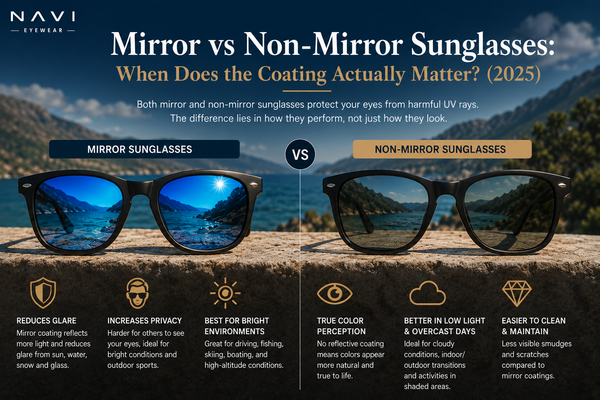
A mirror coating reflects additional light off the outer lens surface, reducing the total visible light that enters the lens. This lowers effective VLT (visible light transmission) and can improve comfort in very high-brightness environments like snow, high-altitude, or intense open-water conditions. Mirror coatings do not add UV protection — UV blocking is determined entirely by the base lens material and certification. For most everyday use, a quality base tint without mirror coating provides equivalent functional performance. Mirror coating is most justified in extreme-brightness environments.

Table of Contents
Part 1: What Is a Mirror Coating? The Physics
How Mirror Coatings Are Applied
A mirror coating — also called a flash coat or reflective coat — is a thin metallic or metallic-oxide layer deposited on the outer surface of a sunglass lens using a vacuum deposition process. During manufacturing, the lens is placed in a vacuum chamber and metallic material (commonly aluminium, chromium, silver, titanium, or their oxides) is vaporized and deposited as an extremely thin film on the lens surface. The resulting coating is typically 100–500 nanometres thick — thinner than a human hair by a factor of several hundred.
What the Coating Physically Does
The metallic coating reflects a portion of the light that strikes the outer lens surface before it can enter the lens at all. The proportion of light reflected depends on the coating thickness and composition — a flash mirror (thinner coating) reflects 10–25% of incoming light; a solid mirror (thicker coating) reflects 35–60% or more. The reflected light bounces back away from the wearer, reducing the total visible light that passes through the lens to the eye.
The optical result: the effective visible light transmission (VLT) of the lens is lower than the base tint alone. A base Category 2 lens at 30% VLT with a solid mirror coat may deliver an effective VLT of 15–20% — equivalent to Category 3 performance. This is the functional mechanism by which mirror coatings extend the useful range of a lens into higher-brightness environments than the base tint alone could comfortably address.
Part 2: What a Mirror Coating Does NOT Do
This is the most important section for buyers to read before making a decision based on mirror coating.
Mirror Coating Does Not Add UV Protection
UV protection is determined entirely by the base lens material and its UV-absorbing treatment. A polycarbonate UV400 lens blocks UV400 whether it has a mirror coating or not. A non-UV400 lens does not become UV400 by adding a mirror coating. The metallic film that creates the mirror effect is too thin and compositionally different from UV-absorbing materials to provide meaningful UV blocking. If you see a mirrored sunglass without an explicit UV400 claim, the mirror coating is providing no UV protection. Verify UV400 on the base lens specification, not on the presence of mirror coating. The full UV400 verification guide is inUV400 vs UV380: what is the difference and why it matters.
Mirror Coating Does Not Replace Polarization
Polarization eliminates horizontally reflected glare by blocking horizontally oscillating light at the PVA film embedded in the lens. Mirror coating reflects some incoming light at the outer surface but does not filter by polarization axis. A mirror-coated non-polarized lens is not equivalent to a polarized lens for glare reduction. If glare elimination — from roads, water, snow — is your primary goal, polarization is the technology you need. Mirror coating is an addition on top of the base lens, not a substitute for polarization. The complete polarization guide is inpolarized vs non-polarized sunglasses: the definitive guide.
Mirror Coating Does Not Make Dark Lenses Darker by Itself
A mirror coating works by reflecting light before it enters the lens — it does not change the tint or chemical properties of the base lens material. The base tint determines the color and most of the darkness of the visual experience through the lens; the mirror adds additional effective darkness through external reflection. Changing from a non-mirror to a mirror version of the same base lens does make the lens effectively darker (lower VLT), but the perceived color of the scene through the lens is still determined primarily by the base tint.
Part 3: Flash Mirror vs Solid Mirror vs Revo Mirror
Flash Mirror
A flash mirror (also called a light mirror or partial mirror) is a thin metallic coating that creates a subtle reflective effect on the outer lens surface. From the outside, the lens has a light sheen that hints at mirror without the full opaque reflectivity of a solid mirror. Flash mirror coatings typically reduce VLT by 5–15% beyond the base tint. They are the most common mirror type in everyday lifestyle and fashion sunglasses — they add visual interest and a modest additional brightness reduction without the intense mirror look.
Solid Mirror
A solid mirror is a thicker metallic coating that produces a fully opaque reflective surface — the high-intensity mirror look associated with ski patrol, motorsport, and competitive outdoor sport eyewear. Solid mirrors reduce VLT by 25–50% or more beyond the base tint, making them appropriate for the highest-brightness environments: glacier skiing, open-ocean sailing, tropical coastal use at midday. The reflective surface is so complete that it is difficult to see the wearer’s eyes through the lens from the outside.
Revo / Iridescent Mirror
Revo and iridescent mirror coatings are multi-layer thin film coatings that produce color-shifting reflective effects — the lens appears to change color as the viewing angle changes. These coatings were originally developed by NASA for satellite applications and entered sunglass use in the 1980s through the Revo brand. The iridescent effect is achieved through thin-film interference rather than simple metallic reflection. Revo coatings can provide similar VLT reduction to solid mirrors while offering distinctive visual aesthetics. They are primarily associated with premium sport and lifestyle brands.
Part 4: How Mirror Coating Affects Visible Light Transmission
The lens category system (Category 0 through 4) classifies lenses by their visible light transmission (VLT) — the percentage of visible light that passes through to the eye. Mirror coatings reduce effective VLT by reflecting light before it enters the lens. A mirror coating effectively shifts a lens toward a darker category:
|
Base Lens |
Base VLT |
Flash Mirror Effect |
Solid Mirror Effect |
|
Category 1 (light tint) |
43–80% |
Pushes toward Cat 2 range |
Pushes toward Cat 2–3 range |
|
Category 2 (medium tint) |
18–43% |
Pushes toward Cat 3 range |
Pushes toward Cat 3–4 range |
|
Category 3 (dark tint) |
8–18% |
Marginal additional reduction |
Pushes toward Cat 4 range |
|
Category 4 (very dark) |
3–8% |
Not typically applied |
Extremely dark — not for driving |
This VLT reduction is the primary functional benefit of mirror coating in high-brightness environments. A base Category 2 lens that is comfortable for moderate outdoor conditions may become uncomfortably bright on a highly reflective snow or water surface. Adding a solid mirror coating effectively brings the lens into Category 3 performance range without requiring a base Category 3 tint, while maintaining the color rendering properties of the Category 2 base tint.
Part 5: Mirror Coating and UV Protection
To state it clearly one more time because this is the most common buyer misconception: mirror coatings do not provide UV protection.
The UV protection in a sunglass lens comes from the lens material itself (polycarbonate with inherent UV400, or CR-39 with UV-absorbing coating) or from a separate UV-absorbing treatment on the lens. The metallic film that creates the mirror effect is physically separated from the UV-absorbing layer — it sits on the outer surface and reflects visible light without meaningfully blocking UV radiation.
Polycarbonate lenses with mirror coatings provide UV400 protection from the polycarbonate base, regardless of whether the mirror is flash or solid. The UV protection does not change with the addition or absence of mirror coating. Glass lenses with mirror coatings may or may not provide UV400 depending on whether the glass was treated with UV-absorbing additives — the mirror coating tells you nothing about UV status. Always verify UV400 on the base lens specification.
Part 6: Mirror Coating and Polarization
Mirror coating and polarization are independent technologies that can be combined in the same lens. A polarized mirror lens has both the PVA polarizing film embedded in the lens for glare elimination and the metallic mirror coating on the outer surface for additional brightness reduction. This combination is common in high-performance ski and sport eyewear where both glare elimination (from snow surface reflection) and maximum brightness reduction (from extreme alpine UV environments) are required simultaneously.
The combination works well: the polarizing film eliminates horizontal surface glare, and the mirror coating reduces the total light load. For the highest-intensity outdoor environments — glacier skiing, offshore sailing at tropical latitudes, high-altitude mountaineering — polarized mirror lenses provide the most complete combination of glare elimination and brightness management available in a sunglass format.
For everyday use in moderate outdoor conditions, a quality non-mirror polarized UV400 lens provides excellent performance without the additional cost of mirror coating. The complete polarization science including the specific environments where polarization makes the most meaningful difference is inpolarized vs non-polarized sunglasses: the definitive guide.
Part 7: When Mirror Coating Provides a Real Functional Advantage
Extreme Brightness Environments
The functional case for mirror coating is strongest in the highest-brightness outdoor environments. Snow and glacier surfaces reflect 80–90% of incident light — combined with high-altitude UV amplification, this creates a light and UV environment that challenges even Category 3 base lenses. A solid mirror on a Category 3 base effectively delivers Category 4 brightness reduction in a lens system that still allows the base tint’s color rendering to work. This is why solid mirror lenses are standard in glacier skiing, high-altitude mountaineering, and polar exploration eyewear.
Open-Water Offshore and Tropical Conditions
Tropical offshore environments combine direct overhead sun, significant water surface reflection, and high UV index conditions. On a clear-sky day at sea at tropical latitudes, the total light load from above and below can exceed what a non-mirror Category 3 lens manages comfortably for a full day. A solid or heavy flash mirror on a Category 3 base provides the additional brightness reduction that makes all-day offshore use genuinely comfortable rather than a persistent squinting exercise.
High-Altitude Alpine and Desert Environments
High-altitude environments above 2500m and desert environments with highly reflective sand and rock surfaces produce UV and visible light intensities that benefit from the additional VLT reduction of mirror coatings. For hikers and climbers in these environments, mirror coating on a Category 3 base is a meaningful functional addition — not a luxury aesthetic choice.
Competitive Outdoor Sport
Competitive cyclists, triathletes, and open-water swimmers often use mirror lenses for the combination of maximum brightness reduction and the aerodynamic and aesthetic streamlining of the mirror surface. In these contexts, the mirror coating serves a genuine functional role in managing the extreme light environments of professional outdoor sport.
Part 8: When Mirror Coating Is Purely Cosmetic
For most everyday sunglass users in moderate outdoor conditions — urban commuting, casual beach days, park walks, driving in typical weather — the functional advantage of mirror coating over a quality non-mirror Category 2 or 3 tinted lens is minimal to negligible. A non-mirror gray polarized UV400 lens at Category 3 provides excellent UV protection, glare elimination, and comfort for all of these scenarios without any mirror effect.
In these conditions, a buyer who chooses mirror lenses is primarily making a style choice. That is entirely legitimate — sunglasses are a visible accessory and aesthetics are a valid purchasing criterion. The mirror look is distinctive, modern, and has genuine design appeal. The important thing is clarity about what you are buying: in moderate conditions, mirror coating is style over substance. That does not make it wrong — it makes it honest.
The mirror-as-style choice also has a practical consideration: mirror coatings are more vulnerable to surface scratching than non-mirror lenses because the metallic film is thin and sits on the outer surface. A scratched mirror coating is more visually obvious and more cosmetically compromising than a scratched non-mirror lens, since the scratch disrupts the reflective uniformity that makes the mirror effect work.
✨ NAVI EYEWEAR — PREMIUM POLARIZED UV400, EVERY PAIREvery Navi sunglass ships with UV400 polarized lenses as standard. FDA-cleared polycarbonate. Oleophobic and anti-saltwater coating. TR90 frames with stainless 5-barrel hinges. Modern premium style. Buy 1, Get 3 Free — $99 for four pairs (≈$25 each). Free shipping. Free replacements. Add 4 pairs to cart — Buy 1 Get 3 Free discount auto-applies. Shop the full collection:navieyewear.com/collections/polarized |
Part 9: Durability — Mirror Coating Over Time
Mirror coatings are the most vulnerable of all lens surface treatments to mechanical damage. The metallic film is extremely thin — measured in nanometres — and sits on the outermost lens surface where it is directly exposed to the same abrasive forces that scratch the base lens. Fabric wipes, dust particles, sand, and the general mechanical stress of daily carry and cleaning all degrade mirror coatings at a faster rate than non-mirror lens surfaces.
The practical consequence: a high-quality mirror sunglass requires more careful lens care than a non-mirror equivalent to maintain the reflective surface over time. This includes using only lens-specific cleaning cloths rather than shirt fabric, storing in a case rather than loose, and avoiding face-down placement on any surface. Buyers who are rough with their sunglasses or who want low-maintenance eyewear should factor mirror coating durability into their decision.
The complete sunglasses care and maintenance guide — covering proper cleaning, storage, and extending the life of all lens coatings including mirror — is inhow to clean and care for sunglasses.
Part 10: Mirror Lens Colors and What They Do
Mirror coatings are available in a range of colors — silver, gold, blue, red, green, pink, purple, and multicolor iridescent. The color of the mirror coating is determined by the composition and thickness of the metallic film and is independent of the base tint color. A gray base lens with a blue mirror coating will appear blue from the outside but still transmit light with the gray tint’s characteristics to the wearer’s eye.
Part 11: Mirror vs Non-Mirror — Side-by-Side
|
Feature |
Mirror Lens |
Non-Mirror Lens |
|
VLT |
Lower than base tint — mirror reflects additional light |
Determined by base tint only |
|
UV protection |
Not added by mirror coat — determined by base lens |
Determined by base lens certification |
|
Glare elimination |
Not provided by mirror coat — requires polarization |
Not provided by tint alone — requires polarization |
|
Best brightness environment |
High-intensity: snow, glacier, offshore, tropical |
Moderate outdoor: everyday, driving, casual |
|
Style |
Distinctive reflective appearance, opaque to observers |
Transparent lens, wearer’s eyes visible |
|
Durability |
Mirror film vulnerable to surface scratching |
Base lens durability only |
|
Cost |
Typically higher (coating adds manufacturing cost) |
Lower |
|
Maintenance |
Requires careful handling to preserve mirror surface |
Standard lens care |
|
Flash mirror |
Subtle sheen, 5–15% additional VLT reduction |
— |
|
Solid mirror |
Opaque reflective surface, 25–50%+ VLT reduction |
— |
Part 12: Best For
Mirror Lenses — Best For:
Non-Mirror Lenses — Best For:
Part 13: Who This Is Not For
Part 14: Common Mistakes
Bottom Line
Mirror coatings do one thing well: they reduce the effective VLT of a lens beyond what the base tint provides, by reflecting additional visible light off the outer surface. In the highest-brightness environments — snow, glacier, tropical offshore, high altitude — this additional brightness reduction is a genuine functional advantage. In moderate everyday conditions, it is primarily a style choice.
What mirror coatings do not do is equally important: they do not add UV protection, they do not replace polarization, and they require more careful handling than non-mirror lenses to maintain their surface over time.
For most buyers, a quality polarized UV400 lens in the right base tint and category for their conditions provides excellent everyday performance without mirror coating. For buyers in extreme-brightness environments who want both maximum brightness reduction and glare elimination, a polarized mirror UV400 lens is the optimal combination.
BrowseNavi Eyewear’s UV400 polarized collection. Every pair is UV400 polarized with FDA-cleared polycarbonate. Add 4 pairs to cart for the Buy 1, Get 3 Free deal at $99. Free shipping. Free replacements.

Frequently Asked Questions
Do mirror sunglasses block more UV than regular sunglasses?
No — mirror coatings do not add UV protection. UV blocking is determined entirely by the base lens material and its UV certification. A polycarbonate UV400 lens with a mirror coating provides exactly the same UV protection as the same polycarbonate UV400 lens without a mirror coating. The mirror reflects visible light, not UV specifically. Always verify UV400 on the base lens specification. The full UV standard guide is inUV400 vs UV380: what is the difference and why it matters.
Are mirrored sunglasses better for bright conditions?
In the highest-brightness environments — snow, glacier, offshore open water, tropical midday sun — yes. A solid mirror coating on a quality base tint reduces effective VLT significantly, providing additional brightness management that a base Category 3 lens alone may not achieve in extreme conditions. For moderate everyday outdoor conditions, a quality non-mirror Category 2–3 lens is typically adequate and does not require the mirror addition for functional performance.
Is a mirror coating the same as polarization?
No — completely different technologies. Polarization eliminates horizontally reflected glare by filtering light polarization at a PVA film within the lens. Mirror coating reflects a portion of all incoming visible light at the outer lens surface. Polarization addresses glare from reflective surfaces; mirror coating addresses total brightness. They solve different problems. Many quality lenses combine both: a polarizing film within the lens and a mirror coating on the outer surface. The complete polarization explanation is inpolarized vs non-polarized sunglasses: the definitive guide.
Do mirror sunglasses scratch more easily?
Yes — the thin metallic film of a mirror coating sits on the outermost lens surface and is more vulnerable to abrasive damage than the bare tinted lens beneath it. Scratches to a mirror surface are also more visually obvious because they disrupt the reflective uniformity, creating visible non-reflective patches. Mirror-coated lenses benefit from consistent use of lens cases, microfibre cloths for cleaning, and avoiding face-down placement on any surface.
What is a flash mirror coating on sunglasses?
A flash mirror (also called a light mirror) is a thin metallic coating that creates a subtle reflective effect on the lens outer surface — a light sheen rather than a fully opaque mirror. Flash mirrors reduce VLT by approximately 5–15% beyond the base tint, providing modest additional brightness reduction and a distinctive aesthetic without the full intensity of a solid mirror. They are the most common mirror type in everyday lifestyle and fashion sunglasses.
Can I get mirror sunglasses with UV400 and polarization?
Yes — mirror coating, UV400 certification, and polarization are independent lens features that can all be present in the same lens. A polarized UV400 polycarbonate lens with a mirror coating provides: UV400 protection from the polycarbonate base, glare elimination from the polarizing film, and additional brightness reduction from the mirror coating. This combination is standard in premium performance sport sunglasses and is the optimal specification for the highest-brightness environments. Browse quality UV400 polarized options atnavieyewear.com/collections/polarized.
Are mirror sunglasses good for driving?
Flash mirror on a moderate base tint: yes, appropriate for most driving conditions. Solid mirror on a dark base tint: potentially too dark for safe driving, particularly in variable light conditions, tunnels, or at dusk. Category 4 effective VLT (from solid mirror on Category 3 base) is not recommended for driving in most jurisdictions. For driving specifically, gray polarized UV400 at Category 2–3 without heavy mirror coating provides the optimal combination of road surface glare elimination and color accuracy for traffic signals and road features.
Why do ski sunglasses often have mirror lenses?
Snow reflects 80–90% of incident light and UV, and high-altitude ski environments add UV amplification from reduced atmospheric filtration. The combination creates one of the highest light and UV load environments of any recreational activity. Mirror coatings on Category 3 base lenses provide the additional VLT reduction that brings effective lens performance into Category 4 range — appropriate for the extreme alpine environment without requiring a separate Category 4 lens. Solid silver mirror is the standard specification for glacier and high-altitude ski eyewear for this reason. The complete skiing sunglass guide is inbest sunglasses for skiing and snowboarding.
Supporting Articles
PREMIUM POLARIZED UV400 — EVERY PAIR, EVERY DAY.Navi Eyewear delivers UV400 polarized lenses with FDA-cleared polycarbonate, oleophobic and anti-saltwater coating, and TR90 frames — no mirror markup required. $99 for four pairs — roughly $25 each. Free shipping. Free replacements. Add 4 pairs to your cart. Buy 1, Get 3 Free discount auto-applies. No code needed. |
SOURCES & CITATIONS[1] Dain SJ.“Sunglasses and sunglass standards.”Clinical and Experimental Optometry, 2003.View source [2] Tanner DF, Kent JS, Jagger JD.“Spectral transmittance characteristics of commercially available UV-protective sunglass lenses.”Optometry and Vision Science, 2007.View source [3] Rosenthal FS, Bakalian AE, Lou CQ, Taylor HR.“The effect of sunglasses on ocular exposure to ultraviolet radiation.”American Journal of Public Health, 1988.View source [4] Gies HP, Roy CR, Toomey S, et al..“Solar UVR exposures of three groups of outdoor workers on the Sunshine Coast, Queensland.”Health Physics, 1995.View source [5] Sliney DH.“UV radiation ocular exposure dosimetry.”Documenta Ophthalmologica, 1994.View source [6] American Academy of Ophthalmology.“Sunglasses: choosing the right pair for UV protection.”AAO EyeSmart, 2023.View source [7] De Faber JT, Naeser K, Kessing SV.“Polarized light and contrast sensitivity under glare conditions.”Ophthalmic Research, 2013.View source |