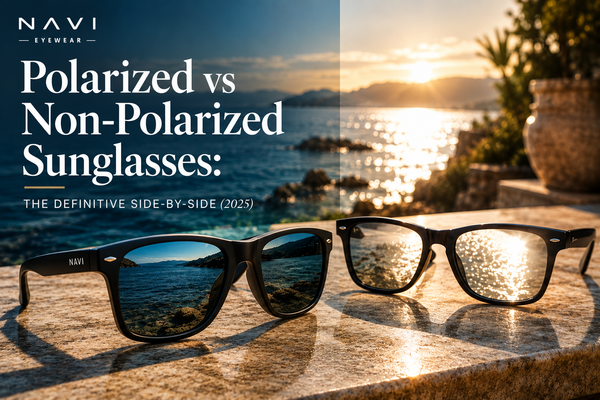

Polarized vs Non-Polarized Sunglasses: The Definitive Side-by-Side
The question comes up every time someone buys a new pair of sunglasses. The non-polarized option is usually $20–40 cheaper. The polarized version sounds like an upgrade, but nobody explains exactly what you are upgrading to — or why it might matter for how you actually use your sunglasses.
This guide answers it completely. What polarization actually does at the physics level. What the real-world difference looks like on a bright road, on the water, in the snow. When polarized wins, when non-polarized is fine, and the one specific scenario where polarized is genuinely the wrong choice. By the end, the decision will be straightforward.
This is a C12 Comparison and Best For supporting post. It links back to the C12 pillar atNavi Eyewear vs Ray-Ban: an honest comparison. For the complete UV protection science including UV400 certification and what UV does to the eyes over time, seethe complete guide to UV eye protection.
Quick Answer
Polarized lenses eliminate horizontally reflected glare from roads, water, snow, and wet surfaces. Non-polarized lenses simply darken the overall scene without removing glare structure. For driving, fishing, beach days, and any outdoor environment with reflective surfaces, polarized lenses provide meaningfully better visual comfort and contrast. Neither type inherently blocks more UV — UV protection is determined by the UV400 certification, not by polarization. In almost every daily outdoor scenario, polarized is the better choice.

Table of Contents
Part 1: How Polarization Works — The Physics in Plain English
Light Is a Wave, and Direction Matters
Natural sunlight oscillates in every direction simultaneously — up, down, left, right, diagonal. This is called unpolarized light. When that light strikes a flat horizontal surface — a road, a lake, a car hood, a wet pavement — the reflected light preferentially oscillates in the horizontal plane. The reflection filters out the other directions and sends horizontally-oriented light waves toward your eyes.
This horizontally reflected light is what creates glare. It is bright, flat, and directionally uniform, which is exactly what overwhelms the visual system and reduces the contrast of everything behind it. The shimmering dazzle off a wet road in afternoon sun, the blinding reflection off the ocean on a clear day, the white-out off fresh snow on a ski slope — all of these are horizontally polarized reflected light.
What a Polarized Lens Does
A polarized lens contains a thin polyvinyl alcohol (PVA) film oriented vertically inside the lens construction. This film acts as a physical filter that blocks horizontally oscillating light waves while allowing vertically oscillating light through. When you look at a reflective surface through a polarized lens, the horizontal surface reflection — the glare — is blocked at the filter. The light coming through the water surface from below, the light reflected off the road texture rather than the road sheen, the light carrying genuine environmental information — this passes through because it is not horizontally polarized.
The result is not just a reduction in brightness. It is a selective elimination of the most visually disruptive light component while preserving the light that carries useful scene information. That is why polarization improves visual clarity in reflective environments in a way that simply darkening the lens cannot. A darker non-polarized lens reduces both the glare and the useful scene light proportionally. A polarized lens removes the glare and leaves the useful light substantially intact.
How to Verify Polarization
The quickest verification test: hold two polarized lenses face to face and rotate one 90 degrees. As the vertical polarization filter of one lens aligns perpendicular to the other, the overlapping area darkens significantly — in a good pair of polarized sunglasses, it will go nearly black. This is the crossed-polarizer effect. A non-polarized lens shows no such darkening regardless of rotation angle. If you are buying polarized sunglasses, this test confirms the polarizing film is present and functional.
Part 2: What Non-Polarized Lenses Actually Do
Non-polarized tinted lenses reduce the total amount of visible light reaching the eye. A Category 2 non-polarized lens at 18–43% visible light transmission (VLT) lets through 18–43% of the available visible light and blocks the rest. This reduces overall brightness in proportion — the bright road surface, the glare patch, the dark shadow under a tree all become proportionally darker together.
This is useful. Reducing overall brightness prevents squinting, reduces photophobia in bright conditions, and improves comfort for many people in high-ambient-light environments. For general outdoor use in diffuse light — overcast days, woodland paths, urban environments without strong reflective surfaces — a quality non-polarized UV400 lens provides adequate performance.
What a non-polarized lens cannot do: it cannot selectively remove the glare. The bright patch of reflected light on the road and the dark tarmac behind it both get darker by the same proportion. The signal-to-noise ratio between useful scene information and glare remains unchanged. You are looking at the same glare pattern at lower overall brightness, not at a glare-free scene.
Part 3: The Real-World Difference — Six Scenarios
1. Driving
This is the scenario where polarized lenses make the most consistent, most safety-relevant difference for the most people. Wet road surfaces produce intense horizontal reflection. After rain, road markings become hard to read through the glare. Puddles produce mirror-like reflections that momentarily obscure road surface details. Low-angle morning and evening sun combined with wet road reflections creates conditions where non-polarized lenses reduce brightness without solving the visual problem. Polarized lenses eliminate the horizontal road reflection, restoring road surface contrast and the legibility of markings in conditions where non-polarized lenses struggle. Research by De Faber, Naeser, and Kessing inOphthalmic Research (2013)demonstrated that polarized lenses improve contrast sensitivity under glare conditions compared to equivalent non-polarized lenses. For the best sunglasses for driving guide, seebest sunglasses for driving: polarized lenses and glare reduction.
2. Fishing
Fishing is where the polarized advantage is most dramatic and most immediately appreciated by anyone who tries both for the first time. Looking at a river or lake through non-polarized lenses: you see the sky’s reflection, ripple patterns, and glare. Looking through quality copper or amber polarized lenses: the surface reflection disappears and you see into the water — the riverbed, the fish holding position in the current, the structure that determines where fish are. The polarized advantage is not marginal here. It is the difference between fishing with visual information and fishing blind.
3. Beach and Open Water
Beach UV environments involve both direct solar UV and significant UV reflection from sand and water. The reflective glare on open water and wet sand is intensely horizontally polarized. Non-polarized lenses darken the scene but leave the glare structure. Polarized lenses eliminate the water and sand reflection, reducing the visual fatigue that comes from prolonged squinting in a high-glare beach environment and improving the comfort of all-day outdoor use near water.
4. Skiing and Snow Environments
Snow reflects 80–90% of incident UV and visible light in a predominantly horizontal plane. On a bright alpine day, non-polarized Category 3 lenses reduce total brightness but leave the uniform glare wash of snow reflections that flattens terrain contrast. Polarized Category 3 lenses restore the shadow and texture contrast that defines ski terrain, making bumps, variations in snow depth, and the transition between groomed and ungroomed surface more legible. For the complete skiing sunglass guide including lens category requirements, seebest sunglasses for skiing and snowboarding.
5. Everyday Urban Use
For urban commuting and everyday outdoor use in a city environment, the polarization advantage is real but less dramatic than on water or snow. Wet city pavements and glass-fronted buildings do produce horizontal glare — particularly during and after rain and in low-sun morning and evening conditions. For most everyday urban users, polarized lenses provide noticeably better visual comfort compared to equivalent non-polarized lenses. The difference is most significant for commuters who drive to work and walk in urban environments.
6. Overcast and Variable Light Conditions
In truly overcast, diffuse-light conditions without strong reflective surfaces, the polarized advantage is minimal. Diffuse overcast light is not strongly directionally polarized, so there is no horizontal reflection layer for the polarizing filter to remove. In these conditions, the lens tint and darkness level matter more than polarization. An amber or rose tinted lens for contrast enhancement in flat light is more useful than a polarized gray lens of the same darkness.
Part 4: Does Polarization Affect UV Protection?
No — and this is one of the most important misunderstandings in sunglass purchasing. Polarization and UV protection are completely independent properties of a sunglass lens.
UV protection is determined by the lens material and any UV-absorbing treatment applied to it. In polycarbonate lenses, UV protection is inherent to the polymer — it blocks UV throughout the material regardless of any other coating or treatment. A UV400 polycarbonate lens blocks UV400 whether it is polarized or not. A non-polarized UV400 lens blocks the same UV as a polarized UV400 lens.
The confusion likely arises from the association between polarized lenses and premium sunglass products — premium products typically also have good UV protection, so the two features often appear together. But they are not the same feature and one does not imply the other. There are polarized lenses with poor UV protection and non-polarized lenses with UV400 certification. Always verify UV400 explicitly, regardless of whether the lens is polarized.
The full UV400 science, the distinction from UV380, and the cumulative eye health consequences of UV exposure over time are covered inUV and eye disease: the complete guide to cataracts, macular degeneration and more and inUV400 vs UV380: what is the difference.
Part 5: Side-by-Side Comparison Table
|
Feature |
Polarized Lenses |
Non-Polarized Lenses |
|
Glare elimination |
Yes — horizontal reflection removed |
No — overall brightness reduced only |
|
UV protection |
Depends on UV certification (separate feature) |
Depends on UV certification (separate feature) |
|
Visual contrast in sun |
Higher — glare layer removed |
Lower — glare layer darkened but intact |
|
Sub-surface water visibility |
Yes — surface reflection eliminated |
No |
|
Driving in wet conditions |
Strong advantage |
Limited advantage |
|
Overcast conditions |
Minimal advantage |
Equivalent |
|
Skiing / snow |
Strong contrast advantage |
Brightness reduction only |
|
LCD screen visibility |
Can cause darkening at some angles |
No interference |
|
Price premium |
Typically $20–40 more (varies by brand) |
Base price |
|
Navi Eyewear |
Polarized standard — all pairs |
— |
Part 6: When to Choose Polarized Sunglasses
Part 7: When Non-Polarized Is the Right Call
Pilots and Instrument Panels
This is the most widely cited legitimate case against polarized lenses. Aircraft cockpit LCD screens display at specific polarization angles. When a polarized lens aligns perpendicularly to the LCD’s polarization, the screen darkens or disappears entirely. This is a safety-critical issue for pilots — aviation regulations explicitly prohibit polarized sunglasses in many cockpit environments. Standard flight glasses are non-polarized for this reason.
ATM and Phone Screen Use in Bright Conditions
The same effect that affects aircraft instruments can cause ATM screens, gas pump displays, and phone screens to appear dark or wash out at certain angles through polarized lenses. This is a minor inconvenience for most users — tilting the phone or rotating the head slightly resolves it. For users who find frequent screen interaction outdoors significantly disrupted, non-polarized may be preferable for their specific pattern of use.
Certain Competitive Cycling Scenarios
Some competitive cyclists who regularly check GPS head units and power meter displays prefer non-polarized lenses to avoid the LCD interaction. For recreational cyclists, the interaction is a minor inconvenience. For competitive cyclists monitoring data constantly on a course, non-polarized amber or rose tinted lenses may be the better functional choice. The complete cycling sunglass specification including the polarization debate is in the complete guide to cycling sunglasses at navieyewear.com/blogs/news/cycling-sunglasses-complete-guide.
Deep Forest and Variable Shadow Environments
In environments with extreme rapid light changes — dense forest at speed, urban environments with alternating full sun and deep shadow — polarized lenses can occasionally interact with surface patterns in ways that make certain surfaces appear slightly iridescent or patchy. This is a subtle effect that most users never notice, but in very specific conditions (particularly looking at wet asphalt through trees) it can momentarily affect visual comfort.
✨ NAVI EYEWEAR — POLARIZED UV400, ALL PAIRS, BUY 1 GET 3 FREEEvery Navi sunglass ships with UV400 polarized lenses as standard. No upgrade needed. FDA-cleared polycarbonate. Oleophobic and anti-saltwater coating. TR90 frames. Buy 1, Get 3 Free — $99 for four pairs (≈$25 each). Free shipping. Free replacements. Add 4 pairs to cart — discount auto-applies. Shop the full collection:navieyewear.com/collections/polarized |
Part 8: Common Mistakes
Part 9: Best For
Polarized — Best For:
Non-Polarized — Best For:
Bottom Line
For most people in most outdoor situations, polarized wins. It eliminates the specific type of light — horizontal surface reflection — that produces the most disruptive glare in the most common outdoor environments. Driving, fishing, beach days, water sports, and skiing all benefit substantially from polarization in ways that standard darkening cannot match.
Non-polarized is not wrong. For overcast conditions, diffuse light, and specific professional contexts (aviation in particular), non-polarized is the better functional choice. For everyday use in bright outdoor conditions with any reflective surface in the environment, polarized is the upgrade that delivers a visible, immediate difference.
Navi Eyewear includes polarized lenses as standard across all models — no upgrade fee, no tiered pricing. Browse the full collection atnavieyewear.com/collections/polarized. Add 4 pairs to cart for the Buy 1, Get 3 Free deal at $99. Free shipping. Free replacements.
Frequently Asked Questions
Do polarized sunglasses block more UV than non-polarized?
No — UV protection and polarization are completely independent features. A UV400 non-polarized lens blocks exactly the same UV as a UV400 polarized lens. The UV blocking is determined by the lens material and UV certification, not by the polarizing filter. Always verify UV400 explicitly on any purchase regardless of polarization status. For the full UV protection guide, seethe complete guide to UV eye protection.
Are polarized sunglasses worth the extra cost?
Yes — for anyone who drives, spends time near water, or uses sunglasses in any environment with reflective surfaces. The glare elimination provided by polarized lenses is a real, measurable improvement in visual clarity and comfort that standard darkening cannot replicate. With Navi Eyewear, polarized lenses are standard on every pair at no upgrade cost — approximately $25 per pair with the Buy 1, Get 3 Free deal atnavieyewear.com/collections/polarized.
Can I use polarized sunglasses for driving?
Yes — and for most drivers, polarized lenses provide a meaningful safety and comfort advantage over non-polarized alternatives. Road surface reflection on wet tarmac is one of the most common driving glare sources, and polarized lenses eliminate it where non-polarized lenses only reduce overall brightness. The one caveat: some older GPS and navigation screen displays can appear dark through polarized lenses at certain angles — tilting the screen or head slightly resolves this for most units.
How do I know if my sunglasses are genuinely polarized?
The definitive test: hold two polarized lenses face-to-face and rotate one 90 degrees. The overlapping area should darken significantly — a genuine polarized lens pair goes nearly black when crossed perpendicularly. Alternatively, look at a reflective horizontal surface (water, a wet road, a car hood) through the lens and rotate the lens. A polarized lens will show dramatic darkening of the surface reflection at one rotation angle. If there is no change through rotation, the lens is not polarized.
Are polarized sunglasses good for the beach?
Highly recommended. Sand reflects approximately 10–15% of UV and visible light, and water reflects up to 25% — both predominantly horizontally polarized. This combination makes beach environments one of the most glare-intense recreational settings available. Polarized lenses eliminate this surface reflection, dramatically reducing the visual fatigue and squinting that comes from prolonged beach exposure. They also improve water visibility for anyone swimming, snorkeling, or watching children in the water.
Why do polarized sunglasses sometimes make screens look dark?
LCD screens work by using polarizing films to control the light from the backlight. The polarizing layer in the screen and the polarizing filter in the sunglass lens can align perpendicularly, causing the screen to appear dark or invisible at certain viewing angles. Rotating the phone slightly — changing the angle at which the screen faces the lens — typically resolves the issue immediately. This is a minor inconvenience for most users and a non-negotiable disqualifier only for pilots and certain professional contexts.
Are polarized sunglasses good for fishing?
Essential for serious fishing. Polarized lenses eliminate the water surface reflection that makes sub-surface features invisible through non-polarized lenses. Through quality copper or amber polarized lenses on clear water, you can see fish holding positions, bottom structure, and feeding lanes that are completely hidden from non-polarized view. The comprehensive fishing sunglass guide covering copper vs amber, offshore vs inshore, and frame requirements is atbest sunglasses for fishing: the complete angler’s guide.
Do Navi Eyewear sunglasses come with polarized lenses?
Yes — polarized lenses are standard across the entire Navi Eyewear collection. Every pair includes UV400 polarized polycarbonate lenses with oleophobic and anti-saltwater coating. There is no non-polarized entry point or upgrade required. Browse the full collection atnavieyewear.com/collections/polarized and add 4 pairs for the Buy 1, Get 3 Free deal at $99.
Is polarized the same as anti-glare?
Polarization is the most effective form of anti-glare for outdoor use against reflective surfaces. Anti-glare coatings on glasses and screens (also called anti-reflective coatings) reduce internal reflections within the lens itself rather than blocking external reflected light. For outdoor glare from roads, water, and snow, polarization is the relevant technology. Anti-reflective coatings are more relevant for indoor and screen use. The two technologies address different types of glare in different environments.
Suggested Internal Links
GET POLARIZED — ALL FOUR PAIRS.Every Navi sunglass ships with UV400 polarized lenses. FDA-cleared polycarbonate. Oleophobic and anti-saltwater coating. TR90 frames with stainless hardware. $99 for four pairs — roughly $25 each. Free shipping. Free replacements. Add 4 pairs to your cart. The Buy 1, Get 3 Free discount auto-applies. |
SOURCES & CITATIONS[1] De Faber JT, Naeser K, Kessing SV.“Polarized light and contrast sensitivity under glare conditions.”Ophthalmic Research, 2013.View source [2] Mainster MA, Turner PL.“Glare’s causes, consequences, and clinical challenges.”American Journal of Ophthalmology, 2012.View source [3] Dain SJ.“Sunglasses and sunglass standards.”Clinical and Experimental Optometry, 2003.View source [4] Rosenthal FS, Bakalian AE, Lou CQ, Taylor HR.“The effect of sunglasses on ocular exposure to ultraviolet radiation.”American Journal of Public Health, 1988.View source [5] Tanner DF, Kent JS, Jagger JD.“Spectral transmittance characteristics of commercially available UV-protective sunglass lenses.”Optometry and Vision Science, 2007.View source [6] American Academy of Ophthalmology.“Sunglasses: choosing the right pair for UV protection.”AAO EyeSmart, 2023.View source [7] Taylor HR, West SK, Rosenthal FS, et al..“Effect of ultraviolet radiation on cataract formation.”New England Journal of Medicine, 1988.View source |