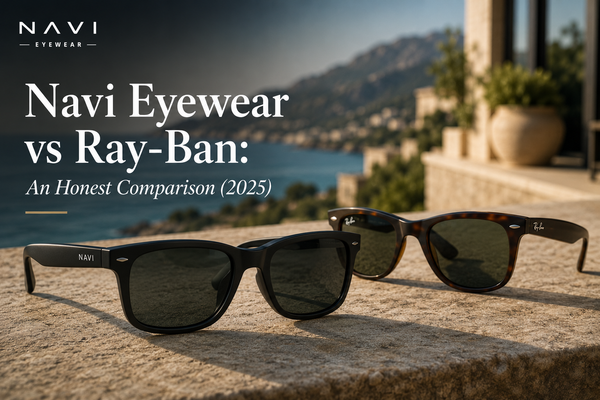

Navi Eyewear vs Ray-Ban: An Honest Comparison (2025)
Ray-Ban is one of the most recognized sunglass brands on the planet. The Wayfarer. The Aviator. The Clubmaster. These are not just sunglasses — they are cultural artifacts. Decades of marketing, Hollywood placement, and genuine heritage have made Ray-Ban synonymous with premium eyewear in the minds of millions of buyers.
But synonymous with premium is not the same as synonymous with the best lens specification for your money. And in 2025, that distinction matters more than ever. The direct-to-consumer sunglasses market has fundamentally changed what is available at every price point. You no longer need to spend $175 on a single pair of polarized sunglasses to get UV400 protection, FDA-cleared impact-resistant lenses, and a premium everyday frame.
This comparison exists to answer one honest question: when you put Navi Eyewear and Ray-Ban side by side on the specifications that actually protect your eyes and serve your daily life, how do they compare? Not in terms of brand story or marketing budget. In terms of what ends up on your face, what it costs, and what you get for that cost.
This is not a hit piece on Ray-Ban. Their products are well made and genuinely iconic. This is a transparent, specification-first comparison that respects both brands and gives you the information to make a decision that is right for your priorities.
This is the C12 Comparison and Best For pillar post. The supporting comparison guides in this cluster cover the specific technical decisions:polarized vs non-polarized sunglasses,UV400 vs UV380: what is the difference,polycarbonate vs glass sunglass lenses,mirror vs non-mirror sunglass lenses, andcheap vs expensive sunglasses: a spec-by-spec comparison.
Quick Answer
Navi Eyewear’s Buy 1, Get 3 Free deal gives you 4 pairs of UV400 polarized sunglasses for $99 — roughly $25 per pair. A single pair of polarized Ray-Bans typically costs $150–$200 or more. Both brands offer UV400 protection, polarized lenses, and impact-resistant polycarbonate. The honest difference is not lens performance. It is price, value, and what your budget actually buys you.

Table of Contents
Part 1: The Price Comparison — What You Actually Pay Per Pair
Ray-Ban Pricing in 2025
Ray-Ban sunglasses retail at premium price points across all major channels. A standard non-polarized pair of Ray-Ban Wayfarers starts at around $154. The polarized version of the same frame jumps to approximately $194. Ray-Ban Aviators follow a similar structure — the classic metal version starts around $161, and the polarized upgrade adds $30–40. The Clubmaster polarized model comes in at $220 or above depending on the finish.
Ray-Ban does not regularly discount. Their distribution model — premium retail, authorized online partners, and their own website — maintains pricing consistency. When you buy Ray-Ban, you pay close to full retail. The brand equity is part of the product, and the pricing reflects that.
There is nothing dishonest about charging a premium for a heritage brand. Ray-Ban has invested enormously in their product history, their silhouettes, and their cultural presence. The question is whether that investment in brand equity translates into better eye protection performance at the lens level — and the honest answer is: not significantly.
Navi Eyewear Pricing
Navi Eyewear operates on a direct-to-consumer model with a Buy 1, Get 3 Free structure. The price is $99 for four pairs. Add any four pairs to your cart and the discount auto-applies at checkout — no code, no fuss. That works out to approximately $25 per pair for UV400 polarized sunglasses with FDA-cleared impact-resistant lenses, oleophobic and anti-saltwater coatings, TR90 frames with stainless 5-barrel hinges, free shipping, and free replacements. Browse the full collection atNavi Eyewear’s polarized sunglasses collection.
The direct-to-consumer model is not a compromise. It is the mechanism that makes the pricing possible. Navi is not paying for premium retail shelf space, celebrity endorsement campaigns, or a century of brand-building. They are building the product at a quality specification and selling it directly to you at a price that removes every layer of middleman markup.
The Per-Pair Math That Changes the Conversation
|
|
Ray-Ban (Polarized) |
Navi Eyewear (Buy 1 Get 3 Free) |
|
Single pair price |
$154–$220+ |
— |
|
Four-pair cost |
$616–$880+ |
$99 |
|
Cost per pair |
$154–$220 |
~$25 |
|
Polarized included |
Upgrade cost ($30–40) |
Yes — standard |
|
Shipping |
Varies by retailer |
Free |
|
Replacement cost |
Full retail price |
Free replacements |
|
UV certification |
UV400 |
UV400 |
|
Impact resistance |
Yes |
Yes — FDA-cleared |
The per-pair math is the most important number in this comparison. When you spend $175 on a single pair of polarized Ray-Bans, you are making a single-pair investment. When you spend $99 on four pairs of Navi Eyewear, you are building a rotation — one in the car, one at the office, one in the beach bag, one as a backup. The UV protection delivered per dollar is not comparable. It is in a different category entirely.
Part 2: UV Protection — UV400 Explained and Why It Matters
What UV400 Actually Means
UV400 is the certification that a sunglass lens blocks 100% of ultraviolet radiation up to 400 nanometres in wavelength. That covers all UVA (315–400nm) and all UVB (280–315nm) that reaches the Earth’s surface. UVC is absorbed by the ozone layer and is not a significant ground-level concern. UV400 is the complete standard — there is no meaningful UV protection specification above it for everyday sunglass use.
Both Navi Eyewear and Ray-Ban offer UV400 certified lenses. This is the baseline that any quality sunglass purchase should meet, and both brands meet it.
Why UV Protection Is More Important Than Most People Realise
The eye is one of the most UV-vulnerable structures in the human body. The cornea absorbs the majority of UVB, and the crystalline lens absorbs much of what remains. Over decades, this cumulative UV exposure drives the oxidative damage to lens proteins that produces cataracts — the leading cause of vision impairment globally. The retina, particularly the macula, is vulnerable to UVA that penetrates to the back of the eye, contributing to age-related macular degeneration.
Research published in the New England Journal of Medicine identified UV radiation as a primary environmental risk factor for cortical and nuclear cataracts, with the relationship dose-dependent: more lifetime UV exposure correlates directly with higher cataract risk. This is not a distant theoretical risk. It is the accumulated consequence of every unprotected outdoor hour over a lifetime.
The specific UV disease mechanisms — covering cataracts, macular degeneration, pterygium, and photokeratitis — are covered in full inUV and eye disease: the complete guide. The UV400 standard and how to verify it on any pair of sunglasses is inthe complete guide to UV eye protection.
UV400 vs UV380: Why the Standard Matters
Some sunglasses — particularly lower-cost products — claim ‘UV protection’ while only blocking to 380nm. The 380–400nm window is UVA that reaches the retina in meaningful doses. UV380 certification leaves this window open. UV400 closes it completely. Both Navi and Ray-Ban use UV400 — but it is worth knowing the distinction when evaluating any other brand in the market. The full breakdown is inUV400 vs UV380: what is the difference.
Does Price Affect UV Protection Quality?
No. UV400 certification is a binary standard — a lens either blocks UV to 400nm or it does not. A $25 polycarbonate lens with UV400 certification blocks the same UV spectrum as a $200 polycarbonate lens with UV400 certification. The UV protection quality of a lens is determined by the material and its certification, not the price of the frame around it. Polycarbonate, which both brands use for most of their sunglass lenses, provides inherent UV protection throughout the material — it is built into the polymer, not a surface coating that can degrade.
Part 3: Polarization — The Glare Science Behind Both Brands
How Polarization Works
Light reflecting off flat horizontal surfaces — roads, water, wet pavements, car hoods — becomes predominantly horizontally polarized. It oscillates in a flat horizontal plane, and it is this horizontally polarized light that produces the intense glare that washes out visual contrast, causes squinting, and in high-intensity scenarios on water or snow can temporarily overwhelm vision.
A polarized lens contains a microscopic filter — a polyvinyl alcohol (PVA) film oriented vertically — that blocks horizontally polarized light while allowing vertically polarized light through. The result: surface reflection is eliminated at the source. Not reduced. Eliminated. The difference between a polarized and non-polarized lens looking at a reflective water surface on a bright day is the difference between seeing the sky’s reflection and seeing the bottom of the lake.
Ray-Ban and Polarization
Ray-Ban offers polarized versions of most of their popular models. The polarized upgrade adds approximately $30–40 to the base price. It is clearly worth it for anyone who spends time driving, near water, or outdoors in bright conditions. The polarization technology in Ray-Ban’s lenses is reliable and well-established. Their lenses are identified by the ‘P’ mark on the lens.
Navi Eyewear and Polarization
Navi Eyewear includes polarized lenses as standard across their collection — not as an upgrade, not at an additional cost. Every pair in the Navi lineup is UV400 polarized. This is a meaningful structural difference from Ray-Ban’s tiered model: with Navi, there is no non-polarized entry point that you need to upgrade from. Browse Navi’s full polarized collection atnavieyewear.com/collections/polarized.
Where Polarization Matters Most
Driving is the most universally relevant polarization use case. Road surface glare from wet tarmac reduces contrast of road markings and surface hazards in a way that standard dark lenses cannot address. Fishing is the most dramatic — polarized lenses reveal sub-surface environments that are invisible without them. Skiing, beach days, open water, and any outdoor environment with reflective surfaces all benefit significantly. The complete guide to why polarization makes a specific, measurable difference in these environments is inpolarized sunglasses: are they worth it.
Part 4: Lens Materials and FDA Standards
Polycarbonate — The Performance Standard
Polycarbonate is the lens material used in the majority of performance and everyday sunglasses from both Navi Eyewear and Ray-Ban (across their mainstream models). Polycarbonate’s properties make it the right choice for any sunglass meant for daily outdoor use:
FDA Impact Resistance Clearance
Navi Eyewear explicitly states FDA-cleared impact-resistant lenses as part of their product specification. In the United States, the FDA regulates sunglasses as medical devices under 21 CFR Part 886 and requires that lenses meet impact resistance standards defined in 21 CFR Part 801. The basic impact test requires lenses to withstand a 1-inch steel ball dropped from 50 inches without fracturing. The high-velocity test (used for protective eyewear) has more stringent requirements.
Sunglass lenses sold in the US are expected to meet basic impact resistance standards as a regulatory requirement. The significance of Navi’s explicit FDA compliance statement is the transparency — it confirms the lenses meet the federal standard rather than leaving the buyer to assume compliance. Ray-Ban lenses also meet impact resistance requirements as required for US retail.
The material science comparison — polycarbonate vs glass vs Trivex vs CR-39, with the performance trade-offs of each — is covered in full inpolycarbonate vs glass sunglass lenses: which is better.
Part 5: Coatings — Oleophobic, Anti-Saltwater, and What They Do
Oleophobic Coating
An oleophobic coating is an oil-repelling surface treatment applied to the outer lens surface. It causes oils from fingerprints, skin contact, and environmental contamination to bead up and roll off rather than spreading into a smear that degrades optical clarity. Oleophobic lenses are significantly easier to clean than uncoated lenses — a single wipe with a clean microfibre cloth removes the majority of contamination without the repeated polishing that uncoated lenses require.
Navi Eyewear includes oleophobic coating as standard. Ray-Ban includes lens coatings on their models, though the specific coating composition varies by product line. For daily outdoor use where lens contact with skin, sweat, and sunscreen is routine, oleophobic coating meaningfully extends the service life of the lens optical surface.
Anti-Saltwater Coating
Marine environments are hostile to optical coatings. Salt spray deposits sodium chloride crystals on the lens surface that, if left and rubbed, act as an abrasive. Prolonged exposure to salt air accelerates the degradation of surface coatings that are not specifically engineered for marine resistance. Anti-saltwater coating protects the lens surface from salt deposit damage, extends coating lifespan in coastal and marine environments, and makes post-session cleaning more effective.
Navi Eyewear includes anti-saltwater coating as a standard lens specification. This is particularly relevant for beach users, boaters, surfers, fishermen, and anyone who spends regular time in coastal or on-water environments. Most standard sunglass lines — including Ray-Ban’s mainstream models — do not specify marine-resistant lens coatings as a standard feature.
Part 6: Frame Construction — TR90 vs Acetate vs Metal
Navi Eyewear: TR90 Nylon with Stainless Hardware
Navi frames are constructed from TR90 nylon — a thermoplastic polyamide developed specifically for performance optical applications. TR90’s properties suit everyday sunglass use well: it is lighter than most acetate frames, significantly more impact-resistant, and flexible without permanent deformation. A TR90 frame can be bent, twisted, and sat on and will spring back to its original shape in ways that rigid acetate cannot.
Navi’s hardware specification is also worth noting: stainless 5-barrel hinges and a stainless lens logo. Hinge quality is the most common failure point in lower-quality frames. A 5-barrel hinge distributes the stress of repeated opening and closing across five contact points rather than three, significantly extending hinge lifespan. Stainless steel hardware resists corrosion in the marine and sweat environments that brass or aluminium hardware degrades in.
Ray-Ban: Acetate and Metal
Ray-Ban’s iconic frames use materials appropriate to their heritage and price point. The Wayfarer and Clubmaster are acetate — a semi-synthetic cellulose polymer that has been the premium fashion frame material since the mid-twentieth century. Acetate is heavier than TR90, more rigid, and less impact-resistant, but it photographs beautifully, feels substantial and premium in the hand, and holds colour and gloss with age in ways that nylon cannot match. For the frames that built Ray-Ban’s reputation, acetate was the right material and remains so.
Ray-Ban’s metal models — the Aviator being the most iconic — use lightweight metal alloys with quality construction appropriate for their retail price. Metal frames are durable when the alloy and hinges are well-specified; Ray-Ban’s mainstream metal frames meet this standard.
The Honest Material Comparison
For everyday use: TR90 is lighter, more impact-resistant, and more resistant to the physical stress of daily carry and use than acetate. For aesthetic premium feel in the hand: acetate wins. For long-term colour and gloss retention in a static display context: acetate. For an active lifestyle where the frame is dropped, packed, sweated on, and exposed to marine and sport environments: TR90 is the more functional choice.
Neither material is objectively superior. They serve different priorities. Navi’s TR90 serves the performance and durability priorities of daily active use. Ray-Ban’s acetate serves the aesthetic and heritage priorities of premium fashion eyewear. Knowing which priority is yours makes the frame material choice straightforward.
Part 7: Style and Design — Heritage vs Modern Premium
Ray-Ban’s Design Heritage
It would be intellectually dishonest to dismiss Ray-Ban’s design contribution. The Wayfarer, introduced in 1956 and revived in the 1980s as one of the best-selling sunglass frames in history, is genuinely iconic. The Aviator predates it, originating as military pilot eyewear in the 1930s. These are not arbitrarily successful designs — they succeeded because they got the proportional relationship between lens, frame, and human face right in a way that has remained culturally relevant across generations.
Owning a pair of Ray-Bans is, to a meaningful degree, owning a piece of that design history. The brand recognition is real. The cultural signaling of the Ray-Ban silhouette is real. If those dimensions of a sunglass purchase matter to you — and for many buyers they do, legitimately — then that is part of what you are paying $175 for and it is a coherent choice.
Navi Eyewear’s Design Position
Navi Eyewear’s aesthetic is contemporary everyday premium — clean, modern, deliberately not referencing any heritage silhouette. The design language prioritizes looking sharp without advertising the brand, suiting an adult buyer who wants to look put-together outdoors without their eyewear being a status signal. This is not a lesser design ambition — it is a different one. Understated modern premium is its own aesthetic, and for buyers who find the conspicuous branding of heritage design labels less appealing than a clean, confident frame, Navi delivers it.
Style is the One Area Where Personal Preference is Non-Negotiable
If you specifically want the Wayfarer silhouette with the Ray-Ban logo, no $25 pair of Navi sunglasses is going to satisfy that desire. Style preference is legitimate, personal, and not reducible to a spec comparison. What the spec comparison tells you is that beyond the style dimension, there is no objective lens performance reason to pay $175 for a single pair of polarized sunglasses when $25 per pair delivers the same UV400 polarized protection in a frame engineered for daily outdoor performance.
Part 8: The Value Equation — What $99 vs $175 Really Buys
The Single-Pair Premium Purchase
At $175 for a single pair of polarized Ray-Bans, you are making a premium single-pair investment. You wear them everywhere, you protect them carefully, and when they get scratched, sat on, or lost — which eventually happens to every pair of sunglasses — you pay full retail to replace them. There is an implicit cost of ownership that extends beyond the purchase price: the caution that comes with wearing your only nice pair of sunglasses in environments where damage is possible.
The Four-Pair Rotation Model
At $99 for four pairs, the purchase logic is completely different. You build a sunglass rotation that matches your life. One pair in the car for driving. One in the beach bag or ski gear. One at the office. One as a dedicated sport pair for activities where damage is most likely. The performance anxiety of ‘these are my only nice pair’ disappears entirely. When one pair gets scratched at the beach, you reach for another. When you lose a pair at the festival, you are not out $175.
The Free Replacement Factor
Navi includes free replacements as part of their offer. This is not a minor footnote — it is a fundamental change to the total cost of ownership calculation. The effective cost of a scratched, damaged, or worn-out pair of Navi sunglasses is zero. The effective cost of the same outcome with Ray-Bans is the full retail price of a replacement. Over the course of owning sunglasses across multiple years of real daily use, the free replacement provision changes the economic comparison significantly in Navi’s favor.
✨ NAVI EYEWEAR — PREMIUM POLARIZED WITHOUT THE PREMIUM MARKUPUV400 polarized lenses with oleophobic and anti-saltwater coating FDA-cleared impact-resistant polycarbonate lenses Lightweight TR90 frames with stainless 5-barrel hinges and stainless lens logo Buy 1, Get 3 Free — 4 pairs for $99 (≈$25/pair). Free shipping. Free replacements. Add 4 pairs to cart — the discount auto-applies. No code needed. Shop the full collection:navieyewear.com/collections/polarized |
Part 9: Side-by-Side Specification Table
|
Specification |
Navi Eyewear |
Ray-Ban |
|
Price — polarized |
≈$25/pair (Buy 1 Get 3 Free) |
$154–$220+ per pair |
|
UV certification |
UV400 |
UV400 |
|
Polarized lenses |
Yes — standard on all pairs |
Yes — upgrade cost |
|
Lens material |
FDA-cleared polycarbonate |
Polycarbonate / glass (varies) |
|
FDA impact resistance |
Yes — explicitly certified |
Yes — regulatory standard |
|
Oleophobic coating |
Yes — standard |
Varies by model |
|
Anti-saltwater coating |
Yes — standard |
Not standard |
|
Frame material |
TR90 nylon |
Acetate / metal (model varies) |
|
Hinges |
Stainless 5-barrel |
Standard metal (varies) |
|
Hardware |
Stainless lens logo |
Brand logo hardware |
|
Shipping |
Free |
Varies by retailer |
|
Replacements |
Free replacements included |
Full retail price |
|
Return policy |
30 days — unworn, original condition |
30 days — varies by retailer |
|
Brand recognition |
Premium independent |
Iconic global heritage brand |
|
Design style |
Modern everyday premium |
Classic heritage silhouettes |
Part 10: Best For — Who Should Choose Each Brand
Choose Navi Eyewear If:
Choose Ray-Ban If:
Part 11: Who This Comparison Is Not For
Part 12: Common Mistakes When Comparing Sunglasses
Assuming Price Equals UV Protection
The most pervasive misconception in sunglass purchasing is that a more expensive pair provides better UV protection. UV400 is a binary certification — a lens either blocks UV to 400nm or it does not. A polycarbonate UV400 lens at $25 blocks the same UV spectrum as a polycarbonate UV400 lens at $200. The UV specification is not a premium feature. It is a baseline standard that any quality sunglass should meet regardless of price.
Not Checking Whether Lenses Are Polarized
Ray-Ban sells both polarized and non-polarized versions of every model. If you are specifically comparing to Navi’s polarized lenses, make sure you are comparing like for like. A non-polarized Ray-Ban at $154 versus a polarized Navi at $25 is not a fair comparison — but it is a comparison that many buyers make without realising. Polarization is not a cosmetic feature. It eliminates surface glare that standard dark lenses leave intact. The complete case for polarization is inpolarized vs non-polarized sunglasses: the definitive guide.
Conflating Lens Darkness with UV Protection
Dark lenses without UV400 certification provide less UV protection than a lighter UV400 lens. The darkness of a lens is determined by how much visible light it transmits — the UV blocking is a separate property determined by the lens material and any applied UV filter. A very dark lens with no UV certification can actually worsen UV exposure by dilating the pupil into unprotected UV. Always verify UV400 explicitly. Lens darkness tells you nothing about UV protection quality.
Buying One Premium Pair Instead of Four Functional Pairs
This is the decision that the Buy 1, Get 3 Free model directly addresses. A single pair of $175 sunglasses is a single pair — worn everywhere, protected anxiously, replaced expensively when damaged. Four pairs at $25 each is a rotation that serves every lifestyle scenario without the anxiety of protecting your only quality pair. For most people who live active outdoor lives, four pairs is more useful than one.
Ignoring the Replacement Cost in the Total Value Calculation
The purchase price is only part of the true cost of owning sunglasses over time. Ray-Ban at $175 per pair, replaced every two to three years due to scratching or damage, costs $87–88 per year per pair. Navi at $25 per pair with free replacements included changes that calculation fundamentally. Factor replacement cost into any premium sunglass comparison.
Not Reading the Return Policy Before Buying
Both brands have return policies with specific conditions. Understanding what you can and cannot return before you buy prevents the surprise of discovering a non-returnable purchase after the fact.
Part 13: Return Policy Comparison
Navi Eyewear Return Policy
Navi Eyewear offers a 30-day return policy. To qualify, sunglasses must be returned in their original, unworn, and undamaged condition — exactly as received. Sunglasses that have been worn outdoors, used at the beach, taken to the gym, or subjected to normal wear do not qualify. This is a standard quality-control return policy. Think of it the same way as returning unworn clothing with tags intact — the return window exists for buyers who decide before use that the product is not right for them, not as a wear-and-return provision.
Ray-Ban Return Policy
Ray-Ban’s return policy applies to purchases made directly through Ray-Ban.com and is generally 30 days in original condition for unworn items. Purchases through third-party retailers — department stores, optical chains, Amazon — are subject to those retailers’ individual return policies, which vary. If you are comparing return policies, make sure you are looking at the same distribution channel.
What Free Replacements Mean in Practice
Navi’s free replacement offer is separate from the return policy and specifically addresses the most common post-purchase scenario: sunglasses that have been worn and experienced normal damage over time. The replacement provision changes the practical ownership experience — you are not returning product you have not tried; you are replacing a pair that served you until it no longer could. This is the provision that meaningfully reduces the long-term cost of Navi ownership compared to any brand that charges full retail for replacements.
Part 14: The Multi-Pair Argument — Why Four Pairs Changes Everything
The Lifestyle Case for a Rotation
Most people who wear sunglasses wear them in multiple contexts that have different requirements. Driving calls for gray polarized lenses that maintain color accuracy for road and traffic signals. Beach and water demand polarization for surface glare and ideally anti-saltwater coating. Outdoor sport may want amber or brown for contrast enhancement. Everyday casual wear wants a frame that looks sharp without being too sporty. No single pair optimally serves all of these scenarios — but four pairs can.
The Practical Loss and Damage Reality
Sunglasses are one of the most commonly lost and damaged personal accessories. They are set down at restaurants and left behind. They slide off boat gunwales into the water. They get sat on in back pockets. They live at the bottom of beach bags and emerge scratched. If you are honest about the practical reality of sunglasses as objects rather than investments, the per-pair anxiety of a $175 purchase is a genuine quality-of-life cost. Four replaceable pairs at $25 each eliminates that anxiety entirely.
The Sharing and Gifting Case
Four pairs at $99 also means extras for partners, children heading outdoors, or guests at a boat day who forgot their sunglasses. A single $175 pair does not accommodate that flexibility. For families, for active social lives, for anyone who regularly finds themselves sharing or lending sunglasses, the multi-pair model solves a recurring practical problem.
For the complete buyer’s guide to what to look for in any sunglass purchase — the full specification checklist beyond just this comparison — seethe complete sunglasses buying guide. For the environmental and long-term cost of cheap, unverified sunglasses compared to quality-specified alternatives, seethe environmental cost of cheap sunglasses.
Bottom Line
Here is the honest summary: Navi Eyewear vs Ray-Ban is not a comparison of lens quality. Both brands deliver UV400 polarized protection through impact-resistant polycarbonate. The real comparison is a comparison of values — what you are prioritizing in a sunglass purchase.
If you are prioritizing brand heritage, specific iconic silhouettes, and the cultural recognition of a logo that has been on the world’s most famous faces for seventy years — Ray-Ban delivers that at $154–$220 per pair. That is a legitimate purchase for buyers who specifically want what Ray-Ban specifically offers.
If you are prioritizing UV400 polarized eye protection with FDA-cleared lenses, modern premium styling, free replacements, anti-saltwater coating, and the practical flexibility of four pairs across your lifestyle contexts — Navi Eyewear delivers all of that at approximately $25 per pair. For buyers whose priority is the specification rather than the brand story, the comparison is not close.
Four UV400 polarized pairs with free shipping, free replacements, and a spec sheet that includes anti-saltwater coating and oleophobic lenses at $99 total is a different category of purchase than one pair at $175. Not better in every dimension. Better in the dimensions that actually protect your eyes and serve your daily life.
Ready to build your rotation?Shop Navi Eyewear’s full polarized collection. Add 4 pairs to your cart — the Buy 1, Get 3 Free discount auto-applies. Free shipping. Free replacements.
Frequently Asked Questions
Are Navi sunglasses as good as Ray-Ban in terms of UV protection?
Yes — on the UV protection specification, Navi and Ray-Ban deliver the same standard. Both provide UV400 certification, which blocks 100% of UVA and UVB radiation to 400nm — the complete UV protection standard for everyday sunglass use. The UV protection quality of polycarbonate UV400 lenses is not determined by brand or price. It is determined by the material and its certification. For the detailed UV400 science, seeUV and eye disease: the complete guide.
Why are Ray-Ban sunglasses so expensive?
Ray-Ban pricing reflects brand equity, heritage, and retail distribution cost as much as product specification. The brand is owned by EssilorLuxottica, the world’s largest eyewear conglomerate, and priced to reflect its position as a premium heritage brand. The Wayfarer and Aviator silhouettes carry decades of cultural investment that is embedded in the price. The lenses themselves — polycarbonate, UV400, polarized — are not uniquely premium materials. The price reflects who makes them and what they represent, as much as what they do.
Do Navi sunglasses actually block UV?
Yes — Navi Eyewear lenses are UV400 certified, blocking 100% of UVA and UVB to 400nm. The UV blocking is inherent to the polycarbonate material, not a surface coating, which means it does not degrade with surface scratching over time. For how to verify UV400 certification on any pair of sunglasses, see7 signs your sunglasses are not protecting your eyes.
What does FDA-cleared impact-resistant mean for sunglass lenses?
FDA-cleared impact resistance means the lenses meet the federal standard under 21 CFR Part 801 and Part 886 for withstanding impact without fracturing into dangerous sharp fragments. The basic impact test requires lenses to survive a 1-inch steel ball dropped from 50 inches without fracturing. Polycarbonate lenses are the material most commonly associated with this standard. It is a safety certification relevant to daily use scenarios where lens impact from flying debris, drops, or accidental contact is possible.
Is Navi Eyewear a legitimate brand with real UV protection?
Yes. Navi Eyewear is a direct-to-consumer premium sunglasses brand with explicitly stated UV400 polarized lenses, FDA-cleared impact-resistant polycarbonate, TR90 frames with stainless hardware, oleophobic and anti-saltwater coatings, and a stated return and replacement policy. The specifications are clear, verifiable, and consistent with a brand building on product quality rather than marketing budget. The direct-to-consumer model is the mechanism that makes the pricing possible — it removes retail and brand markup, not product quality.
What is the Navi Eyewear Buy 1 Get 3 Free deal exactly?
The offer is: add any 4 pairs of Navi sunglasses to your cart and pay $99 total. The discount auto-applies — no coupon code needed. That works out to approximately $25 per pair. The $99 includes free shipping and free replacements. Every pair in the deal includes UV400 polarized lenses, FDA-cleared polycarbonate, TR90 frames, stainless hinges, oleophobic coating, and anti-saltwater coating. Browse the full collection atnavieyewear.com/collections/polarized.
Can I return Navi sunglasses if I change my mind?
Yes — within 30 days of purchase, in original unworn condition. The return policy applies to sunglasses that have not been worn outdoors, used, or subjected to any normal wear. If you receive your order and decide before wearing them that the style or fit is not right, you can return them within 30 days for a refund. Sunglasses that have been worn, used at the beach, or otherwise used are not eligible for return. This is a standard quality-control return policy, not a wear-and-return provision.
Are polarized sunglasses worth paying more for?
Yes — polarization makes a specific, measurable difference in any environment with reflective surfaces: driving on wet roads, fishing on open water, skiing on snow, or spending time at the beach. With Navi, polarization is included as standard at $25 per pair rather than being a $30–40 upgrade. With Ray-Ban, the non-polarized base price is the entry point. If you are comparing sunglass options, always compare polarized to polarized for an accurate price assessment. The complete science of what polarization does is inpolarized sunglasses: are they worth it.
What makes Navi Eyewear different from other affordable polarized sunglasses?
Most affordable polarized sunglasses are affordable because they cut corners on the specification — unverified UV protection, cheap frame hardware, no meaningful coatings, and no replacement or return policy. Navi’s differentiation is a full quality specification at a direct-to-consumer price: explicit UV400 certification, FDA-cleared polycarbonate, stainless 5-barrel hinges, oleophobic and anti-saltwater coatings, TR90 frames, free replacements, and free shipping. The specification is premium. The pricing is possible because of the direct-to-consumer model, not because of material shortcuts.
How does Navi Eyewear compare to other Ray-Ban alternatives?
The direct alternatives to Ray-Ban in the market range from unverified cheap imports at the bottom to mid-premium brands at $80–$120 per pair. Navi’s position is differentiated by the four-pair model at $99 with free replacements — a structure that changes the value calculation entirely. Other alternatives require you to compare single pairs; Navi’s offer requires you to compare four pairs plus free replacements against a single pair. That changes the math in Navi’s favor across every buyer scenario where multiple pairs is a rational preference. See the broaderpremium vs budget sunglasses comparisonfor the full market landscape.
Is there an anti-saltwater coating on Ray-Ban sunglasses?
Ray-Ban does not standardly specify anti-saltwater or marine-resistant coating across their mainstream models. Their lenses include standard surface coatings, but marine-specific resistance is not a stated feature of their general product line. For buyers who regularly use sunglasses in coastal, boating, fishing, or surf environments, Navi’s explicit anti-saltwater coating specification is a meaningful product advantage.
What if I lose a pair of Navi sunglasses?
Navi’s free replacement offer covers replacement of pairs that have been worn and damaged or that develop quality issues. For lost pairs, you are back to the original purchase economics — but at $25 per pair effective cost, replacing a lost pair is a very different financial event than replacing a $175 Ray-Ban. The multi-pair model also means you are more likely to have another pair available immediately while you figure out the replacement.
Supporting Articles
READY TO MAKE THE SWITCH?Four pairs of UV400 polarized sunglasses. FDA-cleared polycarbonate lenses. Oleophobic and anti-saltwater coating. TR90 frames with stainless 5-barrel hinges. $99 total. Free shipping. Free replacements. No code needed — add 4 pairs to your cart and the Buy 1, Get 3 Free discount auto-applies. |
SOURCES & CITATIONS[1] Taylor HR, West SK, Rosenthal FS, et al..“Effect of ultraviolet radiation on cataract formation.”New England Journal of Medicine, 1988.View source [2] Cruickshanks KJ, Klein R, Klein BE.“Sunlight and age-related macular degeneration: the Beaver Dam Eye Study.”Archives of Ophthalmology, 1993.View source [3] Dain SJ.“Sunglasses and sunglass standards.”Clinical and Experimental Optometry, 2003.View source [4] Rosenthal FS, Bakalian AE, Lou CQ, Taylor HR.“The effect of sunglasses on ocular exposure to ultraviolet radiation.”American Journal of Public Health, 1988.View source [5] U.S. Food and Drug Administration.“Impact resistance requirements for sunglass lenses (21 CFR Part 801).”FDA Regulations, 2023.View source [6] American Academy of Ophthalmology.“Sunglasses: choosing the right pair for UV protection.”AAO EyeSmart, 2023.View source [7] World Health Organization.“Solar ultraviolet radiation: global burden of disease from solar ultraviolet radiation.”WHO Environmental Burden of Disease Series, 2006.View source [8] National Eye Institute.“Cataracts: causes, symptoms, diagnosis, and treatment.”National Eye Institute (NIH), 2023.View source [9] De Faber JT, Naeser K, Kessing SV.“Polarized light and contrast sensitivity under glare conditions.”Ophthalmic Research, 2013.View source [10] Sliney DH.“UV radiation ocular exposure dosimetry.”Documenta Ophthalmologica, 1994.View source |