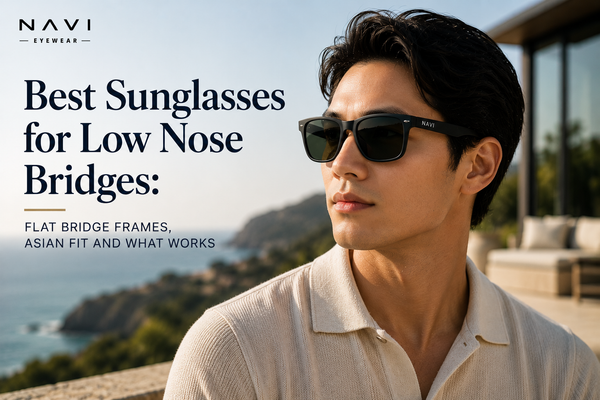

Best Sunglasses for Low Nose Bridges: Flat Bridge Frames, Asian Fit and What Works
A low nose bridge — where the bridge between the eyes sits at or below the level of the inner eye corners, rather than above them — is the most common sunglass fit problem globally. It is particularly prevalent across East Asian, Southeast Asian, and many South Asian populations, as well as among people of African and Pacific Island heritage, and among a significant proportion of European populations. Despite this, the dominant sunglass design paradigm is built around a nose bridge height that does not represent the majority of the world’s population.
The result is familiar: standard sunglasses slide down the nose within minutes. The frame sits too high on the face with the lenses above the eyes. The nose pads or fixed bridge dig into the cheeks rather than resting on the nose. The lenses fog because the frame sits away from the face. Finding sunglasses that stay in place, sit at the right height, and provide genuine UV protection on a low nose bridge is a specific and solvable problem — once you know what design features to look for.
This is the final C11 Specific Audiences supporting post, completing the face-fit cluster. For the high nose bridge companion guide, seebest sunglasses for high nose bridges. For the complete face shape and fit guide, seesunglasses for your face shape: the complete guide. For the fit mechanics and frame measurement guide, seehow to tell if sunglasses actually fit.

Understanding the Low Nose Bridge Fit Problem
What a Low Nose Bridge Actually Means
A low nose bridge is characterised by the bridge of the nose sitting at or below the level of the pupils when viewed face-on. In a typical Western European nose profile, the bridge sits above the inner eye corners, providing a natural ledge for standard nose pads or a saddle bridge to rest on. In a low bridge nose, this ledge is absent or much lower, meaning standard bridges either slide off the nose entirely or rest on the cheeks rather than on the nose itself. The nose may be flat across the bridge with minimal projection, or it may project forward but at a lower angle that does not support standard frame geometry.
The Four Most Common Fit Problems
The Four Design Solutions for Low Nose Bridges
Flat Bridge / Zero Bridge FramesHow it helps: A flat bridge with no nose pad protrusion rests flush against the face across a wide contact area, distributing weight without depending on a raised nose ledge Best for: Low and flat nose bridges with minimal projection; any nose where standard bridges slide off entirely Flat bridge frames — also called zero bridge or no-nose-pad frames — have a bridge that contacts the nose across its full width without protruding individual pads that need a raised bridge surface to grip. The bridge section sits flush or nearly flush against the area between the eyes, using the wider flat contact surface to stay in place on a low nose. This is the design principle behind many sports frames and dedicated low bridge/flat bridge collections. The contact area is wider and flatter than standard bridges, which distributes weight without the sliding that individual pad contact points produce on a flat nose. Flat bridge frames often include a silicone or soft rubber bridge material that grips the skin slightly, further reducing the sliding tendency. The combination of wide contact area and grip material makes flat bridge frames the most effective design for very flat noses where any standard pad or saddle bridge simply slides off. |
Asian Fit / Low Bridge Fit FramesHow it helps: Specifically engineered bridge geometry with lower set contact points, wider nose pad spread, and adjusted frame angles for low bridge face profiles Best for: East Asian, Southeast Asian, South Asian, African and Pacific Island facial profiles; anyone whose standard frames consistently sit incorrectly Asian fit (also called low bridge fit or universal fit by some brands) sunglasses are designed specifically for the facial geometry that includes a lower nose bridge. The engineering differences from standard fit frames: • Lower contact points: the nose pad arms or bridge section are set lower relative to the lens, matching the lower bridge position • Wider pad spread: the pads are positioned further apart to match the wider, flatter nose bridge geometry • Adjusted frame angle: the lens tilt angle is modified to account for the different facial plane angle on flatter faces • Longer nose pad arms: more extension from the frame front to reach the nose correctly Major brands including Oakley, Ray-Ban, and Maui Jim now produce Asian fit variants of their most popular models. The quality of low bridge fit engineering varies significantly between brands — some produce genuine geometric redesigns; others make only minor cosmetic changes that do not fully address the fit. |
Adjustable Nose Pads with Wide SpreadHow it helps: Metal pad arms can be bent to widen the spread, lower the contact point, and angle the pads to match a flat or low nose bridge Best for: Low bridges with some projection; cases where the bridge is lower than average but not completely flat Metal frames with silicone adjustable nose pads can be calibrated by an optician to match a low nose bridge better than standard pad positions. For low bridges specifically, the adjustment involves: widening the pad spread so the pads rest on a broader, more lateral area of the nose rather than the narrow central bridge; lowering the pad arm angle so the contact point drops to meet the actual bridge height; and angling the pads to match the flatter surface angle of a lower bridge nose. This adjustment route works well for low bridges that have some projection — enough surface for the pads to grip when positioned correctly. For very flat noses with minimal projection, even widely spread pads find insufficient grip surface and the flat bridge or Asian fit frame design is more effective. |
Rubberised Nose Grip FramesHow it helps: Rubberised or silicone material at the nose contact point creates friction that resists sliding even without a raised bridge to grip against Best for: All low bridge types, particularly for active use and sport where sliding is exacerbated by sweat Sport frames and some lifestyle frames use rubberised nose sections — sometimes as a full nose piece, sometimes as a rubberised over-mould on the bridge area — that grip the skin through friction rather than mechanical lock against a raised bridge. This is effective for preventing sliding in everyday use and highly effective for active use where sweat would make standard pads slide even on normal bridges. Combined with a flat or low bridge frame design, rubberised nose grip is the most robust anti-sliding solution available. |
Frame Shapes That Work for Low Nose Bridges
Frames with a High Bridge Position
For low nose bridges, the ideal frame has its bridge section positioned high relative to the lens — meaning the bridge contacts the nose higher on the frame, which in practice means the lenses sit lower relative to the nose contact point. This geometry helps the frame sit at the correct eye level on a lower nose bridge rather than riding up above it. Look for frames where the bridge appears to sit in the upper third of the lens height rather than the middle.
Shallow Lenses (Lower Vertical Depth)
Frames with shallower vertical lens depth — 36–40mm rather than 42–48mm — sit closer to the correct eye level on a low bridge nose because there is less lens below the bridge contact point. Deep lenses on a low bridge nose tend to rest on the cheeks because the lower rim extends below the cheekbone level before the bridge has found a support surface. Shallower lenses reduce this problem. The trade-off is slightly less lower-field UV coverage, which can be partially compensated by a closer-fitting frame design.
Wraparound and Sport Frame Designs
Sport frames designed to wrap around the face often use continuous rubberised nose pieces rather than individual pads, combined with close-fitting frame geometry that presses lightly against the face. This approach naturally accommodates lower nose bridges because the frame’s stability comes from the overall close-fitting geometry and rubberised grip rather than depending on a raised nose bridge as the primary support point. For low nose bridge wearers who also need sport and outdoor UV protection, a wraparound sport UV400 frame is often the most comfortable and stable option. For the complete sport frame guide, seethe complete outdoor and sport sunglasses guide.
What to Avoid
Asian Fit vs Standard Fit: The Practical Differences
The term ‘Asian fit’ has become the most common search term for low bridge fit sunglasses, though it is imprecise — not all East or Southeast Asian people have low nose bridges, and many people of non-Asian heritage do. The more accurate label is ‘low bridge fit’ or ‘universal fit’, which describes the functional design characteristic rather than a demographic assumption.
When evaluating Asian fit variants from major brands, the practical test is whether the changes are structural or cosmetic. A genuine low bridge fit redesign changes the nose pad arm geometry, bridge height position, and frame angle. A cosmetic redesign may simply label the same frame as ‘Asian fit’ without meaningful geometric changes. If trying on frames in store is possible, the test is simple: does the frame sit at the correct eye level without sliding after two minutes of natural movement? If not, the design has not addressed the low bridge problem regardless of its label.
Browse theNavi Eyewear UV400 polarized collection for quality UV400 polarized frames. For specific frame fit questions, see our guide onhow to tell if sunglasses actually fit for the complete fitting checklist.
Low Nose Bridge Fit Quick Reference
|
Fit Problem |
Design Solution |
What to Search For |
|
Sliding down constantly |
Flat/zero bridge with rubberised grip OR Asian fit |
Flat bridge sunglasses, zero bridge UV400, low bridge fit |
|
Frame sits too high |
Lower contact point bridge; shallow lens depth |
Low bridge fit, Asian fit, shallow lens sunglasses |
|
Pads pressing on cheeks |
Wide-spread pads or flat bridge that misses cheeks |
Wide nose pad spread, flat bridge, Asian fit |
|
Lens fogging from face gaps |
Close-fitting frame; sport wrap design |
Wraparound sunglasses, sport frame low bridge |
|
Slides with sweat/activity |
Rubberised nose grip material |
Rubberised nose bridge, sport frame, grip sunglasses |
|
Lenses above eye level |
High bridge position in frame; Asian fit geometry |
Asian fit, high bridge position frame, low bridge fit |
UV Protection on a Low Nose Bridge: The Sliding Problem
There is a specific UV protection consequence of a poorly fitting low bridge frame that is worth naming directly. A frame that slides down the nose no longer provides the UV coverage it was designed to deliver. When the frame is in the slid-down position, the lenses sit below the eye level, leaving the upper portion of the visual field — where UV from the sky and high-angle reflections enters — unprotected. Consistent sliding effectively reduces the UV protection delivered by the frame regardless of its UV400 certification. Getting the fit right is not only a comfort and aesthetic issue — it is a UV protection effectiveness issue.
The UV disease that accumulates from inadequately covered outdoor exposure is covered inUV and eye disease: the complete guide. For the complete UV certification and protection guide, seethe complete guide to UV eye protection.
Frequently Asked Questions
What are the best sunglasses for a low nose bridge?
Flat bridge or zero bridge frames with rubberised nose grip, or explicitly labelled Asian fit / low bridge fit frames from brands that have genuinely re-engineered the nose pad geometry. Sport wraparound frames with continuous rubberised nose pieces are also highly effective. The key test: does the frame stay at the correct eye level without sliding for at least 30 minutes of normal wear? If it slides in-store within minutes, it will not work for daily use. For the complete fit assessment, seehow to tell if sunglasses actually fit.
What does ‘Asian fit’ mean for sunglasses?
Asian fit — also called low bridge fit or universal fit by some brands — describes sunglasses specifically designed for facial profiles with a lower nose bridge and flatter facial plane. The engineering differences from standard fit include: lower-set nose pad contact points, wider pad spread, adjusted frame angle to match the flatter facial plane, and sometimes extended nose pad arms. Asian fit addresses the sliding, high-riding, and cheek-contact problems that standard sunglasses cause on low bridge noses. The quality of Asian fit engineering varies significantly across brands — some make genuine geometric redesigns; others make only cosmetic changes.
Why do sunglasses always slide down my nose?
Sliding is caused by a mismatch between the frame’s bridge geometry and a low or flat nose bridge. Standard nose pads and saddle bridges are designed to rest against a raised nose bridge surface that acts as a mechanical stop. On a low or flat nose, this stop surface is absent — gravity and the nose’s natural forward taper pull the frame forward and down without resistance. Solutions: flat bridge frames that use a wide contact area and grip material instead of a mechanical stop; Asian fit frames with geometry designed for low bridge noses; rubberised nose sections that grip through friction; sport frames with close-fitting designs that distribute the frame load across the entire face geometry.
What are flat bridge sunglasses?
Flat bridge sunglasses have a bridge section that contacts the nose across its full width with minimal or zero protrusion above the nose surface — often with a silicone or rubberised material for grip. Unlike standard bridges that depend on individual pad contact points or a saddle that hooks over a raised bridge surface, flat bridge designs rest flush against the area between the eyes and use surface area and friction to stay in place. They are the most effective design for very flat or low-projecting nose bridges where other approaches slide off entirely.
Do nose pads help with a low nose bridge?
Standard nose pads in standard position typically do not help on low bridges — they are designed for the bridge height of an average Western European nose. Adjustable nose pads that can be re-set by an optician can help for low bridges that have some projection — by widening the spread and lowering the contact point. For very flat noses with minimal projection, even adjusted pads find insufficient grip surface. In this case, flat bridge or Asian fit frame designs with rubberised nose contact are more effective than any pad adjustment.
Are there sunglasses specifically designed for Asian faces?
Yes — the Asian fit category exists specifically to address the prevalence of low nose bridges across East Asian, Southeast Asian, and some South Asian populations. Major brands including Oakley, Ray-Ban, Maui Jim, and Randolph Engineering produce Asian fit variants of their most popular models. Dedicated Asian eyewear brands including Owndays, JINS, and Zoff build their entire collections around Asian facial geometry. The caveat: not all Asian fit labels represent genuine geometric redesigns. Test the fit in practice rather than relying on the label alone.
What frame shapes are best for a flat nose bridge?
Wraparound sport frames with continuous rubberised nose pieces; flat bridge frames in any lens shape; frames with shallow vertical lens depth (36–40mm) that reduce cheek contact; and frames explicitly designed as Asian fit or low bridge fit. The frame shape (round, rectangular, oval) is secondary to the bridge design for a flat nose — the bridge geometry is the primary fit variable. Once the bridge design is correct, choose the shape that suits your face proportions and style preference.
Can I stop my sunglasses from sliding without buying new ones?
For existing metal frames with adjustable pads: yes, an optician can widen the pad spread and lower the contact angle to improve grip on a low bridge at no or low cost. For plastic frames with fixed bridges: options are more limited. Anti-slip nose grip inserts — small stick-on silicone pads that attach to the inside of the bridge — can be added to existing frames and improve grip somewhat. These are available cheaply online and are worth trying before replacing the frame. For active use, a frame retention strap or cord attached to the temple tips prevents the frame from sliding fully off the face even if it is not gripping perfectly.
What is the difference between low bridge fit and standard fit sunglasses?
Standard fit sunglasses are designed for an average nose bridge height where the bridge sits above the inner eye corners, providing a natural raised surface for the frame to rest against. Low bridge fit sunglasses are designed for faces where this raised surface is absent or lower, using wider and lower-set contact points, rubberised grip surfaces, and adjusted frame angles to stay in place without depending on a raised bridge. The differences are in the engineering of the nose contact geometry — not simply a size difference or aesthetic variation.
Can I buy low bridge sunglasses with UV400 polarized lenses?
Yes — UV400 polycarbonate and polarization are available in flat bridge and Asian fit designs across multiple brands and price points. The UV protection specification is independent of the bridge design. When buying low bridge sunglasses, verify UV400 certification explicitly just as you would for any sunglass purchase. The UV400 verification guide and the signs of inadequate UV protection are in7 signs your sunglasses are not protecting your eyes.
How does a low nose bridge affect UV protection?
A frame that slides down due to a low nose bridge mismatch provides less UV protection than its certification implies, because the slid-down position leaves the upper visual field — where UV from above and high-angle reflections enters — exposed above the lens level. Consistently worn at the correct position, a UV400 frame on a low bridge nose provides full certified protection. Consistently worn in the slid-down position, it provides significantly less. This makes getting the fit right a UV protection priority, not just a comfort one. The complete UV disease and protection science is inUV and eye disease: the complete guide.
SOURCES & CITATIONS[1] Dain SJ.“Sunglasses and sunglass standards.”Clinical and Experimental Optometry, 2003.View source [2] Rosenthal FS, Bakalian AE, Lou CQ, Taylor HR.“The effect of sunglasses on ocular exposure to ultraviolet radiation.”American Journal of Public Health, 1988.View source [3] Sliney DH.“UV radiation ocular exposure dosimetry.”Documenta Ophthalmologica, 1994.View source [4] Wong TY, Foster PJ, Johnson GJ, Seah SK.“Refractive errors, axial ocular dimensions and age-related cataracts: the Tanjong Pagar Survey.”Investigative Ophthalmology and Visual Science, 2003.View source |