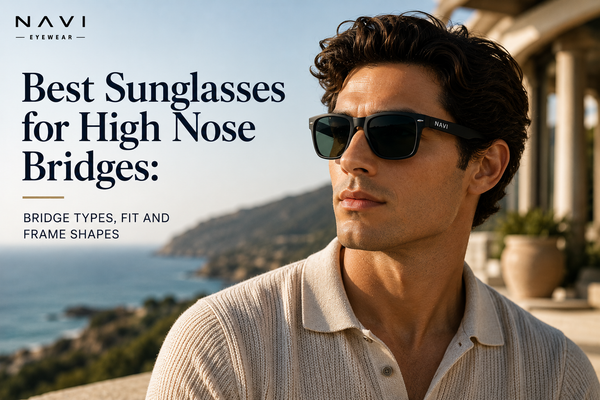

Best Sunglasses for High Nose Bridges: Bridge Types, Fit and Frame Shapes
A high nose bridge — where the nose projects further from the face than average, or where the bridge sits higher between the eyes — creates specific fit problems with standard sunglass frames. The most common: the frame rides up so that the lenses sit too high in the visual field, with the bridge pressing into the nose uncomfortably. Or the frame sits correctly on the bridge but the lower lens rim sits on the cheekbone. Or the keyhole bridge shape that works for lower bridges creates a pinching pressure point on a prominent bridge. These are solvable problems when you know what bridge geometry and frame shapes to target.
Unlike face width, which has a straightforward measurement solution, nose bridge height is more about frame design than a single number. The bridge type — keyhole, saddle, adjustable pad, or no-bridge contact point — determines how the frame interacts with a high nose bridge, and some types work significantly better than others for this geometry.
This is a C11 Specific Audiences supporting post. For the complete face shape and fit guide, seesunglasses for your face shape: the complete guide. For the fit mechanics including how bridge geometry affects sunglass position, seehow to tell if sunglasses actually fit. For the low nose bridge companion guide, seebest sunglasses for low nose bridges.

Understanding High Nose Bridge Fit Problems
What ‘High Nose Bridge’ Actually Means
A high nose bridge can mean two distinct things that are sometimes confused. The first: a high-projecting nose where the bridge extends significantly further from the facial plane than average. The second: a high-set bridge where the top of the nose bridge sits higher between the eyes relative to the eye level — meaning frames with a standard bridge height sit above the normal lens-to-eye position. Both create fit problems, but they manifest differently and are addressed by slightly different frame features.
The Four Most Common Fit Problems
Bridge Types: Which Works for High Nose Bridges
Saddle Bridge (Keyhole Bridge) — Depends on WidthHow it helps: A correctly-wide saddle bridge distributes weight across a larger nose contact area; too narrow creates pinching Best for: High, wide nose bridges where there is enough bridge width to accommodate the saddle shape without pressure The classic keyhole or saddle bridge — the continuous curve that contacts the nose at two points on either side of the top of the bridge — is the most common bridge type in fashion and lifestyle sunglasses. For high nose bridges, the saddle bridge works well when it is wide enough to sit across the nose without the narrowing keyhole shape pressing into a prominent bridge. The key specification: look for saddle bridges with a relatively flat profile rather than a deeply curved keyhole shape. A flat saddle contacts the nose across a wider area and distributes pressure more comfortably on a high bridge. |
Adjustable Nose Pads — The Most Versatile SolutionHow it helps: Pad position, angle, and spread can be calibrated precisely to the individual bridge height and shape Best for: Most high nose bridge types; particularly useful when the bridge is both high and prominent Metal frames with adjustable nose pads — small silicone or acetate pads attached to metal arms that can be bent to different angles and spreads — are the most adaptable solution for high nose bridges. An optician can adjust the pad height (how far the pads project from the frame), the angle (how they meet the nose surface), and the spread (how far apart they sit) to place the frame precisely at the correct height and angle for any nose geometry. For high nose bridges specifically, raising the pad arms positions the frame contact point lower on the nose, allowing the lenses to sit at the correct eye level. If you have struggled to find frames that fit a high nose bridge, a metal frame with adjustable pads fitted by an optician is the most reliable solution. |
High Bridge / Low Base Curve FrameHow it helps: Frames designed with a higher bridge height in the frame construction clear a prominent nose without riding up Best for: Faces where the main problem is the frame riding up onto the nose rather than bridge shape Some frame manufacturers produce designs specifically described as ‘high bridge fit’ — these have an increased distance between the frame’s lens plane and the bridge contact point, meaning they clear a prominent nose without the lens plane tilting upward. These frames are more common in the luxury and prescription eyewear market than in budget sunglasses. If a frame is labelled ‘high bridge fit’ by the brand, it specifically addresses the riding-up problem by geometry rather than through pad adjustment. |
No-Bridge or Rimless with Centre BarHow it helps: A narrow metal bar connecting the lenses with no nose contact other than small pad tips provides minimal contact with a high bridge Best for: High bridges where the primary problem is standard bridge shapes pressing on or around the nose prominently Rimless and semi-rimless designs with a thin metal centre bar produce minimal bridge contact. The two small pad tips at the ends of the bar touch the nose at two points far apart and with minimal surface area, which reduces the pressure that full bridge shapes impose on a prominent nose. The limitation: these frames provide less structural stability than full-bridge designs and are less suitable for high-activity use where frame security matters. |
Frame Shapes That Work for High Nose Bridges
Frames with a Flat or Shallow Bridge Profile
The bridge profile — how deeply the bridge curves down toward the nose — is the most important frame shape variable for high nose bridges. A deeply curved keyhole bridge that narrows aggressively creates pressure on a prominent nose. A flat or shallow bridge that rests across a wider contact area on the upper nose distributes weight more comfortably. When examining frames, look at the bridge from the side: a flatter bridge profile is the target.
Larger Lens Depth for Coverage
High nose bridges often create the problem of the frame riding up, which moves the lenses upward in the visual field and leaves the lower visual area less covered. Frames with a slightly deeper lens (42mm+ vertical depth) maintain adequate lower-field coverage even if the frame sits slightly higher than ideal on the nose. Shallower lenses (below 38mm) can create a situation where adequate coverage requires the frame to sit at exactly the right height — with no margin for the riding-up that high bridges produce.
Aviator and Teardrop Shapes
Aviator-style frames with their teardrop lens shape — deeper at the bottom than the top — are forgiving of the riding-up effect because the deeper lower lens maintains visual coverage even when the frame sits slightly higher. The slim metal bridge of a classic aviator also avoids the pressure that wider plastic bridge shapes create on a prominent nose. Many high-bridge nose wearers find aviators one of the most comfortable frame shapes.
Rectangular Frames with a High Bridge Position
Rectangular frames where the bridge attachment point is positioned higher on the lens — creating a larger gap between the bridge and the lower lens rim — accommodate high noses by leaving more clearance below the bridge contact point. This is a frame design feature rather than a measurement that is typically specified, so it requires visual assessment of the frame’s bridge geometry when browsing.
What to Avoid
Buying Online for a High Nose Bridge
What to Look for in Product Specifications
When buying online, look for: explicit ‘high bridge fit’ labelling; metal frames with adjustable nose pads (these will be described as metal or titanium frames with nose pad icons in specifications); flat or saddle bridge descriptions rather than keyhole; and aviator or teardrop shapes which are inherently more accommodating. Avoid frames described as ‘flat bridge’ in the low-bridge sense — ‘flat bridge’ in children’s and Asian-fit eyewear refers to a frame designed for a low nose bridge, which is the opposite of what is needed here.
The Optician Adjustment Route
For high nose bridges that have caused consistent fit problems with standard frames, an optician visit specifically for fit adjustment is worth pursuing. Metal frames with adjustable pads can be modified precisely to accommodate any nose height and bridge shape. An optician with an adjustment tool can calibrate the pad position in minutes. This service is usually available even for frames purchased elsewhere and typically costs little or nothing at most optical practices.
Browse theNavi Eyewear UV400 polarized collection for quality UV400 polarized frames. Metal frame options with adjustable nose pads provide the most reliable fit solution for high nose bridges. All Navi lenses are polycarbonate UV400.
High Nose Bridge Fit Checklist
|
Fit Point |
What It Should Look Like |
Problem Signal |
|
Lens position |
Lenses sit at mid-eye level — covering from just above the brow to cheekbone |
Riding too high: lenses cover forehead; too low: eyelashes touch lens |
|
Bridge contact |
Bridge rests on nose without pressure points or pinching |
Pressure after 30 min: bridge too narrow or keyhole too deep |
|
Lower rim |
Lower rim clears cheekbones when smiling |
Touching cheek when smiling: lens too deep for nose bridge height |
|
Temple lie |
Arms lie flat against side of head without tension |
Bowing: frame width issue (see wide face guide) |
|
Eyelash clearance |
Minimum 5mm gap between lens back surface and eyelashes |
Touching lashes: frame riding too high or lens too deep |
|
Bridge contact area |
Pads or bridge surface distributes across nose without single pressure point |
Red mark on nose bridge after wear: contact area too narrow |
UV Protection: Still the Foundation
Fit and bridge geometry are the specific challenge for high nose bridges — but UV400 polycarbonate certification remains the non-negotiable foundation beneath any frame choice. A frame that fits perfectly with no UV protection provides no eye health benefit. A frame with UV400 polycarbonate lenses that requires minor adjustment provides both. For the full UV protection science and what cumulative UV exposure means for long-term eye health, seethe complete guide to UV eye protection andUV and eye disease: the complete guide.
Frequently Asked Questions
What sunglasses are best for a high nose bridge?
Metal frames with adjustable nose pads are the most reliable solution — they can be calibrated precisely to any bridge height and shape by an optician. Frames explicitly labelled ‘high bridge fit’ address the geometry directly. Aviator-style frames with a slim metal bridge and adjustable pads are specifically well-suited to high nose bridges. Avoid deeply curved keyhole bridges in plastic frames without adjustment capability. For the complete fit mechanics, seehow to tell if sunglasses actually fit.
Why do my sunglasses always ride up on my nose?
Riding up is the classic high nose bridge problem. It happens when the bridge contact point is too low for your nose height, causing the frame to be pushed upward as the nose projects beyond the bridge clearance. Solutions: metal frames with adjustable pads whose height can be raised to move the contact point up the nose; frames labelled ‘high bridge fit’ which are designed with this clearance built in; aviator shapes whose slim metal bridge provides more clearance than wide plastic bridges; and optician adjustment of existing metal frames.
What is a high bridge fit sunglass?
A high bridge fit sunglass is specifically designed for faces where the nose bridge sits higher between the eyes than average, or where the nose projects significantly further from the facial plane. The design provides more clearance between the frame’s lens plane and the bridge contact point, preventing the frame from being pushed upward by a prominent nose. Some brands — particularly in the prescription eyewear market — produce dedicated high bridge fit collections. The term can also describe the adjustable pad metal frame approach, since the pads can be set to any bridge height.
Do adjustable nose pads help with a high nose bridge?
Yes — they are the most effective solution. Metal frames with silicone adjustable nose pads allow the pad arm height, angle, and spread to be modified by an optician to accommodate any nose bridge geometry. For a high nose bridge, the optician raises the pad arms so the pads contact the nose further down from the frame, effectively increasing the bridge clearance and allowing the frame to sit at the correct height without being pushed up by the nose bridge. This adjustment takes a few minutes and most opticians will do it for any metal frame.
Can I wear aviator sunglasses if I have a high nose bridge?
Aviators are often one of the best choices for high nose bridges. The classic aviator has a slim metal bridge with adjustable nose pads — both features that help with high bridges. The teardrop lens shape, deeper at the bottom, also maintains visual coverage even if the frame sits slightly higher than ideal. The adjustable pads allow the fit to be calibrated to the exact nose geometry. Many people with high nose bridges find aviators more comfortable than plastic frame alternatives.
What type of bridge is best for a high nose bridge?
Adjustable pad metal frames provide the most control and are the most reliable. Among fixed bridge types: flat or shallow saddle bridges that distribute contact across a wider nose area are more comfortable than deeply curved keyhole bridges that press into a single point. Frames designed with a high bridge position — where the bridge attachment is set higher in the lens — clear a prominent nose without requiring adjustment. Rimless or semi-rimless centre bar designs also work well by minimising the contact area with a prominent nose.
How do I stop sunglasses from pressing on my nose?
Pressure on the nose from sunglasses comes from a mismatch between the frame’s bridge shape and the nose geometry. Solutions: switch to a metal frame with adjustable silicone nose pads; have an optician adjust existing metal frame pads to a wider spread and higher position; choose frames with a wider, flatter bridge contact profile; look for high bridge fit frames. If pressure specifically builds over time rather than being present from the first wearing, it is often from pad position — an optician can adjust this in minutes.
What frame shapes suit a high nose bridge?
Aviators (slim metal bridge, adjustable pads, deep lower lens), rectangular frames with a high bridge position, rimless designs with minimal nose contact, and any frame with adjustable nose pads that can be calibrated to the nose height. For the style dimension — how frame shapes interact with facial proportions beyond just nose bridge fit — seesunglasses for your face shape: the complete guide.
Can an optician adjust my sunglasses for a high nose bridge?
Yes — for metal frames with adjustable nose pads, an optician can bend the pad arms to raise, lower, spread, or angle the pads to fit any nose geometry. This is a standard optical fitting service that most opticians provide. It is the most effective intervention for high nose bridge fit problems on existing metal frames. For plastic frames without adjustable pads, the options are more limited — the bridge geometry is fixed by the frame mould. If your current sunglasses are plastic with a fixed bridge, the best solution is often a replacement metal frame with adjustable pads rather than attempting adjustments that the design cannot accommodate.
Do I need special sunglasses for a high nose bridge?
Not necessarily special in the sense of a rare or expensive product — but specific in terms of bridge design. Metal frames with adjustable nose pads are widely available at all price points, from budget online retailers to premium brands. Aviator-style frames with slim metal bridges are also widely available. The challenge is knowing what to look for rather than finding a product that exists. Once you identify metal frames with adjustable pads as the target specification, the options expand significantly compared to searching by size label alone.
What is the difference between a high nose bridge and a prominent nose?
These overlap but are not identical. A high nose bridge refers specifically to the height of the nose bridge between the eyes — how high the top of the nose sits relative to the eye level. A prominent nose refers to how much the nose projects forward from the facial plane. Both can create similar sunglass fit problems (frame riding up, pressure points, insufficient clearance) but through slightly different mechanisms. A high set bridge may not be particularly prominent; a prominent nose may have a bridge at standard height. Adjustable nose pads address both by allowing the contact geometry to be calibrated to the individual nose.
SOURCES & CITATIONS[1] Dain SJ.“Sunglasses and sunglass standards.”Clinical and Experimental Optometry, 2003.View source [2] Rosenthal FS, Bakalian AE, Lou CQ, Taylor HR.“The effect of sunglasses on ocular exposure to ultraviolet radiation.”American Journal of Public Health, 1988.View source [3] Sliney DH.“UV radiation ocular exposure dosimetry.”Documenta Ophthalmologica, 1994.View source |