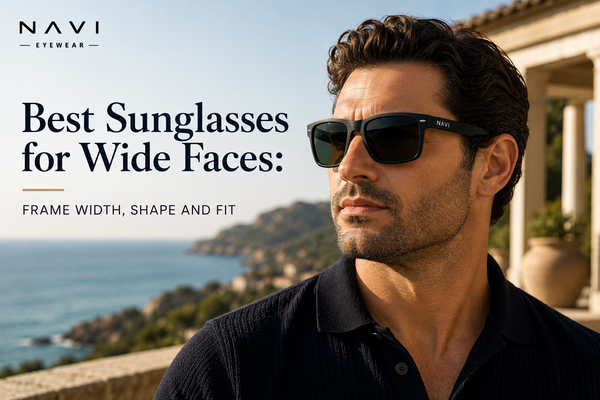

Best Sunglasses for Wide Faces: Frame Width, Shape and Fit
Wide faces are underserved by mainstream sunglass sizing in the opposite direction to narrow faces — but the problem is just as real. Frames that are too narrow for a wide face press into the temples, bow outward at the hinges, sit incorrectly on the nose, and provide inadequate peripheral coverage on both sides. For people with wider faces, the search for sunglasses that actually fit — and look proportional — requires knowing exactly what measurements to target and which shapes work with wider features rather than against them.
This is not about settling for whatever happens to be large enough. There is a distinct aesthetic logic to frames on wider faces, and the shapes that work best are specific: they complement broader features rather than trying to visually narrow them. Combined with the correct frame measurements and a systematic online buying approach, finding sunglasses for a wide face becomes a solvable problem rather than an ongoing frustration.
This is a C11 Specific Audiences supporting post. For the complete face shape guide covering proportional logic for all face types, seesunglasses for your face shape: the complete guide. For fit mechanics and how to read frame measurements, seehow to tell if sunglasses actually fit. For the narrow face guide, seebest sunglasses for narrow faces.

Measuring a Wide Face: The Numbers That Matter
What Counts as a Wide Face
Face width is measured at the widest point — typically across the cheekbones, from one cheekbone to the other. An average adult face width is approximately 140–148mm. A wide face is generally defined as 150mm or above at the cheekbones. Very wide faces — the end of the spectrum where standard large-size frames still pinch — can reach 160mm or more. If you regularly find that sunglasses either press into your temples from the first try-on, or that the temple arms bow visibly outward rather than lying flat against the side of the head, your face width is likely above the standard sizing target.
Reading the Temple Arm Stamp for Wide Faces
The three-number measurement stamp on the temple arm (lens width – bridge width – temple length) determines total frame front width. Total frame front width = (lens width × 2) + bridge width. For a wide face of 150–160mm, the target total frame front width is approximately 148–165mm. This means lens widths of 56–62mm combined with bridge widths of 18–22mm. Frames labelled ‘large’ by mainstream brands often have total widths of 140–148mm — adequate for an average-wide face but still too narrow for the widest end of the spectrum.
Temple Length for Wide Faces
Temple length (the third number, typically 140–150mm in standard adult frames) rarely needs to change for wide faces — the temple length accommodates the ear-to-tip distance, which does not scale with face width. What changes for wide faces is the angle at which the temple bends behind the ear: a wider frame has a shorter horizontal reach before the bend, which can affect how the bend angle relates to individual ear position. Standard 140–145mm temples work for most wide faces; very large frames sometimes use 150mm temples to maintain fit geometry.
Bridge Width for Wide Faces
Bridge width matters for wide faces for a different reason than for narrow faces. A narrow bridge on a wide face positions the lenses too close together relative to the wider pupillary distance that typically accompanies a wider face, placing the optical centre of each lens slightly inside the pupil position. This is a minor optical issue but a real one. For wide faces, bridge widths of 18–22mm typically provide the correct inter-lens positioning. The complete frame measurement mechanics and what each number means for fit are inhow to tell if sunglasses actually fit.
Frame Shapes That Work for Wide Faces
Rectangular FramesWhy it works: Horizontal lines that are wider than tall create visual structure on wider faces; angular geometry complements and defines broader features Best for: Square and round wide faces; wide faces where adding visual structure and definition is the goal Rectangular frames in the correct width — lens widths of 56–62mm — work very well on wide faces. The horizontal emphasis of a wide rectangular frame does not read as wider than the face because the frame width matches the face; instead it creates visual structure that defines and organises wider features. A key detail: the frame’s vertical depth should be moderate to substantial — a very shallow rectangular frame on a wide face can look disproportionately thin. Lens depth of 38–45mm alongside a 58–60mm lens width provides good proportional balance on most wide faces. |
Wayfarer and D-Frame StylesWhy it works: Classic proportional design with wide flat top bar and slightly tapered lower lens; balances width with structure Best for: Wide faces across all face shapes; works for both casual and dressed contexts Wayfarer-style frames — the classic flat-top, slightly keyhole bridge design — are produced in wider sizes that work specifically well on wide faces. The wide top bar of the wayfarer provides the horizontal structure that organises wider features, while the slightly tapered lower lens adds some definition without the severity of a purely rectangular shape. Authentic-sized wide wayfarers (lens width 56–60mm) suit wide faces very well. Avoid the original standard-size wayfarer (54mm lens width) on very wide faces — the proportional tension between the frame’s assertive design and the narrow sizing is visually uncomfortable. |
Aviator FramesWhy it works: Teardrop lens with wide base; the wide lower lens accommodates broad faces while the slim bridge adds lightness Best for: Wide faces, particularly longer or more oval-proportioned wide faces; works across casual and dress contexts Aviator frames — the iconic military-derived teardrop shape — are naturally wide and work well on wide faces when sized correctly. The teardrop lens shape, wider at the bottom than the top, distributes the visual weight of the frame proportionally across a wider face without creating the top-heavy look that some frames produce. Large aviators with lens widths of 57–62mm are available from multiple brands. The slim metal bridge of a classic aviator also provides visual lightness that prevents the frame from feeling too heavy on a wide face. |
Oversized and Fashion-Large FramesWhy it works: Deliberately large lens area provides proportional balance on wider faces where standard frames look too small Best for: Wide faces where contemporary fashion aesthetic is the priority; also provides excellent UV coverage Oversized frames — which can look overwhelming on narrower faces — often work precisely right on wide faces because the large lens area is in proportion to the broader facial canvas. Square oversized frames, large round frames, and wide shield-style single-lens designs all provide proportional balance on wide faces that narrower options cannot. The UV protection benefit of larger lens areas is also notable: more of the periocular area is covered, reducing peripheral UV entry from above and the sides. The proportional logic of oversized frames on wide faces versus narrower faces is covered insunglasses for your face shape: the complete guide. |
Frame Shapes and Features to Avoid
Buying Online for Wide Faces: The Measurement Approach
Your Existing Best-Fitting Pair as Reference
The most reliable method for buying sunglasses online for a wide face is to measure your current best-fitting pair. Use a ruler to measure the lens width of one lens, the bridge width, and calculate the total front width. Then filter online results to frames with matching or close dimensions. Most reputable online retailers provide the full three-number measurement in the product specifications. For a wide face targeting lens widths of 57–62mm, filtering immediately eliminates the majority of standard-size frames and leaves a genuinely relevant shortlist.
Search Terms That Surface Wide-Face Results
Search terms that surface genuinely wide frames: ‘XL sunglasses’, ‘large frame sunglasses’ combined with the measurement range (e.g. ‘60mm lens’), ‘wide head sunglasses’, ‘big head sunglasses’. Specialist wide-fit eyewear retailers including Goliath Eyewear, Zenni (filter by lens width), and large-size specialist brands produce frames specifically for wider faces. Most mainstream brands have at least some frames in the 58–62mm range — the challenge is identifying them without in-store try-on.
The Pupillary Distance Check
Wider faces typically have wider pupillary distances (PD). Average PD is 62–64mm; wide faces often have PDs of 65–70mm. If you know your PD from a glasses prescription, use it to calculate the correct bridge width: bridge width should be approximately PD − (2 × lens width / 2). This calculation helps verify that the optical centre of each lens will sit correctly over each pupil rather than too close together.
BrowseNavi Eyewear’s UV400 polarized sunglasses collection with the measurement approach to identify frames in the right width range for a wide face. All Navi lenses are polycarbonate UV400 — the impact-resistant, inherent UV protection standard.
Wide Face Fit Checklist
|
Fit Point |
Target for Wide Face |
Problem if Wrong |
|
Total frame front width |
148–165mm for most wide faces (150mm+ cheekbone width) |
Too narrow: temples press in, bow outward at hinges |
|
Lens width |
56–62mm per lens |
Too small: frame looks disproportionately small on face |
|
Bridge width |
18–22mm |
Too narrow: lenses too close together; pinching on nose |
|
Temple position |
Hinges sit at outer corner of eyes, not inside them |
Inside hinge position: frame clearly too narrow |
|
Temple lie |
Arms lie flat against side of head without bowing |
Bowing outward: frame still too narrow despite large labelling |
|
Lens coverage |
Lenses reach near outer brow edge and lower orbital rim |
Insufficient coverage: peripheral UV entry from sides |
|
Nose bridge sit |
Bridge rests on nose without the frame riding high or low |
Riding high: bridge too narrow; riding low: bridge too wide |
UV Protection and Wide Faces: A Specific Advantage
One genuine UV protection advantage of larger frames on wider faces: the larger lens area provides better peripheral UV coverage from the sides, reducing the peripheral UV entry that — via the Coroneo mechanism — contributes to pterygium and limbal stem cell damage. The relationship between frame coverage geometry and peripheral UV protection is explained incan sunglasses prevent pterygium? the UV connection. For any frame regardless of width, the UV400 polycarbonate standard is non-negotiable. The UV disease case is inUV and eye disease: the complete guide.
Frequently Asked Questions
What frame width do I need for a wide face?
For a wide face with cheekbone width of 150–160mm, target a total frame front width of 148–165mm. Total frame front width = (lens width × 2) + bridge width. This typically means lens widths of 56–62mm. Verify the three-number measurement on the temple arm stamp rather than relying on ‘large’ or ‘XL’ size labels, which are inconsistent across brands. The most reliable starting point is measuring your current best-fitting pair and using those dimensions as a target.
How do I know if a frame is too narrow for my wide face?
A frame is too narrow if: the temple arms bow visibly outward from the hinge rather than lying flat against the side of the head; the frame presses uncomfortably into the temples within minutes of wearing; the hinges sit noticeably inside the outer corners of the eyes rather than at them; the frame feels tight and leaves pressure marks on the temples after wear. Any of these is a clear indicator that the frame is below your required width range.
What are the best sunglasses for a wide face man?
Rectangular or wayfarer-style UV400 frames in lens widths of 57–62mm. Rectangular frames with moderate depth (40–45mm) provide the proportional structure that works with masculine wider features. Aviators in large sizing — 57–62mm lens width — are also well-suited to wide male faces. The frame should have a total front width within 5–10mm of the face width measured at the cheekbones. The complete face shape guide by gender is inmen’s vs women’s sunglasses: does the distinction matter?.
What are the best sunglasses for a wide face woman?
Wide wayfarer, large oval, or oversized square frames in UV400 at lens widths of 56–60mm. For wide female faces with a rounder shape, a wide rectangular or wayfarer that adds horizontal structure creates definition. For wide faces with more angular features, large oval or round oversized frames soften the geometry while maintaining proportional width. The complete proportional logic for all face shapes is insunglasses for your face shape: the complete guide.
Can I find wide face sunglasses with UV400 protection?
Yes — UV400 polycarbonate is available across a full range of frame widths. Wide-frame sunglasses do not inherently compromise UV protection; the UV400 specification is independent of frame width. The challenge is finding wide frames from brands that verify UV certification explicitly. Avoid large unbranded frames from market stalls and tourist shops that may be wide but lack genuine UV400 protection. Verify UV400 explicitly on any purchase. The UV400 verification guide is in7 signs your sunglasses are not protecting your eyes.
What lens width is right for a wide face?
Lens widths of 56–62mm per lens are the right range for most wide faces (150mm+ cheekbone width). Very wide faces at 158mm+ may need 60–64mm lens widths to achieve the total front width needed. Lens widths below 54mm produce frames that are too narrow for wide faces regardless of other features. When browsing frames, filter by lens width in the product specifications rather than by the brand’s size label.
Do polarized sunglasses come in wide sizes?
Yes — polarized UV400 lenses are available in the full range of frame widths, including wide and extra-wide sizes. The polarization is in the lens film, not the frame, so frame width has no bearing on whether polarization is available. Wide-face wearers should apply the same polarized lens benefits that apply to any wearer: glare elimination from road and water surfaces, improved contrast in variable outdoor conditions, reduced eye fatigue. The full polarization science is inpolarized sunglasses: are they worth it.
How do I buy sunglasses online for a wide face?
The measurement approach: measure your current best-fitting pair (lens width, bridge width, total front width) and filter online results by those dimensions. Look for retailers that display the full three-number measurement in product specs. Search specifically for ‘lens width 58mm’, ‘XL frames’, or ‘wide head sunglasses’. Verify return policy before purchasing so fit can be assessed at home. Virtual try-on tools help filter by proportion but cannot confirm physical fit details like temple pressure.
Are oversized frames good for wide faces?
Frequently yes — this is one of the cases where oversized works as intended. Oversized frames that look overwhelming on narrow faces often provide the proportional balance that wide faces need. Wide square, large round, and shield-style frames that would dominate a narrow face sit in correct proportion on a wide one. The key is still verifying the actual measurement — ‘oversized’ labelling does not guarantee sufficient width for a very wide face.
Why do sunglasses always feel tight on my wide face?
Standard adult sunglass sizing targets face widths of approximately 135–148mm. If your face width is above 150mm, the majority of standard-size frames will be too narrow and press into your temples. This is a sizing gap in most mainstream collections, not a fit problem specific to you. The solution is specifically targeting frames with total front widths of 150mm+, which requires using the measurement approach rather than trying on standard-size frames hoping for the right fit.
What is a wide bridge on sunglasses and do I need one?
Bridge width is the gap between the two lenses at the nose. Wide faces typically have wider inter-pupillary distances, which means the optical centres of the lenses need to be further apart — requiring a wider bridge. For wide faces, bridge widths of 18–22mm typically position the lenses correctly. A narrow bridge (16mm or below) on a wide face places the lenses too close together, which looks visually awkward and can slightly affect the optical relationship between lens centre and pupil position.
SOURCES & CITATIONS[1] Dain SJ.“Sunglasses and sunglass standards.”Clinical and Experimental Optometry, 2003.View source [2] Rosenthal FS, Bakalian AE, Lou CQ, Taylor HR.“The effect of sunglasses on ocular exposure to ultraviolet radiation.”American Journal of Public Health, 1988.View source [3] Coroneo MT, Muller-Stolzenburg NW, Ho A.“Peripheral light focusing by the anterior eye and the ophthalmohelioses.”Ophthalmic Surgery, 1991.View source [4] Sliney DH.“UV radiation ocular exposure dosimetry.”Documenta Ophthalmologica, 1994.View source |