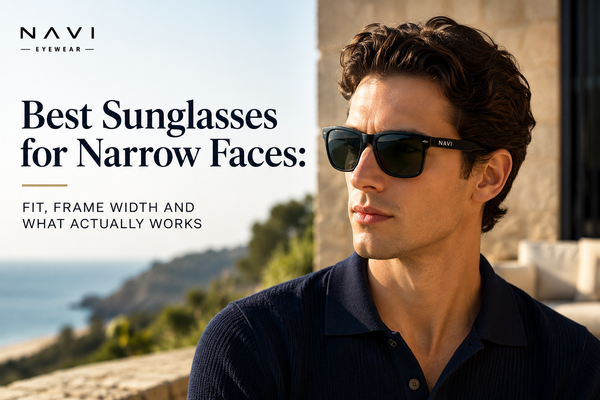

Best Sunglasses for Narrow Faces: Fit, Frame Width and What Actually Works
Most sunglasses are designed for a face width that does not represent the narrowest third of the population. If you have a narrow face and have spent time trying on frames that are too wide, that slide down your nose, that gap at the temples, or that simply look disproportionate — you are not imagining the problem. The standard width range of most mainstream sunglass collections is genuinely not designed for your face geometry, and the mismatch produces both functional problems (poor UV coverage, sliding frames) and aesthetic ones.
The good news is that the correct approach to finding sunglasses for a narrow face is systematic and learnable. Once you know your face measurements, the frame dimension ranges that work for your proportions, and the specific shapes and features to prioritise or avoid, the search becomes significantly more productive. This guide gives you all of that — from the temple arm stamp to the shapes that balance narrow features, to the online ordering strategy that works without trying frames on in person.
This is a C11 Specific Audiences supporting post. For the complete face shape guide covering all shapes and proportions, seesunglasses for your face shape: the complete guide. For the fit mechanics and how to read frame measurements, seehow to tell if sunglasses actually fit. For the UV protection that should underpin any frame choice, seethe complete guide to UV eye protection.

Understanding Your Face Measurements: The Starting Point
How to Measure Your Face Width
Face width — measured at the widest point, typically across the cheekbones — is the primary dimension that determines whether a sunglass frame will fit proportionally. To measure: use a flexible tape measure or a ruler and a mirror. Place the tape measure at one cheekbone, draw it horizontally across the face to the other cheekbone, and record the measurement. A narrow face is generally defined as 130mm or less at the cheekbones. Petite faces — the narrowest end of the spectrum — are often in the 115–125mm range.
Reading the Temple Arm Stamp: The Three Numbers
Every sunglass frame has a measurement stamp on the inside of one temple arm. It reads as three numbers separated by dashes or squares: lens width – bridge width – temple length. For example: 52–17–140. The lens width is the horizontal width of each individual lens in millimetres. The bridge width is the gap between the two lenses at the nose. The temple length is the length of the arm from hinge to tip. For fitting a narrow face, the most important numbers are the lens width and bridge width, which together determine the total frame front width.
Calculating Total Frame Width
Total frame front width = (lens width × 2) + bridge width. For a 52–17–140 frame: (52 × 2) + 17 = 121mm total front width. This is the number to compare against your face width. For a proportional fit, the total frame width should be within approximately 5–10mm of your face width in either direction. For narrow faces in the 120–130mm range, frames with a total front width of 115–135mm will typically fit proportionally. Frames above 140mm will visually overwhelm a narrow face; frames below 110mm may be uncomfortably tight at the temples.
The Lens Width That Works for Narrow Faces
For narrow faces, lens widths of 48–52mm are typically the right range. Lens widths of 54mm and above — the standard for many adult frames — produce total frame widths that are too wide for most narrow faces. When browsing frames, prioritise the lens width specification above the style name. A frame labelled ‘small’ by a brand may still have a 53mm lens width that is too wide for a petite face. The complete frame fit mechanics and what each measurement means for visual and aesthetic result are inhow to tell if sunglasses actually fit.
Frame Shapes That Work for Narrow Faces
Round FramesWhy it works: Round shapes add horizontal visual width through their curved silhouette, creating the impression of broader features Best for: Narrow oval, long, and heart-shaped faces; faces where adding width across the cheek area is the goal Round frames are the classic choice for narrow faces. The circular lens shape, particularly with a thin metal or TR90 frame, adds perceived horizontal width without physically widening the frame beyond what the face can accommodate. The key: the round frame must be appropriately sized — a very large round frame overwhelms a narrow face just as a rectangular one does. Round frames with lens widths of 48–50mm and a low bridge sit proportionally on most narrow faces and create a balanced, slightly retro aesthetic that works across casual and dressed contexts. |
Oval FramesWhy it works: The universal-fit shape: gently curved with no strong horizontal or vertical dominance; balanced proportion across most face widths Best for: Almost all narrow faces; the safest starting point for first-time buyers uncertain about shape Oval frames — slightly wider than they are tall, with softly curved edges — are the most forgiving shape for a narrow face. They add slight horizontal visual width (more than rectangular frames) without the strong geometric statement of a round frame. For narrow faces that are also relatively long, a slightly deeper oval provides better vertical coverage of the eye area. For shorter narrow faces, a shallower oval maintains proportion without adding visual height. |
Cat-Eye FramesWhy it works: Upswept outer corners create visual width at the upper face; the lift draws attention outward and adds perceived breadth Best for: Narrow faces with prominent cheekbones; oval and heart-shaped narrow faces; anyone who wants a strong style statement Cat-eye frames are particularly effective for narrow faces because the upswept temple creates the visual impression of wider cheekbones, which is exactly the balance that narrow faces need. The key for narrow faces: cat-eye frames in small to medium lens widths (48–52mm) maintain the upswept effect without the frame extending past the face width. A cat-eye frame that is too wide for the face loses the cheekbone-lift effect and instead creates the awkward protrusion look of any oversized frame. For the style context and how frame shapes interact with face proportions, seesunglasses for your face shape: the complete guide. |
Thin Metal or TR90 FramesWhy it works: Minimal visual weight; does not add apparent bulk to narrow features; allows the face proportions to remain primary Best for: All narrow face types; particularly effective for faces where the goal is glasses that disappear rather than make a style statement Thin metal frames — wire-rimless, semi-rimless, or thin full-rim in titanium or stainless steel — sit lightly on a narrow face without adding the visual weight that chunky acetate frames impose. A narrow face with a thick acetate frame can appear overwhelmed by the eyewear. Thin TR90 nylon in neutral colours — black, gunmetal, clear — produces the same minimal-weight effect with better durability. For narrow faces specifically, frame visual weight matters alongside frame width. |
Frame Shapes and Features to Avoid
Buying Online Without Trying On: The Measurement Strategy
Measure Your Current Best-Fitting Pair
The most reliable way to buy sunglasses online for a narrow face without trying them on is to use your current best-fitting pair as a reference. Measure the lens width, bridge width, and total frame front width of your existing pair using a ruler. Then filter online searches to frames with the same or similar dimensions. Most online retailers provide the three-number measurement in the product specifications. The online buying strategy for sunglasses is also covered in the buying guide.
The Pupillary Distance Cross-Check
Pupillary distance (PD) — the measurement between the centres of your pupils — correlates closely with face width. Average PD for adults is 62–64mm. People with narrow faces typically have PDs in the 54–60mm range. If you know your PD from a prescription, it is a useful secondary check: a frame with a bridge width of approximately (PD − (lens width × 2) / 2) should position the optical centre of the lens correctly over each pupil, which also means the frame is proportionally sized for your face.
Virtual Try-On Tools
Many online sunglass retailers now offer virtual try-on using a device camera. These tools have improved significantly and provide a useful first-pass filter for whether a frame’s width and style works on your face before purchasing. They are most reliable for assessing relative proportions (is this frame too wide?) rather than absolute fit details (will the nose pads sit correctly?). Use virtual try-on as a shortlist tool alongside the measurement approach.
Return Policies: The Safety Net
When buying sunglasses online for a narrow face without physical try-on, a clear return policy is the practical safety net. Verify the return policy before purchase — ideally 30 days, unworn, with full refund. This allows a fit assessment at home that is more reliable than in a shop environment. Browse quality UV400 polarized options with a returns policy atNavi Eyewear’s sunglasses collection. For the UV400 polarized range specifically, seeNavi Eyewear’s polarized collection.
Fit Checklist for Narrow Faces
|
Fit Point |
What to Check |
Problem if Wrong |
|
Total frame width |
Within 5–10mm of your face width (120–135mm for most narrow faces) |
Frame too wide: temples press, visual protrusion beyond face edge |
|
Lens width |
48–52mm for most narrow faces |
Too wide: overwhelms features; too narrow: insufficient UV coverage |
|
Bridge width |
14–17mm for narrow faces |
Too wide: lenses sit too far apart for your PD; too narrow: pinches nose |
|
Temple length |
Standard 140–145mm; shorter if temples slide past ears |
Too long: temples curve behind ears awkwardly; too short: pressure on temples |
|
Nose pad position |
Pads rest on nose without sliding; lenses sit at mid-eye level |
Slides down: wrong nose pad angle or bridge width too narrow |
|
Temple gap |
Temples lie flat against side of head without bowing out or pressing in |
Bowing out: frame too narrow; pressing in: frame too wide |
|
Bottom rim clearance |
Lower lens rim clears cheekbones when smiling |
Touching cheeks: frame too deep for face geometry |
UV Protection: The Non-Negotiable Beneath the Fit
Fit and proportion matter for a narrow face — but they should never come at the cost of UV protection. The frame style discussion above assumes UV400 polycarbonate lenses as the non-negotiable starting point. UV400 blocks 100% of UVA and UVB to 400nm — a specification that is independent of lens darkness, frame width, or brand. Polycarbonate lenses provide impact resistance alongside inherent UV protection that does not degrade with surface scratching. Never accept a frame in the right width at the cost of unverified or absent UV certification.
The UV disease that accumulates from years of wearing the wrong or non-UV-protective sunglasses is covered inUV and eye disease: the complete guide. For the polarization case that adds glare elimination on top of UV protection for a narrow face wearer who is also outdoors in high-glare environments, seepolarized sunglasses: are they worth it.
Frequently Asked Questions
What frame width is right for a narrow face?
For most narrow faces, a total frame front width of 115–135mm works proportionally. Total frame front width = (lens width × 2) + bridge width. This measurement is on the temple arm stamp as the first two numbers. Lens widths of 48–52mm, combined with bridge widths of 14–17mm, typically produce the right total width range. Anything above a 54mm lens width is likely to extend past the face width on a narrow face, producing the protrusion and sliding problems that make wide frames uncomfortable and unflattering.
How do I know if a frame is too wide for my face?
A frame is too wide if: the temples extend visibly beyond the sides of the face when viewed straight on; the temples press outward against the sides of the head rather than lying flat; the frame slides down the nose because the temples are not maintaining contact; or the overall visual impression is that the frame dominates the face rather than framing it. The frame should sit with the hinges at the outer corners of the eyes — if the hinges are well past the outer eye corners, the frame is too wide.
What are the best sunglasses for a narrow face man?
Round or oval frames in lens widths of 48–52mm with thin metal or TR90 construction, UV400 polycarbonate lenses. Round frames specifically work well for narrow male faces because they add visual width through the curved silhouette without being overtly fashion-forward. Thin metal semi-rimless or rimless designs at narrow widths are also effective — they provide optical quality without visual bulk. The face shape guide covering male face proportions specifically is insunglasses for your face shape: the complete guide.
What are the best sunglasses for a narrow face woman?
Cat-eye, oval, and round frames in 48–52mm lens widths. Cat-eye shapes are particularly effective for narrow female faces because the upswept temple creates the illusion of broader cheekbones — a proportional balance that is specifically flattering for narrow features. Oval frames are the most versatile and fail-safe option. Thin acetate or TR90 in classic colours (tortoiseshell, black, clear) at the right width provides sophisticated styling without overwhelming narrow features. The complete style guide by face shape is insunglasses for your face shape: the complete guide.
How do I stop sunglasses from sliding off a narrow face?
Sliding is the most common functional problem for narrow face wearers using standard-width frames. Solutions: choose frames in the correct width range for your face (most sliding is caused by a frame that is simply too wide and cannot maintain temple contact); ensure rubberised nose pads rather than hard plastic — rubberised grips maintain position on smooth nose bridges; look for frames with adjustable nose pads that can be calibrated to your nose geometry; consider anti-slip sports straps for outdoor activity use. If a frame you love slides, an optician can often adjust the temple bend and nose pads to improve fit.
Can I buy sunglasses online if I have a narrow face?
Yes — with the measurement approach. Measure your current best-fitting pair for lens width, bridge width, and total front width. Filter online search results by lens width (48–52mm) and calculate total front width before purchasing. Most quality online retailers list the three-number measurement in specifications. Use virtual try-on tools as a supplementary filter. Ensure the retailer has a clear return policy so fit can be assessed at home. This approach is more reliable than in-store try-on without knowing your measurements, because it filters the candidate frames to a much smaller and more relevant set before the try-on step.
What does the three-number stamp on sunglass frames mean?
The three-number stamp on the inside of the temple arm is the frame’s measurement specification: lens width – bridge width – temple length, all in millimetres. A stamp reading 50–16–140 means: each lens is 50mm wide, the bridge between the lenses is 16mm, and each temple arm is 140mm long. Total frame front width is calculated as (50 × 2) + 16 = 116mm. This is the number to compare against your face width. For a narrow face, look for totals in the 115–135mm range.
Are there specific brands that make sunglasses for narrow faces?
Several brands specifically produce frames in narrow and petite sizing. Dedicated small-face sunglass brands include Zenni, Clearly, and Vint & York for online options. Mainstream brands that produce genuine small-size lines include Ray-Ban (in their smaller lens width variants), Oliver Peoples, and Persol. For UV400 polarized options that can be found across a range of lens widths, browseNavi Eyewear’s polarized collection with the measurement approach to identify frames in the right width range.
How do I find sunglasses that fit a petite face?
The measurement approach is the most reliable method. Measure your face width and your best-fitting existing pair. Search for frames with lens widths of 46–50mm for the most petite faces (below 120mm face width) or 48–52mm for narrow faces in the 120–130mm range. The bridge width should be 14–16mm for petite faces. Avoid frames labelled ‘one size’ without a measurement specification — these are typically designed for average or wider faces. Children’s frames in teen sizing are sometimes worth considering for very petite adults, as they often fall in the 48–52mm lens width range with appropriate bridge dimensions.
Do narrow face frames provide enough UV coverage?
Yes — provided the frame is correctly sized for the face. A frame that fits proportionally provides the same coverage geometry as a correctly-sized frame on any other face. The problem is when narrow-face wearers resort to large frames that do not fit: these typically gap at the temples and brow, providing worse peripheral UV coverage than a smaller well-fitted frame. A UV400 frame in the right size for a narrow face provides complete UV protection. For the UV certification and coverage standards, see7 signs your sunglasses are not protecting your eyes.
What nose bridge width works best for a narrow face?
Bridge widths of 14–17mm typically work best for narrow faces. A narrow bridge (14–15mm) positions the lenses closer together, which suits faces where the inter-pupillary distance is shorter — common in narrower faces. A wider bridge (18mm+) creates excessive space between the lenses that looks disproportionate and positions the optical centre of the lens incorrectly relative to the pupil. If you have ever noticed sunglasses where the lenses seem to sit slightly to the outside of your pupils rather than centred, a wide bridge is often the cause.
SOURCES & CITATIONS[1] Dain SJ.“Sunglasses and sunglass standards.”Clinical and Experimental Optometry, 2003.View source [2] Rosenthal FS, Bakalian AE, Lou CQ, Taylor HR.“The effect of sunglasses on ocular exposure to ultraviolet radiation.”American Journal of Public Health, 1988.View source [3] Sliney DH.“UV radiation ocular exposure dosimetry.”Documenta Ophthalmologica, 1994.View source [4] Vitale S, Cotch MF, Sperduto RD.“Prevalence of visual impairment in the United States.”JAMA, 2006.View source |