
Transition Lenses vs Prescription Sunglasses: The Honest Comparison
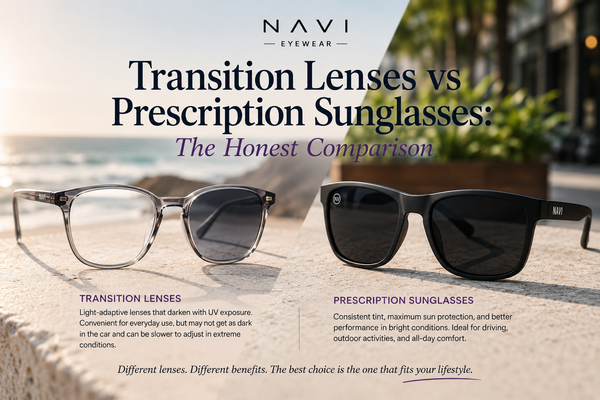
Transition lenses — also marketed as photochromic lenses — promise to solve the prescription wearer's outdoor problem in the most elegant possible way: one pair of glasses that is clear indoors and tinted outdoors, eliminating the need to carry two pairs or switch between them. It is a genuinely appealing proposition. The reality is more nuanced, and the limitations are significant enough in specific situations that many wearers who bought transitions expecting a complete outdoor solution end up also owning prescription sunglasses.
This post gives you the full picture — how transition lenses actually work, what they do well, where they fall short, and how to decide whether they are the right choice for your lifestyle, or whether dedicated prescription sunglasses serve you better.
This is a C8 Prescription and Vision supporting post. For the complete prescription sunglasses guide covering all your options, costs, and ordering process, seethe complete guide to prescription sunglasses. For why polarization matters in outdoor prescription eyewear — something transitions do not provide — seepolarized prescription sunglasses: everything you need to know. And for the full UV protection science that underpins all of this, seethe complete guide to UV eye protection.

How Transition (Photochromic) Lenses Work
Photochromic lenses contain molecules — typically silver halide or organic dye compounds — that change structure when exposed to UV light, causing the lens to darken. When UV exposure is removed (indoors or at night), the molecules revert to their original structure and the lens clears. The darkening and clearing reactions are reversible and repeat indefinitely over the lens's lifespan.
Two properties of this mechanism have significant practical implications that are not always clearly communicated at the point of sale:
The Full Comparison: Transition Lenses vs Prescription Sunglasses
|
Factor |
Transition Lenses |
Prescription Sunglasses |
|
Darkening in cars |
Minimal — windscreens block UV |
Full darkness — always ready |
|
Polarization available |
Some photochromic polarized lenses exist |
Widely available — the recommended option |
|
Hot weather performance |
Reduced — heat limits maximum darkness |
Consistent — fixed tint unaffected by temperature |
|
Transition speed |
30–60 sec darkening; 5+ min clearing |
Instant — no adaptation delay |
|
Darkness level |
Variable — conditions-dependent |
Fixed, predictable, category-consistent |
|
Convenience |
One pair — no switching required |
Requires carrying or switching pairs |
|
Cost (upfront) |
£100–300 / $125–375 premium over clear |
£120–400 / $150–500 for quality pair |
|
UV protection |
UV400 — same standard |
UV400 — same standard |
|
Best suited for |
Mixed indoor/outdoor days, convenience |
Driving, outdoor sport, high-UV environments |
The Driving Problem: Why Transitions Fail in Cars
This is the limitation that catches the most people by surprise. Car windscreens are made from laminated safety glass that blocks the majority of UV radiation — by design, to protect car interiors and occupants from UV degradation and exposure. The photochromic molecules in transition lenses require UV to trigger darkening. Inside a car, that UV is largely absent regardless of how bright or sunny it is outside.
The practical result: you drive in bright sunshine with lenses that are nearly clear, squinting against the same road glare and solar dazzle that dedicated prescription sunglasses are designed to eliminate entirely. For drivers who spend significant time in the car, this is a fundamental functional failure of the transitions proposition. Dedicated prescription sunglasses — gray polarized for optimal driving performance, as detailed inbest sunglasses for driving: polarized lenses and glare reduction — solve this completely. Transition lenses do not.
There are photochromic lenses that respond to visible light rather than UV, which do darken inside vehicles — Transitions XTRActive and some other brands offer this. These are significantly more expensive than standard photochromic lenses and are worth asking about specifically if driving performance is your priority. Even then, they do not provide polarization, which eliminates road surface glare in a way that darkness alone cannot. The polarization science is inpolarized sunglasses: are they worth it.
Where Transition Lenses Genuinely Excel
|
Transition Lenses Win Here Best for: people who move frequently between indoor and outdoor environments, those who want one pair for all conditions Transitions are at their best for people who spend their days moving between environments — in and out of buildings, working partly outdoors and partly in — where carrying and switching glasses multiple times a day is a genuine inconvenience. A teacher who has playground duty, a tradesperson who moves between indoor and outdoor work, or anyone who finds the logistics of two pairs impractical benefits meaningfully from the convenience of transitions. For these wearers, the driving limitation may be acceptable if driving is a minor part of their outdoor UV exposure. Transitions are also well-suited to low-to-moderate UV environments — overcast northern European climates, for instance — where the performance gaps versus dedicated sunglasses are smaller. For the UV environment context including how much UV varies by geography and season, seethe complete guide to UV eye protection. |
|
Prescription Sunglasses Win Here Best for: drivers, outdoor athletes, high-UV environments, water sports, anyone who needs reliable maximum darkness Prescription sunglasses are clearly superior for any situation where consistent, reliable outdoor performance is the priority. For drivers: they darken fully and stay dark regardless of UV levels inside the vehicle, eliminating road glare with polarized lenses in a way transitions cannot replicate. For outdoor athletes — hikers, cyclists, runners, water sport participants — fixed tint prescription sunglasses provide predictable, maximum optical performance without the variability of photochromic reaction speed or temperature effects. For high-UV environments including the tropics, high altitude, and reflective surfaces like snow and water, fixed-tint prescription sunglasses deliver consistently strong protection where transitions may underperform in warm conditions. The activity-specific performance requirements are detailed acrossthe complete outdoor and sport sunglasses guide. |
The Cost Comparison Over Time
Transition lenses are often presented as a cost-saving option — one pair instead of two. The actual cost comparison is more nuanced. A quality transition lens upgrade typically adds £100–300 / $125–375 to the cost of your glasses. A separate pair of quality prescription sunglasses costs £120–350 / $150–440. The 'two pairs' scenario is therefore only modestly more expensive than transitions, while delivering superior performance in every outdoor context.
The real cost saving from transitions comes if you would otherwise be replacing your regular clear glasses and buying prescription sunglasses separately — transitions eliminate one pair entirely. If you already have clear glasses and are considering what to add for outdoor use, dedicated prescription sunglasses typically outperform the transition upgrade at a comparable cost. The full prescription sunglass cost breakdown at different price tiers is inthe complete guide to prescription sunglasses.
The Verdict: Which Should You Choose?
Choose Transition Lenses If:
Choose Prescription Sunglasses If:
Consider Both If:
Many prescription wearers benefit from transitions in their everyday glasses for incidental outdoor time, plus a dedicated pair of prescription sunglasses for driving and sport. This combination gives you the convenience of transitions for daily life and the performance of dedicated prescription sunglasses when it matters. It fits naturally within the collection-building approach inhow to build the perfect sunglasses collection for every occasion — the prescription sunglass pair is simply the performance pair, and the transition glasses handle everything else.
Browse theNavi Eyewear UV400 polarized collection for quality frames suitable for prescription lens fitting. All Navi frames use UV400 polarized lenses as standard — the specification that transitions cannot match for driving and outdoor performance.
Frequently Asked Questions
Do transition lenses work in cars?
Standard transition lenses do not darken significantly inside cars. Car windscreens are made from laminated safety glass that blocks the UV radiation needed to trigger the photochromic darkening reaction. In bright sunshine inside a vehicle, a standard transition lens will remain nearly clear. This is the most significant practical limitation of photochromic lenses for drivers. Some premium photochromic lenses — including Transitions XTRActive — are designed to respond to visible light rather than UV and do darken somewhat inside vehicles, but less fully than outdoors. For consistent driving protection, dedicatedgray polarized prescription sunglasses are the correct solution.
Are transition lenses as good as sunglasses?
For outdoor use outside of vehicles, quality transitions reach a Category 2–3 darkness level in full sun — adequate for most outdoor conditions. However, they do not provide polarization, meaning they reduce overall brightness but do not eliminate the horizontally reflected glare from roads, water, and wet surfaces that polarized lenses remove completely. For activities where glare matters — driving, water sports, cycling, hiking — dedicatedprescription sunglasses with polarization outperform transitions on the most functionally important dimension.
Do transition lenses get dark enough in summer?
Potentially not as dark as you would expect. The photochromic darkening reaction is temperature-dependent — in hot conditions (above approximately 25°C / 77°F), the molecules that create darkness become less efficient, reducing maximum darkness by 10–20% compared to cool conditions. This means that on the hottest, brightest summer days — when you most want maximum darkness — transitions may deliver less darkness than in cooler conditions. Fixed-tint prescription sunglasses deliver consistent darkness regardless of temperature.
Can transition lenses be polarized?
Some photochromic polarized lenses exist — Transitions Vantage and certain other products combine the darkening reaction with polarization. The polarization effect only activates when the lens has darkened; when clear indoors, there is no polarization. The polarization efficiency in photochromic polarized lenses is generally lower than in dedicated polarized prescription sunglasses, and the driving limitation (insufficient UV to darken inside vehicles) still applies. For most wearers who want both prescription correction and polarization, dedicated polarized prescription sunglasses provide more reliable performance.
How long do transition lenses take to darken and clear?
Darkening: most quality photochromic lenses reach substantial darkness within 30–60 seconds of UV exposure, with full darkness taking 1–2 minutes. Clearing: significantly slower — returning to near-clear typically takes 3–7 minutes after going indoors, and up to 10 minutes for full clarity. The clearing delay is the most practically inconvenient aspect in situations where you move rapidly between bright outdoor and indoor environments, as you may spend several minutes indoors with noticeably tinted lenses before they fully clear.
Are transition lenses worth it for children?
For children who consistently wear glasses, transitions have genuine appeal — children are less reliable about carrying and switching to separate sunglasses, and the automatic darkening provides UV protection without requiring a behaviour change. The driving limitation is irrelevant for younger children. The main consideration is whether the transitions reach sufficient darkness for the UV environments children are in. For children in high-UV environments — beaches, outdoor sports, tropical climates — the transition darkness may be inadequate and dedicated sunglasses provide better protection. The complete children's eye protection guide is insunglasses for kids: UV protection from the start.
What is the difference between photochromic and polarized lenses?
Photochromic (transition) lenses darken in UV light and clear indoors — they are a darkness-control technology. Polarized lenses have a fixed filter that blocks horizontally reflected glare regardless of light level — they are a glare-elimination technology. The two address different problems: darkness management versus glare elimination. Some lenses combine both, but standard transitions do not polarize. For a complete explanation of how polarization works and why it outperforms non-polarized dark lenses for glare, seepolarized sunglasses: are they worth it.
Do transition lenses block UV when they are clear indoors?
Yes — UV blocking in photochromic lenses is independent of the darkening state. Quality transition lenses block UV400 whether clear or fully dark. This is because the UV blocking is built into the lens material (polycarbonate inherently blocks UV; CR-39 has a UV coating), not into the photochromic molecules. Clear transition lenses provide the same UV protection as dark ones — they just do not reduce visible light when clear. For a full explanation of how UV protection works in lens materials, seehow sunglass lenses actually work.
Can I get varifocal (progressive) transition lenses?
Yes — progressive photochromic lenses are widely available. They combine multi-distance vision correction with the UV-triggered darkening of transitions in a single lens. The same limitations apply — driving darkness is minimal, hot-weather performance is reduced, and polarization is not available. For outdoor presbyopic prescription wearers who spend significant time in genuine outdoor settings (not primarily driving), progressive transitions provide convenience. For those who drive regularly or need outdoor performance, progressive polarized prescription sunglasses are a superior alternative.
Are transition lenses good for driving at night?
Yes — transition lenses are clear at night, and some photochromic lenses have an anti-reflective coating that improves night driving clarity by reducing headlight glare and internal lens reflections. This is one area where transitions have a slight advantage over dedicated sunglasses, which by definition cannot be worn at night. For drivers who sometimes wear the same pair day and night, transitions are perfectly appropriate at night. Dedicated prescription sunglasses should be stored and not worn after dark.
Which transition lens brand is best?
Transitions Optical (owned by Essilor) is the market leader and widely considered the benchmark for photochromic lens performance — their Signature GEN 8 lens is the current standard, with XTRActive for those who want some in-vehicle darkening. Hoya, Zeiss, and Rodenstock also offer quality photochromic products. At any tier, the quality of the underlying lens material and coatings matters as much as the photochromic brand. Whether photochromic or dedicated prescription sunglasses, UV400 certification and optical quality are the non-negotiable baseline — covered inthe complete sunglasses buying guide.
SOURCES & CITATIONS[1] Dain SJ."Sunglasses and sunglass standards."Clinical and Experimental Optometry, 2003.View source [2] Rosenthal FS, Bakalian AE, Lou CQ, Taylor HR."The effect of sunglasses on ocular exposure to ultraviolet radiation."American Journal of Public Health, 1988.View source [3] Tanner DF, Kent JS, Jagger JD."Spectral transmittance characteristics of commercially available UV-protective sunglass lenses."Optometry and Vision Science, 2007.View source [4] American Academy of Ophthalmology."Photochromic lenses: are they right for you?."AAO EyeSmart, 2023.View source [5] De Faber JT, Naeser K, Kessing SV."Polarized light and contrast sensitivity under glare conditions."Ophthalmic Research, 2013.View source |