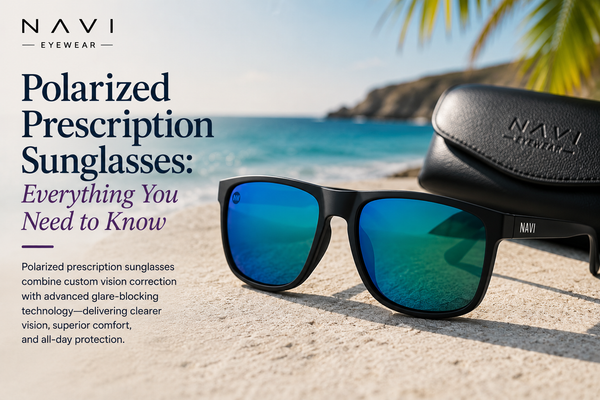

Polarized Prescription Sunglasses: Everything You Need to Know
Polarized prescription sunglasses are arguably the single most useful piece of eyewear available to the approximately 75% of adults who need vision correction. They eliminate the two most significant outdoor visual problems simultaneously — the blurred vision of an uncorrected prescription and the debilitating glare of reflected light from roads, water, and wet surfaces — in one pair that fits your face, your prescription, and your life outdoors.
Despite this, a significant number of prescription wearers either do not know they can get polarized prescription lenses, assume they are prohibitively expensive, or are uncertain whether they work differently from non-prescription polarized lenses. This post answers all of those questions.
This is a C8 Prescription and Vision supporting post. For the complete prescription sunglasses guide covering all options, seethe complete guide to prescription sunglasses. For the science of how polarization works and why it outperforms dark non-polarized lenses for glare, seepolarized sunglasses: are they worth it.

How Polarized Prescription Lenses Work
Polarized prescription lenses combine two distinct optical functions in a single lens: vision correction (the prescription) and glare elimination (the polarization). Understanding how they are manufactured helps explain why they work as well as they do and why the cost is slightly higher than non-polarized equivalents.
The Polarizing Film
The polarizing element in a prescription sunglass lens is a thin film of polyvinyl alcohol (PVA) whose molecular chains have been aligned in a single direction by stretching. This aligned film selectively blocks light waves oscillating in the horizontal plane — the precise orientation of reflected glare from roads, water, and flat surfaces. Light from non-reflective sources passes through freely. The film is embedded within the lens material, not applied as a surface coating, so it cannot be scratched off or degraded by cleaning.
How the Prescription Is Combined With the Polarization
For polycarbonate polarized prescription lenses, the polarizing film is laminated between two layers of polycarbonate before surfacing. The prescription curves are then ground into the surface of the completed laminate, allowing both the polarization and the correction to be present in the finished lens. For CR-39 and high-index polarized prescription lenses, the polarizing film is incorporated during lens casting. In both cases, the prescription and the polarization are fully independent — one does not compromise the other. The lens manufacturing science is covered in full inhow sunglasses are made: from material to finished frame.
Who Benefits Most From Polarized Prescription Sunglasses
|
Drivers With a Prescription Driving is the use case where polarized prescription sunglasses deliver the most immediate, measurable benefit. Road surface glare — the intense reflected light from wet or bright tarmac — is horizontally polarized and eliminated entirely by polarized lenses, while non-polarized dark lenses merely reduce overall brightness without addressing the glare structure. For a prescription wearer who currently drives either without vision correction or in clear glasses, polarized prescription sunglasses represent a significant safety upgrade. Gray polarized prescription lenses are the recommended specification for driving — gray preserves color accuracy for traffic signals while the polarization handles road glare. Seebest sunglasses for driving: polarized lenses and glare reduction for the full driving specification. |
|
Anglers, Sailors, and Water Sport Participants For anyone who spends time on or near water with a prescription, polarized prescription sunglasses are the definitive solution. The water surface reflection problem — which makes sub-surface visibility impossible without polarized lenses — is fully addressed, and the prescription delivers the sharp vision needed to read water features, spot fish, or manage a vessel. Copper and brown tinted polarized prescription lenses are the preferred choice for fishing and water-based activities, as explored insunglasses for water sports: why polarization is non-negotiable. |
|
Hikers, Cyclists, and Outdoor Athletes Outdoor athletes who need vision correction have historically faced the least satisfying outdoor eyewear options — squinting in clear glasses, wearing contacts under sunglasses with all the associated discomfort, or sacrificing optical quality. Polarized prescription sunglasses in sport-compatible polycarbonate eliminate all three compromises. Amber and brown polarized prescription lenses enhance terrain contrast for trail use. Gray polarized prescription lenses suit cycling and road running where color accuracy matters. For the activity-specific lens recommendations, seethe complete outdoor and sport sunglasses guide. |
|
People With Light Sensitivity or Migraines For prescription wearers with photophobia or migraine-related light sensitivity, polarized prescription sunglasses address both the correction need and the specific glare problem that triggers many migraine episodes. Polarization eliminates the spike-intensity glare from reflective surfaces — one of the most potent migraine triggers for many sufferers — while the prescription delivers clear vision without the compensatory squinting that can itself trigger tension headaches. For the full guide to lens features for light-sensitive prescription wearers, seesunglasses for sensitive eyes: migraines, light sensitivity and photophobia. |
Polarized Prescription vs Non-Polarized Prescription: The Comparison
|
Feature |
Polarized Prescription |
Non-Polarized Prescription |
|
Glare elimination |
Complete — blocks horizontal reflected glare |
None — only reduces overall brightness |
|
Vision correction |
Full prescription correction |
Full prescription correction |
|
UV protection |
UV400 — same as non-polarized |
UV400 — same as polarized |
|
Optical clarity |
Equal — no quality trade-off from polarization |
Equal |
|
Cost premium |
£15–50 / $20–60 more than non-polarized |
Lower baseline cost |
|
LCD screen visibility |
May cause darkening at certain screen angles |
No screen angle issue |
|
Best for |
Driving, water, outdoor sport, light sensitivity |
Low-glare indoor/outdoor use |
The LCD Screen Consideration
One genuine limitation of polarized lenses — prescription or otherwise — is their interaction with LCD screens. LCD screens emit polarized light, and when the polarization angle of the screen aligns perpendicularly with the polarizing film in the lens, the screen appears dark or completely black. This typically occurs at specific screen rotation angles.
For most everyday use this is a minor inconvenience — rotating the phone or screen slightly resolves it. For specific professions where reading screens at fixed angles is critical — pilots reading LCD instrument panels, for example — non-polarized prescription sunglasses may be preferable. For the vast majority of drivers, outdoor athletes, and general prescription sunglass wearers, the LCD screen limitation is far outweighed by the glare elimination benefit. The physics of why this happens is explained inhow sunglass lenses actually work.
Tint Options for Polarized Prescription Sunglasses
The tint recommendations for polarized prescription lenses are identical to non-prescription polarized lenses — the prescription does not affect tint performance. The key choices:
The full tint science with activity-by-activity matching is inthe science of lens color and what tint your vision actually needs.
Cost and Where to Buy
What Polarized Prescription Sunglasses Cost
Single-vision polarized prescription sunglasses typically cost £20–50 / $25–65 more than the equivalent non-polarized prescription pair. At a quality high-street optician, a complete pair (frame plus single-vision polarized polycarbonate lenses) runs approximately £150–350 / $190–440. Online optical retailers offer comparable specifications for £80–200 / $100–250. Progressive polarized prescription sunglasses cost more — typically £300–600 / $375–750 at optical practices.
Ordering Online vs In-Person
For single-vision polarized prescription sunglasses, ordering online from an established optical retailer is a reliable and cost-effective approach. You will need your prescription including PD, and the ability to enter the values accurately — the prescription reading guide is inhow to read your glasses prescription for sunglasses. For progressive polarized prescription sunglasses, in-person fitting at an optical practice produces better results because the fitting height — the position of your pupil relative to the lens — must be measured in the specific frame for optimal progressive zone placement.
Browse theNavi Eyewear UV400 polarized collection — all pairs feature genuine UV400 polarized lenses as standard and are suitable for prescription lens fitting at an optical practice for wearers who want the frame-first approach.
Frequently Asked Questions
Can you get prescription sunglasses that are polarized?
Yes — polarized prescription sunglasses are widely available from optical practices and online retailers. The polarizing film is embedded within the lens material independently of the prescription correction, so both functions work together without compromise. Polarized prescription lenses are available in polycarbonate, CR-39, and high-index materials, and in single-vision and progressive (varifocal) designs.
Are polarized prescription sunglasses worth the extra cost?
Yes for most outdoor prescription wearers. The cost premium over non-polarized prescription lenses is modest — typically £20–50 / $25–65 — and the benefit is substantial for any environment with reflective glare: driving, water sports, outdoor sport, and coastal or alpine environments. If you regularly drive, spend time near water, or participate in outdoor activities, the polarization upgrade is consistently one of the best-value specifications in eyewear. The evidence base for this is inpolarized sunglasses: are they worth it.
Do polarized prescription lenses affect vision quality?
No — polarization does not affect the optical quality of prescription correction. The prescription correction is achieved through the curvature of the lens surface, which is independent of the polarizing film embedded within the lens material. A well-manufactured polarized prescription lens delivers identical optical quality to a non-polarized prescription lens of the same material and prescription power, with the addition of horizontal glare elimination.
Can I get polarized varifocal (progressive) prescription sunglasses?
Yes — progressive polarized prescription sunglasses are available, though they are more complex and more expensive than single-vision polarized prescription lenses. The combination provides multi-distance vision correction across all distances alongside glare elimination — the optimal specification for presbyopic prescription wearers who spend significant time outdoors. In-person fitting at an optical practice is recommended for progressive polarized prescription sunglasses to ensure correct fitting height in the chosen frame.
What is the best tint for polarized prescription driving sunglasses?
Gray polarized is the recommended tint for driving in any prescription — it preserves color accuracy for traffic signals, road markings, and hazard identification while eliminating road surface glare. Brown polarized is the acceptable alternative if you prefer warmer contrast, though gray is the safer choice for accurate traffic color recognition. Yellow or very light tints are not suitable for daytime driving. The full driving sunglass specification is inbest sunglasses for driving: polarized lenses and glare reduction.
Do polarized prescription lenses work with GPS and phone screens?
They work with phone and GPS screens in most orientations, but may cause the screen to appear dark or black at specific rotation angles — typically when the screen's LCD polarization aligns perpendicularly with the lens polarizing film. Rotating the screen or device by 45–90 degrees immediately resolves the darkening. For most users this is a minor occasional inconvenience rather than a practical problem. Certain instrument panel displays in aircraft and specialist equipment may be more consistently affected.
How do I verify that prescription sunglasses are genuinely polarized?
The rotation test: hold the prescription sunglasses and a second confirmed polarized lens face to face, then rotate one 90 degrees relative to the other. Genuine polarized lenses darken dramatically as perpendicular polarizing films block all light between them. Alternatively, look at a phone or tablet screen through the lens and rotate the device — genuine polarization causes the screen to darken noticeably at specific angles. These tests work identically for prescription and non-prescription polarized lenses.
SOURCES & CITATIONS[1] De Faber JT, Naeser K, Kessing SV."Polarized light and contrast sensitivity under glare conditions."Ophthalmic Research, 2013.View source [2] Dain SJ."Sunglasses and sunglass standards."Clinical and Experimental Optometry, 2003.View source [3] Rosenthal FS, Bakalian AE, Lou CQ, Taylor HR."The effect of sunglasses on ocular exposure to ultraviolet radiation."American Journal of Public Health, 1988.View source [4] Tanner DF, Kent JS, Jagger JD."Spectral transmittance characteristics of commercially available UV-protective sunglass lenses."Optometry and Vision Science, 2007.View source [5] Mainster MA, Turner PL."Glare's causes, consequences, and clinical challenges."American Journal of Ophthalmology, 2012.View source |