
How to Read Your Glasses Prescription for Sunglasses
Your glasses prescription is a complete specification of exactly how your eyes need to be corrected. An optician can read it in seconds. Most patients leave their eye examination with a piece of paper they cannot interpret. This matters for prescription sunglasses because understanding your prescription helps you order with confidence online, understand what you are getting, and spot errors before they become an expensive mistake.
This post decodes every element of a standard glasses prescription — what each term means, what the numbers tell you, what is relevant for sunglasses versus indoor glasses, and what to do with the information when ordering.
This is a C8 Prescription and Vision supporting post. For the full prescription sunglasses guide covering options and costs, seethe complete guide to prescription sunglasses. For the lens material and specification decisions once you understand your prescription, seehow sunglass lenses actually work.

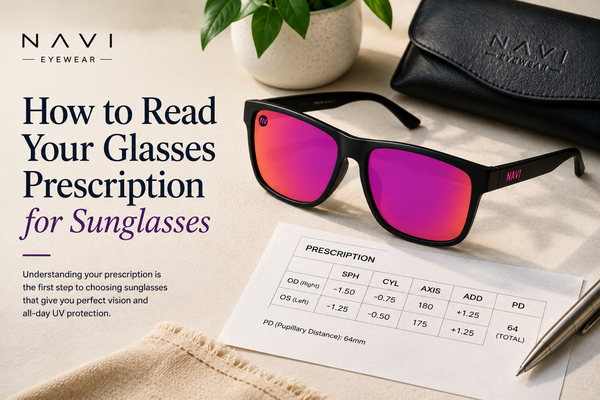
The Sample Prescription: What You Are Looking At
|
Sample Prescription — Annotated
Reading this example:Myopic (short-sighted) with mild astigmatism in both eyes, and a reading addition for presbyopia. For sunglasses, distance single-vision lenses (-2.50 and -3.00) would be used — the Add power is for reading and typically not included in sunglass lenses unless varifocal. |
Every Term Explained
|
OD and OS Means: OD = Oculus Dexter (right eye). OS = Oculus Sinister (left eye). OU = both eyes. Example: OD: -2.50 / OS: -3.00 These Latin abbreviations identify which eye each row of the prescription refers to. Always check which eye you are reading — prescriptions differ between eyes and transposing them produces a pair that does not work. Some modern prescriptions use plain English ('Right' and 'Left') instead. |
|
Sphere (SPH) Means: The main focusing power of the lens, measured in dioptres. Negative values = short-sighted (myopia). Positive values = long-sighted (hyperopia). Example: -2.50 (moderately short-sighted) / +1.75 (moderately long-sighted) Sphere is the most important single number in the prescription for most wearers. For sunglasses, you use the distance sphere — the correction for seeing clearly at distance. If your prescription has an Add value (for reading), this is not included in distance sunglass lenses unless you are ordering progressive (varifocal) sunglasses. A sphere of 0.00 or 'plano' means no correction needed for that component. |
|
Cylinder (CYL) Means: The correction for astigmatism — an irregular curvature of the cornea or lens. Can be negative or positive depending on notation convention. Example: -0.75 CYL (mild astigmatism) / -2.50 CYL (significant astigmatism) If your cylinder is 0.00 or blank, you have no significant astigmatism. Cylinder and axis always appear together — one is meaningless without the other. Mild astigmatism (below about -1.00) has a relatively small visual impact; significant astigmatism (-2.00 and above) requires precise lens manufacturing to correct. High cylinder values can make some online ordering more complex — some retailers restrict high cylinder prescriptions to in-person fitting. |
|
Axis Means: The angle of the cylinder correction, from 1 to 180 degrees. Only relevant if cylinder is present. Example: Axis 180 (horizontal astigmatism) / Axis 90 (vertical astigmatism) Axis tells the lens manufacturer exactly which direction to orient the cylinder correction. A small error in axis — even 5–10 degrees — can produce noticeable distortion in the finished lens, which is why precise manufacturing and careful prescription entry matter when ordering online. If you are entering your prescription manually online, double-check the axis figure for each eye carefully. |
|
Add (Addition) Means: The extra magnifying power added to the lower portion of a varifocal or reading lens for near vision. Only relevant for presbyopes (typically 45+). Example: +1.50 Add (moderate presbyopia) / +2.50 Add (stronger presbyopia) The Add value tells you how much extra magnification is needed for comfortable near vision. For sunglasses, you have two choices: ignore the Add entirely and order single-vision distance lenses (suitable if you use reading glasses separately for close work), or order progressive/varifocal prescription sunglasses that include the Add. For most outdoor activities — driving, hiking, cycling, water sports — single-vision distance lenses are appropriate and the Add is not needed. |
|
Prism Means: A correction for misalignment between the eyes (strabismus or binocular vision problems). Measured in prism dioptres with a base direction. Example: 2Δ Base In (prism to correct inward eye turn) Prism prescriptions require specialist lens manufacturing and are not available from all online retailers. If your prescription includes prism, ordering prescription sunglasses online is significantly more complex — in-person fitting at a specialist optical practice is the recommended route. Many people with prism prescriptions are unaware they have them; it is worth checking whether your prescription includes a prism column before attempting to order online. |
|
PD (Pupillary Distance) Means: The distance in millimetres between the centres of your pupils. May be a single number (monocular PD) or two separate numbers (binocular PD: right eye and left eye). Example: PD 64 (single) or PD 32/32 (binocular) PD is essential for prescription sunglass manufacturing — it tells the lab where to centre the optical zone of each lens relative to your pupils. An incorrect PD produces a lens where the optical centre is misaligned with your visual axis, causing eyestrain and discomfort. Your PD is not always included on a prescription; if it is missing, your optician can measure it for you, or several online retailers provide measurement tools. For progressive prescriptions, monocular PDs (right and left separately) are needed for accurate fitting. |
What to Take From Your Prescription When Ordering Sunglasses
For Single-Vision Distance Sunglasses (Most Common)
For Progressive (Varifocal) Sunglasses
Is Your Prescription Still Valid?
Most prescriptions are valid for two years from the date of your eye examination (one year for contact lens prescriptions in most jurisdictions). Ordering prescription sunglasses on an expired prescription is not recommended — your correction may have changed, and an incorrect prescription will produce a pair that does not perform correctly. If your prescription is over two years old, arrange a new eye examination before ordering. Many optical practices offer free or low-cost eye tests when purchasing prescription lenses.
Common Ordering Mistakes to Avoid
Browse theNavi Eyewear UV400 polarized collection for quality frames suitable for prescription lens fitting. For the complete prescription sunglass options and sourcing guide, seethe complete guide to prescription sunglasses.
Frequently Asked Questions
What does SPH mean on a glasses prescription?
SPH stands for Sphere — the main focusing power of the lens, measured in dioptres. A negative sphere value (e.g. -2.50) means you are short-sighted and the lens converges light to correct for this. A positive value (e.g. +1.75) means you are long-sighted. A sphere of 0.00 or 'plano' means no correction is needed for that component. For prescription sunglasses, the sphere is the primary value used to manufacture the distance-correcting power of the lens.
What does CYL mean on a glasses prescription?
CYL stands for Cylinder — the correction for astigmatism, which is caused by an irregular curvature of the cornea or lens. The cylinder value is always paired with an Axis value that specifies the orientation of the correction. If your CYL field is blank or 0.00, you have no significant astigmatism. CYL values can be written as negative or positive depending on the notation convention used by your optician — most prescriptions in the UK and Europe use negative cylinder notation.
Do I need to include the Add power when ordering prescription sunglasses?
Only if you are ordering progressive (varifocal) prescription sunglasses. For single-vision distance sunglasses — the most common prescription sunglass type — the Add value is not included. The Add is the extra magnification for reading that goes into reading glasses or the lower portion of progressives. Distance sunglass lenses use only the sphere, cylinder, and axis for each eye.
What is PD and do I need it for prescription sunglasses?
PD stands for Pupillary Distance — the measurement in millimetres between the centres of your pupils. It is essential for prescription sunglasses because it tells the lab where to position the optical centre of each lens relative to your line of sight. An incorrect PD produces a lens with misaligned optical centres, causing eyestrain and visual discomfort. Your PD may not be on your prescription — if it is missing, ask your optician to measure it, or use the measurement tool provided by most online optical retailers.
Can I use my contact lens prescription to order prescription sunglasses?
No — contact lens prescriptions and glasses prescriptions are different and not interchangeable. Contact lens prescriptions include back curve and diameter measurements for lens fitting that are not relevant to glasses. More importantly, the sphere and cylinder powers are often different between contact lens and glasses prescriptions due to the different distance of the lens from the eye (vertex distance). Always use your glasses prescription when ordering prescription sunglasses.
What if I have a very high prescription — can I still get prescription sunglasses?
Yes — prescription sunglasses are available across a very wide range of prescription powers, including high myopia, high hyperopia, and significant astigmatism. Very high prescriptions (above approximately -10.00 sphere or +8.00 sphere) may have limited availability in some specialised lens materials and may be better suited to in-person ordering at a specialist optical practice rather than online. High-index lens materials are particularly valuable for high prescriptions because they produce a thinner, lighter lens at the same power. The lens material options for high prescriptions are covered inthe complete guide to prescription sunglasses.
How do I know if my prescription has changed?
You will know definitively only through a new eye examination — vision changes are often gradual enough that you adapt without noticing the deterioration. Signs that suggest a prescription change may be overdue: increasing difficulty seeing clearly at distance even in your current glasses, more frequent headaches after visual tasks, or noticing that you are holding reading material closer or further than you used to. Opticians recommend a full eye examination every two years for adults without eye health conditions, and annually for those over 60 or with conditions such as diabetes or glaucoma.
SOURCES & CITATIONS[1] Vitale S, Ellwein L, Cotch MF, Ferris FL, Sperduto R."Prevalence of refractive error in the United States, 1999–2004."Archives of Ophthalmology, 2008.View source [2] Dain SJ."Sunglasses and sunglass standards."Clinical and Experimental Optometry, 2003.View source [3] American Academy of Ophthalmology."What is a glasses prescription?."AAO EyeSmart, 2023.View source [4] Benjamin WJ."Borish's Clinical Refraction (2nd ed.)."Butterworth-Heinemann, 2006.View source |