
Prescription Sunglasses vs Contact Lenses + Sunglasses: Which Is Better?
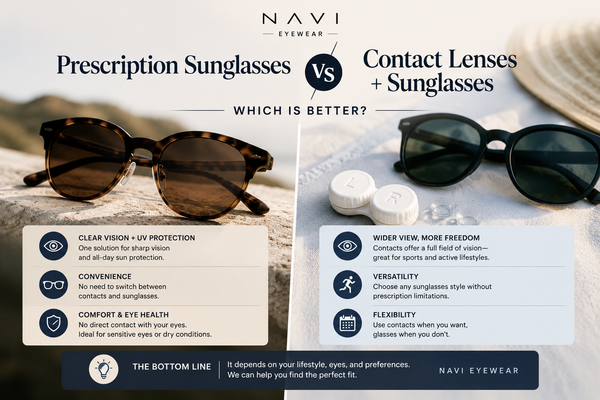
If you need vision correction and want proper UV protection outdoors, you have two main routes: prescription sunglasses (one pair that does both), or contact lenses worn under non-prescription sunglasses (two separate products that combine to do both). Both work. Neither is universally better. Which is right for you depends on your prescription, your activities, your lifestyle, and some practical considerations around eye health that are worth understanding before you choose.
This is a C8 Prescription and Vision supporting post. For the complete prescription sunglasses guide covering all options, costs, and how to order, seethe complete guide to prescription sunglasses. For the UV foundation that makes outdoor eye protection a priority regardless of which route you choose, seethe complete guide to UV eye protection.

The Head-to-Head: Eight Variables That Matter
|
Variable |
Prescription Sunglasses |
Contacts + Non-Rx Sunglasses |
|
Optical quality |
Single lens system — best possible optics |
Single lens system — equally good optics |
|
UV protection |
UV400 built into the lens — always present |
UV400 from the sunglass — equally reliable |
|
Upfront cost |
£120–400 / $150–500 for a quality pair |
Contact lens ongoing cost + quality sunglass £60–150 |
|
Ongoing cost |
Low — one-time purchase, 3–7 year lifespan |
Higher — monthly/daily lens replacement cost ongoing |
|
Eye health |
No contact lens dryness or infection risk |
Outdoor UV, wind, and dust can worsen contact discomfort |
|
Flexibility |
One-purpose pair — outdoor use only |
Same sunglasses work with or without contacts |
|
Water sports |
Ideal — no risk of contact lens loss in water |
Contacts risk displacement or loss in water |
|
Prescription range |
Works for all prescriptions including complex ones |
Works for most — some prescriptions not suitable for contacts |
Where Prescription Sunglasses Win
|
Prescription Sunglasses — The Better Choice Wins when: water sports, high UV environments, contact lens intolerance, complex prescriptions, simplicity Prescription sunglasses are the clearly better option in several specific scenarios. For water sports — surfing, kayaking, swimming, sailing — contacts worn under sunglasses risk displacement, loss, and dangerous eye irritation from salt or chlorinated water. A prescription sunglass pair removes all of these risks entirely. For people who find contact lenses uncomfortable in outdoor conditions — dry, windy, or dusty environments that exacerbate lens dryness and irritation — prescription sunglasses eliminate the contact lens entirely. For complex prescriptions including significant astigmatism, high powers, or prisms that are difficult to fit in contact lens form, prescription sunglasses deliver the full correction without compromise. And for anyone who values simplicity — one pair, always ready, no insertion routine — prescription sunglasses are a lower-friction solution. For the full prescription sunglass options and costs, seethe complete guide to prescription sunglasses. |
Where Contacts Plus Non-Prescription Sunglasses Win
|
Contacts + Non-Rx Sunglasses — The Better Choice Wins when: frame flexibility, travel, activities that mix indoor and outdoor, existing contact lens wearers Contact lenses plus non-prescription sunglasses win on flexibility. The same quality sunglass frame can be worn with any pair of contacts — today's daily disposables, tomorrow's monthly lenses, a different prescription if it changes. The frame choice is unconstrained by prescription requirements: any shape, any base curve, any style works because the lens correction comes from the contact, not the glass. For travellers who want to pack light, one quality sunglass pair plus contact lenses is a simpler kit than carrying both glasses and prescription sunglasses. For activities that move between indoors and outdoors repeatedly — a day that mixes driving, office time, and an outdoor lunch — contact lenses plus any eyewear (clear glasses indoors, sunglasses outdoors) is more flexible than a single-purpose prescription sunglass pair. Browse theNavi Eyewear UV400 polarized collection for quality non-prescription sunglasses that work perfectly over contact lenses. |
The Eye Health Consideration: Contacts Outdoors
There is a specific eye health consideration for contact lens wearers who spend significant time outdoors that is worth understanding explicitly. Outdoor environments — UV light, wind, dust, pollen, and dry air — are more challenging for contact lens wearers than indoor environments. Extended outdoor time in contacts can accelerate lens dryness, increase the risk of particles becoming trapped under the lens, and in high-UV environments, deliver UV to the eye surface around and through the lens (since contact lenses, unless specifically UV-blocking, do not provide meaningful UV protection to the conjunctiva and limbal region).
UV-blocking contact lenses exist and provide some protection to the cornea, but they do not cover the surrounding eye area that sunglasses protect. The American Academy of Ophthalmology specifically notes that UV-blocking contacts are not a substitute for UV-blocking sunglasses because of the coverage gap. For regular outdoor athletes and active people who rely on contacts, the combination of contacts plus quality UV400 sunglasses provides better overall protection than contacts alone — and prescription sunglasses eliminate the contact lens variable entirely for dedicated outdoor sessions. The UV protection case is made in full inthe complete guide to UV eye protection.
The Practical Decision Framework
Choose Prescription Sunglasses If:
Choose Contacts + Non-Prescription Sunglasses If:
Consider Both If:
Many people benefit from having both options available — prescription sunglasses for dedicated outdoor sessions and water activities, and contacts plus a quality sunglass for everyday mixed-environment use. This approach gives you the optimal solution for each context. It fits naturally withinthe guide to building the perfect sunglasses collection for every occasion — the prescription sunglass is simply the specialist pair for the use cases where it excels.
Frequently Asked Questions
Can I wear contact lenses under sunglasses?
Yes — this is a completely standard and safe combination for most contact lens wearers. Any quality UV400 non-prescription sunglass worn over daily or monthly contact lenses provides full vision correction (from the contacts) and full UV protection (from the sunglass). The main practical consideration is that outdoor conditions — wind, dust, dry air — can increase contact lens discomfort during extended outdoor sessions. For water sports, contacts under sunglasses carry the risk of lens displacement or loss on water impact.
Are prescription sunglasses better than contacts for driving?
Both provide equivalent vision correction and UV protection for driving, assuming quality UV400 sunglasses in the contacts scenario. The specific advantage of prescription sunglasses for driving is the elimination of the contact lens variable — no dryness risk during a long drive, no risk of a lens moving during a bright glare event, and no need to handle contacts before an early morning departure. Gray polarized prescription sunglasses are the optimal driving eye protection specification. The full driving sunglass guide is inbest sunglasses for driving: polarized lenses and glare reduction.
Do contacts protect your eyes from UV?
Most standard contact lenses do not provide meaningful UV protection. UV-blocking contact lenses exist and are classified by UV protection level, but even the highest-rated UV-blocking contacts protect only the cornea — they do not cover the conjunctiva, the limbal region, or the surrounding eye area that sunglasses protect. The American Academy of Ophthalmology advises that UV-blocking contacts are not a substitute for UV-blocking sunglasses. Always wear UV400 sunglasses outdoors regardless of whether you wear UV-blocking contacts.
What is the cost comparison over time?
Prescription sunglasses have a higher upfront cost (£120–400 / $150–500 for a quality pair) but a very low ongoing cost over their 3–7 year lifespan. Contact lenses plus non-prescription sunglasses have a lower upfront cost for the sunglass (£60–150 / $75–190) but a significant ongoing cost for monthly contact lens replacement (typically £120–300 / $150–375 per year). Over a 5-year period, prescription sunglasses often represent lower total cost than the contact lens ongoing spend plus a quality sunglass purchase, depending on contact lens type and cost.
Can I swim or surf wearing contact lenses under sunglasses?
Not recommended. Water entry — even wearing sunglasses — carries the risk of water reaching the contacts and causing lens displacement, loss, or dangerous irritation from pathogens in the water. Acanthamoeba, a dangerous corneal parasite, is present in natural water sources and can cause serious infection when it contacts a lens. For any water sport involving submersion or water splash at the eye level, prescription sunglasses that remove the contact lens entirely are the clearly safer option.
Are there contact lenses designed specifically for outdoor sports?
Several contact lens manufacturers offer lenses with UV-blocking properties and moisture-retaining materials designed to reduce dryness during extended outdoor activity. These address the comfort issue but not the coverage gap — they protect the cornea but not the surrounding eye area. For outdoor sport, quality UV400 sunglasses over any contact lens type provide better overall protection than contacts alone, and prescription sunglasses eliminate both the lens and the coverage gap for dedicated outdoor sessions.
What if I need different corrections for distance and reading outdoors?
Progressive (varifocal) prescription sunglasses provide multi-distance correction in a single outdoor pair. For contact lens wearers, monovision correction — one eye corrected for distance, one for near — is a common presbyopia solution that allows single-vision sunglasses to work over the contacts. Monovision adaption is individual and requires an optician assessment. The progressive prescription sunglass option is covered in depth inthe complete guide to prescription sunglasses.
SOURCES & CITATIONS[1] Cullen AP."Ultraviolet induced ocular disease."Documenta Ophthalmologica, 1994.View source [2] Dain SJ."Sunglasses and sunglass standards."Clinical and Experimental Optometry, 2003.View source [3] American Academy of Ophthalmology."UV-blocking contact lenses."AAO EyeSmart, 2023.View source [4] Pitts DG, Cullen AP, Hacker PD."Ocular effects of ultraviolet radiation from 295 to 365 nm."Investigative Ophthalmology and Visual Science, 1977.View source [5] Rosenthal FS, Bakalian AE, Lou CQ, Taylor HR."The effect of sunglasses on ocular exposure to ultraviolet radiation."American Journal of Public Health, 1988.View source |