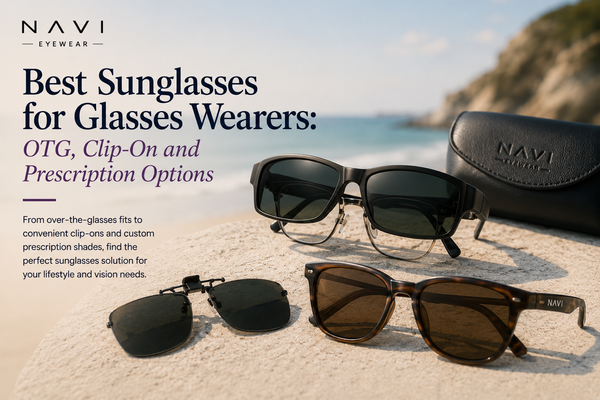

If you wear prescription glasses full-time and spend time outdoors, you face a problem that roughly a third of the adult population shares: standard sunglasses do not correct your vision, so wearing them means choosing between seeing clearly and protecting your eyes. Most glasses wearers have found one workaround or another — squinting in their regular glasses, wearing contacts for sunny days, perching sunglasses awkwardly over their frames — but few have systematically assessed all the available options against their actual needs.
This guide covers every viable option for glasses wearers who want sun protection: over-the-glasses (OTG) designs, clip-on sunglasses, prescription sunglasses, contact lenses plus regular sunglasses, and photochromic lenses. Each option has a genuine use case. The right one depends on your prescription, your activities, your budget, and how often you actually need outdoor sun protection.
This is the final C8 Prescription and Vision supporting post. For the complete prescription sunglass guide covering costs and ordering, seethe complete guide to prescription sunglasses. For the contacts-versus-prescription-sunglasses decision specifically, seeprescription sunglasses vs contact lenses and sunglasses. For the UV stakes — why any of this matters — seethe complete guide to UV eye protection.

The Five Options: A Complete Overview
|
Option |
Cost |
Optical Quality |
Convenience |
Best For |
|
OTG sunglasses |
£15–60 / $20–75 |
Good — single vision system over the glasses |
Very high — fits over any glasses |
Occasional outdoor use, hiking, driving |
|
Clip-on sunglasses |
£15–80 / $20–100 |
Good — minimal extra optics |
High — quick attach/detach |
Regular use, commuting, everyday outdoor |
|
Prescription sunglasses |
£120–400 / $150–500 |
Excellent — single dedicated lens system |
Moderate — requires carrying second pair |
Driving, sport, high-UV, daily outdoor use |
|
Contact lenses + sunglasses |
£60–150 lens + contacts |
Excellent — single vision per eye |
Moderate — requires lens insertion |
Active sport, water, flexible frame choice |
|
Photochromic lenses |
£100–300 / $125–375 upgrade |
Good — single pair solution |
Very high — no switching |
Mixed indoor/outdoor days, low-UV environments |
Option 1: Over-the-Glasses (OTG) Sunglasses
|
OTG Sunglasses — Worn Over Your Prescription Frames ✓ Pros: Works with any glasses; no prescription order needed; immediate solution; affordable; UV400 available ✗ Cons: Larger, heavier combination; reflections between lens surfaces; style compromises; must fit your frame shape OTG sunglasses are non-prescription frames specifically designed with wider, deeper lens areas and extended temples to fit over standard prescription glasses. Quality OTG designs from sport and outdoor brands — particularly those designed for driving, hiking, and cycling — provide genuine UV400 protection and, in polarized versions, glare elimination over your existing prescription correction. The optical trade-off is inherent to any two-lens system: light passes through your prescription lens and then through the OTG sunglass lens, with reflections possible between the surfaces. This produces marginally less optical clarity than a single dedicated lens system, and the reflection can produce a ghost image in strong light. For most everyday outdoor use, the optical compromise is minor and the convenience value is significant. Fit is the critical variable in OTG selection. OTG frames come in small, medium, and large sizes that are designed to accommodate different prescription frame widths. Measure the width of your prescription frame at its widest point and match to the OTG frame's specified fit range. An OTG that is too narrow will press against your prescription frame temples; one that is too wide will sit unstably. Quality OTG frames with rubberised nose rests and temple grips maintain position without pressing into your prescription frame or slipping. The fit mechanics for any frame are explained inhow to tell if sunglasses actually fit. |
Option 2: Clip-On Sunglasses
|
Clip-On Sunglasses — Attach to Your Prescription Frames ✓ Pros: Quick and easy to attach and remove; compact and packable; UV400 polarized versions available; works with existing glasses ✗ Cons: Must match your specific frame shape and size; clip mechanism can scratch frame coatings; limited style range; some optical quality compromise Clip-on sunglasses attach to prescription frames via spring clips, magnetic mounts, or sliding arms. Magnetic clip-ons — where a magnetic overlay flips up or detaches cleanly — have become the most popular format because they attach quickly, leave no scratch marks, and flip up instantly when moving indoors. To find clip-ons that fit your specific frame, you need your glasses brand, model, and size — clip-ons are manufactured to fit specific frame models rather than as universal fits, though some brands offer universal size ranges. For regular outdoor use — commuting, driving to work, casual outdoor time — clip-ons with UV400 polarized lenses represent one of the most cost-effective solutions available to glasses wearers. A quality magnetic polarized clip-on at £30–60 / $40–75 provides genuine glare elimination and UV protection over an existing prescription at a fraction of the cost of prescription sunglasses. The polarization performance is identical to a standalone polarized sunglass. For why polarized specifically matters over any lens darkness, seepolarized sunglasses: are they worth it. |
Option 3: Prescription Sunglasses
|
Prescription Sunglasses — A Dedicated Second Pair ✓ Pros: Best optical quality; no double-lens compromise; full UV400 and polarization; sport frames available; all prescription types ✗ Cons: Higher upfront cost; requires carrying a second pair; needs ordering and possibly fitting appointment Dedicated prescription sunglasses are the highest-performing option for glasses wearers who spend significant time outdoors. A single lens delivers both correction and UV protection without the two-lens compromise of OTG or clip-on designs. For drivers, the combination of gray polarized prescription lenses eliminates road glare while correcting vision — an experience that OTG and clip-on designs approximate but do not fully replicate. For outdoor sport — hiking, running, cycling, water sports — prescription sunglasses in sport-compatible polycarbonate deliver the performance, durability, and fit security that wearing two frames simultaneously cannot provide. The cost barrier is real but smaller than many glasses wearers expect, particularly via online optical retailers. Single-vision polarized polycarbonate prescription sunglasses from established online retailers typically start from £80–120 / $100–150 — a modest investment for something used daily. The complete ordering guide, including how to read your prescription and what to specify when ordering, is inhow to read your glasses prescription for sunglasses. The full cost breakdown at all price tiers is inthe complete guide to prescription sunglasses. |
Option 4: Contact Lenses Plus Non-Prescription Sunglasses
|
Contact Lenses + Non-Rx Sunglasses — Two Separate Products ✓ Pros: Full frame flexibility; any sunglass style works; no prescription constraint on sunglass choice; optimal optical quality ✗ Cons: Requires contact lens tolerance; outdoor conditions worsen contact lens comfort; water sport risk of lens loss For glasses wearers who are also comfortable wearing contact lenses, this combination offers the greatest flexibility. Any quality sunglass frame — including the fullNavi Eyewear UV400 polarized collection — becomes available without prescription constraints. The UV400 polarized performance is identical to what a prescription wearer gets from prescription sunglasses, without the ordering complexity. The limitations are the same as for any contact lens wearer outdoors: wind, dust, and dry outdoor air can worsen lens comfort during extended sessions, and water sport activities carry the risk of lens displacement or loss. The full assessment of this option against prescription sunglasses is inprescription sunglasses vs contact lenses and sunglasses. |
Option 5: Photochromic (Transition) Lenses in Your Regular Glasses
|
Photochromic Lenses — One Pair That Darkens Outdoors ✓ Pros: Single pair convenience; automatic adjustment; UV400 when clear or dark; no carrying a second pair ✗ Cons: Does not darken in cars; slower to clear than to darken; reduced darkness in hot weather; no polarization in standard versions Photochromic lenses in your everyday glasses eliminate the switching problem entirely — the same pair that is clear indoors darkens automatically outdoors. For glasses wearers who want the simplest possible solution, this is the strongest argument for transitions. The limitations are significant for specific use cases: the most important is the driving limitation — car windscreens block the UV needed to trigger darkening, so transitions remain near-clear inside vehicles in bright sunshine. For regular drivers, this makes photochromic lenses an incomplete outdoor solution. For non-drivers or those for whom driving is a minor part of outdoor time, the limitation is less important. The detailed comparison of transitions versus prescription sunglasses — including the temperature and speed limitations — is intransition lenses vs prescription sunglasses: the honest comparison. |
Making the Decision: Which Option Is Right for You?
For Occasional Outdoor Use
OTG sunglasses or clip-ons deliver the best value for glasses wearers who only occasionally need sun protection — a walk at lunchtime, a weekend trip to the beach, occasional driving in bright conditions. The upfront cost is low, no ordering process is required, and the optical compromise is minor for the usage level. Ensure any OTG or clip-on purchase includes UV400 certification — the same check that applies to any sunglass purchase, as covered in7 signs your sunglasses are not protecting your eyes.
For Regular Driving
Prescription sunglasses or contacts plus polarized sunglasses are the clear recommendations for regular drivers. OTG and clip-ons work adequately for driving, but the two-lens optical compromise and the additional weight and width of wearing two frames reduces the experience. Photochromic lenses in regular glasses do not adequately darken inside vehicles. Gray polarized prescription sunglasses deliver the optimal driving experience: full vision correction, full UV protection, and glare elimination on road surfaces. Seebest sunglasses for driving: polarized lenses and glare reduction for the full specification.
For Outdoor Sport and Active Use
Prescription sunglasses are the strongest recommendation for glasses wearers who participate in hiking, cycling, running, or water sports. The combination of two frames (OTG) or the disruption of glasses under a helmet or sporting context makes OTG and clip-ons impractical for most sport applications. Contacts plus sport sunglasses work well for dry-land activities. Prescription sport sunglasses — polycarbonate lenses in TR90 nylon frames with rubberised grips — provide the fit security, impact resistance, and optical performance that active use demands. For the activity-specific requirements, seethe complete outdoor and sport sunglasses guide.
For Travel
Clip-ons are the most travel-practical solution for glasses wearers — compact, lightweight, and instantly ready without carrying a second frame. For longer trips to high-UV destinations — the Mediterranean, tropical locations, alpine environments — the UV stakes are higher and prescription sunglasses provide better protection for extended outdoor sessions. The travel-specific UV context and packing considerations are inbest sunglasses for travel.
Frequently Asked Questions
What are the best sunglasses for people who wear glasses?
The best option depends on your usage frequency and primary activity. For occasional use: OTG sunglasses or polarized clip-ons — affordable, immediately available, no ordering required. For regular driving: prescription sunglasses with gray polarized lenses — the two-lens systems do not eliminate driving glare as effectively. For outdoor sport: prescription sunglasses in sport frames, or contacts plus non-prescription polarized sunglasses. For everyday convenience: photochromic lenses in your regular glasses — though with the driving limitation noted intransition lenses vs prescription sunglasses. There is no single universal best option — the right choice is the one that matches your actual usage pattern.
Can you wear sunglasses over prescription glasses?
Yes — OTG (over-the-glasses) sunglasses are specifically designed for this purpose. They have wider, deeper lens areas and extended temples to accommodate prescription frames underneath. Quality OTG designs with UV400 certification provide full UV protection over your prescription glasses. The optical quality involves a minor compromise compared to a single dedicated lens system, but for most outdoor uses the difference is not significant. Fit is the critical factor — OTG frames need to match the width of your prescription frame.
Are clip-on sunglasses any good?
Quality clip-on sunglasses — particularly polarized magnetic flip-up designs — are a genuinely good solution for regular glasses wearers who want UV protection and glare elimination without ordering prescription sunglasses. The optical quality is good, UV400 polarized versions are widely available, and the convenience of attaching and removing quickly makes them practical for everyday use including driving and commuting. The limitation is that they must match your specific frame model for a secure, non-scratching fit. For the UV protection checklist that applies to clip-ons as to any sunglass purchase, see7 signs your sunglasses are not protecting your eyes.
What are OTG sunglasses?
OTG stands for Over-The-Glasses — sunglasses designed to be worn over existing prescription frames. They are sized and shaped to accommodate the width, height, and temple depth of a standard prescription frame underneath, with their own UV-protective lenses in front. OTG sunglasses come in UV400 and polarized versions and are available from sport, outdoor, and driving eyewear brands. They are an affordable, immediately available alternative to prescription sunglasses for glasses wearers who want outdoor UV protection without a prescription lens order.
Can I wear clip-on sunglasses while driving?
Yes — polarized clip-on sunglasses provide glare reduction for driving, and UV400 versions provide UV protection. The practical performance is adequate for driving, though dedicated prescription sunglasses with polarized lenses deliver better glare elimination because there is no two-lens optical system. If you drive regularly in bright conditions, prescription sunglasses are the superior long-term investment. The full driving sunglass specification is inbest sunglasses for driving: polarized lenses and glare reduction.
How do I find clip-on sunglasses that fit my glasses frames?
Find your glasses frame brand, model name, and size (printed inside one temple arm). Search for clip-ons made specifically for your frame model — many optical brands produce model-specific clip-ons. Universal clip-on sizes (small, medium, large) work for a wider range of frames but may not fit as precisely. Magnetic clip-ons require either a frame with built-in magnetic points or a universal magnetic attachment system. When buying online, check the specified dimensions against your frame dimensions to confirm fit compatibility.
Is it safe to wear OTG sunglasses while driving?
Yes — OTG sunglasses with UV400 lenses are safe for driving. Polarized OTG lenses provide road surface glare reduction. The combination is wider than your regular glasses, which can marginally reduce peripheral vision depending on the OTG design — choose OTG frames that do not extend significantly beyond your prescription frame width to minimise this. The UV and visual safety case for any sun protection while driving is made inbest sunglasses for driving: polarized lenses and glare reduction.
How much do prescription sunglasses cost compared to clip-ons?
Clip-on sunglasses typically cost £15–80 / $20–100 depending on quality and whether they are model-specific or universal fit. OTG sunglasses cost a similar range at £20–60 / $25–75. Prescription sunglasses from online retailers start from around £80–120 / $100–150 for single-vision polarized polycarbonate, rising to £200–400 / $250–500 for high-street optical practice orders or progressive lens designs. The cost-per-year comparison favours prescription sunglasses over 3–5 years of regular use, and their optical performance advantage is significant for driving and outdoor sport. The full cost analysis is inthe complete guide to prescription sunglasses.
Can I use OTG sunglasses for hiking and outdoor sport?
OTG sunglasses are suitable for hiking, walking, and lower-intensity outdoor activities. For higher-intensity sport — cycling, trail running, water sports — the combination of two frames becomes awkward and the wider combined profile creates wind resistance and stability issues. Prescription sport sunglasses in polycarbonate frames with rubberised grips are the recommended solution for active sport use. The activity-specific recommendations for outdoor sport are inthe complete outdoor and sport sunglasses guide.
What UV protection do clip-on sunglasses provide?
Quality clip-on sunglasses with explicit UV400 certification provide the same 100% UVA and UVB protection as any UV400-certified sunglass lens. The UV protection applies regardless of whether the clip-on is polarized or not, and regardless of the tint colour. Always check for explicit UV400 labelling on clip-ons — the same warning about dark lenses without certification that applies to any sunglass applies here. The UV400 standard is explained in full inwhat does UV400 actually mean.
Should I get prescription sunglasses or keep using clip-ons?
If you drive regularly, spend significant time outdoors, or participate in any sport or active outdoor activity, prescription sunglasses provide meaningfully better performance than clip-ons for those use cases. If your outdoor exposure is primarily incidental — walks, errands, occasional outdoor dining — quality polarized clip-ons are an excellent and affordable solution that does not justify the cost and logistics of prescription sunglasses. Many glasses wearers find that quality clip-ons serve everyday outdoor use well while prescription sunglasses serve driving and active use — fitting naturally withinhow to build the perfect sunglasses collection for every occasion.
SOURCES & CITATIONS[1] Vitale S, Ellwein L, Cotch MF, Ferris FL, Sperduto R."Prevalence of refractive error in the United States, 1999–2004."Archives of Ophthalmology, 2008.View source [2] Dain SJ."Sunglasses and sunglass standards."Clinical and Experimental Optometry, 2003.View source [3] Rosenthal FS, Bakalian AE, Lou CQ, Taylor HR."The effect of sunglasses on ocular exposure to ultraviolet radiation."American Journal of Public Health, 1988.View source [4] De Faber JT, Naeser K, Kessing SV."Polarized light and contrast sensitivity under glare conditions."Ophthalmic Research, 2013.View source [5] American Academy of Ophthalmology."Sunglasses: protecting your eyes from UV radiation."AAO EyeSmart, 2023.View source |