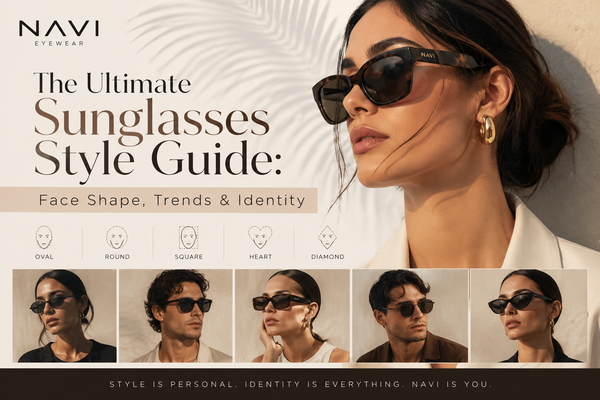

The Ultimate Sunglasses Style Guide: Face Shape, Trends & Identity
Most buying guides start with the assumption that you already know what you want and just need help finding it. This one starts further back. Before frame shapes and tint colors and trend reports, there is a more fundamental question: what is the right sunglasses for you — not your face shape in the abstract, not a generic style type, but the combination of proportional balance, personal identity, and functional need that makes a pair feel like yours.
This guide covers all three dimensions. Face shape matching — the structural logic of why certain frames balance certain face proportions. Frame style identity — what different designs communicate and the cultural lineage that gives them their meaning. Trends — what is happening in 2025 and how to engage with trends without becoming entirely dependent on them. And the psychology underneath all of it: why sunglasses work as an accessory the way almost nothing else does.
This is the C4 Style, Trends and Identity pillar post. The supporting posts in this cluster cover each element in deeper detail:sunglasses for your face shape,sunglasses trends 2025,the psychology of sunglasses, andthe history of sunglasses and style evolution. The foundation for all of this — UV protection, polarization, and lens technology — is inthe complete guide to UV eye protection.

Face Shape and Frame Choice: The Proportional Logic
Face shape matching is not a rule system — it is a proportional logic. The goal is visual balance: frames that counterbalance the strongest features of your face shape, creating a more harmonious overall proportion. A round face is widened and given definition by angular frames. An angular face is softened by rounder ones. An oval face, which is already well-balanced, works with almost everything.
Understanding the principle is more useful than following a prescriptive list, because face shapes exist on a spectrum rather than in discrete categories, and most people's faces have features of more than one shape. The cards below describe the core logic for each shape — not absolute rules, but a framework for understanding why certain choices tend to work.

|
Oval Face Works well: Almost all frame shapes — this is the most versatile face shape for sunglasses Generally avoid: Frames dramatically larger than the face width — can overpower even balanced proportions Oval faces are characterised by a forehead that is slightly wider than the chin, balanced cheekbones, and a length that is approximately one and a half times the width. This natural balance means virtually any frame shape works — the face itself provides the visual equilibrium that other shapes must achieve through frame choice. The main consideration for oval faces is scale: the frame width should roughly match the face width at the temples. Oversized frames that extend significantly beyond the face can look disproportionate even on a well-balanced oval. |
|
Round Face Works well: Angular frames — square, rectangular, geometric; frames wider than they are tall Generally avoid: Round or circular frames — amplify the roundness; small narrow frames — disappear on rounder faces Round faces have similar width and length with full cheeks and a rounded chin. The styling goal is to create the visual impression of more length and angularity. Angular frames — particularly rectangular and square shapes — introduce horizontal and vertical lines that counterbalance the face's dominant curves. Frames that are slightly wider than they are tall work well. A higher bridge that sits prominently on the nose also helps elongate the face visually. The frames most likely to look good on a round face are also some of the most classically masculine shapes, which is why rectangular frames have historically dominated men's eyewear. |
|
Square Face Works well: Round, oval, and curved frames; cat-eye shapes; frames with upswept corners Generally avoid: Square or rectangular frames — mirror the face's existing angularity; geometric shapes with hard corners Square faces have a strong jawline, prominent cheekbones, and a forehead width similar to the jaw width. The face's natural angularity is the defining feature — and the styling goal is to soften it. Round, oval, and curved frames introduce organic lines that contrast with the jaw's strong geometry. Frames that are slightly wider than the face can also help by directing attention upward and outward rather than toward the jaw. Cat-eye shapes, which have their widest point above the horizontal centre, are particularly effective at this — they shift visual weight upward and away from the jawline. |
|
Heart Face Works well: Bottom-heavy frames; round and oval shapes; rimless or thin-rim designs; aviators Generally avoid: Top-heavy frames; cat-eye shapes that emphasise the wide forehead; oversized square frames Heart-shaped faces are wider at the forehead and temples, tapering to a narrow chin. The styling goal is to balance the wider upper face against the narrower lower face — either by adding visual weight at the bottom of the frame or by minimising visual weight at the top. Aviator frames, with their characteristic drop shape that is wider at the top and narrows slightly toward the bottom, work well because they echo the face's proportions in a balanced way. Round and oval shapes that are not top-heavy distribute visual weight more evenly. Rimless and thin-wire frames are less visually prominent and let the face itself dominate. |
|
Oblong / Rectangular Face Works well: Oversized frames with height; round and oval shapes; frames with decorative temples Generally avoid: Narrow frames; small lenses; rimless designs — all make a long face appear longer Oblong faces are longer than they are wide, with a forehead, cheekbones, and jaw of similar widths. The styling goal is to create the impression of width and reduce apparent face length. Oversized frames with significant lens height cover more of the face and reduce the visible length. Decorative or distinctive temples draw the eye outward toward the sides of the face, creating the impression of width. Round and large oval frames work better than narrow horizontal shapes, which emphasise the face's length rather than countering it. |
For a complete face shape analysis with specific frame recommendations for each category, seesunglasses for your face shape: the complete guide. And remember that the physical fit — bridge width, temple length, frame width — must work alongside the proportional aesthetic. A frame that looks right in theory but slides off your nose or sits unevenly is not the right frame.How to tell if sunglasses actually fit covers the physical mechanics.
Frame Styles and What They Signal
Every major sunglass frame shape carries cultural associations that have developed over decades of wear by specific subcultures, industries, and public figures. These associations are not rigid — they evolve, and individuals wear them against type deliberately — but they are real enough that the frame you choose communicates something about how you see yourself, or how you want to be seen.
|
Aviator Identity signal: Adventure, authority, and a certain laconic cool Cultural era: 1930s military aviation, 1970s mainstream adoption, enduring crossover classic The aviator was designed in 1936 for US Army Air Corps pilots — large lenses to cover the full orbital area, a thin metal frame to minimise weight, and a teardrop shape that maximises coverage without excessive frame presence. Its association with pilots, then with military culture broadly, then with 1970s Hollywood gave it a particular kind of authority — competent, slightly removed, not trying. The aviator is the closest thing to a genuinely universal frame: it works across face shapes (particularly oval, heart, and oblong), reads as both masculine and feminine depending on scale and lens colour, and carries enough cultural history to feel substantial without being overtly fashion-forward. |
|
Wayfarer Identity signal: Counterculture credibility, artistic independence, downtown cool Cultural era: 1956 original Ray-Ban design, 1960s counterculture, 1980s revival via film and music The Wayfarer's thick acetate frame, keyhole bridge, and slight backward tilt were radical in 1956 — a deliberate break from the metal frame aesthetic that had defined sunglasses since the 1930s. Its adoption by James Dean, Bob Dylan, Jack Nicholson, and decades of musicians and artists gave it a particular countercultural lineage that still reads clearly. The Wayfarer signals engagement with culture, aesthetic interest, and a preference for substance over trend. It works particularly well on oval and round faces, where its angular-but-rounded shape provides useful contrast. |
|
Round / Circle Identity signal: Artistic intellectualism, bohemian identity, philosophical detachment Cultural era: 1960s–70s counterculture and folk, recurrent in indie and art-adjacent circles Round frames carry a specific intellectual and bohemian association — John Lennon, Allen Ginsberg, Mahatma Gandhi. The shape communicates a certain distance from mainstream fashion, an alignment with ideas rather than trends. In recent years, small round frames have experienced several revival cycles in indie and streetwear contexts. For wearers, round frames work best on angular and square faces where the circle's organic geometry contrasts with the face's strong lines. On already-round faces, they tend to amplify the roundness rather than balance it. |
|
Cat-Eye Identity signal: Confident femininity, retro glamour, editorial sophistication Cultural era: 1950s Hollywood glamour, 1970s exaggerated revival, recurring haute couture reference The cat-eye is one of the most deliberately and self-consciously stylish frame shapes in eyewear history. Its upswept outer corners were designed to feminise and glamourise — a visual lift that references the eye shape of classic Hollywood makeup. Cat-eye frames are most commonly worn by women, but unisex and masculine interpretations have a small but genuine presence in contemporary eyewear. They work particularly well on square and round faces, where the upswept shape provides useful vertical lift. They tend to overemphasise the forehead on already wide-foreheaded heart-shaped faces. |
|
Shield / Sport Wraparound Identity signal: Athletic performance identity, technical capability, active lifestyle alignment Cultural era: 1980s–90s sport and cycling, 2000s performance sport, current athleisure crossover Wraparound sport frames crossed from functional athletic eyewear into fashion territory in the 2000s and have never fully retreated. The shield and sport wraparound signal physical capability and outdoor activity — a different kind of aspiration from the cultural signals of aviators or wayfarers. In the current athleisure moment, sport frames worn with everyday clothing communicate a lifestyle orientation toward health and movement. For anyone who actually participates in outdoor sport, they also happen to be the most functionally appropriate design — which is a rare convergence of form and function. |
|
Oversized Identity signal: Effortless luxury, self-assurance, editorial fashion consciousness Cultural era: 1960s–70s Italian glamour, recurring fashion-week reference, current quiet luxury alignment Oversized frames occupy a specific position in the style landscape: they require a certain confidence to wear, because their scale commands attention and does not allow for self-effacement. They read as deliberately fashionable in a way that more neutral shapes do not. For faces that can carry the scale — oval and oblong faces particularly — they create a strong, cohesive visual statement. Current iterations in the quiet luxury aesthetic tend toward oversized but understated: large lenses, minimal branding, subtle colours. |
What Is Happening in Sunglasses in 2025
Trend cycles in sunglasses are slower than in clothing — frames are a bigger investment and a more durable purchase. The trends shaping 2025 are continuations and refinements of directions that started several years ago rather than sharp breaks. For the full 2025 trend breakdown with specific style references, seesunglasses trends 2025: the styles to know. Below is the directional overview.
Quiet Luxury Continues
The quiet luxury aesthetic — which prioritises quality, understatement, and material integrity over logos and conspicuous branding — continues to dominate premium eyewear. In practice, this means clean acetate in neutral tones (tortoiseshell, transparent brown, black, cream), minimal metal hardware, understated shapes (oval, round, slightly oversized), and an absence of decorative elements that would read as fussy or tryhard. The frame should look expensive without announcing itself.
Sport-to-Street Crossover
Technical sport sunglasses — primarily shield designs, wraparounds, and cycling-inspired shapes — continue to cross into everyday fashion wear. This is partly driven by the broader athleisure moment and partly by a genuine appreciation for the quality and coverage of sport-engineered frames. The crossover looks least self-conscious when the wearer has an actual outdoor or sport context that the frame references authentically.
Retro Shapes in Contemporary Materials
1990s nostalgia continues to pull oval and shield shapes back into mainstream fashion, rendered in contemporary lens colours and materials. Small oval frames in transparent acetate, rimless designs with coloured lenses, and butterfly shapes in lightweight acetate all reference the 1990s in ways that feel current rather than costumey when done with restraint.
Coloured and Gradient Lenses
After several seasons of very dark or very neutral lenses, coloured and gradient tints have returned to fashion. Rose, amber, light blue, and green gradient lenses — often in lighter, more transparent tints than performance lenses — provide a visual identity element that dark neutrals do not. The fashion function of a coloured lens is different from its performance function: a pale rose tint as a style choice is a different object from an FL-41 rose-amber tint as a photophobia management tool, even though they may look similar.
Why Sunglasses Work as an Accessory — The Psychology
Sunglasses occupy a unique position among accessories because they conceal the most communicative part of the face. The human eye is the primary instrument of social reading — we detect emotion, attention, and intention primarily through eye contact and gaze. Covering the eyes with dark lenses removes this reading capacity from observers, which is experienced by the wearer as a form of social confidence and freedom. This is not a trivial effect: research in social psychology confirms that people wearing sunglasses report lower social anxiety, behave more assertively, and are perceived as more confident and mysterious by observers. The full exploration of this phenomenon is inthe psychology of sunglasses: why we love them beyond sun protection.
Beyond the eye concealment effect, sunglasses function as one of the most visible and legible identity signals available in daily dress. Unlike clothing, which is largely covered in seated or working contexts, sunglasses are always visible from the front and centre. The frame you choose communicates something about your aesthetic sensibility, your cultural affiliations, and your self-concept — whether you intend it to or not. This is why people who otherwise pay little attention to accessories will often have strong opinions about sunglasses.
This identity function is also why the sunglasses conversation does not end with a single pair. Different frames serve different contexts and self-presentations — not because the person is being inauthentic in any of them, but because a multi-faceted identity naturally calls for different tools.How to build the perfect sunglasses collection for every occasion covers the practical approach to building a thoughtful collection without overinvesting.
Balancing Style and Function: Where They Meet
The best version of sunglass buying is when the aesthetic choice and the functional choice converge — when the frame that looks best on you also happens to provide adequate coverage, the right tint for your primary environment, and a fit that stays secure. This convergence is more achievable than most buyers realise, because there is no inherent contradiction between a stylish frame and a functional one.
The main areas where style and function diverge in practice: very small frames that look elegant but provide inadequate UV coverage (the solution is to choose a frame that is small in lens height but covers the orbit, rather than one where the lens is genuinely tiny); very flat frames that sit away from the face (stylish but leaves peripheral light entry paths open — the solution is a slight base curve even on fashion frames); and very dark fashion lenses without UV400 certification (the solution is UV400 certification on any lens, regardless of how dark it is). The7-sign checklist for whether your sunglasses are protecting you applies as much to the most stylish pair in your collection as to any other.
Browse theNavi Eyewear collection for sunglasses that combine UV400 certification and polarized lenses with styles designed for both form and function. For the gift buyer's perspective on choosing sunglasses for someone else — which requires balancing their face shape, their lifestyle, and their aesthetic without a fitting session —the ultimate sunglasses gift guide covers the full approach.
Frequently Asked Questions
How do I choose sunglasses that suit my face shape?
The general rule is contrast: choose frames that counterbalance your face's dominant shape. Round face — angular frames. Square face — round or curved frames. Heart face — bottom-heavy or balanced frames like aviators. Oval face — almost anything works. Oblong face — oversized frames with height to add width. But the rule is a starting point, not a constraint — personal style, skin tone, and what you actually love wearing matter. For the complete face shape analysis, seesunglasses for your face shape: the complete guide.
What sunglasses are trending in 2025?
The dominant directions in 2025 are: quiet luxury (clean acetate in neutral tones, minimal branding, understated shapes), sport-to-street crossover (shield and wraparound designs worn outside athletic contexts), retro 1990s shapes in contemporary materials (small ovals, rimless designs, butterfly shapes), and coloured and gradient lenses after seasons of neutral-dominant eyewear. For the full trend breakdown with specific references, seesunglasses trends 2025: the styles to know.
Do sunglasses shape matter as much as the lens?
They address different things. Frame shape determines aesthetic proportion, fit geometry, and how much UV protection the frame actually delivers in practice. Lens specification determines UV protection level, glare management, and visual performance. Both matter — a perfectly specified lens in a frame that sits away from your face provides less real-world UV protection than the certification implies. A beautiful frame with no UV400 certification provides no ocular UV protection at all. The ideal pair gets both right.
Can men wear cat-eye sunglasses?
Yes. Cat-eye frames exist across a spectrum from strongly feminine to gender-neutral, and several contemporary eyewear brands offer cat-eye interpretations designed without gender signalling. In general, smaller cat-eye proportions with minimal upswept exaggeration read more neutrally. The frame works well on square and round male faces for the same proportional reason it works on those shapes generally — the upswept shape provides contrast to strong horizontal lines. Styling the rest of the look matters: cat-eye frames look very different in a minimal, understated outfit versus a traditionally feminine one.
What is the most versatile sunglass frame shape?
Oval and aviator shapes are generally considered the most versatile — they work across the widest range of face shapes and personal styles without reading as strongly trend-specific. An oval frame in a neutral acetate works in almost any context from sport to business to casual to evening. Aviators carry enough cultural history to feel substantial without being overtly fashionable, and their scale works well on most face shapes. The most versatile single pair is typically a medium-sized oval or classic aviator in a neutral colour with gray polarized UV400 lenses.
Should I buy sunglasses based on trends or timeless styles?
A practical approach: build a base of one or two pairs in timeless shapes that work for your face and serve your UV protection needs well, then use trend-forward pieces as additions rather than replacements. Timeless shapes — classic aviator, medium oval, simple rectangle — are investments that remain wearable across multiple trend cycles. Trend-specific shapes are better treated as seasonal additions that complement rather than replace the wardrobe base.How to build the perfect sunglasses collection for every occasion covers the full collection building strategy.
Do men and women need different sunglasses?
The functional requirements are identical: UV400 certification, adequate coverage, proper fit to face dimensions, and appropriate lens specification for the environment. What differs is proportional fit — most men have slightly wider and larger faces than most women, and frame dimensions should match accordingly. Gender labelling in sunglasses is largely a marketing distinction rather than a functional one. The most important variables are face size and shape, not gender category.Men's vs women's sunglasses: does the distinction actually matter examines this question in full.
SOURCES & CITATIONS[1] Goffman E."The Presentation of Self in Everyday Life."Anchor Books / University of Edinburgh Social Sciences Research Centre, 1959.View source [2] Knapp ML, Hall JA, Horgan TG."Nonverbal Communication in Human Interaction (8th ed.)."Cengage Learning, 2014.View source [3] Zhong CB, Liljenquist K."Washing away your sins: threatened morality and physical cleansing."Science, 2006.View source [4] Ellsworth PC, Carlsmith JM."Eye contact and gaze aversion in aggressive encounters."Journal of Personality and Social Psychology, 1973.View source [5] Dain SJ."Sunglasses and sunglass standards."Clinical and Experimental Optometry, 2003.View source [6] Lakey PS, Berkowitz CM, Nirmalakhandan N, et al.."The impact of frame geometry on peripheral UV exposure at the eye."Ophthalmic and Physiological Optics, 2020.View source |