
Best Sunglasses for Running: Lightweight, Secure & UV-Ready
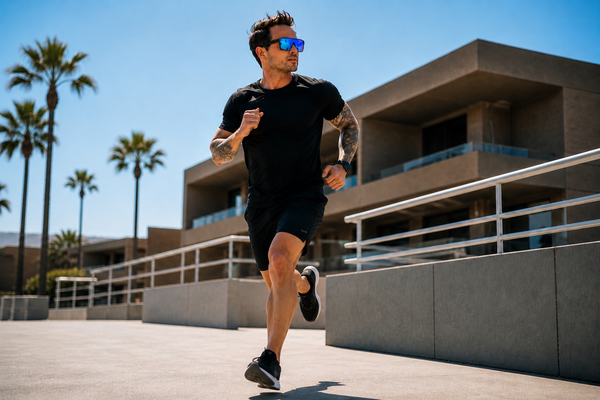
Running is the sport that most brutally exposes poor sunglass fit. A pair that feels perfectly secure during a short walk will be sliding down your nose within the first kilometre of a run. The repetitive vertical impact of each stride creates a rhythmic destabilising force on the frame that magnifies every millimetre of bridge fit imprecision into a constant, distracting bounce. Fix the fit and you fix most of running's sunglass problems. Get the fit wrong and no lens specification in the world will make the pair usable.
Beyond fit, running has specific demands on weight, lens tint, UV protection, and fog management that are worth understanding before you buy. This guide covers all of them — the fit mechanics that make a running sunglass work, the lens choices that match different running environments, and the specifications that actually matter versus the ones that are marketing noise.
This is a C3 Activity and Sport supporting post. For the complete outdoor sport framework, seethe complete outdoor and sport sunglasses guide. For the UV health case that makes eye protection a running necessity rather than a preference, seethe complete guide to UV eye protection.

Why Fit Is the Primary Concern for Running Sunglasses
Every running stride creates a small upward impact as the foot strikes the ground and a downward inertial force as the body decelerates. For a sunglass frame that fits slightly too wide, sits slightly too far from the face, or has insufficient nose pad grip, this rhythmic force is enough to produce a visible and distracting bounce — or a progressive slide that requires manual adjustment every few minutes.
The practical consequence of poor fit during running is not just discomfort. A frame that slides creates a choice between stopping to adjust — which interrupts both pace and rhythm on a timed run — or continuing to run with compromised vision, which is a safety issue on road crossings, technical trail, and any environment with visual hazards. This is why experienced runners consistently rate fit and retention ahead of lens quality when describing what makes a pair work for them.
The mechanics of what makes a sunglass fit well — bridge width, temple length, frame width, base curve, and the role of rubberised grips — are covered in depth inhow to tell if sunglasses actually fit. The running-specific application of those principles is below.
The Four Fit Problems Running Creates — and How to Solve Them
|
The Sliding Bridge Why it happens: Bridge too wide for nose width, or smooth nose pads that lose grip with perspiration Fix: Narrow the bridge fit or switch to rubberised nose pads — silicone or thermoplastic elastomer grips maintain friction on wet skin The sliding bridge is the most common running sunglass problem and the most disruptive. A frame that slides even 2–3mm out of position on each stride disrupts the optical centre alignment of the lens, produces visual distortion, and requires constant attention. Rubberised nose pads are the most effective single intervention — they maintain grip on perspiring skin in a way that smooth plastic or metal nose pads cannot. Many dedicated running sunglass designs incorporate moulded rubberised nose bridges rather than adjustable nose pads, which further eliminates the slip point. |
|
Temple Bounce Why it happens: Temples too long or too light — insufficient weight behind the ear to counteract forward inertial shift Fix: Check temple length — the bend should sit just behind the top of the ear; try frames with slightly more weight or hook geometry at the temple tip Temple bounce occurs when the temples are too long relative to the distance from the hinge to the ear, allowing the frame to shift slightly forward and back with each stride. The fix is a temple that hooks firmly behind the ear rather than just resting against it. Some running-specific frames have a slight inward curve at the temple tip — sometimes called an ear sock or temple hook — that provides a positive engagement with the ear rather than relying purely on friction. |
|
Cheekbone Contact Why it happens: Frame too large for face, or lens height too great — frame rests on cheekbones and lifts with each stride Fix: Size down in lens height or overall frame size; check that no part of the frame rests on the cheek when looking straight ahead If the bottom of the frame contacts your cheekbones, every stride that compresses your face slightly — as happens naturally during running — will lift the frame off its intended position. Cheekbone contact also creates a pressure point that produces discomfort over longer runs. The fix is simply a frame that does not contact the cheeks. When trying on running sunglasses, simulate a running head movement — up, down, and slightly forward — and check whether any contact occurs. |
|
Fogging During Effort Why it happens: Warm moist air from the body condenses on the lens — particularly at the start of a run or during rain Fix: Choose frames with ventilation between the lens and the face; hydrophilic anti-fog coating helps; avoid frames that seal tightly against the brow Fogging is a temperature and airflow problem, not a lens quality problem. It occurs when warm, moist air from perspiration and breath meets a cooler lens surface. The solution is ventilation: frames that allow airflow between the lens and the face break the stagnant warm air layer that causes condensation. This is why running sunglasses with a gap between the top of the lens and the brow bar typically fog less than designs that seal the orbital area. In cold weather, the temperature differential is larger and fogging is more acute — choose frames with more open ventilation geometry for winter running. |
The Running Sunglasses Specification
|
Specification |
Recommendation |
Why It Matters for Running |
|
Weight |
Under 30g — lighter is better |
Heavier frames amplify the inertial bounce problem with each stride |
|
Frame material |
TR90 nylon or Grilamid |
Lightest structural materials; flex without breaking; accept rubber grips |
|
Nose pads |
Rubberised silicone or TPE |
Maintain friction on perspiring skin; critical for sliding prevention |
|
Temple grips |
Rubberised tips or ear hooks |
Positive engagement with the ear prevents rearward or forward slide |
|
Base curve |
6–8 base — moderate wraparound |
Close-fitting reduces peripheral UV entry and keeps frame stable |
|
UV protection |
UV400 certified |
UV accumulates significantly over a 60–90 minute outdoor run |
|
Polarization |
Recommended for road running |
Road surface glare is a meaningful visual issue on wet or bright conditions |
|
Lens tint |
Amber or rose for trail; gray for road |
Contrast for terrain on trail; color accuracy on road |
|
Lens material |
Polycarbonate |
Impact resistance if frame contacts face or ground; inherent UV protection |
|
Ventilation |
Adequate gap between lens and brow |
Reduces fogging from exertion — particularly important in warm conditions |
Tint by Running Environment
Road Running — Gray Polarized
Road running in bright conditions benefits most from gray polarized lenses. Gray preserves color accuracy for traffic lights, road markings, and hazard identification — all relevant for road safety. Polarization eliminates road surface glare on wet tarmac, which is a meaningful distraction on early morning and rainy runs. For the full tint science behind why gray is the road running choice, seethe science of lens color and what tint your vision actually needs.
Trail Running — Amber or Rose Polarized
Trail running demands contrast enhancement for terrain reading at high speed. Amber and rose tints filter blue light scatter, producing crisper edge definition of rocks, roots, and surface changes that matter enormously when foot placement decisions are made in fractions of a second. A trail runner who misjudges a root or a rock at speed is at real risk of a fall. The contrast enhancement of amber or rose over neutral gray is a functional safety benefit, not merely an aesthetic preference.
Variable Conditions — Interchangeable Lenses
Many dedicated sport sunglass systems offer interchangeable lens options — a dark tinted lens for bright sun, a lighter amber or rose for overcast conditions, and a clear lens for night running. For runners who train across a wide range of conditions including early morning, dusk, and overcast days, an interchangeable system provides flexibility that a fixed dark lens cannot. The alternative approach — building a small collection with different lenses for different conditions — is covered inthe guide to building a complete sunglasses collection.
UV Accumulation During Running: Why It Matters More Than You Think
A 60-minute outdoor run on a clear summer day can accumulate a significant UV dose — particularly for runners who train in the middle of the day or at altitude. UV exposure during running is often underestimated because the activity does not feel as UV-intensive as, say, a day at the beach. But the combination of open sky, no shade overhead during road running, and the extended duration of training sessions means that regular outdoor runners accumulate meaningful lifetime UV exposure through their sport. Marathon runners and ultra-distance athletes, who spend hours in continuous outdoor UV, face cumulative UV loads that are genuinely significant from a long-term eye health perspective. The full case for consistent UV protection in any outdoor sport is inthe complete guide to UV eye protection.
For runners over 40, wherethe cumulative UV burden has already begun to narrow the safety margin, UV protection during running shifts from a preference to a clear health priority. The same amber or brown tint that improves trail contrast also filters additional blue light, providing a marginal additional layer of high-energy visible light protection alongside the UV400 baseline.
Browse theNavi Eyewear UV400 polarized collection for running-appropriate sunglasses meeting the weight, fit, and lens specifications above. For building an eyewear set that covers running alongside driving and other outdoor activities,the guide to building a complete sunglasses collection covers multi-use coverage without over-spending.
Frequently Asked Questions
What should I look for in sunglasses for running?
In priority order: fit security (rubberised nose pads and temple grips that stay in place during stride impact), weight under 30g, UV400 certification, polycarbonate lenses, and a tint matched to your primary running environment — amber or rose for trail, gray for road. Polarization is recommended for road running in wet or bright conditions. The technical foundation for all of these specifications is inhow sunglass lenses actually work.
Why do my sunglasses keep sliding when I run?
The most common causes are: bridge too wide for your nose width (frame sits too high and slides down with each stride impact); smooth plastic nose pads that lose grip with perspiration; temples too long (frame shifts forward and back with each stride); or frame too wide (temples bow outward and lose contact pressure). The priority fix is rubberised nose pads — silicone or TPE grips maintain friction on wet skin in a way smooth pads cannot. If rubberised pads do not solve it, the frame dimensions need to change.
Do I need polarized sunglasses for running?
Recommended but not essential for all running. For road running on wet or bright surfaces, polarization eliminates road glare that standard dark lenses reduce but do not eliminate. For trail running in dry forest conditions, the benefit is smaller — contrast enhancement from the lens tint is more important than polarization in that environment. For road running around water, through urban areas with glass buildings, or in any condition with significant horizontal reflective surfaces, polarized lenses provide a meaningful comfort and visual clarity advantage. The full polarization evidence is inpolarized sunglasses: are they worth it.
What lens tint is best for trail running sunglasses?
Amber or rose. Trail running at speed requires fast, accurate terrain reading — identifying rocks, roots, and surface changes in the fraction of a second before each foot placement. Amber and rose tints enhance contrast by filtering blue light scatter, producing crisper edge definition of trail features than neutral gray. For the complete tint guide, seethe science of lens color and what tint your vision actually needs.
Are expensive running sunglasses worth it?
For regular runners, yes — but not because of brand prestige. The specific value of quality running sunglasses is: genuine UV400 certification (cheap pairs often fail UV transmission testing), rubberised grip materials that are properly bonded to TR90 frames (cheap copies use grip material that peels within weeks), optical quality without distortion (distortion forces the visual system to compensate continuously, causing fatigue), and coating durability that survives regular perspiration exposure. The case for quality over cheap is made in full inthe environmental cost of cheap sunglassesandpremium vs budget sunglasses: what do you actually get for the money.
Can I run in regular everyday sunglasses?
For short, slow runs on shaded paths, everyday sunglasses with UV400 certification are adequate UV protection. For any run longer than 30 minutes, in direct sun, on technical terrain, or at any meaningful pace, everyday sunglasses typically fail on fit security — they slide, bounce, or require adjustment. They also tend to be heavier than dedicated running designs, which amplifies the bouncing problem. If you run regularly, a lightweight dedicated running pair with rubberised grips is a worthwhile investment.
How do I stop my running sunglasses from fogging up?
Fogging during running is caused by warm, moist breath and perspiration air meeting a cooler lens surface. The most effective fix is frame geometry: choose frames that allow airflow between the lens and the face rather than frames that seal the orbital area. A gap at the top of the frame between lens and brow, or vented temples, allows warm air to escape before it condenses on the lens. Anti-fog coatings help, but they wear faster than other coatings and need periodic reapplication. In cold weather, keep sunglasses closer to body temperature by storing them in a chest pocket before putting them on — the reduced temperature differential delays fogging onset.
SOURCES & CITATIONS[1] Moehrle M."Ultraviolet exposure in the Ironman triathlon."Medicine and Science in Sports and Exercise, 2001.View source [2] Sliney DH."Ocular exposure to environmental light and ultraviolet: the impact of spectacles and sunglasses."Journal of AAPOS, 2014.View source [3] Rosenthal FS, Phoon C, Bakalian AE, Taylor HR."The ocular dose of ultraviolet radiation to outdoor workers."Investigative Ophthalmology and Visual Science, 1988.View source [4] Taylor HR, West SK, Rosenthal FS, et al.."Effect of ultraviolet radiation on cataract formation."New England Journal of Medicine, 1988.View source [5] De Faber JT, Naeser K, Kessing SV."Polarized light and contrast sensitivity under glare conditions."Ophthalmic Research, 2013.View source [6] Coroneo MT, Muller-Stolzenburg NW, Ho A."Peripheral light focusing by the anterior eye and the ophthalmohelioses."Ophthalmic Surgery, 1991.View source [7] Dain SJ."Sunglasses and sunglass standards."Clinical and Experimental Optometry, 2003.View source |