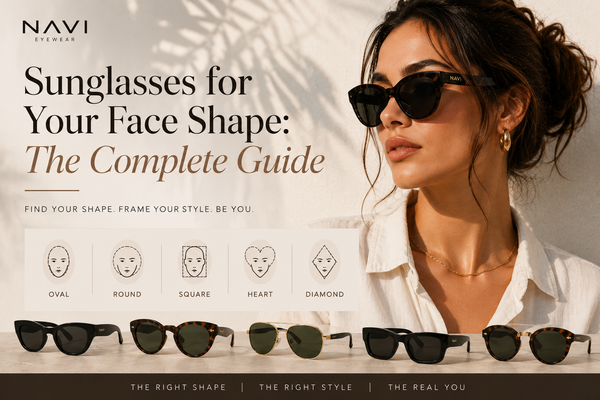

Sunglasses for Your Face Shape: The Complete Guide
There is a reason some sunglasses look effortlessly right and others — even beautiful frames on their own — just do not quite work on your face. The difference is usually proportional balance: the relationship between the frame's geometry and the dominant lines of your face. When those two things align, the result looks natural. When they clash, something feels off even if you cannot immediately identify why.
This guide explains the proportional logic that underlies face shape matching — not as a rigid rule system, but as a framework for understanding why certain choices tend to work. Once you understand the principle, you can apply it intelligently, including when to break the rules deliberately for a specific effect.
This is a C4 Style and Identity supporting post. For the broader style guide covering frame identities, trends, and the psychology of why sunglasses work as an accessory, seethe ultimate sunglasses style guide. For the physical fit mechanics that must work alongside aesthetic proportion, seehow to tell if sunglasses actually fit.

The Core Principle: Contrast Creates Balance
The foundational logic of face shape matching is simple: the frame should contrast with, not mirror, the dominant lines of the face. A round face — where the dominant line is the curve — looks more balanced with angular frames that introduce straight lines and sharp corners. A square face — where the dominant feature is strong horizontal and vertical lines — looks more balanced with round or curved frames that soften the geometry.
This contrast principle explains most of the face shape rules you will encounter. It also explains why oval faces are considered the most versatile — they already have a natural balance of curve and line that does not create a strong dominant feature to contrast against. Almost any frame works because there is no single visual element that needs counterbalancing.
The principle has a second layer: scale. The frame should be proportional to the face — not dramatically larger or smaller. A frame that is significantly wider than the face looks unstable. A frame that is significantly narrower makes the face appear wider. Finding the right scale, alongside the right shape contrast, is what makes a frame look like it belongs. For the physical dimension measurements that help you find the right scale when shopping online, seehow to tell if sunglasses actually fit.
How to Identify Your Face Shape
Face shape identification is easier than most guides make it sound. Pull your hair back, stand in front of a mirror, and look at your face with a relaxed, neutral expression. Consider three things:
You can also trace the outline of your face on a mirror with a dry-erase marker, or take a straight-on photograph and compare the proportions. Do not worry about fitting perfectly into a single category — most faces have elements of more than one shape, and the goal is to identify the dominant characteristic rather than achieve a perfect classification.
Face Shape by Face Shape: The Complete Breakdown
|
Oval Key features: Forehead slightly wider than chin, length approximately 1.5x the width, balanced cheekbones Styling goal: Maintain the existing balance — avoid frames that overpower the proportions Best frames: Almost all shapes — aviator, wayfarer, square, round, cat-eye, oversized Generally avoid: Frames dramatically wider than face width or very small frames that disappear
Oval is considered the ideal face shape for sunglasses because its natural proportional balance means almost any frame works. The only real constraint is scale — the frame width should roughly match the face width at the temples, and very small or very oversized frames will look out of proportion even on a well-balanced oval. If you have an oval face, the most useful advice is to focus on the frame qualities that matter for your lifestyle and UV protection needs —tint and lens performance for your primary environment — rather than spending time eliminating frame shapes from consideration. |
|
Round Key features: Width and length roughly equal, full cheeks, rounded chin, soft jawline Styling goal: Create visual length and angularity to counterbalance the dominant curves Best frames: Rectangular, square, geometric shapes; frames wider than they are tall; angular frames with sharp corners Generally avoid: Round or circular frames (amplify roundness); very small frames (disappear on rounder faces); perfectly square tiny frames
Round faces benefit most from frames that introduce straight lines and angular geometry. A rectangular frame — wider than it is tall, with relatively sharp corners — provides maximum contrast against a round face's dominant curves, creating the visual impression of more length and definition. A higher bridge that rises prominently above the nose also helps elongate the face visually. The frames that tend to underperform on round faces are those that echo the face's own geometry: round frames amplify the roundness, and very small frames fail to provide enough visual weight to counterbalance the face's fullness. |
|
Square Key features: Strong jawline, prominent cheekbones, forehead and jaw of similar width, angular features Styling goal: Soften the dominant angularity with curved and organic frame geometry Best frames: Round, oval, and circular frames; cat-eye shapes; frames with upswept corners; rimless and thin-wire designs Generally avoid: Square or rectangular frames (mirror the face's own angularity); geometric shapes with hard corners
Square faces have strong horizontal and vertical lines — a wide jaw, a defined brow, and cheekbones of similar width. The styling goal is to introduce curves and organic shapes that contrast with this angularity. Round and oval frames are the most effective — the circle's organic geometry sits in direct contrast to the jaw's straight lines. Cat-eye frames, which sweep upward at the outer corners, shift visual weight away from the jaw and toward the upper face. Rimless and thin-wire designs are less visually prominent and allow the face's natural lines to show more clearly — which can work well if the intention is a more minimal, understated look. For a deeper dive into the cultural associations of these frame shapes, seethe complete style guide. |
|
Heart Key features: Wider forehead and temples, prominent cheekbones, narrow chin Styling goal: Balance the wider upper face against the narrower lower face Best frames: Bottom-heavy frames; round and oval shapes; aviators; rimless or thin-rim designs; frames wider at the bottom Generally avoid: Top-heavy frames; cat-eye shapes (emphasise the wide forehead); oversized square frames with wide tops
Heart-shaped faces — widest at the forehead and temples, narrowing to a pointed or narrow chin — benefit from frames that add visual weight at the bottom or distribute it more evenly than the face naturally does. Aviator frames, with their teardrop shape that is slightly wider at the bottom, echo the face's proportions in a balanced way rather than amplifying the top-heaviness. Round and oval shapes with their width centred rather than at the top also work well. Rimless designs are the most subtle choice — they are less visually prominent than solid frames and allow the face to read more naturally without the frame emphasising the upper face. |
|
Oblong / Rectangular Key features: Longer than wide, forehead, cheekbones, and jaw of similar widths, elongated chin Styling goal: Create the impression of width and reduce apparent face length Best frames: Oversized frames with significant lens height; round and large oval shapes; decorative temples; frames with strong horizontal lines Generally avoid: Narrow frames; small lenses; rimless designs; frames that emphasise length over width
Oblong faces are distinguished by their length relative to width — they are narrower and longer than other shapes, with proportions that read as elegant but can benefit from frames that add visual width and reduce the apparent length. Oversized frames with significant vertical depth cover more of the face, reducing the visible face length. Frames with decorative or distinctive temples draw the eye outward, creating the impression of width. Round and large oval shapes provide width in both directions. The frames to avoid are those that emphasise the face's length — narrow, small, or elongated shapes that extend the vertical dimension rather than expanding the horizontal. |
|
Diamond Key features: Narrow forehead, wide cheekbones (the widest point), narrow chin Styling goal: Add width to the forehead and soften the prominent cheekbones Best frames: Cat-eye shapes; oval and semi-rimless with wide top; frames with detailing or width at the temple; rimless designs Generally avoid: Very narrow frames; frames with width concentrated at the cheekbone level
Diamond faces are less commonly discussed but genuinely distinctive: they have a narrow forehead, the cheekbones as the widest point, and a narrow chin. The styling goal is to add visual width at the forehead and soften the prominence of the cheekbones. Cat-eye frames work particularly well because their upswept width is concentrated at the temple and outer corner — exactly where diamond faces need visual expansion. Oval and semi-rimless frames with some width at the top of the lens also add forehead volume. Rimless designs are a minimal option that allows the strong cheekbone structure to read naturally without the frame adding competing geometry. |
Quick Reference: Face Shape at a Glance
|
Face Shape |
Best Frames |
Avoid |
Key Principle |
|
Oval |
Almost all shapes |
Frames much wider than face |
Maintain existing balance |
|
Round |
Rectangular, square, angular |
Round frames, very small frames |
Add angularity and length |
|
Square |
Round, oval, cat-eye, rimless |
Square or rectangular frames |
Soften angular jawline |
|
Heart |
Aviator, round, oval, rimless |
Cat-eye, oversized top-heavy |
Balance wide forehead vs narrow chin |
|
Oblong |
Oversized with height, large oval |
Narrow or elongated frames |
Add width, reduce apparent length |
|
Diamond |
Cat-eye, oval with wide top |
Narrow frames at cheekbone level |
Add width at forehead |
Beyond Face Shape: The Other Variables
Skin Tone and Frame Colour
Face shape determines frame geometry. Skin tone influences frame colour. Warm skin tones — yellow, peachy, golden undertones — generally work better with warm frame colours: tortoiseshell, gold, brown, warm neutrals. Cool skin tones — pink, blue, neutral undertones — tend to suit cool frame colours: black, silver, grey, blue, and jewel tones. This is a tendency rather than a rule, and personal preference overrides it freely — but it is a useful starting point when choosing between two frames that both work for your face shape.
Eyebrow Alignment
A detail that many style guides overlook: the top of the sunglass frame should roughly follow the line of your eyebrows, or sit just at the brow. When the top of the frame sits significantly below the brow, a visible strip of brow appears above the frame — which tends to look unbalanced. When the frame sits well above the brow, the frame looks too large for the face. This alignment is particularly important for aviators and browline frames, where the upper frame geometry is the most visually prominent element.
The Role of Personal Style
Face shape matching is a starting framework, not a complete system. A person with a round face who is drawn to round frames for genuine aesthetic and identity reasons — who feels that round frames reflect their artistic sensibility or their cultural references — may be better served by wearing what resonates with them rather than mechanically following the contrast rule. The psychology of why sunglasses work as an accessory is partly about genuine self-expression, and that cannot be fully reduced to a proportional formula. The deeper story of why we choose the sunglasses we do is inthe psychology of sunglasses: why we love them beyond sun protection.
Browse theNavi Eyewear collection with this framework in mind. For building a collection that serves different occasions, contexts, and moods — which sometimes means having frames from different parts of the face shape spectrum for different purposes —how to build the perfect sunglasses collection for every occasion covers the full approach.
Frequently Asked Questions
How do I know what face shape I have?
Pull your hair back and look straight into a mirror or take a straight-on photograph. Compare: forehead width versus jaw width (wider forehead suggests heart or oval; similar widths suggest square or round or oblong); whether the cheekbones are the widest point (suggests diamond); and the ratio of face length to width (longer than wide suggests oblong; similar length and width suggests round or square). Most faces have features of more than one shape — identify the dominant characteristic rather than seeking a perfect classification.
What sunglasses look best on a round face?
Angular frames — rectangular, square, and geometric shapes — work best on round faces. The principle is contrast: angular lines counterbalance the round face's dominant curves, creating visual length and definition. Frames that are wider than they are tall are particularly effective. A slightly higher bridge also helps by elongating the face visually. Avoid round and circular frames, which amplify the face's roundness, and very small frames, which disappear without providing enough visual balance.
What sunglasses look best on a square face?
Round, oval, and curved frames work best on square faces. Cat-eye shapes and frames with upswept corners are particularly effective — they shift visual weight upward and away from the strong jawline. Rimless and thin-wire designs are a more subtle option that soften the frame's visual impact without introducing specific geometric contrast. The frames to avoid are square and rectangular shapes that mirror the face's own angularity. For the full square face analysis, seethe ultimate sunglasses style guide.
What sunglasses look best on an oval face?
Almost all frame shapes work on oval faces — this is the most versatile face shape for sunglasses because the face's natural proportional balance means no single visual element needs counterbalancing. The main consideration is scale: the frame width should roughly match the face width at the temples. Very small frames can look undersized on an oval face, and frames dramatically wider than the face can look overpowering. Focus on the lens and style qualities that matter for your lifestyle rather than spending time eliminating frame shapes.
Can I wear oversized sunglasses if I have a small face?
Yes, with a scale adjustment. Oversized proportions relative to the face work best when the frame extends slightly beyond the face width rather than dramatically so. The look reads as intentionally oversized rather than simply too large when the proportional difference is controlled. If you love the oversized aesthetic but have a narrow face, look for frames described as oversized for a narrow or small fit — many brands offer this sizing variation, and the internal dimensions will be more proportionate while the external visual impression remains bold.
Do the same face shape rules apply to men and women?
The proportional principles are the same — contrast with dominant lines, match the scale to the face width. What differs is that men's and women's faces tend to have different average dimensions (men's faces are typically wider and longer), so frame sizing recommendations differ even when the shape guidance is identical. A round face is a round face regardless of gender, and the same contrast principle applies. Gender labelling in eyewear is largely a marketing convention rather than a functional distinction, as explored inmen's vs women's sunglasses: does the distinction actually matter.
What if I cannot identify my face shape clearly?
Most people's faces are closer to oval than to any other shape — oval is the proportional average rather than a specific distinct type. If your face does not obviously fit round, square, heart, or oblong, it is probably closest to oval and the most versatile frame shapes (classic aviator, medium oval, wayfarer) are safe starting points. Trying frames on — either in person or using a virtual try-on tool — is ultimately more useful than any categorisation system, because the subjective response of seeing a frame on your face in real time is the most reliable signal.
SOURCES & CITATIONS[1] Goffman E."The Presentation of Self in Everyday Life."Anchor Books, 1959.View source [2] Lakey PS, Berkowitz CM, Nirmalakhandan N, et al.."The impact of frame geometry on peripheral UV exposure at the eye."Ophthalmic and Physiological Optics, 2020.View source [3] Dain SJ."Sunglasses and sunglass standards."Clinical and Experimental Optometry, 2003.View source [4] Coroneo MT, Muller-Stolzenburg NW, Ho A."Peripheral light focusing by the anterior eye and the ophthalmohelioses."Ophthalmic Surgery, 1991.View source [5] Knapp ML, Hall JA, Horgan TG."Nonverbal Communication in Human Interaction (8th ed.)."Cengage Learning, 2014.View source |