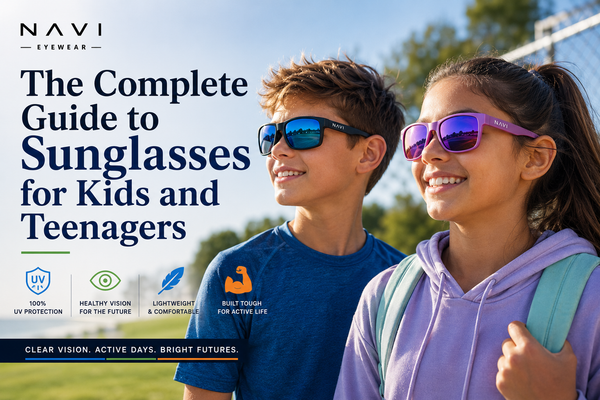

The Complete Guide to Sunglasses for Kids and Teenagers
Parents who apply sunscreen to their children without thinking to protect their eyes are making a mistake that is unfortunately common and understandable. UV protection for children’s eyes is at least as important as UV protection for their skin — and by some measures, more so. Children’s crystalline lenses are significantly more UV-transparent than adults’, admitting substantially more UV radiation to the retina for the same ambient exposure. The UV that reaches a child’s retina on a summer afternoon is meaningfully higher than what an adult receives in the same conditions — and the cumulative UV that accumulates in childhood contributes directly to the cataract and macular degeneration risk that manifests 40 or 50 years later.
The second problem: the children’s sunglass market is saturated with products that look protective and are not. Dark lenses without UV400 certification — sold in pharmacies, supermarkets, and tourist shops for a few pounds — are actively worse than no sunglasses, because they dilate the pupil into unprotected UV while providing no UV barrier. Identifying which children’s sunglasses actually protect — and convincing children and teenagers to wear them consistently — is the practical challenge this guide addresses.
This is the C11 Specific Audiences pillar post. The supporting guides in this cluster cover specific audience segments:sunglasses for seniors: eye protection as vision changes,best sunglasses for narrow faces,best sunglasses for wide faces,best sunglasses for high nose bridges, andbest sunglasses for low nose bridges. The UV disease science that underpins the children’s protection case is inUV and eye disease: the complete guide to cataracts, macular degeneration and more.

Part 1: Why Children’s Eyes Need More UV Protection, Not Less
The UV-Transparent Crystalline Lens
The crystalline lens of the eye provides natural UV filtration, absorbing UV that passes through the cornea before it can reach the retina. But this filtration is not constant across age. Infant and young children’s lenses are nearly transparent to UV — a child’s lens transmits substantially more UV to the retina than an adult’s lens at the same ambient UV exposure. This differential is greatest in the first decade of life and narrows progressively as the lens yellows slightly with age (an early change that also marks the very beginning of cataract formation).
The practical implication: for the same UV environment, a young child receives a significantly higher retinal UV dose than a parent standing beside them. The UV damage to retinal cells that accumulates during those hours of childhood outdoor play is irreversible. The retinal pigment epithelium that is being exposed to this elevated UV dose is the same structure whose failure decades later produces age-related macular degeneration. This is not a hypothetical future risk — it is cumulative damage that begins with the first unprotected outdoor session and adds with every subsequent one.
The Lifetime UV Accumulation Argument
UV-related eye disease is fundamentally a cumulative exposure disease. The cataracts and macular degeneration that appear at 65 or 70 are the result of a lifetime of UV accumulation that began in childhood. Research on the dose-response relationship between UV exposure and cataract risk — including the landmark Chesapeake Bay Watermen Study — shows that the relationship is continuous: more lifetime UV produces more risk, with no safe threshold below which UV is harmless to ocular tissue. Protecting children’s eyes from the first years of outdoor play reduces the lifetime UV total that drives disease in later life.
The WHO estimates that up to 80% of a person’s lifetime UV dose is accumulated before age 18 — in part because children spend more time outdoors than adults, in part because of the lens transparency differential described above. This estimate is widely cited and represents the clearest case available for prioritising children’s UV eye protection. The full cumulative UV disease science is inUV and eye disease: the complete guide.
Children Spend More Time Outdoors
Beyond the biological differential, children simply spend more unprotected outdoor time than most adults. School playtimes, after-school outdoor activities, holidays and beach trips, weekend sport, and the general outdoor orientation of childhood and adolescence produce a total outdoor UV exposure that exceeds most office-working adults’ total for the same period. Summer school holidays alone — six to eight weeks of unstructured outdoor time, often in high-UV environments during travel — deliver a significant UV dose to an unprotected child’s eyes.
The Habit Formed in Childhood Is the Habit Carried Through Life
Children who grow up treating sunglasses as automatic outdoor equipment — in the same category as shoes and sun cream — are significantly more likely to maintain the habit as adults. The cultural norm around sunscreen use in Australia — which has the world’s most consistent sun protection behaviour — was built through decades of school-based education and parental habit modelling that began in childhood. Sunglasses habit formation works the same way: children who reach adulthood with the automatic sunglass-on reflex carry a habit that protects their eyes for the next 50 years. Children who reach adulthood without this habit face decades of preventable UV accumulation to break from scratch.
Part 2: Age-Specific Guidance from Infants to Teenagers
Infants (0–2 years)UV risk vs adults: Highest relative UV dose per unit exposure due to maximum lens transparency Key challenge: Getting any protection on at all; securing a frame that stays on a moving infant Infants have the most UV-transparent lenses and the least practical means of wearing sunglasses independently. The primary protection for infants should come from shade: pram hoods, sun canopies, hats with wide brims, and avoiding direct sun during peak UV hours (10am–4pm). Infant sunglasses are available from specialist children’s eyewear brands and should be used when shade is unavailable — on the beach, at outdoor events, on extended walks in bright conditions. Infant frames must be flexible (no rigid metal that could injure if the frame is pulled), have a secure strap or band to prevent removal, and carry explicit UV400 certification. Do not assume any children’s product is UV400 without checking — the certification problem in children’s eyewear is most acute at the infant end of the market. |
Toddlers (2–5 years)UV risk vs adults: Very high relative UV dose; significant outdoor time begins Key challenge: Durability and flexibility — toddlers will bend, drop and sit on frames; keeping them on Toddlers are the age group where consistent sunglass habit formation begins to be practically achievable. Toddler frames must be: flexible enough to survive being twisted, dropped on hard surfaces, and generally abused; free of small parts that could become a choking hazard; fitted with soft-grip nose pads and temple tips that are comfortable for a small face; and certified UV400. TR90 nylon or rubberised flexible polymer frames are the appropriate materials at this age — stiff acetate and metal frames with separate hardware are inappropriate. Spring hinges that allow the temple to flex outward without snapping are valuable for toddler frames. Size at this age: the frame must not be so large that it slips off or so small that the temples press on the cheeks — both common problems with adult sizing applied to small children. |
School Age (5–12 years)UV risk vs adults: High relative UV dose; highest total outdoor exposure (playtime, sport, activities) Key challenge: Getting children to wear them willingly; durability for active play School-age children are the most important group for habit formation. They are old enough to understand and remember the habit, active enough to accumulate significant UV in sport and outdoor play, and socially aware enough that peer behaviour and parental modelling both matter. The most successful approach: make sunglasses as automatic as shoes for outdoor school activities, sport, and holidays. UV400 wraparound sport frames for outdoor sport; slightly less wraparound everyday frames for school playtimes and general outdoor use. Polycarbonate lenses are essential at this age for the impact resistance needed during active play — a flying ball or playground fall that could shatter a glass or CR-39 lens does not break polycarbonate. Let the child choose the frame within a pre-selected range of appropriate UV400 options — a child who has chosen their own sunglasses is more likely to wear them. |
Teenagers (12–18 years)UV risk vs adults: High absolute UV dose; highest total outdoor sport and social exposure Key challenge: Social acceptance; teenagers will not wear something they consider uncool Teenagers are the most challenging group for sunglass habit formation because social acceptance becomes a primary filter for behaviour. The practical approach: quality sunglasses that teenagers genuinely want to wear because they look good and feel premium — not child-targeted designs that they consider uncool. Teenagers can wear adult-specification sunglasses in appropriate sizes, which means access to the full range of quality UV400 polarized frames. The UV protection argument lands differently for teenagers than for young children: the abstract future risk of cataracts at 70 is not motivating; the immediate benefits of reduced squinting, better visual comfort, and performance enhancement in sport are more relevant. For teenage athletes: connecting sunglasses to their sport performance — better contrast in ball sports, reduced fatigue in long outdoor sessions — is a more effective habit motivator than long-term health arguments. The sport-specific performance guides inthe complete outdoor and sport sunglasses guide provide the performance case that resonates with sport-active teenagers. |
Part 3: Frame Materials for Children — What Survives Active Use
TR90 Nylon: The Recommended Children’s Frame Material
TR90 nylon — a thermoplastic polyamide — is the most appropriate frame material for children’s sunglasses. It is flexible without being floppy: TR90 frames can be bent significantly without snapping, and spring back to shape after impact and deformation. This is the property that matters most in a children’s frame, which will be dropped on hard surfaces, pulled by siblings, sat on, packed into rucksacks without cases, and generally abused in ways that would destroy stiff acetate or metal frames. TR90 also takes no-glue, integral construction — there are no separate components to detach and become small-part hazards.
Rubberised and Soft-Polymer Frames for the Youngest Children
For infants and toddlers, fully rubberised or soft-polymer frames are preferable to TR90 for the lowest ages. These frames are essentially indestructible, create no sharp edges if deformed, and are safe from a choking hazard perspective. The optical quality and UV certification must still be verified — ‘rubber frame’ does not imply UV400 lens certification. Several specialist children’s eyewear brands produce rubberised frames with UV400 polycarbonate lenses that are appropriate from infancy.
Polycarbonate Lenses: Non-Negotiable for Active Children
Polycarbonate lenses are the non-negotiable lens material for children’s sunglasses. The specific property that matters: polycarbonate is impact-resistant — it absorbs impacts without shattering. Glass and CR-39 lenses can fracture under impact and produce sharp fragments. For children who are playing actively — which is all children — the impact resistance of polycarbonate is a safety specification as much as a durability one. Polycarbonate also has inherent UV protection throughout the material — the UV blocking is built into the lens, not a surface coating that can be scratched off. For the lens material science, seehow sunglass lenses actually work.
Spring Hinges for Durability
Spring hinges — which contain a spring mechanism that allows the temple to flex outward 10–20 degrees beyond 90 degrees before springing back — significantly extend the lifespan of children’s frames. They accommodate the pulling and twisting that children apply to glasses, and the wider-than-normal temple opening that happens when a child tries to put glasses on a head that is too large or at an odd angle. For any frame that will be worn by a child aged 2–10, spring hinges are a worthwhile construction feature.
Secure Attachment Systems for Young Children
Young children can and will remove sunglasses. For infants and toddlers, adjustable elastic straps or bands that connect the temple tips behind the head prevent removal and keep the frame on a moving child. These bands also prevent the frame from falling off during active play and becoming lost or damaged. From approximately age 4–5, when the child begins to understand and accept the habit, elastic bands become less necessary and standard temples become practical.
Part 4: The UV400 Verification Problem in Children’s Eyewear
⚠ The Cheap Children’s Sunglass ProblemDark lenses without UV400 certification are actively worse than no sunglasses for children. Here is why: a dark lens reduces the visible light reaching the eye, causing the pupil to dilate. A dilated pupil in an unprotected eye admits more UV to the retina than a pupil at its normal diameter in bright conditions. A child wearing a dark non-UV400 sunglass is experiencing greater UV retinal exposure than they would with no sunglass at all. The children’s sunglass market has a significant UV certification problem. Independent testing of low-cost children’s sunglasses — including products from major retailers, pharmacies, and supermarkets — has found UV protection failure rates of 40–60% in unverified cheap products. These are glasses sold specifically as children’s sunglasses, often with bright colours and cartoon characters, that do not deliver the UV protection they imply by their design. |
How to Verify UV400 Certification
The verification process for any children’s sunglass purchase:
The full UV400 verification guide for any sunglass purchase is in7 signs your sunglasses are not protecting your eyes.
Part 5: Getting Children to Wear Sunglasses — The Habit Formation Guide
Start Before They Can Refuse
The easiest time to establish the sunglass habit is before the child is old enough to resist it. Infants and toddlers who have worn sunglasses from their earliest outdoor experiences develop an expectation that sunglasses are part of going outside, not an imposition. The difficulty increases with each year the habit is delayed — a seven-year-old who has never worn sunglasses will resist them more than a seven-year-old for whom they are a normal part of the outdoor routine.
Model the Behavior
Children’s behavior mirrors their parents’ in most domains, and sunglasses are no exception. A parent who consistently wears sunglasses outdoors and treats it as a normal, automatic behavior provides the most powerful habit model available. Conversely, a parent who tells a child to wear sunglasses while not wearing them themselves produces cognitive dissonance that undermines the instruction. Consistent parental UV protection habit modelling is the most effective single intervention for children’s sunglass adoption.
Let Them Choose (Within the Right Range)
Children aged 4 and above respond positively to being given a choice within a pre-selected range of appropriate options. Offering two or three frames that all meet the UV400 polycarbonate standard — in colours and styles the child finds appealing — gives them ownership of the choice while ensuring any selection is appropriately protective. A child who has chosen their own sunglasses is significantly more motivated to wear them than one who has had an adult’s choice imposed.
Make It Part of the Going-Outside Routine
The habit is most durable when it is embedded in a consistent pre-outdoor routine rather than deployed intermittently. ‘Shoes, coat, sunglasses’ — a simple verbal prompt that becomes part of the leaving-the-house sequence — is more effective than case-by-case negotiation about whether today is sunny enough. Routine is the mechanism of habit, and children respond to routine more reliably than to rational persuasion.
For Teenagers: The Right Pair Solves the Problem
Teenagers will not wear sunglasses they find socially embarrassing. The solution is not to argue the health case more forcefully — it is to ensure the available pair is one they genuinely want to wear. Quality sunglasses in appropriate styles — the same styles worn by athletes, influencers, and adults they admire — remove the social barrier. A teenager who sees quality sunglasses as a desirable item rather than a parental imposition is the teenager who wears them. The psychological and identity dimensions of sunglass adoption are inthe psychology of sunglasses: why we love them beyond sun protection.
Part 6: Children’s Sport and Outdoor Activity — Activity-Specific Requirements
School Sport and Outdoor PE
School sport — particularly athletics, cricket, tennis, football, and field sports — involves extended outdoor UV exposure during the high-UV hours of the school day. Many schools do not actively encourage sunglass use during outdoor PE, but there is no sensible reason to discourage it. Polycarbonate UV400 wraparound frames that stay secure during active movement are appropriate for all school outdoor sport. For contact sports, polycarbonate impact resistance is specifically important.
Beach and Water Activities
Beach holidays are among the highest UV exposure scenarios for children. Sand reflects 10–15% of UV, open water reflects up to 25%, and the open sky at a beach delivers UV without the attenuation of shade. A child who spends a beach day without adequate eye protection receives a UV dose to the retina that is substantially higher than a comparable period of other outdoor activity. UV400 polarized sunglasses — with polarization to eliminate water surface glare that is particularly distracting for children trying to navigate in and out of water — are appropriate from toddler age for beach environments. For the beach-specific UV context, seebest sunglasses for the beach: UV400, polarized and salt-resistant.
Skiing and Winter Sports
Children on ski holidays face the highest UV environments of any common recreational scenario — snow reflection of 80–90% UV plus altitude amplification plus extended outdoor exposure. Snow blindness in children is more severe than in adults because of their more UV-transparent lenses. Children skiing or snowboarding must wear either Category 3 UV400 sunglasses or, preferably, ski goggles that provide full face sealing and wind protection appropriate for the speeds involved. The full skiing UV protection guide is inbest sunglasses for skiing and snowboarding.
Cycling and Running
Children cycling and running face the same UV accumulation and wind exposure that adults do, scaled by the higher UV transparency of their lenses. For children’s cycling in particular, polycarbonate impact-resistant lenses are specifically important for protection against road debris and crash scenarios. Lightweight wraparound frames that stay secure during active movement without heavy nose pad pressure are the appropriate specification.
Part 7: Prescription Sunglasses for Children
When to Consider Prescription Sunglasses for Children
Children who wear prescription glasses full-time face the same outdoor vision compromise as adults: clear glasses provide no UV protection and non-prescription sunglasses do not correct vision. For children who spend significant time outdoors in sport or unstructured play, prescription sunglasses provide the optimal combination of vision correction and UV protection. They are particularly relevant for children with significant prescriptions who squint in bright conditions to compensate for uncorrected distance vision — squinting in bright light is both uncomfortable and affects the child’s ability to participate fully in outdoor sport.
Photochromic Lenses for Children: Practical Appeal
Photochromic (transition) lenses — which darken in UV light and clear indoors — have particular practical appeal for prescription-wearing children because they eliminate the need to carry and switch between indoor glasses and sunglasses. For school-age children who move between indoor classrooms and outdoor play multiple times per day, a single photochromic pair is logistically simpler than two pairs. The limitations (driving behaviour, reduced darkness in hot conditions) are less relevant for children than for adults. The full photochromic vs prescription sunglasses comparison is intransition lenses vs prescription sunglasses: the honest comparison.
OTG Sunglasses for Children Who Wear Glasses
For children who wear prescription glasses and do not yet have prescription sunglasses, OTG (over-the-glasses) designs provide immediate UV protection over existing frames. Children’s OTG sunglasses are available in smaller sizes appropriate for children’s frames. The optical compromise of the two-lens system is minor for occasional use — the UV protection benefit far outweighs the optical limitation. The full OTG and clip-on guide is inbest sunglasses for glasses wearers: OTG and clip-on options.
Browse theNavi Eyewear UV400 polarized collection for quality UV400 polarized frames. For teenagers who are ready for adult-specification sunglasses, Navi frames in appropriate sizes provide the quality and style that makes consistent wear likely. All Navi lenses are polycarbonate UV400 — the impact-resistant, inherent UV protection standard appropriate for active use.
Children’s Sunglass Specification by Age: Quick Reference
|
Age Group |
Frame Material |
Lens Material |
Attachment |
Min. UV Spec |
Lens Category |
|
Infant (0–2) |
Soft polymer / rubber |
Polycarbonate UV400 |
Elastic strap required |
UV400 |
Cat 2 |
|
Toddler (2–5) |
TR90 nylon / flexible |
Polycarbonate UV400 |
Elastic strap or spring hinge |
UV400 |
Cat 2 |
|
School age (5–12) |
TR90 nylon / sport |
Polycarbonate UV400 |
Standard temples; spring hinge |
UV400 |
Cat 2–3 |
|
Teenager (12–18) |
TR90 / adult spec |
Polycarbonate UV400 |
Standard adult temples |
UV400 |
Cat 2–3 |
|
Any age — skiing |
TR90 or goggles |
Polycarbonate UV400 |
Goggle strap |
UV400 |
Cat 3–4 |
|
Any age — beach |
TR90 / any |
Polycarbonate UV400 polarized |
Standard or strap |
UV400 polarized |
Cat 2–3 |
Frequently Asked Questions
At what age should children start wearing sunglasses?
From the earliest outdoor exposure. The WHO recommends UV-protective eyewear for children from infancy when outdoors. The biological case is clear: infant and toddler lenses are more UV-transparent than adult lenses, admitting more UV to the retina. The practical approach for the youngest ages: shade first (pram hoods, wide-brim hats, avoiding peak UV hours) alongside UV400 infant sunglasses when shade is unavailable. As soon as the habit can be established and maintained — typically from age 2–3 — sunglasses should be part of every outdoor session. The full UV disease case for early protection is inUV and eye disease: the complete guide.
Are cheap children’s sunglasses UV protected?
Not reliably. Independent testing of low-cost children’s sunglasses finds UV protection failure rates of 40–60% in unverified products. Dark lenses without UV400 certification are actively worse than no sunglasses — they dilate the pupil into unprotected UV. Always verify UV400 certification explicitly on any children’s sunglass purchase. The cheapest route to genuine UV400 children’s sunglasses is reputable children’s eyewear brands from opticians or verified online retailers, not market stalls, tourist shops, or unbranded online sellers. The full UV400 verification process is in7 signs your sunglasses are not protecting your eyes.
Do children really need polarized sunglasses?
Polarization is beneficial but not the first priority for children — UV400 certification with polycarbonate lenses is the non-negotiable baseline. For beach use, water sports, and skiing, adding polarization is recommended: it eliminates the surface glare from water and snow that is distracting and potentially disorienting for children navigating these environments. For general everyday and sport use, UV400 polycarbonate without polarization is adequate. Do not accept non-UV400 lenses in exchange for polarization — they are not equivalent. The polarization science is inpolarized sunglasses: are they worth it.
How do I get my child to wear sunglasses?
Start early — the habit is easiest to establish before the child is old enough to resist. Model the behaviour consistently — children whose parents wear sunglasses outdoors are more likely to do so themselves. Let the child choose from a pre-approved range of UV400 options — ownership of the choice increases motivation to wear. Embed sunglasses in the pre-outdoor routine (‘shoes, hat, sunglasses’) rather than making each outdoor session a separate negotiation. For resistant children, start with high-motivation outdoor activities — beach days and sport sessions where the immediate benefit (reduced squinting, better comfort) is most perceptible.
What are the best sunglasses for a toddler?
UV400 polycarbonate lenses in flexible TR90 nylon or rubberised polymer frames with spring hinges and an elastic strap attachment. The elastic strap is important for this age — toddlers remove glasses, and a strap both prevents removal and catches the frame when dropped. The frame must be genuinely UV400 certified — verify explicitly, do not assume because the product is sold as children’s eyewear. Specialist children’s eyewear brands including Real Kids Shades, Babiators, and Julbo produce appropriate toddler-specific designs that meet these requirements.
How do children’s eyes differ from adults’ in terms of UV risk?
Children’s crystalline lenses are more UV-transparent than adults’ — they transmit substantially more UV to the retina for the same ambient UV environment. This differential is greatest in the first decade of life and narrows as the lens gradually yellows with age (the very beginning of cataract formation). The WHO estimates that up to 80% of a person’s lifetime UV dose may be accumulated before age 18. For the same outdoor exposure, a child’s retina receives more UV than an adult’s — making protection in childhood more important, not less.
What lens colour is best for children’s sunglasses?
Gray for everyday and general outdoor use — it provides color accuracy for the visual environment without any tint that could alter perception in unfamiliar ways for young children. Amber or brown for beach and sport use — contrast enhancement benefits children’s ability to read terrain and track balls. The lens category (darkness) matters more than tint for children: Category 2 (18–43% VLT) for everyday outdoor use and most sport; Category 3 (8–18% VLT) for beach, skiing, and high-UV environments; Category 4 for glacier and extreme alpine conditions.
Do children need sunglasses on cloudy days?
Yes, on any day when the UV index is above 3 — which in the UK occurs from approximately March to October, including overcast days. Cloud cover attenuates visible light significantly but attenuates UV much less efficiently — a moderately overcast day can deliver 50–70% of the UV of a clear day. For children in high-UV environments (beach, skiing, tropical travel), the overcast day UV risk is particularly important to communicate because the apparent brightness reduction creates a false sense of safety. The year-round UV case is inwinter sunglasses: why UV protection doesn’t stop in cold weather.
Are prescription sunglasses available for children?
Yes — prescription sunglasses are available for children from opticians and specialist children’s eyewear brands. For children with significant prescriptions who spend substantial time outdoors, prescription sunglasses provide the optimal UV protection alongside vision correction. Photochromic prescription lenses — which adapt between clear indoors and tinted outdoors — are particularly practical for school-age children who move between indoor and outdoor environments multiple times per day. The full prescription sunglasses guide is inthe complete guide to prescription sunglasses.
How often should I replace my child’s sunglasses?
Replace when: the lenses are significantly scratched (particularly in CR-39 lenses where scratching can degrade the UV surface coating), the frame is deformed or the nose pads damaged, the UV400 certification cannot be confirmed for an older pair of uncertain history, or the child has outgrown the frame size. In polycarbonate lenses, surface scratching does not affect the inherent UV protection — but it does affect optical clarity, which matters for visual development and comfort. For children who are rough with their eyewear, an annual replacement budget for the frame and lenses is a reasonable expectation.
Can children wear adult sunglasses?
Teenagers from approximately age 12–14 can often wear smaller adult frames comfortably, particularly those in petite or small adult sizes. The critical fit requirement is that the frame sits correctly on the child’s nose without sliding down and that the temples do not extend past the ears. For younger children, adult frames are typically too wide and too deep — they sit incorrectly on small faces and provide inconsistent UV coverage. Children’s specific sizing from infant through school-age to early teen requires purpose-sized frames from children’s or junior collections.
What is the difference between UV380 and UV400 for children’s sunglasses?
UV380 lenses block UV to 380nm, missing the 380–400nm UVA range that reaches the retina and contributes to long-term retinal UV damage. UV400 blocks the full 100–400nm range, covering all UVA and UVB that reaches Earth’s surface. For children, whose retinas receive more UV per unit exposure than adults’, the extra 380–400nm UVA protection provided by UV400 — not UV380 — is the appropriate standard. Always verify UV400 specifically, not just ‘UV protection’ which can mean UV380. The detailed UV400 vs UV380 comparison is inUV400 vs UV380: what is the difference?.
SOURCES & CITATIONS[1] World Health Organization.“Solar ultraviolet radiation: global burden of disease from solar ultraviolet radiation.”WHO Environmental Burden of Disease Series, 2006.View source [2] Taylor HR, West SK, Rosenthal FS, et al..“Effect of ultraviolet radiation on cataract formation.”New England Journal of Medicine, 1988.View source [3] Sliney DH.“UV radiation ocular exposure dosimetry.”Documenta Ophthalmologica, 1994.View source [4] Dain SJ.“Sunglasses and sunglass standards.”Clinical and Experimental Optometry, 2003.View source [5] Rosenthal FS, Bakalian AE, Lou CQ, Taylor HR.“The effect of sunglasses on ocular exposure to ultraviolet radiation.”American Journal of Public Health, 1988.View source [6] American Academy of Ophthalmology.“Sunglasses: protecting your eyes from UV radiation.”AAO EyeSmart, 2023.View source [7] Tanner DF, Kent JS, Jagger JD.“Spectral transmittance characteristics of commercially available UV-protective sunglass lenses.”Optometry and Vision Science, 2007.View source [8] Cruickshanks KJ, Klein R, Klein BE.“Sunlight and age-related macular degeneration: the Beaver Dam Eye Study.”Archives of Ophthalmology, 1993.View source [9] Pitts DG, Cullen AP, Hacker PD.“Ocular effects of ultraviolet radiation from 295 to 365 nm.”Investigative Ophthalmology and Visual Science, 1977.View source [10] Coroneo MT, Muller-Stolzenburg NW, Ho A.“Peripheral light focusing by the anterior eye and the ophthalmohelioses.”Ophthalmic Surgery, 1991.View source |