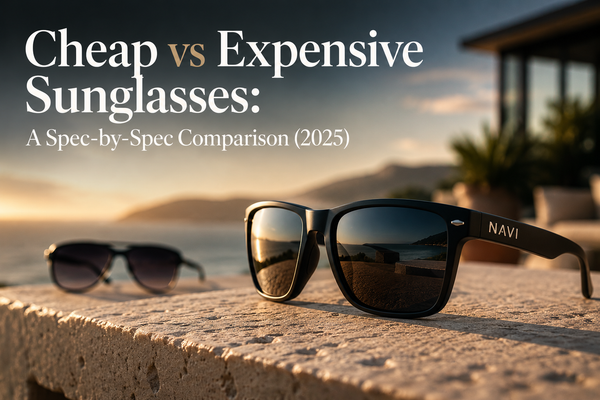

Cheap vs Expensive Sunglasses: A Spec-by-Spec Comparison
The gap between a $10 pair of sunglasses and a $200 pair is obvious when you look at the price tag. What is less obvious is exactly what you are paying for — and just as importantly, what you are not. Some of the difference is real: lens quality, frame engineering, coating stack, and construction durability genuinely improve across price tiers. Some of the difference is brand premium: the name on the temple arm, the heritage of the silhouette, the marketing budget that put it there.
This guide runs through every specification that actually matters for eye protection and daily performance, and tells you honestly where price makes a measurable difference and where it does not. The result is a framework for buying at any budget without compromising on the things that protect your eyes — and without overpaying for the things that do not.
This is the final C12 Comparison and Best For supporting post, completing the cluster. It links back to the cluster pillar atNavi Eyewear vs Ray-Ban: an honest comparison. The supporting posts in this cluster covering specific technical comparisons arepolarized vs non-polarized sunglasses,UV400 vs UV380,polycarbonate vs glass sunglass lenses, andmirror vs non-mirror sunglass lenses.
Quick Answer
Price makes a real difference in frame construction quality, hinge durability, lens optical clarity, coating stack, and long-term reliability. Price does not make a difference in UV protection: a UV400 lens at $25 blocks the same UV as a UV400 lens at $200. The danger zone is not expensive sunglasses — it is cheap sunglasses without UV certification, which can actively worsen UV exposure. The sweet spot is a clearly-specified, UV400-certified, polarized product from a brand that discloses its lens and frame specifications. You do not need to spend $200 to get there.

Table of Contents
Part 1: The Danger Zone — Cheap Sunglasses Without UV Certification
⚠ Dark Lenses Without UV400 Are Actively HarmfulA dark lens without UV400 certification causes pupil dilation in the reduced ambient light reaching the eye. A dilated pupil in unprotected UV admits more radiation to the retina than a normal pupil under full sun with no glasses. Independent testing has found UV certification failure rates of 40–60% in unverified budget sunglass products from market stalls, tourist shops, and unbranded online sellers. Never buy sunglasses without an explicit UV400 claim. Lens darkness tells you nothing about UV protection. |
This is the most important fact in the cheap vs expensive sunglass comparison. The specific risk of cheap sunglasses is not just that they protect less than expensive ones — it is that dark lenses without UV certification actively increase UV exposure to the retina compared to no glasses at all. The pupil, which normally constricts in bright light to limit UV entry, is fooled by the reduced visible light into dilating, while the uncertified lens does nothing to block the UV that comes with it.
Research by Rosenthal et al. in the American Journal of Public Health demonstrated that sunglass lenses significantly reduce ocular UV exposure — but only when they actually block UV. Lenses that darken without blocking UV are not a neutral choice; they represent negative protection relative to the unaided eye in bright conditions. Independent testing of budget sunglass products has found substantial rates of UV protection failure even in products explicitly sold as sunglasses. The full UV disease risk from unprotected ocular UV exposure is inUV and eye disease: the complete guide to cataracts, macular degeneration and more.
Part 2: UV Protection — Where Price Makes No Difference
UV400 is a binary standard. A lens either blocks UV to 400nm or it does not. A $25 polycarbonate lens with UV400 certification blocks the same UV spectrum as a $200 polycarbonate lens with UV400 certification. The UV protection quality is determined by the lens material and its certification — not by the price of the frame around it, not by the brand name, and not by the marketing language on the packaging.
In polycarbonate lenses specifically, UV protection is inherent to the polymer throughout the material. It does not degrade with surface scratching, age, or chemical exposure. A quality UV400 polycarbonate lens at $25 maintains its UV400 specification for years of daily use in the same way a $200 UV400 polycarbonate lens does.
The implication for buyers: UV protection is the one specification where there is no quality-per-dollar trade-off. If a pair of sunglasses — at any price point — carries explicit UV400 certification on polycarbonate lenses, the UV protection is complete. There is no meaningful additional UV protection that more expensive sunglasses provide beyond this standard.
The UV400 standard, how to verify it, and what to do if a product’s UV status is unclear are covered inUV400 vs UV380: what is the difference and why it matters and7 signs your sunglasses are not protecting your eyes.
Part 3: Lens Optical Quality — Where Price Makes a Moderate Difference
Base Lens Optical Clarity
Optical clarity in sunglass lenses is measured by how well the lens transmits light without distortion, chromatic aberration (color fringing), or optical power variation across the lens surface. This is where price genuinely does buy something: premium lens manufacturers use tighter optical tolerances, better quality control, and higher-grade base materials than budget producers. The practical consequence for most users: very cheap lenses (below $5 retail cost) can sometimes produce subtle visual distortions visible in peripheral vision or on straight-line edges. Quality polycarbonate lenses from reputable manufacturers do not.
The Diminishing Returns Above a Threshold
The optical quality improvement from $5 to $25 lenses is meaningful and perceptible. The improvement from $25 to $200 lenses is marginal and imperceptible to most buyers in everyday use. Above a certain manufacturing quality threshold — which is achievable at modest cost with quality polycarbonate and proper manufacturing controls — optical clarity ceases to be a differentiating factor between price tiers. The optical leap is from the budget uncontrolled tier to the quality-controlled tier. The optical premium above that is primarily for prescription applications where high precision matters, not for plano (non-prescription) sunglass lenses.
Polarization Optical Quality
Polarized lenses vary in optical quality by the quality and alignment of the PVA polarizing film embedded in the lens. Budget polarized lenses use lower-quality PVA film that may have visible grain or imperfect alignment, producing slight distortion or uneven glare elimination. Quality polarized lenses use precisely aligned, uniform-grade PVA film that provides clean glare elimination without visible optical artefacts. This is a real quality difference that is perceptible in direct comparison. It is also a quality threshold that is achievable below the premium brand price point with a properly specified product.
Part 4: Polarization — What You Pay For
As covered in the optical quality section, polarization quality is genuinely price-related to a point. The distinction is between three tiers:
The jump from budget unverified to quality-specified polarized is significant and worth paying for. The jump from quality-specified to premium optical is marginal for most users and primarily serves highly specific visual tasks (fishing in specific water conditions, competitive sport with precise contrast requirements). For everyday outdoor use, quality-specified polarized UV400 provides the full functional benefit of polarization. The complete polarization science is inpolarized vs non-polarized sunglasses: the definitive guide.
Part 5: Frame Construction — Where Price Makes a Real Difference
Frame Material Quality
Frame material quality is one area where price consistently buys something real. The difference between very cheap acetate and quality TR90 nylon, between soft flexible injection-moulded plastic and properly engineered thermoplastic polyamide, is visible and tactile. Very cheap frames have:
Quality TR90 nylon frames are lightweight, impact-resistant, accurately moulded with consistent geometry, and maintain their shape and finish under years of daily outdoor use. The difference is real and correlates with price up to a threshold — above which additional cost goes to brand premium rather than better frame engineering.
Nose Pad Engineering
Nose pad design affects both comfort and UV coverage. Cheap frames use generic nose pad geometry that does not account for the variation in nose bridge shape across human populations. Quality frames engineer nose pad angle, spread, and contact area for comfort across a range of face geometries. For buyers with specific nose bridge geometry — particularly lower nose bridges — nose pad engineering makes a meaningful fit difference that cheap frames do not address.
Part 6: Hinge Quality — The Most Overlooked Durability Factor
The hinge is the most mechanically stressed component of any sunglass frame. Every time the frame is opened and closed, the hinge absorbs the full rotational stress of that motion. Over the lifespan of a regularly used pair of sunglasses, the hinge will open and close thousands of times. The quality of the hinge determines whether the frame lasts 6 months or 6 years.
Budget frames use 3-barrel hinges in low-grade metal alloys. The 3-barrel design concentrates stress across fewer contact points, accelerating wear. The alloy chosen for budget hinges may corrode quickly in marine and sweat environments, or strip the screw thread after moderate use, leaving the hinge irreparably loose.
Quality frames use 5-barrel hinges in stainless steel. The 5-barrel design distributes stress across five contact points, dramatically extending hinge lifespan. Stainless steel resists corrosion in salt and sweat environments — the two most common accelerated-wear environments for sunglasses. Navi Eyewear specifies stainless 5-barrel hinges across their collection specifically because hinge quality is one of the most consequential construction details for frame longevity.
Part 7: Lens Coatings — What the Premium Coating Stack Buys
The Coating Stack Comparison
Premium sunglasses build a stack of functional coatings on the base lens: anti-reflective (AR) coat to reduce internal reflections, hard coat for scratch resistance, hydrophobic or oleophobic coat to repel water and oils, and sometimes anti-fog and anti-saltwater treatments. Budget sunglasses typically apply only the minimum: sometimes a single hard coat, sometimes no coating beyond the base lens surface.
Part 8: Brand Premium — What You Are Really Paying For
Above a quality threshold that is achievable at $25–50 per pair with direct-to-consumer pricing, most of the additional cost in premium designer sunglasses is brand premium — the commercial value of the name, the heritage of the silhouette, the decades of marketing investment, and the retail distribution infrastructure that makes the brand available in premium department stores.
This is not a cynical observation. Brand heritage has real value to buyers who specifically want it. A pair of Ray-Ban Wayfarers is a cultural artifact with genuine design history that Navi’s frames do not replicate. If that heritage is part of what you are buying, paying the premium for it is a coherent choice.
What it is not is a UV protection choice, a lens performance choice, or a frame engineering choice — at least not above the quality threshold that marks the boundary between genuinely inadequate product and genuinely adequate product. A $175 pair of designer sunglasses does not protect your eyes more than a $25 pair of quality-specified UV400 polarized polycarbonate sunglasses. The $150 difference is buying the brand, not the spec.
✨ NAVI EYEWEAR — THE PREMIUM SPEC WITHOUT THE PREMIUM MARKUPUV400 certified. Polarized. FDA-cleared polycarbonate. Oleophobic and anti-saltwater coating. TR90 frames with stainless 5-barrel hinges. Stainless lens logo. Modern everyday premium style. Buy 1, Get 3 Free — $99 for four pairs (≈$25 each). Free shipping. Free replacements. Add 4 pairs to cart — discount auto-applies. No code needed. Shop the full collection:navieyewear.com/collections/polarized |
Part 9: The True Cost of Ownership Calculation
The Single Expensive Pair Model
At $175 for a single pair, the annual cost depends entirely on how long the pair lasts and what happens to it. A pair that survives 3 years of careful use costs approximately $58 per year. A pair that gets scratched after 18 months costs $117 per year. A pair that gets sat on, lost, or dropped in the water — as happens to sunglasses with real frequency — costs the full $175 replaced whenever the next pair is needed.
The Four-Pair Rotation Model
At $99 for four pairs of Navi Eyewear with free replacements, the calculation is different. The $99 purchase covers four pairs with full spec — UV400, polarized, FDA-cleared polycarbonate, stainless hinges, oleophobic and anti-saltwater coating. Each pair is approximately $25. When one gets scratched, you reach for another from the rotation. When one goes overboard on a fishing trip, you are not out $175. The free replacement provision means damaged pairs cost zero to replace beyond the original purchase.
The Per-Year Math
|
Scenario |
Single $175 Pair |
4x Navi at $99 |
|
Year 1 cost |
$175 |
$99 |
|
Year 2 if undamaged |
$0 (same pair) |
$0 (rotation + free replacements) |
|
Year 2 if one pair damaged |
$175 replacement |
$0 (free replacement) |
|
4-pair coverage |
$700 |
$99 |
|
Total over 3 years (1 damage event) |
$350 |
$99 |
|
Total over 3 years (2 damage events) |
$525 |
$99 |
The true cost of ownership comparison changes dramatically when damage and replacement are factored in realistically. Sunglasses are lost and damaged at high rates in real-world use — they are among the most commonly misplaced personal items. Any cost-of-ownership comparison that assumes zero damage events is not reflecting real-world use.
Part 10: The Sweet Spot — Premium Spec at Direct-to-Consumer Pricing
The insight that the direct-to-consumer model makes possible: a product can be built to a premium specification — quality-controlled UV400 polycarbonate, aligned polarizing film, stainless hardware, full coating stack — and sold at a significantly lower price than equivalent heritage brands, not because it is cheaper to make, but because it eliminates every layer of middleman markup between the factory and the buyer.
Navi Eyewear’s $99 for four pairs is not a budget product at a premium price. It is a premium-specified product at a direct-to-consumer price. The UV400 certification is genuine. The polarized lenses are quality-controlled. The FDA-cleared polycarbonate is the same material specification as impact-resistant performance eyewear. The oleophobic and anti-saltwater coatings are the practical coating stack for daily outdoor use. The stainless 5-barrel hinges are the construction detail that determines frame longevity.
The sweet spot in the market is not the cheapest available product — which carries the UV certification failure risk discussed in Part 1. It is the clearly-specified, quality-controlled, transparent-specification product at a price that direct-to-consumer distribution makes possible. That is where you get the full UV400 polarized polycarbonate spec without the brand markup.
Part 11: Cheap vs Expensive Sunglasses — Spec-by-Spec
|
Specification |
Budget Cheap (<$15) |
Quality Mid-Range ($25–60) |
Premium Designer ($150+) |
|
UV certification |
Often missing or UV380/unverified |
UV400 — verified |
UV400 — verified |
|
UV protection mechanism |
Surface coating (if present) |
Polycarbonate inherent |
Polycarbonate or glass with coating |
|
Polarization quality |
Often fake or low-grade PVA film |
Quality-controlled PVA |
Premium optical polarization |
|
Lens material |
Unknown plastic, often CR-39 |
Polycarbonate |
Polycarbonate or glass |
|
Impact resistance |
Typically fails FDA standard |
FDA-cleared polycarbonate |
Meets FDA standard |
|
Oleophobic coating |
Rarely included |
Quality brands include it |
Standard on premium |
|
Anti-saltwater coating |
Not included |
Quality brands include it |
Often not included |
|
Frame material |
Cheap injection plastic |
TR90 nylon or quality acetate |
Premium acetate or metal |
|
Hinge type |
3-barrel base metal |
5-barrel stainless |
Quality metal (varies) |
|
Optical clarity |
Variable, some distortion |
Quality-controlled, clear |
Premium-controlled, clear |
|
Replacement policy |
None |
Free replacements (Navi) |
Full retail price |
|
Cost per pair |
<$15 |
≈$25 (4-pair deal) |
$150–$220+ |
Part 12: Best For
Budget Cheap Sunglasses — Best For:
Quality Mid-Range UV400 Polarized (e.g. Navi Eyewear) — Best For:
Premium Designer Sunglasses — Best For:
Part 13: Who This Is Not For
Part 14: Common Mistakes
Bottom Line
The spec-by-spec comparison produces a clear framework: UV protection does not improve with price above the UV400 threshold. Lens optical quality and polarization quality improve meaningfully from budget unverified to quality-specified, and marginally from quality-specified to premium optical. Frame construction and hinge quality improve with price up to a threshold above which additional cost goes to brand premium. Coating stack improves from nothing at the budget tier to a complete functional stack at quality mid-range.
The practical conclusion: the dangerous tier is the bottom — cheap, unverified, dark lenses that actively worsen UV exposure. The smart tier is quality-specified UV400 polarized polycarbonate with a proper coating stack from a brand that discloses its specifications. You do not need to spend $175 to be in the smart tier. You need to spend enough to be above the dangerous tier, with explicit UV400 certification and quality-controlled polarization.
Navi Eyewear’s $99 for four pairs sits squarely in the smart tier — full spec transparency, UV400 polycarbonate, quality-controlled polarization, complete coating stack, stainless hardware, free replacements — at a price that direct-to-consumer distribution makes possible without compromising any of the specifications that actually protect your eyes.
BrowseNavi Eyewear’s UV400 polarized collection. Add 4 pairs for the Buy 1, Get 3 Free deal at $99. Free shipping. Free replacements.
Frequently Asked Questions
Do cheap sunglasses damage your eyes?
Cheap sunglasses without UV400 certification can actively worsen UV eye exposure compared to no glasses, because the dark lens causes pupil dilation into unprotected UV. This is not a minor risk — cumulative UV exposure over years without adequate protection is the primary driver of cataracts and age-related macular degeneration. Any sunglass without explicit UV400 certification should be avoided for outdoor UV protection purposes. The full UV disease science is inUV and eye disease: the complete guide.
Are expensive sunglasses better at blocking UV?
No — UV400 is a binary standard available at all price points above the quality threshold. A $25 UV400 polycarbonate lens blocks the same UV as a $200 UV400 polycarbonate lens. The price difference above the UV400 baseline buys frame quality, optical precision, coating stack, brand heritage, and retail markup — not additional UV protection. Price makes no difference to UV performance above the UV400 certification threshold.
What is the minimum I should spend on sunglasses?
The minimum is not a dollar figure — it is a specification. Any sunglasses you buy for outdoor UV protection must carry explicit UV400 certification. If you can find a genuinely UV400 certified pair with quality-controlled lenses at $20, that is sufficient for UV protection. The practical challenge is that the UV certification failure rate in budget unverified products is high enough that buying without specification transparency is risky. Navi Eyewear’s $99 for four pairs provides transparent specification at approximately $25 per pair with free replacements.
Is it worth buying polarized sunglasses vs cheap non-polarized?
For any outdoor use involving driving, water, beach, snow, or reflective surfaces — yes. Polarized lenses eliminate horizontal surface glare that non-polarized lenses cannot address regardless of darkness. The choice is not between polarized expensive and non-polarized cheap; Navi Eyewear provides quality-controlled polarized UV400 at approximately $25 per pair. The full polarization case is inpolarized vs non-polarized sunglasses: the definitive guide.
How can I tell if cheap sunglasses have real UV protection?
Look for explicit UV400 labelling on the lens, tag, or product description. A UV torch test (under $10) can broadly discriminate obvious UV400 from obvious zero protection. An optician can measure UV transmission definitively in under 60 seconds for any pair. The full verification guide is in7 signs your sunglasses are not protecting your eyes.
What makes Navi Eyewear different from other cheap sunglasses?
Navi Eyewear is not a cheap sunglass product. It is a quality-specified UV400 polarized polycarbonate product at a direct-to-consumer price. The specification is explicitly disclosed: UV400 certification, FDA-cleared impact-resistant polycarbonate, quality-controlled polarized PVA film, oleophobic coating, anti-saltwater coating, TR90 frames with stainless 5-barrel hinges. The $25 per pair price reflects direct-to-consumer distribution, not cut corners in specification. The difference from genuinely cheap sunglasses is specification transparency and quality control.
Are polarized sunglasses worth it if I’m on a budget?
Yes — and Navi’s four-pair deal at $99 makes quality-controlled polarized UV400 accessible at approximately $25 per pair. The functional benefit of polarization — eliminating surface glare for driving, fishing, beach, and water sports — is not a premium luxury. It is a daily functional advantage that quality-specified polarized lenses provide at any price point above the unverified budget tier. Browse the full collection atnavieyewear.com/collections/polarized.
Do I need to spend $150+ to get quality sunglasses?
No. The quality threshold that provides complete UV400 protection, quality-controlled polarization, impact-resistant FDA-cleared polycarbonate, and a functional coating stack is achievable well below $150 with direct-to-consumer brands that disclose their specifications. The $150+ tier buys brand heritage, iconic silhouettes, and premium retail markup — not meaningfully better eye protection for most outdoor use cases.
Supporting Articles
THE SMART TIER. NOT THE EXPENSIVE TIER.UV400 certified. FDA-cleared polycarbonate. Polarized. Oleophobic and anti-saltwater coating. TR90 frames. Stainless 5-barrel hinges. Four pairs for $99. That’s the full spec at the direct-to-consumer price. Free shipping. Free replacements. Add 4 pairs — Buy 1, Get 3 Free auto-applies at checkout. |
SOURCES & CITATIONS[1] Rosenthal FS, Bakalian AE, Lou CQ, Taylor HR.“The effect of sunglasses on ocular exposure to ultraviolet radiation.”American Journal of Public Health, 1988.View source [2] Taylor HR, West SK, Rosenthal FS, et al..“Effect of ultraviolet radiation on cataract formation.”New England Journal of Medicine, 1988.View source [3] Dain SJ.“Sunglasses and sunglass standards.”Clinical and Experimental Optometry, 2003.View source [4] Tanner DF, Kent JS, Jagger JD.“Spectral transmittance characteristics of commercially available UV-protective sunglass lenses.”Optometry and Vision Science, 2007.View source [5] U.S. Food and Drug Administration.“Impact resistance requirements for sunglass lenses (21 CFR Part 801).”FDA Regulations, 2023.View source [6] American Academy of Ophthalmology.“Sunglasses: choosing the right pair for UV protection.”AAO EyeSmart, 2023.View source [7] Cruickshanks KJ, Klein R, Klein BE.“Sunlight and age-related macular degeneration: the Beaver Dam Eye Study.”Archives of Ophthalmology, 1993.View source [8] World Health Organization.“Solar ultraviolet radiation: global burden of disease from solar ultraviolet radiation.”WHO Environmental Burden of Disease Series, 2006.View source |