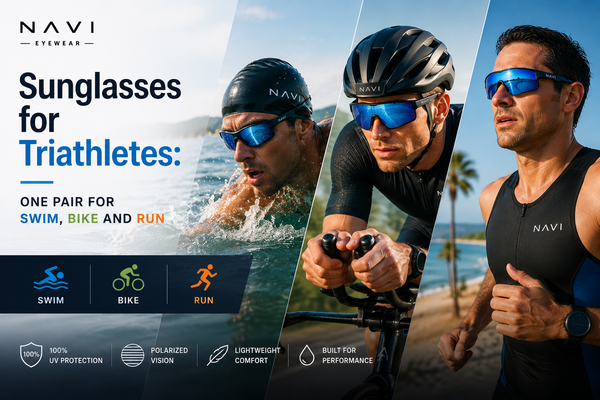

Sunglasses for Triathletes: One Pair for Swim, Bike and Run
Triathlon is the sport that asks more of eyewear than any other. A pair of sunglasses that works for a triathlete must: survive a swim start without falling off or flooding the visual field with water, go on in seconds during T1 with wet hands and no mirror, stay secure on the bike at 40 km/h for anything from 20 to 180 kilometres, provide adequate UV protection and glare management on the run leg in varying light conditions, and remain comfortable enough that the athlete is not conscious of wearing them at hour six of an Ironman.
Most sunglasses fail at least one of these requirements. The good news is that the specification that addresses all of them is clear, and quality sport sunglasses built to that specification are widely available. This guide covers every discipline-specific requirement, the transition logistics that many triathletes overlook, and the single-pair specification that works from sprint to Ironman distance.
This is the final C10 Sport Performance Deep Dives supporting post. For the cycling-specific depth that covers the bike leg in full, seethe complete guide to cycling sunglasses. For the running specification, seebest sunglasses for running: lightweight, secure and UV-ready. For the water sports UV context, seesunglasses for water sports: why polarization is non-negotiable.

The Three Disciplines: What Each Demands
The Swim: Not Worn, But the Transition Sets the StandardUV risk: Minimal — swim goggles handle the water; sunglasses go on in T1 Key spec: Elastic or secure temple design; quick-don in T1 with wet hands Sunglasses are not worn during the swim leg — swim goggles handle that. But the swim determines the most important sunglass requirement: the T1 transition. Coming out of the water, the athlete has wet hands, a wetsuit to remove or partially unzip, a helmet to put on, and a bike to mount — all in the minimum possible time. Sunglasses must go on in a single motion without adjustment, even with wet hands. The design features that enable a fast T1: elasticated temple tips or rubbery grips that slide over the ears without snagging the wetsuit hood; a comfortable single-motion fit that requires no nose pad adjustment; and a frame that can be pre-clipped into the helmet vents to go on simultaneously with the helmet. Many experienced triathletes practice their T1 routine specifically including sunglass donning, because fumbling with a pair that does not fit cleanly costs seconds that race against much better-trained technique. |
The Bike: The Highest-Demand Discipline for EyewearUV risk: High to very high — 40+ km/h wind exposure, extended UV accumulation, road surface glare Key spec: UV400 polarized, wraparound geometry, anti-fog ventilation, helmet compatibility The bike leg is where sunglasses are most critically needed and most heavily tested. Wind at cycling speeds causes rapid tear evaporation, road debris risk is highest, UV accumulation over a long bike leg is significant, and road surface glare in wet conditions reduces road reading clarity. The complete cycling specification for this leg is covered in depth inthe complete guide to cycling sunglasses. For triathlon specifically: the key additions are helmet integration (the sunglass must fit cleanly under the TT or road helmet without pressure on the nose pad from the helmet’s close-fitting design), and the ability to maintain position at aero-position head angles where the face is tilted downward and the glasses can shift toward the nose. |
The Run: Comfort, Weight and UV for the Final LegUV risk: Moderate to high — open-course UV, often the hottest part of the day in morning-start events Key spec: Lightweight, secure grip, adequate darkness for variable light By the run leg, the athlete has already worn their sunglasses for the entire bike leg — potentially two to six hours in an Ironman. Any pressure point, weight load, or grip failure that was tolerable on the bike becomes significantly more noticeable after that duration. The run leg demands that the frame is light enough to be forgotten, grips well enough that the bouncing gait of running does not dislodge it, and provides adequate UV protection for what is often the hottest, highest-sun period of a morning-start triathlon event. For the run leg specifically: rubberised temple and nose grip is the critical feature. Sweat from the preceding bike leg has saturated the nose bridge area, and standard plastic on wet skin provides almost no friction. Rubberised over-mould on the nose pad and temple tips maintains position through even a marathon run leg. The running-specific specification is inbest sunglasses for running: lightweight, secure and UV-ready. |
T1 and T2: The Transition Logistics
T1 — Swim to Bike
T1 is where most triathlon sunglass mistakes happen. The sequence: exit water — remove swim cap and goggles — start wetsuit removal — reach the bike rack — put on helmet (and sunglasses if pre-positioned in helmet) — put on shoes if not already on bike — mount and go. The two main sunglass strategies for T1:
T2 — Bike to Run
T2 is simpler for sunglasses. The athlete dismounts, racks the bike, removes the helmet (with the sunglasses, if pre-clipped), puts on running shoes, and continues with the same sunglasses into the run. No sunglass change is needed if the pair works for both legs — which with the right pair it should. Some athletes remove their sunglasses at T2 if the run leg begins in shade or if the glasses have become significantly sweaty and uncomfortable. Generally, keeping the same pair through the run is faster and simpler.
The Triathlete Sunglass Specification: Everything That Matters
|
Specification |
Requirement |
Why It Matters for Triathlon |
|
UV400 certification |
Non-negotiable |
Long outdoor exposure across all three legs and post-race; bike leg UV accumulation is high |
|
Polarization |
Strongly recommended |
Road glare on wet surfaces in the bike leg; any open-water transition area or coastal course |
|
Lens tint |
Gray or amber Cat 2–3 |
Gray for colour accuracy on road; amber for variable light including overcast run leg |
|
Frame material |
TR90 nylon or Grilamid |
Lightweight for all-day comfort; flexible enough for helmet pre-clip; impact resistant |
|
Nose grip |
Rubberised TPE over-mould |
Critical for sweat management across a long event; standard plastic fails on wet skin |
|
Temple grip |
Rubberised tips |
Secure through bike vibration and run bounce without pressure points over hours |
|
Lens retention |
Positive full-rim or secure semi-rim |
Must not loosen during crash or impact; polycarbonate lens for impact resistance |
|
Frame weight |
Below 30g preferred |
Cumulative comfort over 4–17 hours of racing; every gram noticed by late in an Ironman |
|
Ventilation |
Brow vents |
Prevents fogging during effort changes on the bike; essential for temperature transitions |
|
Helmet compatibility |
Low-profile temples |
Must sit below helmet brim and not conflict with fit retention system |
Can One Pair Really Work for All Three Legs?
The answer is yes — with the right pair. The requirements across all three legs are not contradictory: they all point toward the same specification. UV400 polycarbonate, polarized, gray or amber, Category 2–3, TR90 frame with rubberised grip, lightweight, ventilated, helmet-compatible. This is also the specification of a quality road sport sunglass that is not specifically designed for triathlon. Dedicated triathlon eyewear exists from brands including Rudy Project and Bolle, and they add convenience features (lens swapping systems, helmet clip design) but the underlying optical specification is identical to quality sport sunglasses.
The one situation where a single pair is genuinely inadequate: extreme light variation events where the bike leg runs through tunnels or heavy shade and the run leg is in bright open sun. For these events, photochromic lenses — which adapt to light level — are the optimal solution. Photochromic sport lenses that combine polarization with the darkening reaction provide the full triathlon specification with adaptive darkness. The photochromic science including its limitations (adaptation speed, behaviour in hot conditions) is inthe complete guide to cycling sunglasses (Part 6).
UV Exposure in Triathlon: More Than You Might Expect
A standard Olympic triathlon involves approximately 2–3 hours of outdoor activity. A 70.3 (half Ironman) involves 4–6 hours. A full Ironman involves 8–17 hours of continuous outdoor racing, typically in summer conditions in high-UV locations. The UV dose accumulated over a full Ironman race — even accounting for the wetsuit covering the body — is substantial for the face and eyes. Regular Ironman competitors who race multiple events per year accumulate meaningful lifetime UV doses.
UV400 protection is as important for triathlon as for any outdoor sport, and the case is particularly strong for long-distance racing where the total UV dose per event is high. The cumulative UV disease picture for regular outdoor athletes is inUV and eye disease: the complete guide. For the specific UV risk of open-water swimming environments that triathlon transitions occur in, seesunglasses for water sports: why polarization is non-negotiable.
Browse theNavi Eyewear UV400 polarized collection for quality UV400 polarized frames suitable for triathlon training and racing. All Navi lenses meet UV400 certification with polycarbonate construction for the impact resistance and long-term UV protection reliability that multi-sport racing demands.
Frequently Asked Questions
What sunglasses are best for triathlon?
UV400 polarized gray or amber polycarbonate lenses in a lightweight TR90 wraparound frame with rubberised nose and temple grips, positive lens retention, brow ventilation, and low-profile temples compatible with triathlon helmets. Gray polarized is the most versatile specification for most race conditions. Amber works better in variable or overcast light. Photochromic polarized for events with significant light variation. The bike leg is where the specification is most heavily tested — the full cycling specification is inthe complete guide to cycling sunglasses.
Should I wear sunglasses during the swim?
No — swim goggles handle vision and eye protection during the swim. Sunglasses go on during T1, either pre-clipped in the helmet or picked up from the transition area. Some open-water swimming specialists wear prescription swim goggles with tinted lenses, but standard non-prescription goggles with UV coating are standard. Save the sunglasses for T1 and beyond.
How do I put on sunglasses quickly in T1?
Practice the motion. The most common efficient T1 approach: pre-clip sunglasses by the temples into the helmet vents before the race, so they go on simultaneously with the helmet. This requires that the glasses have flexible temple arms that can be spread to clip in without snapping, and that the helmet vents are wide and parallel enough to grip the temples. Test this in training — not for the first time in a race. With wet hands, rubberised temple tips slide onto the ears more reliably than smooth plastic.
Do I need polarized sunglasses for triathlon?
Polarization is strongly recommended for the bike leg specifically — road surface glare from wet tarmac reduces contrast of road markings and surface hazards in a way that darker non-polarized lenses cannot address. For coastal and open-water transition areas and any bike course near water, polarization eliminates reflected glare that can be momentarily vision-disrupting at speed. The LCD instrument panel interaction that makes polarization slightly contentious for competitive road cyclists applies equally to triathlon athletes with GPS computers and power meters — seethe complete guide to cycling sunglasses(Part 2) for the full discussion.
What lens tint is best for triathlon?
Gray polarized is the first recommendation for most triathlon races — it provides color accuracy for road navigation and traffic management during the bike leg, adequate UV reduction across all three legs, and polarization for glare. Amber works better in variable or overcast conditions and provides marginally better road surface contrast in some conditions. Photochromic gray for races with significant light variation including underground sections, forested run courses, or morning-to-afternoon light changes in longer races.
Will sunglasses fall off during the run leg?
With the right frame they will not — but this is one of the most common triathlon equipment failures. The key features that prevent run leg displacement: rubberised nose pad over-mould that maintains grip on wet, sweaty skin (standard plastic has almost no friction when wet); rubberised temple tips that grip behind the ear; positive nose bridge fit that prevents the frame from sliding down. Test the secure fit specifically during a hard run effort, not just during a gentle jog. If the frame moves at all during a 5-minute tempo effort, it will be problematic by kilometre 30 of an Ironman marathon.
Can I use the same sunglasses for training and racing?
Yes — and it is recommended. The same pair used consistently in training is the pair the athlete will not be conscious of during racing. A new pair worn for the first time on race day introduces fit uncertainty, pressure point risk, and the distraction of unfamiliar eyewear at exactly the wrong moment. Training in the race sunglasses also validates the T1 workflow, confirms helmet compatibility, and identifies any fit issues weeks before they matter.
Do triathlon sunglasses need special lenses?
No — the specification that works for triathlon is the same specification that works for road cycling and running: UV400 polycarbonate, polarized, gray or amber Category 2–3. Dedicated triathlon eyewear brands add convenience features (clip-in helmet systems, interchangeable lens systems, aerodynamic frame profiles) but the optical specification is not different from quality sport sunglasses. The fundamental requirements are impact-resistant lenses, reliable UV protection, polarization for glare, and a frame that stays put through sweat and movement.
What UV protection do triathletes need?
UV400 polycarbonate lenses, worn consistently across training and racing. Long-distance triathlon events deliver UV doses equivalent to a full day of outdoor work, and regular competitors who race multiple events per season accumulate meaningful lifetime UV. Polycarbonate is specifically recommended because the UV protection is inherent to the material throughout — not a surface coating that can degrade. The cumulative UV disease risk for regular outdoor athletes over years of training and racing is addressed inUV and eye disease: the complete guide.
Are there specific triathlon sunglasses brands worth considering?
Rudy Project, Bolle, Shimano, Oakley, and Smith all produce sport sunglasses specifically designed or well-suited to triathlon use. The differentiating features in dedicated triathlon designs: easy-clip helmet integration, interchangeable lens systems for conditions changes, aerodynamic frame profiles that reduce drag at speed, and specifically designed rubberised grip systems. For athletes who race occasionally, quality general sport sunglasses at the right specification perform equivalently to dedicated triathlon eyewear at typically lower cost.
Can I wear prescription sunglasses for triathlon?
Yes — prescription sunglasses in polycarbonate UV400 with polarization are available and appropriate for triathlon. The T1 logistics are the same as for non-prescription pairs. Contact lenses plus non-prescription sport sunglasses is the more common approach for prescription triathletes, as it separates the prescription from the eyewear and allows any sport sunglass to be used. Contact lens tolerance in open-water swimming (risk of pathogen exposure and lens loss) is the specific concern for the swim leg — remove contacts before the swim and replace in T1, or wear in a sealed goggle that prevents water contact. The full prescription wearers’ options are inthe complete guide to prescription sunglasses.
What happens if my sunglasses fog on the bike?
Lens fogging in triathlon occurs when the face’s warmth from effort condenses on a cooler lens surface — particularly during early-race effort surges in cooler morning conditions. Prevention: choose frames with brow ventilation channels; slightly lower the glasses on the nose bridge during high-effort sections to increase airflow; use hydrophobic coatings that reduce condensation adhesion; avoid frames that seal completely against the face (which works for skiing but traps warm air for cycling). For the full anti-fog strategy, seethe complete guide to cycling sunglasses (Part 2, Ventilation and Anti-Fog section).
SOURCES & CITATIONS[1] De Faber JT, Naeser K, Kessing SV.“Polarized light and contrast sensitivity under glare conditions.”Ophthalmic Research, 2013.View source [2] Dain SJ.“Sunglasses and sunglass standards.”Clinical and Experimental Optometry, 2003.View source [3] Rosenthal FS, Bakalian AE, Lou CQ, Taylor HR.“The effect of sunglasses on ocular exposure to ultraviolet radiation.”American Journal of Public Health, 1988.View source [4] Craig JP, Nichols KK, Akpek EK, et al..“TFOS DEWS II definition and classification report.”Ocular Surface, 2017.View source [5] Sliney DH.“UV radiation ocular exposure dosimetry.”Documenta Ophthalmologica, 1994.View source [6] Tanner DF, Kent JS, Jagger JD.“Spectral transmittance characteristics of commercially available UV-protective sunglass lenses.”Optometry and Vision Science, 2007.View source |