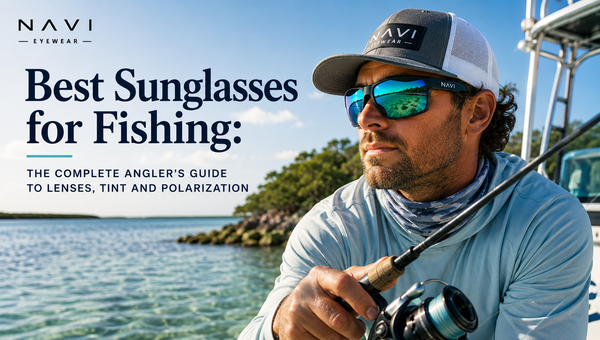

Best Sunglasses for Fishing: The Complete Angler’s Guide to Lenses, Tint and Polarization
Of all the sports and activities that benefit from the right sunglasses, fishing is the one where eyewear most directly determines what you can do. Without polarized lenses, you see the surface of the water — reflections, glare, and sky. With copper or amber polarized lenses, you see through it: the structure of a river bed, the shadow of a trout holding in a current, the silhouette of a bass suspended near a weed bed. The difference is not cosmetic. It is the difference between fishing blind and fishing with information.
This is why serious anglers — from competitive fly fishers to tournament bass anglers to offshore game fishing captains — treat polarized sunglasses as their most important piece of fishing equipment after the rod. Not because of UV protection, though that matters too for hours on open water. But because polarization gives them a visual capability they simply do not have without it.
This is a C10 Sport Performance Deep Dives supporting post. For the complete outdoor sport UV context, seethe complete outdoor and sport sunglasses guide. For the tint science in depth, seethe science of lens color and what tint does your vision need. For the complete UV eye disease context relevant to extended open-water fishing, seeUV and eye disease: the complete guide.

The Physics of Polarization for Fishing: Why It Works
The Water Surface Reflection Problem
The surface of water acts as a partial mirror. Light from the sky reflects off the water surface at specific angles, producing the glare that makes fishing visually difficult — the bright, shifting reflections that obscure anything beneath. This reflected light is predominantly horizontally polarized: the light waves oscillate in the horizontal plane as they bounce off the flat water surface.
A polarized lens contains a filter that blocks horizontally polarized light while allowing vertically polarized light through. When you look at water through a polarized lens, the surface reflection — being horizontally polarized — is blocked. What remains is the vertically polarized light coming through the water surface from below, carrying information about what is beneath. This is why polarization reveals the underwater environment in a way that simply darkening the lens without polarization cannot achieve.
Why Standard Dark Lenses Don’t Work for Fishing
This is the most common misconception among anglers who have not fished with quality polarized lenses: that a very dark non-polarized sunglass provides similar visibility into water. It does not. A dark non-polarized lens reduces the overall brightness of the visual scene including the surface reflection, but it reduces the brightness of both the reflection and the light coming through the water surface in equal proportion. The signal-to-noise ratio — the ratio of useful sub-surface information to surface glare — is unchanged. You see a darker glare, not through it. Polarization specifically removes the glare signal without reducing the useful sub-surface signal, which is why it is uniquely effective for fishing. The full polarization science and verification guide is inpolarized sunglasses: are they worth it.
The Fishing Lens Tint Guide: Copper, Amber, Gray and More
|
Copper / Rose Copper — The Definitive Fishing Tint VLT: 20–40% VLT (Category 2) Fishing application: All freshwater fishing, inshore saltwater, sight fishing in clear water Copper is the fishing tint. It combines two properties that are uniquely valuable for fishing: blue-scatter filtering that enhances the contrast of underwater features, and a spectral shift that increases the visual penetration of water’s natural spectral filtering. Water preferentially absorbs red wavelengths as depth increases, shifting the colour of underwater objects toward green and blue. Copper’s spectral profile enhances the warm tones that remain visible in shallow to mid-depth water, increasing the contrast of fish, bottom structure, and vegetation against the surrounding water environment. The practical result: in clear water environments — chalk streams, mountain rivers, tropical flats, clear lakes — copper lenses reveal sub-surface features, fish silhouettes, and bottom structure that are invisible through any other commonly available tint. Most serious freshwater and inshore fly fishers use copper as their primary lens. |
|
Amber / Brown — Variable Water and All-Round Option VLT: 18–43% VLT (Category 2) Fishing application: Variable water clarity, mixed fishing sessions, murky to moderate-clarity water Amber and brown provide the contrast-enhancing blue-scatter filtering of copper at a slightly cooler spectral balance that some anglers prefer in variable water conditions or when alternating between water fishing and general outdoor scanning. In murkier water where copper’s warm-tone enhancement has less sub-surface depth to work with, amber provides adequate contrast enhancement without the slight colour shift that copper introduces. For anglers who also use their fishing sunglasses for driving to the location and general outdoor use, amber is a more versatile all-round tint than the slightly more specialist copper. |
|
Gray Polarized — Offshore and Open Ocean VLT: 8–18% VLT (Category 3) Fishing application: Offshore saltwater, pelagic game fishing, open-water trolling Gray polarized is the preferred tint for offshore and open-ocean fishing where the visual task shifts from sub-surface reading to horizon scanning and glare elimination. At sea, the depth of water and the conditions of offshore fishing mean that sub-surface fish spotting is less relevant than comfort during extended hours on a bright reflective ocean. Gray reduces overall brightness to a comfortable level, and polarization eliminates the surface glare that causes squinting and fatigue over a long day at sea. For distance viewing — watching for bird activity, bait balls, and surface breaking fish — gray’s colour accuracy supports natural distance scanning. |
|
Yellow / Light Amber — Low Light and Overcast Fishing VLT: 40–80% VLT (Category 0–1) Fishing application: Dawn and dusk fishing, heavily overcast conditions, low-light river fishing Dawn and dusk are prime feeding times for many species. In the low-light conditions of these windows, any significant darkness in a lens reduces already-limited visibility. Yellow or very light amber lenses at Category 0–1 maintain maximum light transmission while providing the blue-scatter filtering that enhances contrast of fish and features in low-light water. Polarization in yellow lenses reduces the surface glare that is present even at low light angles. For dedicated dawn/dusk anglers, a yellow polarized lens as a second option alongside a primary copper or amber lens covers the full light range of a fishing day. |
Fishing Style — Tint and Specification Selector
|
Fishing Style |
Water Type |
Primary Tint |
Polarized? |
Category |
|
Fly fishing — chalk stream/river |
Clear, shallow |
Copper |
Essential |
Cat 2 |
|
Fly fishing — loch/lake |
Variable clarity |
Amber or Copper |
Essential |
Cat 2 |
|
Bass fishing — freshwater |
Moderate clarity |
Copper or Amber |
Essential |
Cat 2 |
|
Pike / predator fishing |
Often murky |
Amber |
Essential |
Cat 2 |
|
Carp fishing |
Variable |
Amber |
Recommended |
Cat 2 |
|
Inshore saltwater / sea bass |
Clear to moderate |
Copper or Amber |
Essential |
Cat 2 |
|
Offshore saltwater |
Deep, open ocean |
Gray |
Essential |
Cat 3 |
|
Tropical flats fishing |
Crystal clear, bright |
Copper |
Essential |
Cat 2–3 |
|
Dawn / dusk any style |
Any |
Yellow or Light Amber |
Recommended |
Cat 0–1 |
|
Ice fishing |
N/A surface |
Gray or Amber |
Recommended |
Cat 2–3 |
UV Protection for Fishing: The Most Serious Outdoor UV Exposure
Fishing produces among the highest UV exposures of any recreational activity. The combination of factors is severe: extended sessions of 4–10+ hours; open water environments with 10–25% UV reflectance adding to direct solar UV; minimal natural shade in most fishing environments; and the specific body orientation of fishing — looking downward at water surfaces that reflect UV directly upward toward the face.
Regular anglers who fish through seasons over years accumulate UV doses that rival outdoor occupational workers. The diseases this drives — cataracts, age-related macular degeneration, pterygium — are all more common in populations with high outdoor UV exposure histories. Polycarbonate UV400 lenses with the inherent UV protection built into the material (not a surface coating that degrades) are the most reliable choice for the long-term UV exposure of regular fishing. The UV disease picture is inUV and eye disease: the complete guide.
Frame Requirements for Fishing
Wraparound Coverage: Essential, Not Optional
The specific frame requirement for fishing that differs from most other sports is the direction of UV entry. When an angler looks downward at the water surface, UV reflected from that surface enters the eye from below — through the gap at the bottom of the lens that most standard frames leave open. Close-fitting wraparound frames that minimise this gap below the lens provide meaningfully better UV protection for fishing than flat-lens fashion frames. This is the same Coroneo peripheral UV mechanism discussed in the context of pterygium prevention incan sunglasses prevent pterygium? the UV connection— fishing is one of the highest-risk activities for pterygium specifically because of the combined UV and reflected UV from water surfaces.
Hydrophobic Lens Coatings
Water splash, rain, and spray are inevitable in most fishing environments. Hydrophobic lens coatings that cause water to bead and roll off the lens surface rather than spreading into a film that obscures vision are a practical necessity for fishing sunglasses. A lens without hydrophobic coating that has been hit by spray provides significantly compromised vision until dried. The coating science and what hydrophobic coatings do is inlens coatings explained: anti-reflective, hydrophobic, mirror and more.
Saltwater Corrosion Resistance
For saltwater fishing, frame materials and hardware must resist the accelerated corrosion that salt spray and immersion produce. TR90 nylon frames are inherently corrosion-resistant. Stainless steel screws are preferable to standard steel. Any exposed metal hardware on hinges and nose pads should be non-corroding. Rinse frames with fresh water after saltwater sessions to remove salt deposits that accumulate and attack materials over time.
Secure Fit During Casting
Overhead casting — particularly in fly fishing and surf fishing — involves rapid arm movements and head positions that can dislodge unsecured eyewear. Rubberised nose and temple grips, secure lens retention, and frames sized accurately for the angler’s face are the fit requirements. A retainer strap connecting the temple arms is standard practice for boat fishing where a dropped pair is lost permanently and for wading fly fishers where a dislodged pair in fast water is irretrievable.
Browse theNavi Eyewear UV400 polarized collection for quality UV400 polarized frames suitable for freshwater and coastal fishing. All Navi lenses are polycarbonate UV400 — the impact-resistant, inherent UV protection standard appropriate for extended outdoor fishing sessions.
Species-Specific Fishing Sunglasses: What the Guides Use
Trout and Salmon Fly Fishing
Copper polarized is the near-universal choice among serious trout fly fishers. Clear chalk streams and spate rivers offer the best sub-surface visibility conditions — and copper’s ability to penetrate the water surface and reveal fish holding positions, feeding lanes, and bottom structure is most fully utilised here. Side shields — additional coverage panels on the temporal side of the frame — are used by some serious sight fishers to eliminate peripheral light that can reduce the effectiveness of the polarization by introducing non-polarized light from the sides.
Bass and Predator Fishing
Copper or amber polarized for freshwater bass and pike. Water clarity varies more in stillwater bass and predator environments than in clear rivers, and amber’s slightly broader spectral performance in moderate-clarity water makes it a useful alternative or complement to copper. Tournament bass anglers who fish across varied water types through a season often carry both copper (clear water) and amber (stained or murky water) lenses.
Offshore Game Fishing
Gray polarized at Category 3 is the offshore standard. Game fishing — for marlin, tuna, mahi-mahi, and similar pelagic species — takes place in deep, open ocean where sub-surface sight fishing is largely irrelevant. The visual tasks are horizon scanning for surface activity, bird watching, and managing the intense reflective glare of open ocean over long days. Gray maintains colour accuracy for distance scanning and horizon reading, and the Category 3 darkness is appropriate for the extreme brightness of open-ocean environments.
Tropical Flats Fishing
Copper polarized at Category 2–3 for the clear, shallow tropical environments of bonefish, permit, and tarpon flats. Tropical flats fishing is the ultimate sight fishing discipline — spotting fish in water that is 30–120cm deep, often moving quickly across sand or grass bottom, requires the maximum sub-surface visibility that polarization and copper tint provide. The combination of tropical UV intensity (one of the highest UV environments outside polar regions) and the visual demands of sight fishing makes copper polarized UV400 the non-negotiable specification for guides and experienced flats anglers.
Frequently Asked Questions
What are the best sunglasses for fishing?
Copper or amber polarized UV400 polycarbonate lenses in a close-fitting wraparound frame with hydrophobic coating. Copper is the first choice for clear freshwater and inshore fishing where sub-surface visibility is the primary requirement. Amber is the versatile alternative for variable water clarity. Gray polarized is the offshore standard. For the full tint guide and species-specific recommendations, see the tint cards and fishing style table above, andthe science of lens color and what tint does your vision need.
Do polarized sunglasses really help with fishing?
Yes — dramatically and immediately. Without polarized lenses, the water surface acts as a partial mirror reflecting sky and glare. With copper or amber polarized lenses, that reflection is removed and the sub-surface environment is revealed. The first time an angler who has been fishing with standard sunglasses puts on copper polarized lenses and looks at the water, the difference is immediately apparent: fish, structure, and features that were invisible are suddenly visible. This is not exaggeration. Polarization is the most impactful single equipment change available to visual fishers. The science of why is inpolarized sunglasses: are they worth it.
What is the best lens colour for fishing sunglasses?
Copper for clear freshwater and inshore saltwater fishing where sub-surface visibility is the goal. Copper’s blue-scatter filtering and spectral profile specifically enhance the contrast of underwater features in clear to moderate-clarity water. Amber is the slightly more versatile alternative across varied water clarity. Gray is the offshore standard where sub-surface reading is not the primary visual task. Yellow for dawn and dusk fishing in low-light conditions. The copper vs amber decision is the most common question among anglers: if you fish primarily in clear rivers, streams, and lakes, copper; if you fish across varied conditions including murky or stained water, amber.
Copper vs amber polarized — which is better for fishing?
For clear water fishing: copper wins. Its spectral profile is specifically optimised for enhancing sub-surface contrast in water — the warm-tone enhancement compensates for water’s natural blue-shift and increases the visual definition of fish and bottom features. For variable or murky water: amber is the more versatile choice. Many experienced anglers carry both: copper as their primary lens for clear conditions, amber as a backup for variable or stained water. If buying only one pair, copper is the recommendation for any angler who primarily fishes clear water environments.
Are polarized sunglasses good for sea fishing?
Yes — polarization is essential for any form of sea fishing. For inshore and coastal fishing: copper or amber polarized for the same sub-surface reading benefits that apply in freshwater. For boat fishing in moderate visibility: amber polarized. For offshore deep-sea fishing: gray polarized Category 3 for glare elimination over long open-ocean days without the colour shift that copper introduces when sub-surface reading is not the task. The water sports and sea fishing UV context is insunglasses for water sports: why polarization is non-negotiable.
Can polarized sunglasses help me spot fish?
In clear water conditions: yes, directly and significantly. Polarization removes the surface reflection that obscures sub-surface visibility, allowing anglers to see fish holding in current, feeding in weed beds, and suspended at depth in still water. In murky or stained water where visibility is limited by suspended particles rather than surface reflection: the benefit is reduced, as removing the surface glare reveals less useful information when the water itself limits visibility. The clearer the water, the more directly polarization improves fish spotting.
What UV protection do I need for fishing?
UV400 polycarbonate lenses, worn consistently for all fishing sessions. Fishing is one of the highest UV exposure activities — extended sessions on open water with UV reflection from the surface, often without shade. Regular anglers accumulate UV doses that rival outdoor workers over a fishing career. Polycarbonate is specifically recommended because the UV protection is inherent to the material throughout — not a surface coating that degrades with scratching or age. The long-term UV disease risk from years of fishing without protection is covered inUV and eye disease: the complete guide.
Do I need a retainer strap for fishing sunglasses?
For boat fishing: strongly recommended. A pair of sunglasses lost overboard on open water is gone — a quality pair at £100–200 is worth securing. For wading fly fishing in moving water: equally important — a pair dislodged in fast current is irretrievable. For bankside fishing where loss risk is lower, a retainer strap is optional but adds security. Retainer straps also prevent the repeated pick-up-and-put-on cycle that wears lens coatings through contact with rough surfaces.
What are the best sunglasses for fly fishing?
Copper polarized UV400 polycarbonate in a close-fitting frame, Category 2 (18–43% VLT). The copper tint is the choice of most experienced fly fishers for its sub-surface visibility in clear streams and rivers. Close-fitting frames with minimal brow gap reduce peripheral light that reduces polarization effectiveness when scanning water at low angles. A retainer strap for wading. Hydrophobic coating for rain and splash. For the complete polarization case, seepolarized sunglasses: are they worth it.
Should fishing sunglasses be polarized or just UV400?
Both — there is no choice between them. UV400 is the non-negotiable health baseline: it protects against the cumulative UV that drives cataracts and macular degeneration. Polarization is the performance and visual comfort feature: it eliminates surface reflection to reveal sub-surface environments and eliminates the glare that causes eye fatigue over long fishing sessions. Any serious fishing sunglass needs both. A UV400 non-polarized lens protects your eyes but leaves you fishing blind. A polarized lens without UV400 is not a responsible outdoor eye health product.
What is the best frame material for saltwater fishing sunglasses?
TR90 nylon for the frame body — it is inherently resistant to salt corrosion, lightweight, and flexible enough to withstand the repeated temperature changes and impacts of fishing environments. Stainless steel or titanium screws for any hardware that must be metal. Avoid standard steel hardware which corrodes rapidly in saltwater. Rinse all saltwater fishing frames thoroughly with fresh water after each session — this is the most important maintenance habit for preserving frame hardware and coating integrity over a fishing season.
SOURCES & CITATIONS[1] De Faber JT, Naeser K, Kessing SV.“Polarized light and contrast sensitivity under glare conditions.”Ophthalmic Research, 2013.View source [2] Dain SJ.“Sunglasses and sunglass standards.”Clinical and Experimental Optometry, 2003.View source [3] Rosenthal FS, Bakalian AE, Lou CQ, Taylor HR.“The effect of sunglasses on ocular exposure to ultraviolet radiation.”American Journal of Public Health, 1988.View source [4] Coroneo MT, Muller-Stolzenburg NW, Ho A.“Peripheral light focusing by the anterior eye and the ophthalmohelioses.”Ophthalmic Surgery, 1991.View source [5] Sliney DH.“UV radiation ocular exposure dosimetry.”Documenta Ophthalmologica, 1994.View source [6] Tanner DF, Kent JS, Jagger JD.“Spectral transmittance characteristics of commercially available UV-protective sunglass lenses.”Optometry and Vision Science, 2007.View source |