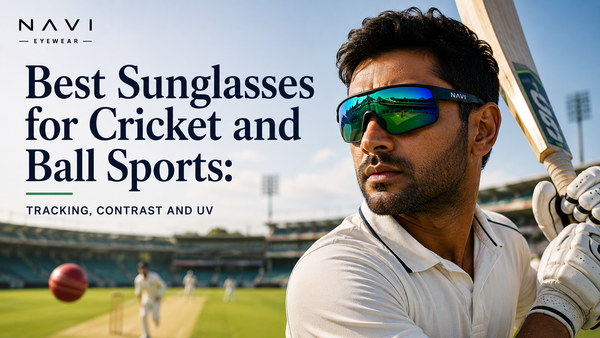

Best Sunglasses for Cricket and Ball Sports: Tracking, Contrast and UV
Tracking a fast-moving ball against varied backgrounds is one of the most demanding visual tasks in sport. A cricket ball bowled at 90mph gives the batsman approximately 400 milliseconds from delivery to shot selection — a window in which the visual system must identify the ball, read its trajectory, detect spin, and execute a motor response. The margin between seeing the ball clearly and failing to do so is the margin between a productive innings and an early dismissal.
The right sunglasses make ball tracking measurably easier. Not through any optical trick, but through the specific contrast-enhancing properties of amber and yellow tints that increase the apparent brightness difference between a fast-moving ball and the backgrounds it passes through: grass, sky, crowd, and pavilion. The wrong sunglasses — or no sunglasses at all — leave the batsman squinting against bright sky or losing the ball against a grey overcast background where contrast is minimal.
This is a C10 Sport Performance Deep Dives supporting post. For the tint science in depth — the spectral mechanism of why amber enhances contrast for ball tracking — seethe complete guide to cycling sunglasses (Part 6 covers the full tint guide) andthe science of lens color and what tint does your vision need. For the UV protection case across outdoor sport, seethe complete outdoor and sport sunglasses guide.

The Ball Tracking Visual Challenge
Why Ball Sports Are Uniquely Demanding
Ball sports place a specific and demanding requirement on the visual system: they require high-speed contrast detection of a moving object against rapidly changing backgrounds. A batsman at the crease must track a red, white, or pink ball against backgrounds that change within a single delivery: the bowler’s run-up against the crowd, the delivery against the sky and sightscreen, the bounce against the pitch surface, and the flight off the edge against the slip cordon. Each background change requires an instantaneous contrast recalibration by the visual system.
Lens tints that enhance contrast reduce the visual system’s work in this recalibration. Amber and yellow tints filter the short-wavelength blue scatter that reduces the contrast of moving objects in most outdoor conditions. The result is that ball edges, flight paths, and spin directions are more visually distinct than under natural light — not dramatically, but measurably, particularly in the lower-contrast conditions of overcast sky or flat pitch light where ball tracking is hardest.
The Low Sun Problem
The most severe ball tracking challenge in cricket and many other outdoor ball sports is the low-angle sun of morning and late afternoon play. Bowling or serving into a low sun creates a situation where the ball is visible for the first part of its trajectory and then temporarily lost against the solar glare. This is the most dangerous visual situation in cricket batting: the ball is invisible for a critical fraction of a second during the delivery. Polarized lenses help with horizontal reflected glare, but they do not address the direct sun source. For low sun conditions, a brimmed cap combined with amber or brown UV400 sunglasses provides the best available visual environment. The overall glare and performance science is inhow sunglasses affect your mood, focus and mental wellbeing.
Sunglasses for Cricket: Position-Specific Requirements
Batting: Contrast and Ball-Tracking Priority
Batting is the position where sunglasses most directly affect performance. The batsman faces the ball delivery from rest and must track it from the bowler’s hand through its full flight and bounce. Amber tinted UV400 lenses at Category 2 (18–43% VLT) are the recommended batting specification: they enhance ball contrast against grass, pitch, and sky backgrounds without darkening the visual environment to the point where ball tracking in shadow is affected. The amber tint’s blue-scatter filtering specifically improves the contrast of the red cricket ball against green and brown backgrounds — the most common batting tracking scenario.
Fielding: UV Protection and Glare Management
Fielders spend extended periods in open sunshine without the shelter a batting crease position provides, and are the players most at risk of cumulative UV exposure during a day’s play. UV400 polarized lenses are recommended for fielding: the polarization eliminates reflected glare from the pitch surface and wet outfield that can produce momentary visual disruption on a skied catch or a ball running through the field. Category 2–3 UV400 with polarization is the fielding specification. For close catchers and slip fielders who need maximum visual acuity for edge-detecting, non-polarized amber at Category 2 is preferred by many players.
Wicket-Keeping: The Toughest Visual Position
Wicket-keepers are the most visually challenged players on the field. They must track every delivery from a crouched position behind the stumps, reading the ball from the bowler, through the air, off the bat or pad, and to their gloves — continuously for the duration of a full day’s play. This is 6–8 hours of concentrated ball tracking in full outdoor UV exposure. UV400 amber at Category 2 is the recommended wicket-keeping lens: light enough to maintain visibility throughout the day, contrast-enhancing for ball tracking, and UV400 certified for the extended outdoor exposure that the position demands.
Bowling: Low Priority but Still Important
Bowlers face into the batting end during delivery, often into the sun at certain times of day. UV400 protection and glare management matter, but the visual demands of ball tracking are less acute during bowling than batting or keeping. Any quality UV400 Category 2–3 lens is appropriate for bowling. Bowlers should be aware of the UV accumulation over a full day’s play and the total fielding time that contributes to their session UV dose.
The Lens Tint Breakdown for Ball Sports
|
Tint |
VLT |
Ball Sport Application |
Why It Works |
|
Amber / Brown |
18–43% (Cat 2) |
Cricket batting, baseball hitting, tennis baseline play |
Blue-scatter filtering enhances ball contrast against grass and sky; warm tones improve red/yellow ball visibility |
|
Yellow / Orange |
40–80% (Cat 1–2) |
Overcast cricket, indoor tennis, grey-sky ball sports |
Maximum contrast in low-light; restores edge definition when flat light removes shadow contrast |
|
Gray |
8–18% (Cat 3) |
Fielding in bright sun, outdoor spectator use |
Neutral darkness for overall brightness reduction; polarized version eliminates surface glare |
|
Rose / Pink |
25–45% (Cat 2) |
Variable light cricket, tennis in changing conditions |
Contrast enhancement at lighter VLT; good for changing cloud and sun conditions within a match |
|
Clear / Very Light |
80–100% (Cat 0) |
Indoor sports halls, early morning low light |
Debris and wind protection without any optical density; UV400 still required |
Cricket-Specific Considerations
The Red vs White vs Pink Ball
Cricket uses three ball colours depending on format: red (Test and first-class cricket), white (limited-overs day cricket and floodlit matches), and pink (day-night Tests). Each colour has different contrast characteristics against typical backgrounds. Red balls against green outfields: amber tints enhance this contrast specifically. White balls against blue sky and coloured kit: amber provides less relative advantage; gray provides adequate brightness management. Pink balls under floodlights or at dusk: yellow or light amber tints improve visibility in the lower-contrast light of the transition period between day and floodlit play.
Cricket UV Exposure: Longer Than You Think
A full county cricket day involves up to six hours of outdoor play in open conditions, plus warm-up, drinks breaks, and intervals — potentially eight or more hours of UV exposure for a player in the field. A Test match is five days of this. Regular first-class and amateur cricketers accumulate very high lifetime UV doses, particularly those who play through summer seasons in high-UV climates — Australia, the Caribbean, South Asia, and South Africa. The cumulative UV disease risk for regular outdoor ball sport players is meaningful and addressed inUV and eye disease: the complete guide.
Hat and Helmet Compatibility
Cricket helmets are mandatory for batting and close fielding positions. Sunglasses worn under a batting helmet must sit below the helmet grille and clear the peak without pressing against the face. Wraparound designs with moderately curved temples and a slim profile above the lens work best under a batting helmet. Cricket caps worn in the field have a significant brim that provides overhead UV reduction — the combination of UV400 sunglasses and a cap is particularly effective for fielders.
Tennis, Baseball, and Other Ball Sports
Tennis
Tennis players face the ball tracking challenge on both forehand and backhand groundstrokes from the baseline, at the net, and on the serve return — each with a different ball trajectory and background. The most challenging scenario in tennis is the serve return against a low-angle sun, where the ball is briefly lost against the solar glare. Amber at Category 2 is the recommended baseline tint for tennis: it enhances the yellow ball’s contrast against the court surface and varied backgrounds. Some players prefer the lighter Category 1 amber for indoor and overcast conditions. The very fast lateral head movement of rally play means that secure, close-fitting frames that do not shift during rapid directional changes are essential.
Baseball and Softball
Baseball and softball share cricket’s fly ball tracking challenge: fielders must track pop flies and line drives against sky backgrounds, often directly into the sun or at low sun angles. The traditional solution — the flip-down tinted visor on a baseball cap — is still widely used at amateur level. Amber and copper polarized UV400 sunglasses provide the same contrast enhancement and add polarization for reflective surface glare on wet outfields. For batting: amber UV400 for ball-tracking contrast. For outfield: amber or copper polarized for fly-ball tracking against sky.
Football (Soccer) and Rugby
Ball sports where sunglasses are less commonly worn due to contact risk, but UV exposure is significant for outdoor players in sun-exposed positions. Goalkeepers and back-line players in football who face the sun for extended periods benefit from UV400 eye protection. Lightweight wraparound designs with polycarbonate impact-resistant lenses are appropriate. For contact sports, the risk of lens or frame contact injury should be assessed — soft sport-specific frames designed to flex and not shatter on impact are preferable.
Browse theNavi Eyewear UV400 polarized collection for quality UV400 polarized sunglasses suitable for cricket, tennis, and outdoor ball sports. All Navi lenses are polycarbonate UV400 — impact-resistant and UV-certified for extended outdoor sport use.
Frame Requirements for Ball Sports
|
Secure Fit During Rapid Movement Specification: Rubberised nose pad and temple grips; close-fitting wraparound Ball sports involve rapid head movements — tracking a ball requires the head to follow the delivery, flight, and bounce in a single smooth motion. Sunglasses that shift position during this tracking movement disrupt the visual field at exactly the wrong moment. Rubberised nose pad grips and rubberised temple tips that maintain position on sweaty skin are essential for any ball sport use. The frame must stay where it was set without any conscious adjustment during play. |
|
Lightweight Construction Specification: TR90 nylon or Grilamid frame; polycarbonate lenses A heavy sunglass frame becomes a pressure load over a full day’s play. For cricket specifically — where a player might wear sunglasses for six hours of fielding — frame weight is a meaningful comfort factor. TR90 nylon and Grilamid are the lightest structural frame materials available. Polycarbonate lenses are lighter than glass and significantly lighter than some CR-39 designs. The lightweight frame assessment is covered in the context of any sport frame purchase inthe complete sunglasses buying guide. |
|
Polycarbonate Lens Material Specification: UV400 polycarbonate — impact resistant throughout Ball sports carry a specific impact risk that most other sports do not: a ball travelling at speed can strike the lens directly. A cricket ball at short leg, a baseball on an infield hop, a tennis ball on a disputed volley — each presents a lens impact scenario. Polycarbonate lenses absorb impacts without shattering, providing the impact protection that CR-39 and glass lenses do not. The inherent UV protection of polycarbonate — built into the material, not a surface coating — is also specifically valuable for ball sport use where years of play accumulate significant UV. The lens material science is inhow sunglass lenses actually work. |
Frequently Asked Questions
What are the best sunglasses for cricket?
Amber or yellow UV400 polycarbonate lenses in a lightweight, close-fitting TR90 frame with rubberised grip. For batting: amber Category 2 (18–43% VLT) — the tint most directly enhances ball contrast against grass and sky backgrounds. For fielding: amber or brown polarized UV400 for glare elimination alongside contrast. For wicket-keeping: amber Category 2, non-polarized for maximum visual clarity. The full tint science and why amber specifically benefits cricket is inthe science of lens color and what tint does your vision need.
Do sunglasses help with batting in cricket?
Yes — in specific and measurable ways. Amber tinted lenses enhance the visual contrast of the ball against grass, pitch, and sky backgrounds, making the ball easier to track from the bowler’s hand through its flight and bounce. They reduce squinting in bright conditions, which affects head position and movement pattern consistency. They eliminate the low-angle sun glare that temporarily obscures the ball during certain delivery angles. The overall effect is a more stable, comfortable visual environment for the full duration of an innings.
Should cricket players wear polarized sunglasses?
For fielding: yes, polarized UV400 is recommended — it eliminates reflected glare from the pitch surface and wet outfield that can disrupt concentration and produce momentary visual disturbance. For batting and wicket-keeping: many professional players prefer non-polarized amber lenses, because polarization filters some of the surface reflections that carry information about ball trajectory and pitch condition. The compromise: brown or amber polarized provides glare elimination alongside contrast enhancement, performing better for batting than gray polarized.
What lens color is best for cricket batting?
Amber or yellow. Amber (Category 2, 18–43% VLT) for most conditions — bright sun, partially overcast, or variable cloud. The amber tint filters blue scatter to enhance the contrast of the red or pink ball against green and brown backgrounds. Yellow (Category 1, 43–80% VLT) for very overcast, flat-light conditions where amber would be slightly too dark and where contrast enhancement of the ball is the primary need rather than brightness reduction.
Are there professional cricketers who wear sunglasses while batting?
Yes — several prominent professional cricketers have used tinted amber or yellow lenses while batting, particularly players from high-UV cricket nations including Australia and the West Indies. The practice is more common in women’s cricket where helmets without a fixed metal grille allow more comfortable sunglass integration. Many batting coaches now recommend UV400 amber sunglasses for batting practice in bright conditions as a standard approach to reducing squinting and improving ball visibility.
What is the best UV protection for outdoor ball sport players?
UV400 polycarbonate lenses, worn consistently for all outdoor play regardless of cloud cover. Ball sport players in full-day outdoor conditions — cricketers, tennis players, baseball players, and footballers in sun-exposed positions — accumulate very high lifetime UV doses. The UV eye disease risk from years of outdoor sport without protection is real: cataracts, macular degeneration, and pterygium are all more common in people with high outdoor exposure histories. The complete UV disease picture is inUV and eye disease: the complete guide.
Can I wear sunglasses for tennis?
Yes — amber UV400 at Category 2 is the recommended tennis lens. The yellow ball’s contrast against clay, hard court, and grass backgrounds is enhanced by amber’s blue-scatter filtering. Frames must be close-fitting with secure rubber grips to stay in position during rapid lateral head movements. Some competitive tennis players avoid sunglasses because they are unaccustomed to them, but the evidence for contrast enhancement in ball tracking sports supports their use when the player has time to adapt. The prescription sunglasses option is relevant for players who wear glasses, covered inthe complete guide to prescription sunglasses.
What sunglasses do baseball players use?
Baseball players use several solutions for different positions. Batters most commonly use amber or copper polarized UV400 for ball contrast at the plate. Outfielders use amber or gray polarized for fly ball tracking and glare from grass surfaces. Infielders often use amber without polarization for maximum visual clarity on ground balls and line drives. The flip-down tinted flip — a partial amber filter clipped to the helmet brim — remains the most common solution for batters in professional baseball because it integrates with the existing helmet setup.
Do sunglasses affect depth perception in ball sports?
Amber and brown tinted lenses at Category 2 density do not meaningfully affect depth perception in normal outdoor conditions. Very dark lenses (Category 3 and above) reduce the luminance of the visual environment to a point where depth cues become subtly harder to read — this is why Category 2 rather than Category 3 is the recommended density for batting and ball-tracking positions. Gray polarized lenses can affect surface reflection-based depth cues slightly in specific situations, which is one reason some cricket batters prefer non-polarized amber for the crease.
How important is UV protection for cricket and ball sport players?
Very — for players who spend full days playing in outdoor conditions, UV protection is one of the most important long-term health considerations. A regular cricket player who plays throughout a season accumulates UV doses equivalent to or exceeding those of many outdoor workers. Over a career spanning 10–20 years of regular play, this is a substantial cumulative UV burden. The diseases it drives — cataracts, age-related macular degeneration, and pterygium — are all more common in populations with high outdoor UV exposure. UV400 polycarbonate sunglasses worn consistently throughout outdoor play represent a meaningful long-term investment in eye health. Browse quality UV400 options atNavi Eyewear’s UV400 polarized collection.
What sunglasses are safe for contact ball sports like football?
For contact sports where ball or physical contact with the face is possible, polycarbonate lenses are essential — they are impact-resistant and will not shatter on contact. Frames should be flexible and without sharp protrusions that could cause injury if the frame contacts the face under impact. Sport-specific frame designs with soft-edge construction reduce the injury risk if the frame is struck. For sports where frequent contact makes any eyewear a safety concern, the risk-benefit trade-off should be discussed with a sports medicine professional. The general sport frame selection guide is inthe complete outdoor and sport sunglasses guide.
SOURCES & CITATIONS[1] De Faber JT, Naeser K, Kessing SV.“Polarized light and contrast sensitivity under glare conditions.”Ophthalmic Research, 2013.View source [2] Dain SJ.“Sunglasses and sunglass standards.”Clinical and Experimental Optometry, 2003.View source [3] Tanner DF, Kent JS, Jagger JD.“Spectral transmittance characteristics of commercially available UV-protective sunglass lenses.”Optometry and Vision Science, 2007.View source [4] Mainster MA, Turner PL.“Glare’s causes, consequences, and clinical challenges.”American Journal of Ophthalmology, 2012.View source [5] Rosenthal FS, Bakalian AE, Lou CQ, Taylor HR.“The effect of sunglasses on ocular exposure to ultraviolet radiation.”American Journal of Public Health, 1988.View source [6] Sliney DH.“UV radiation ocular exposure dosimetry.”Documenta Ophthalmologica, 1994.View source |