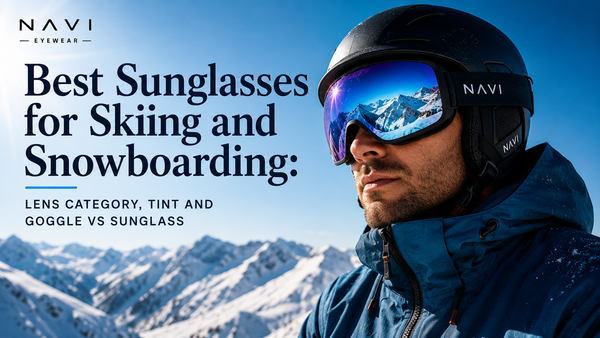

Best Sunglasses for Skiing and Snowboarding: Lens Category, Tint and Goggle vs Sunglass
The snow environment is among the highest UV environments that recreational users encounter anywhere on Earth. Snow reflects 80–90% of incident UV — among the highest reflectances of any natural surface. At altitude, the reduced atmospheric column above the mountain amplifies UV intensity by 10–12% per 1000 metres. A skier at 2500m on a clear alpine day is experiencing UV intensities several times higher than at sea level on a bright summer day, with those UV rays arriving from both above and below.
Yet skiing and snowboarding have among the lowest rates of consistent, correctly-specified eye protection of any UV-intensive sport. Many skiers wear Category 2 fashion sunglasses that are inadequate for the UV environment. Many snowboarders cycle between goggles on the mountain and no eye protection at the base or après ski. And almost everyone underestimates the overcast snow UV risk — grey skies reduce visible light dramatically but attenuate UV far less, creating a UV environment that can still cause photokeratitis within a session.
This is a C10 Sport Performance Deep Dives supporting post. For the photokeratitis science — what happens when snow UV exposure exceeds the eye’s protective capacity and the full mechanism of snow blindness — seephotokeratitis: snow blindness, welder’s flash and UV eye burns. For the cycling sunglasses pillar covering tint science in depth, seethe complete guide to cycling sunglasses. For the complete UV eye disease context, seeUV and eye disease: the complete guide.

The Snow UV Problem: Why the Mountain Is Different
Snow Reflectance: The UV Multiplier
Fresh snow reflects between 80 and 90% of UV that falls on it — significantly more than sand (15–25%), water (10–25%), or grass (2–6%). This means that on a snow-covered slope, UV reaches the eyes from two directions simultaneously: directly from the sun above, and reflected back from the snow surface below. The combined effect is an ambient UV environment that wraps around the orbital area in a way that no other common environment produces. Standard sunglasses that protect from above-horizon light but leave the lower field open provide meaningfully less protection in snow than their UV400 certification would suggest — the reflected UV from below enters through the gaps that standard frames leave at the bottom of the lens.
Altitude Amplification
UV increases approximately 10–12% per 1000 metres of altitude as the reduced atmospheric column above filters less UV. A typical intermediate ski resort at 1500–2000m adds 15–25% to baseline UV intensity. High-altitude alpine resorts at 2500–3000m add 25–36%. Glacier skiing above 3500m can produce UV intensities more than 40% above sea-level baseline. Combined with snow’s high reflectance, the total UV environment at altitude on snow is among the most intense that humans regularly encounter outside polar research stations.
The Overcast Myth
One of the most dangerous misconceptions in snow sport: that grey, overcast skies mean lower UV. Cloud cover reduces visible light dramatically — the mountain feels darker and less dazzling. But cloud attenuates UV far less efficiently than visible light. An overcast day at altitude can still transmit 50–70% of the UVB that a clear day delivers. Combined with snow’s reflectance, a flat-light overcast day on a snowfield is still a high-UV environment capable of causing photokeratitis within a session and accumulating meaningful cataract-driving UV. The photokeratitis mechanism and the overcast snow blindness risk are covered in full inphotokeratitis: snow blindness, welder’s flash and UV eye burns.
Lens Category Requirements for Snow Sports
|
⚠ Category Minimum Requirements for Snow Environments Ski resort conditions (1000–2500m, typical alpine): Category 3 minimum (8–18% VLT). Category 2 fashion sunglasses are inadequate. High-altitude and glacier conditions (above 2500m): Category 4 (3–8% VLT) or fully-enclosed ski goggles with equivalent filter. Base village and resort on-snow areas at low altitude: Category 2–3 depending on brightness. Overcast flat-light days: do not drop below Category 2 even in flat light — the UV is still present. Use a contrast-enhancing tint (amber/yellow) rather than reducing lens category. |
|
Environment |
Altitude |
UV Intensity |
Min. Category |
Recommended Tint |
|
Ski resort — bright sun |
1000–2500m |
Very high (snow + altitude) |
Cat 3 |
Gray or brown |
|
Ski resort — flat light/overcast |
1000–2500m |
High (overcast doesn’t reduce UV much) |
Cat 2 |
Amber or yellow |
|
High alpine / glacier |
Above 2500m |
Extreme |
Cat 4 or goggles |
Dark gray or mirror |
|
Snowboard park / halfpipe |
Variable |
High |
Cat 3 |
Amber or gray |
|
Resort base / village |
Below 1000m |
Moderate-high |
Cat 2–3 |
Any UV400 |
|
Nordic / cross-country |
Variable, flat terrain |
High (snow reflection) |
Cat 3 |
Gray polarized |
|
Snowshoeing / winter hiking |
Variable |
High (snow + open sky) |
Cat 3 |
Gray or amber |
Goggle vs Sunglasses: Which Should You Choose?
When Goggles Are the Right Choice
Ski goggles provide protection that sunglasses cannot match in specific conditions. They seal against the face, eliminating all peripheral UV entry including the reflected-from-below UV that standard sunglasses allow through the frame gap. They provide full wind protection at descent speeds, preventing the rapid tear evaporation that produces the stinging, burning eye discomfort of high-speed skiing without protection. They offer impact protection across the full orbital area. And they integrate with ski helmets through the over-the-goggle (OTG) design and the goggle-to-helmet interface that prevents the gap between goggle frame and helmet brim that allows cold air and UV entry from above.
When Sunglasses Are the Right Choice
The OTG (Over-the-Glasses) Question for Prescription Wearers
Skiers and snowboarders who wear prescription glasses have three options: prescription goggles (customised with their prescription, optimal but expensive), OTG goggles specifically sized to fit over prescription frames (widely available and the most common practical solution), and contact lenses plus standard goggles or sunglasses (eliminates the two-eyewear problem but requires contact lens tolerance in cold, dry conditions). The full guide to prescription wearers’ options including OTG designs is inbest sunglasses for glasses wearers: OTG and clip-on options.
Lens Tint Guide for Snow Sports
|
Gray — Bright Sunshine on Piste VLT: 8–18% VLT (Category 3) Best conditions: Bright sun, high-contrast piste, blue-sky days Gray is the go-to tint for bright alpine days with good visibility. It reduces overall brightness without colour shift, preserving the natural contrast of the piste surface and the colour accuracy of sky, snow, and terrain. Gray polarized reduces reflected glare from flat snow sections and icy patches. The limitation: gray provides no contrast enhancement in flat-light conditions — when shadows disappear from the snow surface under overcast sky, gray makes reading terrain bumps and variable snow harder rather than easier. |
|
Amber / Brown — Variable and Overcast Conditions VLT: 18–43% VLT (Category 2) Best conditions: Overcast, variable cloud, mixed conditions Amber and brown are the contrast-enhancing tints for skiing in variable or flat-light conditions. By filtering blue scatter, they increase the apparent contrast of snow surface features — bumps, shadows, terrain changes — that become invisible under flat, diffuse overcast light with a gray lens. Many experienced skiers keep an amber lens specifically for overcast days and switch to gray for bright sun. Amber at Category 2 VLT also maintains adequate light transmission for use in lower light without becoming uncomfortably dark. For the full tint science and how blue-scatter filtering affects terrain contrast, seethe science of lens color and what tint does your vision need. |
|
Yellow / Orange — Flat Light and Heavy Overcast VLT: 55–80% VLT (Category 0–1) Best conditions: Heavy overcast, fog, whiteout conditions Yellow lenses maximise contrast in the flattest light conditions. On a grey, foggy mountain where the horizon between snow and sky is almost invisible, yellow’s blue-scatter filtration restores some of the shadow contrast that makes terrain features visible. Very low VLT versions provide almost no UV protection, so UV filtering needs to be confirmed specifically for any yellow ski lens. Higher-quality yellow-tinted lenses at Category 1 (43–80% VLT) provide both contrast enhancement and meaningful UV protection — the key is verifying UV400 certification even in light tints. |
|
Mirror Coatings — High-Altitude and Glacier Use VLT: Variable base lens VLT + mirror reduces effective VLT further Best conditions: Glacier, extreme altitude, very bright conditions Mirror coatings reflect additional light from the outer lens surface, effectively reducing the VLT of the base lens. They are used in the highest UV environments — glacier skiing, extreme alpine, and polar conditions — where even a Category 3 base lens needs further brightness reduction. Mirror coatings do not add UV protection — the UV blocking remains determined by the base lens certification. A mirrored lens with UV400 certification provides the same UV protection as the equivalent non-mirrored UV400 lens. The mirror coating science is covered inlens coatings explained: anti-reflective, hydrophobic, mirror and more. |
|
Photochromic — Variable Alpine Conditions VLT: Adaptive: typically 20–80% VLT range Best conditions: Mixed-light resort skiing, commuting between piste and lift/village Photochromic ski lenses adapt to light conditions — darkening in bright sun and clearing under overcast or in lift shade. For resort skiing with varied lighting, photochromic lenses eliminate the need to carry and swap lenses. The limitation for skiing specifically: photochromic lenses adapt relatively slowly (30–60 seconds to fully darken) and may not keep pace with the rapid light transitions of high-speed descent through variable piste conditions. Premium photochromic ski lenses with faster adaptation address this better than budget versions. |
Key Frame Specifications for Snow Sports
Full Coverage and Face Sealing
Unlike most other sports, snow protection benefits specifically from lenses and frames that minimise gaps — both for UV protection from below-horizon reflected snow UV, and for wind protection at speed. Ski goggles achieve this completely. Sunglasses for snow use should have a close-fitting wraparound design with minimal frame gap at the cheekbone and brow. The difference between a standard fashion sunglass and a sport wraparound in terms of peripheral UV protection at the nasal limbus — the specific mechanism identified by Coroneo research — is particularly significant in snow environments where UV enters from all directions.
Anti-Fog Ventilation
Temperature differential between the face (warm from exertion) and the air (cold at altitude) creates rapid lens fogging when ventilation is inadequate. Ski goggle manufacturers invest heavily in ventilation engineering — multiple vent channels, anti-fog lens coatings, and double-lens construction that insulates the inner lens surface from cold air. For sunglasses worn in ski environments, anti-fog hydrophobic coatings and brow ventilation reduce but do not eliminate the fogging that goggles manage more completely.
Secure Fit at Speed
At high-speed skiing and snowboarding, a sunglass that shifts position even slightly provides inconsistent UV protection (gaps appear and disappear) and visual disruption. Rubberised nose pads and temple grips, secure lens retention in the frame, and temple design that integrates with helmet straps are all important for on-piste sunglass security. For goggles, the strap tension and foam seal ensure position stability at any speed.
Browse theNavi Eyewear UV400 polarized collection for quality UV400 polarized sunglasses appropriate for ski resort base areas and moderate on-snow conditions. For high-altitude and on-piste use in the conditions described in this guide, purpose-built ski goggles meeting EN ISO 12312-1 are the recommended primary protection.
Frequently Asked Questions
What category sunglasses do I need for skiing?
Category 3 (8–18% VLT) is the minimum for standard ski resort conditions at 1000–2500m. Category 2 fashion sunglasses are inadequate — they transmit too much UV and visible light for alpine snow environments. For high-altitude and glacier skiing above 2500m, Category 4 (3–8% VLT) or purpose-built ski goggles meeting EN ISO 12312-1 are appropriate. The UV environment at ski resort altitude with snow reflection is several times more intense than at sea level on a bright summer day, which is why Category 3 is the minimum rather than the recommended.
Can I wear sunglasses instead of goggles for skiing?
For moderate-speed skiing at resort altitude in good visibility conditions, Category 3 UV400 wraparound sunglasses provide adequate UV protection. For high-speed on-piste skiing, powder conditions with debris risk, high-altitude or glacier environments, children, or any conditions involving wind and precipitation, goggles provide meaningfully better protection through full face sealing and impact coverage. Many experienced skiers use goggles on-piste and switch to sunglasses at the base village and on chairlifts. The overcast-day risk applies equally to sunglasses: do not drop to Category 2 just because the sky is grey.
Can you get snow blindness on a cloudy day?
Yes — this is one of the most important and least understood snow sport safety facts. Cloud cover reduces visible light dramatically, making the mountain feel dimmer. But cloud attenuates UVB far less efficiently than visible light — an overcast sky at altitude can still transmit 50–70% of clear-sky UVB. Combined with snow’s 80–90% UV reflectance, a flat-light overcast day on a snowfield remains a high-UV environment capable of causing photokeratitis within a session. Never ski without UV400 Category 3+ protection on the basis that the sky looks grey. The full photokeratitis science is inphotokeratitis: snow blindness, welder’s flash and UV eye burns.
What is the best lens tint for snowboarding?
Amber or brown for variable and overcast conditions — the most common snowboard environment where visibility into terrain features, park obstacles, and halfpipe edges matters. Gray for bright, high-sun conditions in open alpine terrain. Yellow for flat-light, foggy, and twilight conditions where contrast is minimal without tint assistance. Photochromic for riders who move between varied light conditions and do not want to carry multiple lenses.
What lens color is best for skiing in flat light?
Amber or yellow. Flat-light conditions occur when overcast sky removes directional shadow from the snow surface, making terrain bumps, variable snow texture, and piste features very difficult to see. Amber tints restore contrast by filtering the blue-dominant flat light, revealing the subtle warm-cool contrast differences that define snow surface features. Yellow provides this effect at lighter VLT, appropriate for very dark flat-light conditions. Gray lenses provide no contrast enhancement in flat light and make terrain reading worse by reducing overall brightness without improving the relevant contrast cues.
Are polarized sunglasses good for skiing?
Polarized lenses are beneficial for ski resort base areas, flat slope sections, and any environment where reflected glare from wet or icy snow surfaces produces discomfort. On steep, variable terrain at speed, polarization is less important because glare elimination is secondary to terrain contrast. Many dedicated ski sunglass brands offer both polarized and non-polarized versions of their performance lenses. For ski resort everyday use, polarized Category 3 gray or amber is an excellent all-round specification.
Do I need UV400 sunglasses for skiing?
Absolutely — UV400 is the minimum certification for any ski or snow sport eyewear. The snow environment delivers some of the highest UV doses of any recreational activity through the combination of altitude amplification and snow’s high reflectance. Standard ‘fashion’ lenses without explicit UV400 certification may provide significantly less UV blocking than the alpine environment demands. Verify UV400 explicitly on any ski eyewear purchase. The broader UV eye disease risk from cumulative ski season UV exposure is inUV and eye disease: the complete guide.
What are the best goggles for skiing?
Quality ski goggles with UV400-certified lenses, adequate lens category for the intended altitude (Category 3 for resort, Category 4 for glacier), spherical or toric lens geometry for distortion-free peripheral vision, effective ventilation to prevent fogging, secure helmet integration, and a comfortable foam face interface. The major ski goggle brands — Oakley, Smith, Uvex, POC — all produce quality options across price tiers. Lens interchangeability is the most valuable practical feature — the ability to swap between bright-sun (gray/dark) and flat-light (amber/yellow) lenses within a day is the single biggest convenience upgrade from a fixed-lens goggle.
Can children wear sunglasses for skiing or do they need goggles?
Children should use goggles for on-piste skiing and snowboarding. Children fall more often than adults and face higher impact risk that goggles’ full orbital coverage addresses. Children’s eyes are also more UV-transparent than adults’, admitting more UV to the retina for the same ambient exposure — making the full sealing protection of goggles even more valuable. For resort base and lift areas, UV400 Category 3 sunglasses are appropriate. The children’s UV eye protection context is insunglasses for kids: UV protection from the start.
How do I stop ski goggles from fogging?
Fogging prevention in ski goggles: ensure ventilation channels are clear and not blocked by a neck gaiter or helmet brim; avoid wiping the inner lens surface (this removes the anti-fog coating); do not store goggles lens-down on a warm surface; when going inside, remove goggles and let them clear in ambient air rather than holding them close to the face; choose goggles with double-lens construction (insulated inner lens that is less affected by temperature differential). For persistent fogging, anti-fog sprays applied to the outer surface (not inner) can supplement the built-in anti-fog coating.
Should I buy ski goggles with interchangeable lenses?
Yes, if you ski in varied conditions — which most regular skiers do. The ability to swap a bright-sun gray lens for a flat-light amber or yellow lens in a day, or season-to-season, significantly extends the useful range of a single goggle frame. The cost of a second lens is typically much lower than a second complete goggle. For skiers who ski only in reliable bright-sun conditions, fixed-lens goggles at the appropriate category are simpler and often less expensive.
SOURCES & CITATIONS[1] Geis HP, Roy CR, Toomey S, et al..“Solar UVR exposures of three groups of outdoor workers on the Sunshine Coast, Queensland.”Health Physics, 1995.View source [2] Sliney DH.“UV radiation ocular exposure dosimetry.”Documenta Ophthalmologica, 1994.View source [3] Pitts DG, Cullen AP, Hacker PD.“Ocular effects of ultraviolet radiation from 295 to 365 nm.”Investigative Ophthalmology and Visual Science, 1977.View source [4] Dain SJ.“Sunglasses and sunglass standards.”Clinical and Experimental Optometry, 2003.View source [5] Tanner DF, Kent JS, Jagger JD.“Spectral transmittance characteristics of commercially available UV-protective sunglass lenses.”Optometry and Vision Science, 2007.View source [6] Rosenthal FS, Bakalian AE, Lou CQ, Taylor HR.“The effect of sunglasses on ocular exposure to ultraviolet radiation.”American Journal of Public Health, 1988.View source [7] World Health Organization.“Solar ultraviolet radiation: global burden of disease from solar ultraviolet radiation.”WHO Environmental Burden of Disease Series, 2006.View source |