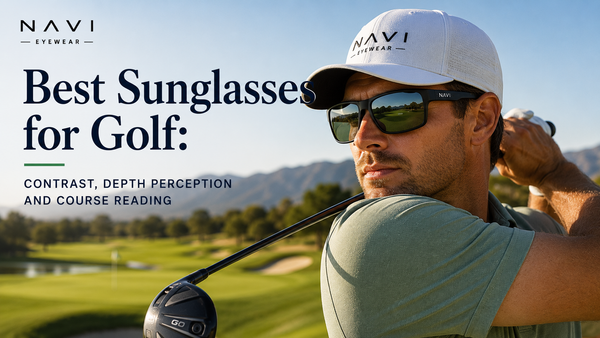

Best Sunglasses for Golf: Contrast, Depth Perception and Course Reading
Golf is one of the few sports where eyewear can meaningfully affect performance rather than simply protect against UV and debris. The visual tasks of golf — reading green contours and grass grain direction, judging distances across fairways, tracking a small white ball against varied sky and course backgrounds — are all contrast and depth perception challenges that the right lens tint directly addresses. The wrong tint reduces performance. The right tint improves it.
This is not marketing language. The contrast-enhancing properties of amber and brown tinted lenses have a clear spectral basis: they filter short-wavelength blue scatter that reduces the sharpness of green-grass edges and terrain contours, producing a visual environment where the features that define a golf course are more legible. Combined with appropriate UV protection for a sport that involves four to five hours of open-sky outdoor exposure per round, the right golf sunglasses are both a performance and a health investment.
This is a C10 Sport Performance Deep Dives supporting post. For the complete sport sunglasses science including UV accumulation in outdoor sport, seethe complete outdoor and sport sunglasses guide. For the cycling pillar covering the same lens tint science in depth, seethe complete guide to cycling sunglasses. For why UV400 matters for any outdoor sport, seethe complete guide to UV eye protection.

The Visual Demands of Golf: What the Eye Is Actually Doing
Green Reading
Reading a putting green is fundamentally a contrast task. The golfer must identify subtle elevation changes — often fractions of a degree over several metres — and grass grain direction (which affects ball roll) from a standing position at varying distances from the hole. These features are rendered by the visual system through the differential light reflection of bent and upright grass blades at different angles. Tints that reduce scatter and enhance the contrast between different grass orientations make these subtle features more legible. Amber and brown tints do this by filtering the short-wavelength blue light that scatters within the grass surface and reduces edge contrast.
Distance Judgement and Depth Perception
Distance judgement in golf — particularly across open fairways where standard depth cues like nearby objects and relative size are limited — depends heavily on atmospheric contrast. Haze and blue scatter reduce the apparent clarity of distant features, making it harder to judge distance accurately. Contrast-enhancing tints that reduce blue scatter improve the apparent clarity of distant greens, bunkers, and course features, supporting better distance judgement. This effect is most significant on hazy days and in high-humidity environments where blue scatter is greatest.
Ball Tracking
Tracking a golf ball from impact through flight to landing requires rapid contrast detection against varied backgrounds — blue sky, white cloud, green tree lines, and brown-green fairway. The optimal tint for ball tracking balances sufficient overall brightness reduction (to prevent squinting against a bright sky background) with contrast enhancement of a white ball against green and brown surroundings. Amber and brown tints provide this balance: they darken the sky background and enhance the contrast of the green-brown course terrain, both of which help ball tracking.
The Polarization Question for Golf
Polarization in golf is genuinely debated among serious players in a way that is not the case for most sports. The argument for polarization: it eliminates reflected glare from water hazards, wet fairways, and shiny pin markers that can disrupt the visual field and produce momentary glare. The argument against: some golfers report that polarized lenses affect their depth perception on greens, particularly for distance putting, because the polarization changes the way subtle surface reflections from the grass are perceived. This is a real and documented effect — polarization filters the same surface reflections that carry information about green contour and grain direction. The practical resolution: gray polarized lenses affect depth perception on greens more than brown/amber polarized, because gray does not provide the contrast enhancement that compensates for the lost reflection information. Brown or amber polarized lenses — which simultaneously eliminate glare and enhance contrast — work better for most golfers than gray polarized. Non-polarized amber is the traditional choice of many professional tour caddies who specifically avoid polarization for putting.
The Golf Lens Tint Guide
|
Amber / Brown — The Golf Standard VLT: 18–43% VLT (Category 2) Golf verdict: Strongly recommended — first choice for most golfers Amber and brown are the established performance tints for golf, used by tour players and club golfers alike. They filter blue scatter to enhance the contrast of green grass, terrain contours, and course features. The visual effect on a golf course: greens appear more clearly defined, grain direction is more legible, fairway contouring is more distinct. Brown also enhances the warmth of the overall color environment, which many golfers find more comfortable and natural over the duration of a round than the neutral reduction of gray. For reading greens: amber and brown are the recommended first choice. For ball tracking: both work well. For distance judgement on hazy days: amber’s blue-scatter reduction provides the best atmospheric clarity. The full tint science is inthe science of lens color and what tint does your vision need. |
|
Gray — Neutral Option, Polarized for Water Courses VLT: 8–18% VLT (Category 3) Golf verdict: Acceptable — best for courses with significant water features in bright conditions Gray lenses reduce overall brightness evenly without shifting color balance. For golf specifically, this is a limitation: the lack of contrast enhancement means green reading and terrain contouring are not improved beyond what natural vision provides. Gray polarized lenses are useful for courses with significant water hazards where glare is a genuine problem, and for morning tee times when low sun angles produce glare from dew-wet fairways. For most golf use, amber or brown provides meaningfully better contrast performance than gray. |
|
Rose / Copper — Variable Light Specialist VLT: 25–45% VLT (Category 2) Golf verdict: Recommended for overcast rounds and early/late light Rose and copper tints provide the contrast benefits of amber at lighter densities, making them suitable for overcast rounds, evening twilight golf, and any condition where Category 3 brown or gray would be too dark. The blue-scatter filtering is similar to amber; the lighter VLT maintains adequate brightness in lower-light conditions. Rose is particularly effective in the specific light condition of flat, diffuse overcast — where shadows disappear from the green surface and reading becomes harder — because it restores some of the warm-cool contrast that would otherwise be lost. |
|
Yellow — Low-Light and Dusk Golf VLT: 55–80% VLT (Category 0–1) Golf verdict: Specialist only — dawn, dusk, or very overcast conditions Yellow lenses provide maximum light transmission with mild blue-scatter reduction. For dawn and dusk golf where the primary concern is maintaining adequate light for ball tracking rather than UV protection, yellow lenses provide the contrast of a tinted lens without the darkness that would reduce visibility. Not suitable for conditions where significant UV is present — Category 0 provides minimal UV protection and is appropriate only as a wind and debris barrier in low-UV light. |
UV Protection for Golf: Why the Round Is Longer Than You Think
A standard 18-hole round takes four to five hours to complete. Walking rounds are closer to five hours; buggy rounds can be completed in under four. For most golfers playing in the middle of the day, this represents a four-to-five hour block of open-sky UV exposure with minimal natural shade on many courses. Golf courses in sunny climates — the Mediterranean, Florida, California, the Arabian Gulf, Southeast Asia, and Australia — deliver UV doses during a round that are equivalent to a full beach day in terms of cumulative ocular UV. Regular golfers playing two or three rounds per week in these conditions accumulate very high lifetime UV doses.
UV400 certification is the non-negotiable baseline for any golf sunglass. The cumulative UV from years of regular golf contributes meaningfully to the lifetime UV dose that drives cataracts and age-related macular degeneration. The full UV eye disease science and what regular outdoor sports exposure means for long-term ocular health is inUV and eye disease: the complete guide.
Frame Requirements for Golf
Minimal Frame Intrusion on Peripheral Vision
Golf requires peripheral vision awareness during setup, swing, and ball tracking. A frame that intrudes into the peripheral visual field — particularly at the bottom of the lens near the cheekbone — is distracting during the swing and can affect address position. Quality golf sunglasses use relatively thin frame rims and position the bottom lens edge higher on the face to leave the lower peripheral field clear. The ‘sport wrap’ design that works well for cycling can be slightly too enclosing for golf; many golfers prefer a slightly flatter design with minimal brow and temple hardware.
Lightweight and Secure Over a Full Round
Golf rounds are long and physically variable — walking, riding, standing, crouching for putting reads, and hitting shots from multiple addresses. Sunglasses must stay secure throughout without the pressure points that build up over four to five hours of wear. Rubberised nose pad and temple tips that maintain grip without pressure are the key comfort features. Lightweight TR90 or similar frames minimise the load on the nose and temples over the duration of a round.
Hat and Visor Compatibility
Most golfers wear a cap or visor during play, which affects both the UV environment and the sunglass fit. A cap brim provides meaningful UV reduction to the superior eye, reducing the UV entering from above — which is one reason a cap-plus-UV400-sunglasses combination is particularly effective for golf. The sunglass frame must sit below the visor brim without conflict, and the temple arms must not press against the cap band. Frames with relatively short, curved temple arms that sit close to the head work best with golf caps.
Do Pro Golfers Wear Sunglasses on Tour?
The majority of PGA Tour and European Tour professionals do not wear sunglasses during competitive play. This is primarily not a vision preference but a superstition and routine factor: tour professionals play in the same standardised visual environment they practised in, and changing any element of that environment — including introducing sunglasses — is considered a swing variable to be avoided. Some tour professionals do wear tinted lenses routinely, particularly those who grew up playing in high-UV climates.
For recreational golfers, the visual performance benefit of amber tinted UV400 sunglasses — better green reading, better distance judgement on hazy days, reduced squinting that affects concentration — outweighs any adaptation concern. The squinting-reduction benefit in particular is relevant: squinting affects facial muscle tension that many recreational golfers find interferes with their swing rhythm and pre-shot routine. The research on how squinting affects mood and focus through the facial feedback mechanism is inhow sunglasses affect your mood, focus and mental wellbeing.
Browse theNavi Eyewear UV400 polarized collection for quality UV400 sunglasses suitable for golf. For the complete outdoor sport UV protection context covering all the conditions that apply on the golf course, seethe complete outdoor and sport sunglasses guide.
Golf Conditions vs Lens Specification: Quick Reference
|
Condition |
Recommended Tint |
Polarized? |
Category |
Primary Benefit |
|
Bright sunny day, parkland course |
Brown/Amber |
Optional |
Cat 2–3 |
Green contrast, terrain definition |
|
Bright sun, coastal/links course |
Brown Polarized |
Yes |
Cat 2–3 |
Glare from water + green contrast |
|
Overcast, diffuse light |
Rose/Copper |
No |
Cat 2 |
Maintain contrast without over-darkening |
|
Morning/evening, low sun |
Amber or Rose |
Optional |
Cat 2 |
Ball tracking against low-angle sun |
|
Dawn/dusk, twilight round |
Yellow |
No |
Cat 0–1 |
Maximum visibility, wind/debris protection |
|
High-altitude/mountain course |
Brown Polarized |
Yes |
Cat 3 |
UV protection + terrain contrast at altitude |
Frequently Asked Questions
What is the best lens color for golf sunglasses?
Amber or brown is the established performance choice for most golf conditions. Both tints filter short-wavelength blue scatter that reduces the contrast of green surfaces, making terrain contours, grain direction on greens, and course features more legible. Brown provides a slightly warmer colour balance than amber and is often preferred for course reading. Rose or copper is the recommended alternative for overcast conditions and early/late light where brown would be too dark. The full lens colour science and how different tints affect different visual tasks is inthe science of lens color and what tint does your vision need.
Are polarized sunglasses good for golf?
It depends on how you prioritise glare elimination vs green-reading performance. Polarized lenses eliminate reflected glare from water hazards, wet fairways, and morning dew — genuinely useful on courses with significant water features or for morning tee times. The counterargument: polarized lenses filter surface reflections from the grass that carry information about green contour and grain direction, which some golfers find reduces the legibility of subtle green features. The compromise: brown or amber polarized lenses — which combine glare elimination with contrast enhancement — work better for golf than gray polarized, because the contrast enhancement partially compensates for the lost reflection information. Non-polarized amber remains the traditional preference of many serious golfers for green reading.
Do sunglasses improve golf performance?
Yes, in specific and measurable ways. Amber and brown tinted lenses enhance the contrast of green surfaces and terrain features, making green reading and distance judgement more accurate in many conditions. Eliminating squinting reduces facial muscle tension that can interfere with swing routine and pre-shot setup. Reducing glare from sand bunkers and water hazards removes the momentary visual disturbances that affect concentration during approach shots and putting reads. The performance effects are more subtle than in speed sports, but they are real and consistent with the spectral properties of the relevant tints.
Can sunglasses affect putting?
Potentially — in both directions. The right tint can improve putting by making green contours and grain direction more legible, reducing the squinting that affects stance and alignment, and eliminating glare from the green surface in bright conditions. The wrong tint — particularly very dark gray polarized lenses — can reduce depth perception on greens by filtering the surface reflections that carry contour information. Non-polarized amber or brown at Category 2 darkness is the optimal putting tint for most golfers. Some tour professionals prefer no glasses on the green for putting specifically, which is a valid choice if visual performance without glasses is the established baseline.
What UV protection do golfers need?
UV400 is the non-negotiable baseline. A standard 18-hole round represents four to five hours of open-sky UV exposure — equivalent in cumulative UV dose to a full beach session in the same UV conditions. Regular golfers playing multiple rounds per week in sunny climates accumulate very high lifetime UV doses that contribute meaningfully to cataract and macular degeneration risk. The cumulative UV disease picture and what regular outdoor sport exposure means for long-term eye health is inUV and eye disease: the complete guide.
Are there specific sunglasses designed for golf?
Yes — several major eyewear brands produce golf-specific sunglasses with amber or brown tinted lenses, lightweight frames, and minimal brow/temple hardware to reduce peripheral vision intrusion. Oakley, Callaway, and specialist golf eyewear brands market specifically to golfers. The key specifications (amber or brown UV400 with lightweight secure frames) can however be met by quality general sport sunglasses that are not specifically marketed for golf, often at lower cost with equivalent optical performance.
Should I wear sunglasses for golf in the UK?
Yes — for UV protection on any day the UV index is above 3, which occurs from March to October in the UK across most of the country. For performance, amber or rose tinted lenses specifically improve green reading in the variable, often overcast British light more than they do in the flat, bright sunshine that makes amber most commonly associated with continental European golf conditions. The UK UV context and the year-round UV case is inwinter sunglasses: why UV protection doesn’t stop in cold weather.
Can I wear prescription sunglasses for golf?
Yes — prescription sunglasses are available in amber and brown tinted lenses at Category 2 and 3 darkness, and provide full vision correction alongside the contrast enhancement that benefits golf performance. For golfers who currently play in clear prescription glasses, amber tinted prescription sunglasses represent a meaningful performance upgrade alongside UV protection. The full prescription sunglasses guide covering options and ordering is inthe complete guide to prescription sunglasses.
What frame style works best for golf?
Semi-rimless or thin full-rim designs with minimal lower frame that leaves the lower peripheral field unobstructed. Oval or slight wrap designs without extreme base curve — the aggressive wraparound that works for cycling and running can be slightly too enclosing for the varied head positions of golf. Lightweight TR90 or similar frame material. Rubberised nose pad and temple grips for security over a full four-to-five hour round. Cap/visor compatibility — relatively short temples that sit below and clear of the cap band.
Do sunglasses help with tracking the golf ball in flight?
Yes — amber and brown tints enhance the contrast of a white ball against green and brown course backgrounds (the most common tracking scenario on approach shots and from the fairway). Against a blue sky background, any tinted lens that reduces sky brightness helps ball tracking by reducing the luminance differential between the sky and the ball. The most challenging ball tracking scenario — a white ball against white cloud — is marginally helped by any darkness that reduces sky brightness and marginally reduced by very dark lenses that also reduce the ball’s apparent brightness. Category 2 amber is the optimal compromise for all-round ball tracking.
What are the best sunglasses for golf in bright sunshine?
Brown polarized UV400 at Category 2–3 darkness. The brown tint provides contrast enhancement for green reading, the polarization eliminates glare from water and wet grass, the Category 2–3 darkness provides adequate brightness reduction for bright conditions without over-darkening to the point of affecting depth perception. In the brightest conditions — Mediterranean summer golf, desert courses — Category 3 brown is preferable; for UK summer bright days, Category 2 provides better all-round performance. Browse quality UV400 options atNavi Eyewear’s polarized collection.
SOURCES & CITATIONS[1] De Faber JT, Naeser K, Kessing SV.“Polarized light and contrast sensitivity under glare conditions.”Ophthalmic Research, 2013.View source [2] Dain SJ.“Sunglasses and sunglass standards.”Clinical and Experimental Optometry, 2003.View source [3] Tanner DF, Kent JS, Jagger JD.“Spectral transmittance characteristics of commercially available UV-protective sunglass lenses.”Optometry and Vision Science, 2007.View source [4] Mainster MA, Turner PL.“Glare’s causes, consequences, and clinical challenges.”American Journal of Ophthalmology, 2012.View source [5] Rosenthal FS, Bakalian AE, Lou CQ, Taylor HR.“The effect of sunglasses on ocular exposure to ultraviolet radiation.”American Journal of Public Health, 1988.View source [6] Sliney DH.“UV radiation ocular exposure dosimetry.”Documenta Ophthalmologica, 1994.View source |