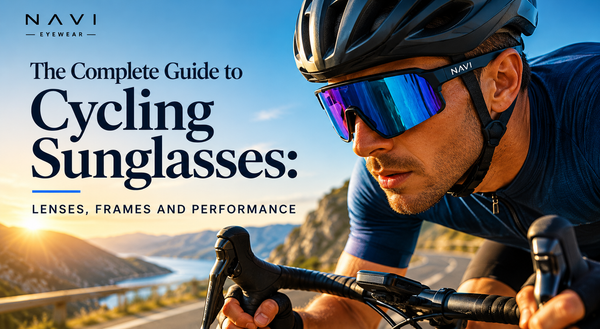

The Complete Guide to Cycling Sunglasses: Lenses, Frames and Performance
Cycling places more specific and demanding requirements on eyewear than almost any other sport. A road cyclist rides for four to six hours in conditions that change from bright midday sun to shaded woodland to grey overcast within a single session. Their eyes face wind at 30–40 km/h that causes rapid tear evaporation and dry eye discomfort. Insects and road debris travel toward the face at combined closing speeds exceeding 60 km/h. UV exposure over a long ride accumulates to levels equivalent to a day at the beach. And the glasses must integrate with a helmet, not interfere with peripheral vision during route reading, and stay secure through sweat, vibration, and the occasional crash.
For mountain bikers, the requirements shift: impact protection becomes primary, visibility into terrain shadow and forest shade demands contrast-enhancing tints, and the combination of a full-face helmet with glasses requires careful compatibility planning. For commuter cyclists, variable light from tunnel to bright road to dark underpass in minutes requires adaptive lens technology. For competitive cyclists, every gram and every millimetre of aerodynamic profile matters.
This guide covers all of it — the complete specification for every cycling discipline from the perspective of optics, UV protection, aerodynamics, fit, and long-term eye health. The physics of why cycling’s UV problem is more serious than most cyclists realise is covered in depth, alongside the practical lens, frame, and tint choices that address it.
This is the C10 Sport Performance Deep Dives pillar post. The supporting guides in this cluster cover specific sports in depth:best sunglasses for golf,best sunglasses for skiing and snowboarding,best sunglasses for fishing: the complete angler’s guide,best sunglasses for cricket and ball sports, andsunglasses for triathletes. The UV foundation and the general outdoor sport context are inthe complete outdoor and sport sunglasses guide andthe complete guide to UV eye protection.

Why Cycling Has the Most Demanding Eyewear Requirements of Any Land Sport
The UV Accumulation Problem
A four-hour road ride at moderate pace exposes the eyes to more UV than most recreational activities. The reasons are specific to cycling’s exposure profile:
The cumulative UV dose from consistent cycling without adequate protection — several hundred hours per year for regular riders — represents one of the highest UV accumulation profiles outside dedicated outdoor occupations. The diseases this UV drives over a lifetime are covered inUV and eye disease: the complete guide. UV400 certification is the non-negotiable baseline for any cycling eyewear.
The Wind and Debris Problem
Wind is the most immediately impactful environmental factor for cyclists beyond UV. At road cycling speeds of 30–40 km/h, even in still air, wind speed across the face is sufficient to rapidly dessicate the tear film and produce the gritty, irritated eyes that many cyclists experience within 30–60 minutes without eyewear. Add ambient wind to a descent at 60 km/h and the eye desiccation rate becomes significant within minutes. For cyclists with pre-existing dry eye, riding without glasses is genuinely uncomfortable from the first kilometre.
Beyond comfort, wind carries debris: insects, road grit, mud spray, and agricultural particulates that can strike the eye at high speed. Cyclists have a disproportionately high rate of eye foreign body injuries compared to most sports — the forward riding position and high speed combine to make the unprotected eye a target for anything the wind carries. The complete dry eye and outdoor environment interaction is insunglasses for dry eye: how UV, wind and glare make it worse.
The Visual Performance Problem
Cycling is a visually demanding activity. Road surface reading — identifying potholes, gravel patches, wet sections, and road markings at speed — requires high visual acuity and contrast sensitivity. Trail reading for mountain bikers requires rapid identification of surface texture, root and rock position, and elevation change in variable lighting conditions. Lens specification directly affects performance: the wrong tint reduces contrast exactly when it matters, and glare from road surfaces can temporarily mask hazards at critical moments.
Research on glare and driving performance — which is most directly comparable to road cycling in terms of the visual task — consistently shows that glare reduces hazard detection reaction time. The same mechanism operates for cyclists: road surface glare reduces contrast of the surface features that define hazards. Polarized lenses eliminate this glare, and contrast-enhancing tints improve the definition of surface features. The performance evidence for polarization in high-speed surface-reading tasks is inpolarized sunglasses: are they worth it.
Road Cycling — The Performance Specification
Lens Material: Polycarbonate as the Standard
Polycarbonate is the dominant lens material for road cycling sunglasses for three reasons: impact resistance, weight, and inherent UV protection. A crash at road cycling speeds brings the face into potential contact with the road surface, barriers, and other riders. Polycarbonate lenses absorb impacts without shattering — they may crack or deform, but they do not produce the sharp fragments that glass or even some CR-39 lenses can. The inherent UV protection of polycarbonate — built into the material throughout, not a surface coating — is also specifically valuable for cycling, where hours of accumulated UV exposure make the reliability of UV blocking over time important. For a detailed comparison of lens materials and how UV protection works differently in polycarbonate vs CR-39, seehow sunglass lenses actually work.
Base Curve and Wraparound Geometry
Road cycling sunglasses are almost universally high-base-curve wraparound designs — base 6–8 frames that curve to follow the face geometry. This is not simply aesthetic: the wraparound geometry provides wind protection from peripheral air ingress, reduces peripheral UV entry, improves aerodynamics by reducing the air resistance profile of the frame edges, and maintains stable lens position during the varied head angles of a road ride. The technical consequence of this geometry for prescription wearers is that standard prescription lenses cannot simply be dropped into high-wrap frames without a wrap-correction calculation — the curved lens introduces optical distortions that require compensation. This is why sport-specific prescription cycling sunglasses require specialist optical fitting.
Ventilation and Anti-Fog
Road cycling sunglasses must manage the significant temperature differential between a hard effort on the bike and coasting downhill in cold air. Without ventilation, lenses fog immediately on intensity changes. Quality cycling eyewear uses ventilated frame sections above and below the lens, or perforated lens edges, to maintain airflow across the lens surface that prevents condensation. For road cycling in cold and wet conditions, hydrophobic lens coatings that shed water droplets immediately are a significant performance feature — a lens covered in water spray on a wet descent provides essentially no usable vision.
Frame Weight and Helmet Integration
Road cyclists in helmets wear the combined weight of helmet, visor, and glasses for hours. Frame weight matters: a 30g sunglass frame is barely noticeable for a one-hour ride but becomes a meaningful face pressure load over a five-hour sportive, particularly on the nose and temples. Quality road cycling frames use TR90 nylon or Grilamid — both thermoplastic polyamides with excellent strength-to-weight ratios — to minimise frame weight while maintaining structural integrity. The temple arms must clear the inner rim of the helmet and sit comfortably under the helmet straps. Road cycling sunglasses specifically designed for helmet use have shorter, thinner temples and sometimes flexible temple tips that route under helmet straps without the pressure point that standard sunglass temples create.
The Polarization Decision for Road Cycling
The road cycling community is divided on polarization in a way that most other sports are not. The argument against polarization for road cycling: polarized lenses can interact with LCD instrument panels (GPS computers, power meters with digital displays), darkening them at certain viewing angles. For cyclists who frequently check head-unit data, this is a minor but real inconvenience. The argument for polarization for road cycling: road surface glare — from wet tarmac particularly — is a genuine hazard and performance limiter. Reflective road surfaces after rain reduce contrast dramatically, masking the potholes and road features that matter. Polarization eliminates this glare completely. The practical resolution: gray polarized lenses are suitable for most road cycling use, with the LCD interaction being a manageable occasional inconvenience for most riders. For competitive time-trialling where power meter data is frequently checked, non-polarized amber or rose lenses may be preferable. The full polarization science and the LCD screen interaction are inpolarized sunglasses: are they worth it.
Mountain Biking — Where Impact and Contrast Dominate
Impact Protection: The Primary Requirement
Mountain biking crashes are more frequent and more severe than road cycling crashes in terms of what the eyewear must withstand. Root strikes, branch impacts, and face-down crashes on hard surfaces demand lens materials and frame designs that absorb and deflect impacts without catastrophic failure. Polycarbonate lens material provides the best available impact resistance — it is the material of choice for ballistic eyewear and sports safety glasses. Frames for mountain biking should be a single-piece or dual-piece design without separate nose pad hardware that can fail on impact, and lens retention should be positive rather than reliant on friction fit.
Contrast Enhancement for Trail Reading
Mountain bike trail reading is fundamentally different from road surface reading. The visual task is: identify root and rock position, read surface texture variations, detect elevation changes and off-camber sections, and spot the line through features at speeds from 15 to 60+ km/h in conditions from bright sunlight to dappled forest shade. Amber, copper, and rose tints significantly enhance the visual contrast of terrain features in the most common MTB environments — forest trails, dirt tracks, and natural terrain. These tints increase the spectral contrast between the brown-orange tones of earth, roots, and rocks against the green-blue tones of vegetation and sky, improving the edge definition of exactly the features that matter for trail reading.
Full-Face and Open-Face Helmet Compatibility
MTB sunglasses must work with two distinct helmet types depending on riding discipline. Cross-country and trail riders using open-face helmets have similar compatibility requirements to road cyclists. Enduro and downhill riders using full-face helmets face a different requirement: the goggle-style protection that most enduro riders prefer integrates directly into the full-face helmet chin guard area. Full-size MTB goggles are a separate product from cycling sunglasses, and the choice between goggles and glasses for enduro riding depends on speed, terrain type, and personal preference. Below approximately 40 km/h on technical terrain, glasses with good peripheral coverage are manageable; above this speed on exposed terrain, goggles provide meaningfully better wind, debris, and impact protection.
Lens Interchangeability for Changing Conditions
Mountain bike riding often involves extended trails with dramatic lighting changes — from open moorland to dense forest canopy to bright summit plateau within a single ride. Many quality MTB cycling sunglasses are designed with interchangeable lens systems: a quick-release mechanism allows lens swaps in under 30 seconds. A common two-lens MTB kit: amber/rose lenses for the forest and shaded sections, clear or very lightly tinted lenses for tunnels and very dark forest. Photochromic lenses provide an alternative to the two-lens approach — they adapt continuously to light changes without requiring a stop to swap lenses.
Commuter Cycling — Variable Light, Urban Glare, and All-Day Wearability
The Commuter’s Specific Challenge
Commuter cyclists face a visual environment that changes more rapidly than any other cycling discipline. A typical urban commute may involve: bright morning sun on an exposed road section, deep shadow under bridges and in cuts, bright glare from glass-fronted office buildings, darker residential streets with tree cover, underground cycling infrastructure with artificial lighting, and back into bright sun on the final approach. The lens that is perfect for the sun section is too dark for the underground; the lens that works underground provides inadequate UV protection in the open.
Photochromic Lenses: The Commuter’s Solution
Photochromic lenses — which darken in UV light and clear in its absence — are the strongest commuter cycling lens option for this variable light environment. They adapt across the full light range that a commute typically covers, without requiring the cyclist to stop and swap lenses. The limitation that matters for some commuters: photochromic lenses do not adapt inside tunnels and underpasses where there is no UV trigger. The adaptation is also not instantaneous — a good quality photochromic lens takes 20–40 seconds to darken fully and 3–5 minutes to fully clear. For most commute profiles, this lag is manageable. The full photochromic lens science and limitations — including the driving context that applies equally to cycling in terms of LCD screen interactions — is intransition lenses vs prescription sunglasses: the honest comparison.
Urban Glare and Polarization for Commuting
Urban cycling in wet conditions produces the same road surface glare that makes polarization valuable for driving. Wet city roads after rain reflect headlight glare and ambient light in ways that reduce contrast of road markings and surface features significantly. For evening and early morning commutes, the combined effect of road surface reflection and low sun angles creates glare conditions that polarized lenses manage better than standard dark lenses. Gray polarized photochromic lenses — combining adaptation to light level with polarization for glare — are the optimal commuter cycling lens specification. For the full glare elimination science, seepolarized sunglasses: are they worth it.
Frame Materials, Construction, and What Quality Actually Means
TR90 Nylon vs Grilamid: The Two Performance Standards
The majority of quality cycling sunglasses use either TR90 nylon or Grilamid (polyamide-12) for their frames. Both are thermoplastic polyamides with excellent properties for cycling use. TR90 is lighter and more flexible, providing the rubber-like grip at nose pads and temple tips without requiring a separate over-mould. Grilamid has slightly better chemical resistance and is used in some premium sport frame applications for its rigidity in specific frame elements. The practical difference for most cyclists is minimal — both materials produce lightweight, durable, comfortable frames. What differentiates quality cycling frames is the engineering of the individual components — the hinge mechanism, the nose pad geometry, the lens retention system — more than the base polymer choice.
Lens Retention Systems: Why It Matters at Speed
At road cycling speeds, a lens that can work loose from its frame under vibration or impact is a safety problem. Quality cycling sunglasses use positive-retention lens systems: either a full-rim design with a secure press-fit, or a nylon wire semi-rimless design with a wire threaded through a groove in the lens edge that holds the lens mechanically. The semi-rimless wire system is common in competitive cycling eyewear because it minimises frame weight while providing secure retention. For mountain biking, full-rim designs provide better lens security under the impacts and vibrations that the trail environment produces.
Nose Pad Design for Secure Fit During Sweat
Sweat is the enemy of sunglass stability. As a ride progresses and sweat accumulates on the nose bridge and temples, frames without adequate grip management begin to slide. Quality cycling sunglasses address this through: rubberised TPE nose pad over-moulds that maintain grip on wet skin; curved nose pad geometry that matches the nose bridge contour rather than applying point pressure; and adjustable nose pad systems that allow the frame to be calibrated to individual nose geometry. The fit security consideration for sports sunglasses is covered in detail in the buying guide, and the general fit mechanics are inhow to tell if sunglasses actually fit.
Lens Tint Science for Cycling — Which Colour for Which Conditions
|
Gray Polarized VLT: 8–18% VLT (Category 3) Best for: Bright road cycling, commuting in sun, coastal and open terrain riding Gray is the most versatile road cycling tint. It reduces overall brightness evenly across the spectrum, preserving natural color perception of traffic signals, road markings, and the landscape. Polarization eliminates road surface glare from wet tarmac. The limitation: at constant Category 3 darkness, it may be too dark for shaded forest sections and overcast conditions. Best suited to road cyclists who ride primarily in open terrain and good weather, and to any cyclist for whom color accuracy of the environment is a priority (commuters reading road markings, racers reading competitors’ kit colors). For the full gray lens science, seethe science of lens color and what tint does your vision need. |
|
Amber / Brown VLT: 18–43% VLT (Category 2) Best for: Mixed terrain, MTB trail riding, variable light road cycling, general outdoor use Amber and brown tints filter short-wavelength blue light and enhance warm contrast tones — the brown-orange tones of terrain, earth, gravel, and roots that define cycling surfaces. This contrast enhancement significantly improves the visual definition of road and trail features compared to gray at equivalent brightness levels, making amber and brown the preferred MTB trail tints. The slightly higher VLT than Category 3 gray also makes amber workable in more varied light conditions. For gravel and off-road road cycling where surface reading is as important as glare management, brown polarized is often the preferred choice. |
|
Rose / Pink VLT: 30–50% VLT (Category 2) Best for: Forest MTB, overcast and flat-light conditions, early morning and evening rides Rose tints are the light-gathering tints of cycling eyewear. At 30–50% VLT, they provide useful protection from bright conditions while dramatically improving visibility in low-light and overcast environments where darker lenses reduce visibility below the comfort threshold. Rose tints also enhance the visual contrast of terrain under forest canopy — the blue-filtering effect increases the apparent brightness of earth and root tones under the blue-shifted light of dense forest shade. For early morning and evening training rides, rose tints maintain visibility when gray Category 3 lenses would be uncomfortably dark. |
|
Yellow / Orange VLT: 55–80% VLT (Category 0–1) Best for: Night riding, deep forest, heavy overcast, dawn/dusk training Yellow lenses are pure light-gathering lenses. They increase perceived contrast in low-light conditions by filtering out short-wavelength haze-producing scatter while allowing the maximum visible light transmission. For night riding with artificial lights, yellow lenses enhance the perceived contrast of road and trail edges. They provide minimal UV protection at Category 0–1 and are not suitable for any conditions where significant UV is present. For dedicated low-light use, yellow is the optimal choice. |
|
Photochromic (Transitions / Adaptive) VLT: Variable: typically 20–85% VLT depending on UV exposure Best for: Commuting, mixed terrain, training rides with variable light sections Photochromic lenses adapt their darkness to ambient UV levels — darkening in sunlight and clearing in shade or overcast. For cycling, they address the core challenge of variable light conditions within a single ride. The key limitations for cyclists: adaptation speed (20–40 seconds to fully darken, 3–5 minutes to fully clear) may be insufficient for rapid light transitions at speed; the darkening reaction is reduced in hot conditions; and photochromic lenses do not darken inside tunnels or underpasses where UV is absent. Photochromic cycling lenses with a polarized state when darkened (polarized-photochromic combinations) provide both adaptation and glare elimination, representing the technically optimal specification for most variable-light cycling use. The full photochromic science is intransition lenses vs prescription sunglasses: the honest comparison. |
UV Accumulation in Cycling — The Long-Term Health Case
Calculating Cycling UV Dose
A regular road cyclist riding 200km per week — approximately 6–8 hours of outdoor exposure — accumulates a UV dose over a cycling season that is equivalent to, or exceeds, the UV dose received by many outdoor workers in the same period. Over a decade of consistent cycling, the cumulative ocular UV accumulation is substantial. The diseases driven by this accumulation — cataracts, age-related macular degeneration, pterygium, and photokeratitis — are all addressed in depth inUV and eye disease: the complete guide. The practical implication: every cyclist who rides regularly outdoors for years or decades should treat UV400 eye protection as a health priority on the same level as a well-fitted helmet.
Why Cycling Creates Elevated UV Risk
The specific features of cycling that elevate UV risk beyond most recreational sports are the combination of: duration (long rides deliver prolonged UV exposure without the shade that most other outdoor environments provide), forward-facing gaze orientation (the cyclist faces directly toward the sun during significant portions of most routes), and altitude exposure (hilly terrain regularly reaches altitudes where UV intensity is meaningfully higher). Competitive cyclists and club riders who complete multiple centuries or sportives per season face a cumulative UV burden over their cycling years that warrants consistent UV400 protection from the start of their cycling life.
The Post-Cycling Dry Eye Issue
Many regular cyclists notice dry, gritty eye discomfort in the hours after a long ride — particularly after descents with significant wind exposure. This is wind-driven tear evaporation, which is not a permanent condition but indicates that the ocular surface is regularly stressed during cycling. Close-fitting cycling eyewear with good brow and temple coverage significantly reduces this post-ride dryness by maintaining the microenvironment around the eye that slows tear evaporation. For cyclists who already have dry eye as a background condition, proper cycling eyewear is not optional — it is essential outdoor eye health management.
The Complete Cycling Eye Protection Checklist
Browse theNavi Eyewear UV400 polarized collection for quality UV400 polarized frames suitable for road cycling, commuting, and general outdoor sport. All Navi lenses meet UV400 certification with polycarbonate construction for maximum impact resistance and reliable UV protection over years of cycling use.
Cycling Discipline vs Specification: Quick Reference
|
Discipline |
Primary Lens Tint |
Polarized? |
Category |
Key Frame Feature |
|
Road cycling — sunny |
Gray |
Yes |
Cat 3 (8–18% VLT) |
High wrap, ventilated, helmet compatible |
|
Road cycling — variable |
Brown/Amber |
Yes |
Cat 2–3 |
Interchangeable lens system or photochromic |
|
MTB — trail |
Amber or Rose |
Optional |
Cat 2 (18–43% VLT) |
Impact resistance, full-rim, secure retention |
|
MTB — enduro/DH |
Clear or Rose |
No |
Cat 0–1 or goggle |
Full-face helmet compatibility or goggles |
|
Commuter — variable |
Photochromic gray |
Yes when dark |
Adaptive |
Lightweight, all-day wearability, anti-fog |
|
Commuter — night/low light |
Yellow or clear |
No |
Cat 0 |
Maximum VLT, anti-glare coating |
|
Sportive / gran fondo |
Gray polarized |
Yes |
Cat 3 |
Lightweight, long-ride comfort, UV400 |
|
Track / velodrome indoor |
Clear or very light yellow |
No |
Cat 0 |
Debris protection, anti-scratch |
Frequently Asked Questions
Do I need special sunglasses for cycling?
Not necessarily ‘special’ in the sense of a dedicated cycling product — but the requirements are specific enough that a general fashion sunglass is usually not optimal. Cycling eyewear needs: high-base-curve wraparound geometry for wind protection, secure fit under sweaty conditions, lightweight construction for long-ride comfort, ventilation to prevent fogging, and lens tints matched to cycling’s specific light environments. A quality sport sunglass meeting these specifications works well for cycling even without ‘cycling’ branding. What you should not use: flat-lens fashion frames that admit wind from the sides, heavy frames, or non-UV400 lenses. Browse quality UV400 options atNavi Eyewear’s polarized collection.
What is the best lens tint for road cycling sunglasses?
Gray polarized is the best all-round tint for road cycling in good conditions — it maintains color accuracy for traffic and road features while eliminating road surface glare. Brown or amber polarized is better for mixed terrain and variable conditions, providing contrast enhancement for road surface features. For overcast and early morning/evening rides, a lighter Category 2 amber or rose tint maintains visibility where Category 3 gray would be too dark. The complete tint science with activity-specific matching is inthe science of lens color and what tint does your vision need.
Do I need polarized sunglasses for cycling?
Polarization is strongly recommended for road cycling and commuting because it eliminates road surface glare — particularly from wet tarmac — that reduces contrast of road markings and surface hazards. The one counterargument specific to cycling: polarized lenses can interact with LCD instrument panels (GPS computers, power meters), darkening them at certain viewing angles. For competitive cyclists who frequently check head-unit data, non-polarized contrast-enhancing tints (amber, rose) may be preferable. For recreational road cyclists and commuters, gray polarized is the recommended default. The full polarization science is inpolarized sunglasses: are they worth it.
Are photochromic cycling sunglasses worth it?
Yes for commuters and riders who frequently encounter variable light conditions — forest trails, urban riding, mixed terrain. Photochromic lenses adapt continuously to light levels without requiring a stop to swap lenses. The limitations: they take 20–40 seconds to fully darken and 3–5 minutes to fully clear; they darken less in hot conditions; and they do not darken inside tunnels without UV. For dedicated road cycling in consistently bright conditions, a fixed-tint gray polarized lens is simpler and performs equally well. For mixed conditions, photochromic quality significantly affects performance — budget photochromic lenses with slow adaptation are frustrating; premium photochromic lenses with rapid adaptation are genuinely useful.
Can I wear prescription glasses under a cycling helmet?
Yes — many cyclists wear prescription glasses under their cycling helmet without issue, particularly with road cycling helmets designed with generous internal clearance. The practical challenges: glasses temples can conflict with helmet retention buckle positions, and glasses lenses may not provide adequate UV protection. Solutions include: prescription cycling sunglasses (the optimal choice for cyclists who wear glasses and ride regularly), contact lenses plus non-prescription cycling sunglasses (eliminates the two-frame problem), or OTG cycling sunglasses worn over prescription glasses. The complete prescription wearers’ options guide is inbest sunglasses for glasses wearers: OTG and clip-on options.
What UV protection do I need for cycling?
UV400 is the non-negotiable minimum — it blocks 100% of UVA and UVB to 400nm. For polycarbonate lenses specifically, this protection is inherent to the lens material and will not degrade over years of cycling use regardless of surface scratching. For cycling’s UV risk profile — which involves hours of accumulated exposure per ride across hundreds of rides per year — the reliability of long-term UV protection is particularly important. The UV accumulation risk specific to cycling, and its connection to cataracts, macular degeneration, and other UV-driven eye conditions, is explained inUV and eye disease: the complete guide.
Can cycling damage your eyes without sunglasses?
Yes, in two distinct ways. First, the accumulated UV exposure from consistent cycling without UV protection contributes to the lifetime UV dose that drives cataracts, age-related macular degeneration, and pterygium. A regular cyclist who rides hundreds of hours per year without UV400 protection accumulates significant preventable ocular UV over a cycling career. Second, the acute effects: wind-driven tear evaporation produces dry eye discomfort and corneal surface stress; debris impacts at cycling speeds can cause corneal foreign body injuries and abrasions that are painful, vision-disrupting, and potentially infection-risking.
What are the best sunglasses for mountain biking?
Impact-resistant polycarbonate UV400 lenses in a full-rim secure-retention frame, with amber or rose tint for terrain contrast enhancement. Lens interchangeability is valuable for rides with dramatic lighting variation. Foam brow pads that seal the gap between the frame and forehead brim reduce debris entry from above. TR90 nylon frames provide the flex-without-break durability needed for MTB use. For high-speed enduro and downhill riding, purpose-built MTB goggles with full orbital coverage are preferred over open-frame sunglasses.
Do cycling sunglasses prevent road rash on the face?
Cycling sunglasses provide meaningful eye and periocular skin protection in a crash: polycarbonate lenses are impact-resistant and wrap around the orbital area to reduce the extent of direct facial contact with the road surface. They do not prevent road rash on exposed facial skin beyond the lens coverage area. For full facial protection in high-risk riding, an enduro or downhill full-face helmet provides significantly more coverage. Standard cycling sunglasses are best understood as eye protection that provides incidental periocular benefit rather than crash protection equipment.
How do I stop cycling sunglasses from fogging?
Fogging occurs when warm, humid air from exertion meets a cooler lens surface and condenses. Prevention: choose frames with ventilated brow sections and perforated lens edges that allow airflow across the lens surface; slightly lower the glasses on the nose bridge during climbs and high-effort sections to increase airflow; use anti-fog lens treatments or coatings applied to the inner lens surface; and for cold-weather riding, hydrophobic lens coatings help shed condensation faster. The best anti-fog cycling glasses are designed with the ventilation architecture built into the frame — add-on treatments help but cannot fully compensate for a frame design that traps air.
What category lens do I need for cycling in overcast conditions?
Category 2 (18–43% VLT) is the appropriate range for most overcast conditions. Category 3 (8–18% VLT) — appropriate for bright sunny conditions — is too dark for overcast riding and reduces visibility of road surface detail. Photochromic lenses that adapt between Category 2 and 3 are ideal for variable conditions. Yellow lenses (Category 0–1) are appropriate only for very dark overcast, heavy rain, or dawn/dusk conditions where any meaningful UV protection lens would reduce visibility unacceptably.
Should I wear sunglasses for indoor cycling / turbo trainer?
No UV protection is needed for indoor cycling since the UV risk is absent. If riding near a fan producing significant wind, lightweight eye protection reduces the drying effect on the eyes — clear or minimally tinted lenses are appropriate for this purpose. For cycling in a room with direct sunlight through windows, note that most windows block the majority of UV, so UV400 sunglasses are not needed indoors regardless of sunlight exposure.
SOURCES & CITATIONS[1] De Faber JT, Naeser K, Kessing SV.“Polarized light and contrast sensitivity under glare conditions.”Ophthalmic Research, 2013.View source [2] Mainster MA, Turner PL.“Glare’s causes, consequences, and clinical challenges.”American Journal of Ophthalmology, 2012.View source [3] Dain SJ.“Sunglasses and sunglass standards.”Clinical and Experimental Optometry, 2003.View source [4] Sliney DH.“UV radiation ocular exposure dosimetry.”Documenta Ophthalmologica, 1994.View source [5] Wood JM, Tyrrell RA, Chaparro A, et al..“Even dimmer than we thought: mesopic luminances in the real driving environment.”Investigative Ophthalmology and Visual Science, 2012.View source [6] Rosenthal FS, Bakalian AE, Lou CQ, Taylor HR.“The effect of sunglasses on ocular exposure to ultraviolet radiation.”American Journal of Public Health, 1988.View source [7] Taylor HR, West SK, Rosenthal FS, et al..“Effect of ultraviolet radiation on cataract formation.”New England Journal of Medicine, 1988.View source [8] Craig JP, Nichols KK, Akpek EK, et al..“TFOS DEWS II definition and classification report.”Ocular Surface, 2017.View source [9] Gies HP, Roy CR, Toomey S, et al..“Solar UVR exposures of three groups of outdoor workers on the Sunshine Coast, Queensland.”Health Physics, 1995.View source [10] Tanner DF, Kent JS, Jagger JD.“Spectral transmittance characteristics of commercially available UV-protective sunglass lenses.”Optometry and Vision Science, 2007.View source |