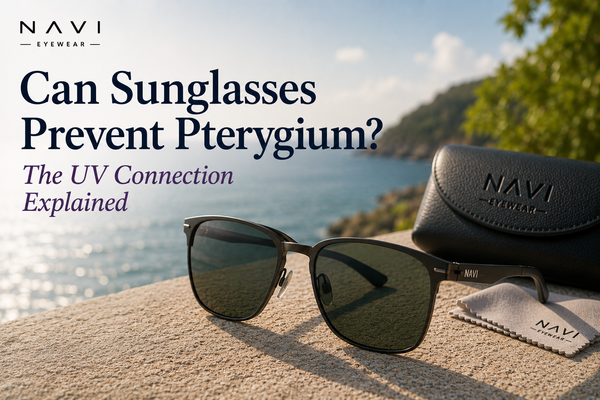

Can Sunglasses Prevent Pterygium? The UV Connection Explained
Pterygium is one of the most clearly UV-caused conditions in all of ophthalmology. Unlike the relationship between UV and cataracts or macular degeneration — where UV is one important factor among several — the relationship between UV and pterygium is so direct and so well-documented that pterygium prevalence is used by researchers as a proxy measure for population-level UV exposure. The condition is rare in high-latitude, low-UV populations and endemic in equatorial, high-UV environments — a geographic distribution that tracks UV intensity with near-perfect correlation across multiple continents and decades of epidemiological research.
The answer to the question in this post’s title is yes — but with important qualifications about what type of protection, what frame geometry, and when in life protection needs to start to be most effective. This guide covers the biology of pterygium formation, who is most at risk, the specific mechanism by which sunglasses provide protection, and what the evidence says about prevention versus management.
This is a C9 Eye Health Conditions supporting post. For the full picture of UV and ocular disease — covering cataracts, macular degeneration, photokeratitis, and how UV protection works across all UV-linked conditions — seeUV and eye disease: the complete guide to cataracts, macular degeneration and more. For the UV protection fundamentals including UV400 certification and frame selection, seethe complete guide to UV eye protection.

|
Medical Disclaimer This guide is for educational purposes only and does not constitute medical advice. If you have been diagnosed with pterygium or are concerned about a growth on your eye, consult a qualified ophthalmologist. Sunglasses can reduce the UV risk factor for pterygium but are not a treatment for an existing pterygium. |
What Is Pterygium? A Closer Look at ‘Surfer’s Eye’
Pterygium (pronounced teh-RIJ-ee-um, plural pterygia) is a fleshy, fibrovascular growth of the conjunctiva — the clear membrane covering the white of the eye — that extends across the limbus onto the corneal surface. It typically begins at the nasal side of the eye (closest to the nose) and grows horizontally toward the corneal centre.
In its early stages, pterygium is primarily a cosmetic concern — the pinkish-white growth is visible in the eye and can cause mild irritation, redness, and a foreign body sensation. As it grows, it can induce corneal astigmatism (distorting the corneal curvature and blurring vision), cause dry eye symptoms, and if allowed to reach the visual axis — the central optical zone of the cornea — directly impair vision. In advanced cases, pterygium can produce permanent corneal scarring.
The informal name ‘surfer’s eye’ reflects one of the most affected populations: surfers who spend thousands of hours in the water under high UV, wind, and reflective conditions. But the condition affects any person with high cumulative outdoor UV exposure — farmers, fishermen, construction workers, landscapers, and anyone who has spent decades working or living in high-UV environments without consistent eye protection. A related but less severe condition, pinguecula (a yellowish, raised conjunctival growth that does not cross onto the cornea), is essentially an earlier stage of the same UV-driven process. Both are covered in the full disease section ofUV and eye disease: the complete guide.
The UV-Pterygium Mechanism: The Coroneo Effect
The specific mechanism linking UV to pterygium was described most completely by Australian ophthalmologist Moran Coroneo in a landmark 1991 paper that fundamentally changed the understanding of how UV reaches and damages the nasal limbus — the precise location where pterygium almost exclusively develops.
|
The Coroneo Effect: How UV Reaches the Nasal Limbus UV light entering the eye from the temporal side (the side toward the ear and temple) — at angles that standard sunglasses frames may not block — can be focused by the curvature of the anterior cornea onto the nasal limbus. The limbus is the junction between the cornea and the sclera (white of the eye), and it is where the limbal stem cells live. These stem cells are the source of the corneal epithelial cells that maintain the cornea’s health and optical clarity. At the nasal limbus, peripheral UV is focused to an intensity approximately 20 times higher than the ambient UV level. This concentrated UV dose drives photochemical damage to the limbal stem cells, triggering abnormal cell division, loss of the barrier function that normally prevents conjunctival cells from migrating onto the cornea, and ultimately the fibrovascular ingrowth that becomes a pterygium. The Coroneo effect explains two features of pterygium that puzzled researchers before this mechanism was identified: why pterygium develops almost exclusively at the nasal limbus (not the temporal), and why pterygium is primarily a UV-driven condition when the eye appears to have natural UV-filtering structures. The answer is that peripheral UV — entering from angles not fully covered by conventional eyewear or the orbital brow — is the primary driver, and the nasal limbus is the focal point of that peripheral UV. |
Who Is Most at Risk?
Geographic and Environmental UV Intensity
Pterygium prevalence follows UV intensity globally with near-perfect geographic correlation. In northern European and northern North American populations at latitudes above 50 degrees, pterygium is relatively rare — lifetime prevalence of 1–2% in most studies. In Mediterranean and southern US populations, prevalence rises to 5–10%. In tropical and equatorial populations — parts of Africa, South and Southeast Asia, the Pacific Islands, and tropical Latin America — prevalence reaches 20–30% or higher in some communities. In the most exposed occupational groups within high-UV regions, prevalence above 30% has been documented. This geographic gradient is one of the strongest evidence bases for the UV-pterygium causal relationship in all of environmental ophthalmology. The UV intensity context and how UV varies by geography, season, and environment is inthe complete guide to UV eye protection.
Outdoor Occupation and Recreational Exposure
Outdoor occupational groups have pterygium rates several times higher than matched indoor workers. Farmers, fishermen, construction workers, lifeguards, agricultural workers, and outdoor recreational groups including surfers, windsurfers, cricketers, and golfers accumulate the highest lifetime UV doses and consequently the highest pterygium rates. The dose-response relationship is clear: more hours of unprotected outdoor UV exposure correlates with both earlier pterygium onset and larger pterygium size at presentation.
Age
Pterygium is primarily an adult condition that reflects lifetime UV accumulation — it is rare before the age of 20 in all but the highest-UV tropical populations, and its prevalence increases steadily through adulthood, peaking in the 50–60 age group. The implication for prevention: protection in early adulthood — when the habit is formed and when the cumulative dose is still low — is far more impactful than attempting to reduce exposure after significant pterygium-driving UV has already accumulated.
Light Iris Colour and Skin Complexion
People with lighter iris colour have less natural UV-filtering pigmentation in the iris and therefore receive higher internal UV doses at the limbus for the same ambient UV exposure. Some studies suggest lighter-eyed individuals have higher pterygium rates, though the geographic effect (high-UV populations tend to have darker pigmentation) makes this relationship complex in epidemiological analysis.
Wind and Dust Exposure
Wind and dust are co-risk factors for pterygium — they produce chronic ocular surface irritation and inflammation that, combined with UV, accelerates limbal stem cell damage. This is why occupational and recreational exposures that combine UV with wind — surfing, sailing, farming in arid regions, construction — produce particularly high pterygium rates. Close-fitting wraparound sunglass frames that reduce wind exposure to the ocular surface address both risk factors simultaneously.
How Sunglasses Prevent Pterygium: The Frame Geometry Is Everything
This is the most important and most underappreciated aspect of pterygium prevention through sunglasses: the frame geometry matters as much as — and possibly more than — the UV400 certification of the lens.
The Coroneo effect establishes that the UV driving pterygium enters the eye from the temporal side at angles that conventional flat-lens fashion frames may not block. A UV400 lens in a flat frame that sits away from the face provides full UV protection for light entering directly through the lens — but does not protect against the peripheral temporal UV that the Coroneo mechanism identifies as the primary pterygium driver.
Close-fitting wraparound frames with a high base curve (6–8 base) that sit near the face reduce peripheral UV entry from the temporal side significantly. Research by Coroneo and colleagues demonstrated that high-wrap frames reduce the peripheral UV dose reaching the nasal limbus by up to 98% compared to no eyewear, while flat-lens conventional frames reduce it by approximately 50–70%. For pterygium prevention specifically, the frame specification matters critically — a quality UV400 lens in a close-fitting wraparound frame provides the maximum preventive benefit; the same UV400 lens in a fashion frame sitting away from the face provides substantially less. The base curve and frame fit geometry is explained in detail inhow to tell if sunglasses actually fit.
The Evidence Base: What Research Shows About Prevention
|
Summary of the Prevention Evidence The evidence for sunglasses preventing pterygium comes from several converging research streams: 1. Geographic epidemiology: the near-perfect correlation between population UV exposure and pterygium prevalence across dozens of studies on multiple continents provides strong indirect evidence that UV causes pterygium and that reducing UV exposure would reduce incidence. 2. Dose-response studies: individuals with higher lifetime UV exposure have higher pterygium rates, larger pterygium at presentation, and earlier age of onset — the hallmarks of a causal dose-response relationship. 3. Occupational interventions: occupational health interventions including mandatory UV protective eyewear in high-risk outdoor industries have produced measurable reductions in pterygium rates in the protected workforce. 4. Coroneo mechanism research: the precise identification of how peripheral UV reaches and damages the nasal limbus provides the mechanistic basis for understanding both why pterygium develops and exactly what type of eyewear frame geometry most effectively prevents it. The WHO and AAO both identify UV reduction through protective eyewear as the primary modifiable preventive intervention for pterygium. |
Pterygium Prevention vs Treatment: Understanding the Distinction
Prevention — What Sunglasses Actually Do
Consistent UV400 wraparound sunglass use throughout life reduces cumulative UV dose to the nasal limbus, reduces the UV-driven limbal stem cell damage that initiates pterygium formation, and slows the growth of early-stage pinguecula toward pterygium. People who have never had a pterygium and who adopt consistent UV protection from early adulthood have significantly lower lifetime pterygium risk than those who do not.
Growth Reduction in Existing Pterygium
For people who already have a pterygium, UV protection — consistent UV400 wraparound sunglass use — slows further growth. Pterygium growth is driven by continued UV exposure to the limbal stem cells. Reducing that UV dose reduces the growth stimulus. A small pterygium that is not yet clinically significant can potentially remain clinically stable for years or decades with consistent UV protection, where it might otherwise grow to require surgical intervention.
Post-Surgical Recurrence Prevention
Pterygium surgery removes the visible growth from the cornea and conjunctiva. The recurrence rate after surgery is significant — historically 30–80% in high-UV populations with continued UV exposure, and much lower with post-surgical UV protection and in low-UV environments. For patients who have had pterygium surgery, consistent UV400 wraparound sunglass use is the most important modifiable factor in preventing recurrence. This is one of the most evidence-based applications of post-surgical UV protection in all of ophthalmology. The post-surgical eye protection context is insunglasses after eye surgery: LASIK, cataract surgery and more.
What Sunglasses Cannot Do
Sunglasses cannot reverse an existing pterygium. Once the fibrovascular tissue has grown onto the cornea, it cannot be removed by UV protection alone. The only treatment for a clinically significant pterygium is surgical excision. Sunglasses can prevent new pterygia from forming, slow the growth of existing ones, and prevent recurrence after surgical removal — but they are not a treatment for established pterygium.
Pterygium Risk by Environment: A Reference Table
|
Environment / Activity |
Relative UV Risk |
Specific Risk Factors |
Recommended Frame |
|
Northern Europe, UK (indoor) |
Low |
Cumulative ambient exposure |
UV400, any frame |
|
Northern Europe, UK (outdoor work) |
Moderate |
Daily UV accumulation without protection |
UV400, close-fitting |
|
Mediterranean coast |
High |
Intense UV + sea/sand reflection |
UV400, wraparound |
|
Surfing / water sports |
Very high |
Water reflection doubles UV dose; wind irritation |
UV400, high-wrap sport |
|
Tropical/equatorial outdoor |
Very high |
Year-round peak UV + cumulative dose |
UV400, full-wrap daily |
|
High altitude (skiing, mountaineering) |
Very high |
Snow reflection + reduced atmospheric UV filter |
UV400, Category 3-4 |
|
Farming / outdoor construction |
High |
Daily UV + wind + dust |
UV400, wraparound with side coverage |
|
Post-pterygium surgery |
All environments |
Recurrence risk highest in first 12 months post-op |
UV400, wraparound — non-negotiable |
The Right Sunglasses for Pterygium Prevention
The specification for pterygium-preventive sunglasses combines two requirements that must both be met: the lens must block UV400, and the frame must sit close enough to the face and have sufficient base curve to reduce peripheral temporal UV entry. UV400 without the frame geometry addresses only part of the mechanism. Frame coverage without UV400 provides wind protection but inadequate UV protection. Both matter.
Browse theNavi Eyewear UV400 polarized collection for close-fitting UV400 polarized frames. For the complete UV and eye disease picture — including all other UV-driven conditions that the same sunglasses simultaneously protect against — seeUV and eye disease: the complete guide.
Frequently Asked Questions
Can sunglasses prevent pterygium from developing?
Yes — with the qualification that frame geometry matters as much as UV400 certification. The UV that drives pterygium enters the eye primarily from the temporal side at angles that flat-lens fashion frames may not fully block. Close-fitting wraparound UV400 frames reduce peripheral UV to the nasal limbus by up to 98%, providing the most effective protection available. Research consistently shows that populations and individuals with consistent UV400 wraparound eye protection have significantly lower pterygium rates than matched groups without protection. The prevention is most effective when started early in life before significant UV accumulation has occurred. For the complete UV eye disease context, seeUV and eye disease: the complete guide.
What is pterygium and what causes it?
Pterygium is a fleshy fibrovascular growth of the conjunctiva that extends across the limbus onto the corneal surface, almost always starting at the nasal side of the eye. It is caused primarily by cumulative UV radiation — specifically through the Coroneo mechanism, in which peripheral UV entering from the temporal side of the eye is focused by the anterior corneal curvature onto the nasal limbus at high intensity, damaging the limbal stem cells that maintain corneal health. Wind and dust exposure are co-contributing irritant factors. The condition is endemic in high-UV equatorial regions and rare in low-UV northern populations, reflecting the UV dose-response relationship.
Will sunglasses stop my pterygium from growing?
Consistent UV400 wraparound sunglass use slows pterygium growth by reducing the UV stimulus that drives continued limbal stem cell damage and fibrovascular proliferation. A small pterygium that is not yet clinically significant can remain stable for years with consistent UV protection. However, sunglasses cannot reverse existing pterygium tissue — they slow growth and prevent new formation but do not shrink or remove established tissue. If your pterygium has grown to the point of affecting vision, causing significant astigmatism, or producing persistent symptoms, discuss surgical options with your ophthalmologist.
What type of sunglasses are best for preventing pterygium?
UV400 polycarbonate lenses in a close-fitting high-base-curve frame (base 6–8) with minimal temporal gaps. The frame geometry is the critical variable: the Coroneo mechanism shows that peripheral UV from the temporal side is the primary driver of pterygium development, and flat-lens fashion frames that sit away from the face provide substantially less protection at the nasal limbus than wraparound designs. Add polarization for any environment with significant reflective UV — water, snow, sand. For the frame fit mechanics, seehow to tell if sunglasses actually fit.
Why does pterygium mostly grow from the nasal side of the eye?
This is explained by the Coroneo effect. UV light entering the eye from the temporal side (toward the ear) at oblique angles is focused by the curvature of the anterior cornea onto the nasal limbus — the area at the inner corner of the eye where the cornea meets the sclera. This peripheral UV focusing concentrates UV intensity at the nasal limbus at approximately 20 times ambient UV levels, driving the stem cell damage that initiates pterygium formation there rather than elsewhere on the conjunctiva. The symmetry of the effect — temporal UV focusing onto the nasal limbus — explains the consistent nasal-side distribution of pterygium across millions of cases.
Can pterygium come back after surgery?
Yes — pterygium recurrence after surgery is a significant clinical problem, with historical recurrence rates of 30–80% in high-UV populations with continued UV exposure. Recurrence is driven by the same UV mechanism that caused the original pterygium — continued UV damage to the limbal stem cells at the surgical site. The most effective interventions for preventing recurrence are: consistent UV400 wraparound sunglass use post-operatively, conjunctival autograft (a surgical technique that covers the exposed limbal area with healthy conjunctival tissue from the patient’s own eye), and mitomycin C application during surgery (an antiproliferative agent). Post-surgical UV protection is covered insunglasses after eye surgery: LASIK, cataract surgery and more.
Who is most at risk of developing pterygium?
People with high cumulative outdoor UV exposure — particularly those in tropical and equatorial regions, outdoor occupational workers (farmers, fishermen, construction workers, lifeguards), and recreational outdoor groups with high UV exposure (surfers, sailors, outdoor athletes). The risk increases with age as cumulative UV accumulates. Wind and dust exposure compound the risk by adding chronic ocular surface irritation to the UV stimulus. Fair-skinned individuals with light irises have slightly less natural UV filtering, though the geographic UV environment dominates the risk picture.
Is pterygium the same as a cataract?
No — these are completely different conditions affecting different structures. Pterygium is a growth of conjunctival tissue that extends across the surface of the eye (the cornea), visible as a pinkish-white fleshy growth on the white of the eye. Cataracts are a clouding of the crystalline lens inside the eye, invisible from outside and only detectable through an eye examination. Both conditions are associated with UV exposure, but through different mechanisms and at different ocular structures. Both are preventable through consistent UV400 eye protection.
How do I know if I have a pterygium?
Pterygium is typically visible with the naked eye as a pinkish-white, slightly raised, triangular growth extending from the white of the eye (sclera) toward the cornea, almost always on the nasal side (toward the nose). In early stages it may cause mild irritation, redness, and a foreign body sensation. More advanced pterygium may cause increased sensitivity to light, excessive tearing, and blurred vision from corneal distortion. Any growth on the eye surface should be assessed by an ophthalmologist or optometrist, who can confirm the diagnosis and assess size, growth rate, and whether treatment is needed.
Do sunglasses help if I already have a pterygium?
Yes — in two important ways. First, consistent UV400 wraparound sunglass use slows the growth of existing pterygium by reducing the UV stimulus that drives continued limbal stem cell damage. Second, reducing the combined wind and UV irritation to the ocular surface reduces the redness, foreign body sensation, and irritation symptoms that pterygium causes in daily life. If you have had pterygium surgery, UV protection is critical for preventing recurrence. For the complete post-surgical UV protection guide, seesunglasses after eye surgery: LASIK, cataract surgery and more.
Does living in the UK mean I don’t need to worry about pterygium?
The UK’s latitude significantly reduces pterygium risk compared to Mediterranean or tropical environments, and pterygium is less common in the UK general population. However, UK residents who holiday in high-UV destinations — the Mediterranean, tropical beach holidays, skiing holidays — receive significant UV doses during those trips that add to lifetime accumulation. Outdoor workers in the UK accumulate significant UV over careers spanning decades. And the UV protection that reduces pterygium risk simultaneously reduces the risk of cataracts, macular degeneration, photokeratitis, and other UV-driven conditions that are relevant at UK latitudes. UV400 wraparound sunglass use is a sensible year-round habit at any latitude. The year-round UV case is inwinter sunglasses: why UV protection doesn’t stop in cold weather.
Can children get pterygium?
Pterygium is rare before age 20 in most populations — it reflects lifetime UV accumulation, and children have had insufficient time to accumulate the dose that typically drives pterygium formation. However, in tropical populations with very high UV environments, pterygium has been documented in teenagers. More importantly, the UV exposure accumulated in childhood and adolescence contributes to the lifetime total that will eventually drive pterygium in adulthood. Consistent UV protection in childhood builds the habit and reduces the lifetime accumulation. The complete children’s UV eye protection guide is insunglasses for kids: UV protection from the start.
SOURCES & CITATIONS[1] Coroneo MT, Muller-Stolzenburg NW, Ho A.“Peripheral light focusing by the anterior eye and the ophthalmohelioses.”Ophthalmic Surgery, 1991.View source [2] Ang M, Li X, Wong W, et al..“Prevalence of and racial differences in pterygium: a multiethnic population study in Asians.”Ophthalmology, 2012.View source [3] Saw SM, Tan D.“Pterygium: prevalence, demography and risk factors.”Ophthalmic Epidemiology, 1999.View source [4] Dain SJ.“Sunglasses and sunglass standards.”Clinical and Experimental Optometry, 2003.View source [5] Sliney DH.“UV radiation ocular exposure dosimetry.”Documenta Ophthalmologica, 1994.View source [6] Liu L, Wu J, Geng J, et al..“Geographical prevalence and risk factors for pterygium: a systematic review and meta-analysis.”BMJ Open, 2013.View source [7] Rosenthal FS, Bakalian AE, Lou CQ, Taylor HR.“The effect of sunglasses on ocular exposure to ultraviolet radiation.”American Journal of Public Health, 1988.View source [8] World Health Organization.“Solar ultraviolet radiation: global burden of disease from solar ultraviolet radiation.”WHO Environmental Burden of Disease Series, 2006.View source |