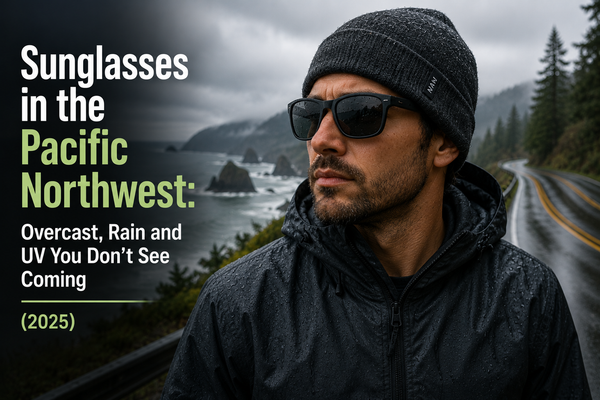

Sunglasses in the Pacific Northwest: Overcast, Rain and UV You Don’t See Coming
Seattle gets approximately 226 cloudy or overcast days per year. Portland is similar. The Pacific Northwest coast — from Bellingham to Crescent City — is the cloudiest, rainiest populated region in the contiguous US. If you live here, the question “do I need sunglasses today?” gets answered “no” on a default basis by a gray sky, and on most days you leave them at home.
This guide explains why that default is wrong about UV and right about glare management — but also why the Pacific Northwest has its own specific glare problem that demands polarized lenses even on days when the sun never breaks through. Gray polarized UV400 in the right lens category for the Pacific Northwest is not the same pair as the Cat 3 amber polarized that a Phoenix resident needs. But it is a pair you should be wearing more consistently than the sky tells you to.
This is a C21 Geography & Climate supporting post. It links back to the cluster pillar atsunglasses by climate and geography: the complete US regional guide. For the underlying UV science of cloudy days, seeshould you wear sunglasses on a cloudy day? the UV science.
Quick Answer
Gray polarized UV400 Category 2 is the Pacific Northwest all-conditions pair. Category 1 UV400 for consistently overcast days when Cat 2 feels too dark. Category 3 for the clear summer days (June through September) when Seattle and Portland actually get sun and UV Index reaches 6–7. Polarized because the dominant Pacific Northwest glare source is wet road surface reflection — present on most driving days regardless of sky brightness. UV400 because moderate overcast still delivers UV Index 3–4, and the region’s outdoor-heavy culture means substantial outdoor time accumulating that UV.

Table of Contents
Part 1: The Pacific Northwest UV Profile
The Pacific Northwest sits at latitudes 42–49°N. At these latitudes, the maximum solar elevation at midsummer noon is approximately 65–67 degrees in Seattle — lower than the Sun Belt but still capable of producing UV Index 6–7 on clear July days. The defining characteristic of Pacific Northwest UV is not its intensity but its pattern: most of the region’s UV is delivered through overcast and partly cloudy conditions, not through the clear-sky conditions that most people associate with sunglass use.
Seattle’s average UV Index by month:
|
Month |
Clear-Sky UV Index |
Typical Overcast UV Index |
Recommendation |
|
January |
1–2 |
0.5–1 |
Discretionary; UV very low |
|
February |
2–3 |
1–2 |
Occasional UV400 on clear days |
|
March |
3–4 |
1.5–2.5 |
UV400 recommended on clear and partly cloudy days |
|
April |
4–5 |
2–3 |
UV400 for most outdoor days |
|
May |
5–6 |
2.5–3.5 |
UV400 for most outdoor days |
|
June |
6–7 |
3–4 |
UV400 daily; Cat 2 for outdoor activity |
|
July |
6–7 |
3–4 |
UV400 daily; Cat 2–3 for sun breaks |
|
August |
5–6 |
2.5–3.5 |
UV400 daily |
|
September |
4–5 |
2–3 |
UV400 for most outdoor days |
|
October |
2–3 |
1–1.5 |
UV400 on clearer days |
|
November |
1–2 |
0.5–1 |
Discretionary; UV low |
|
December |
1 |
0.5 |
Discretionary; UV very low |
Part 2: Why the Gray Sky Misleads on UV
The human visual system has no UV sensors. UV is completely invisible. The decision to protect against UV must be based on UV Index data, not on how bright the sky looks. In the Pacific Northwest, this matters more than anywhere else in the US because the sky almost never looks like a high-UV day — but from March through September, UV is routinely in the range where protection is warranted.
Clouds scatter UV rather than blocking it. A typical Pacific Northwest moderate overcast (altostratus or stratus cloud) reduces UV by 40–60% compared to a clear sky. On a July overcast day in Seattle with a clear-sky UV Index of 7, moderate overcast still delivers UV Index 3–4 to the ground. That is the moderate category where WHO guidance recommends eye protection.
The behavioral consequence of this visual mismatch: most Pacific Northwest residents wear sunglasses only on the rare clearly sunny days, protecting against a minority fraction of their actual annual UV outdoor exposure while going unprotected on the majority of outdoor days that are overcast but still UV-active from March through September.
The complete cloudy-day UV science is inshould you wear sunglasses on a cloudy day? the UV science.
Part 3: Seasonal UV Variation in the Pacific Northwest
The Pacific Northwest has the most pronounced UV season of any US region in terms of the contrast between summer peak and winter low. December and January in Seattle produce UV Index 1 or below on most days — essentially no meaningful UV protection need. By March, clear days reach UV Index 3–4. By June through August, clear days reach UV Index 6–7 and overcast days reach UV Index 3–4.
The practical UV protection window for Pacific Northwest residents: approximately March through October, with April through September being the priority months. Outside this window, UV protection is largely discretionary (though the driving polarization benefit persists year-round regardless of UV, since wet roads produce glare in any season).
The transition months — March, April, September, and October — are when UV exposure is most commonly underestimated. The temperatures are mild, the skies are often partly cloudy, and the cultural instinct to wear sunglasses has not yet been activated or has already been deactivated for the season. But UV Index 3–4 on a clear or partly cloudy March day in Seattle is above the WHO moderate threshold. The spring UV exposure window opens earlier than most Pacific Northwest residents’ sunglass habits do.
Part 4: The Wet Road Glare Problem — The Pacific Northwest’s Main Sunglass Issue
UV protection may be the less-recognized sunglass need in the Pacific Northwest, but it is not the most immediate daily need. The most immediately noticeable daily sunglass problem in the Pacific Northwest is wet road surface glare.
When it rains — which in Seattle and Portland is most of October through May — road surfaces become partially reflective. The thin water film on a wet road acts as a mirror for overhead and low-angle light sources: streetlights, oncoming headlights, and whatever ambient sky brightness exists. This reflection is predominantly horizontally polarized. It creates a shimmer across the forward road surface that reduces the contrast of lane markings, makes puddles and standing water less distinguishable from dry pavement, and produces a general visual noise that increases driving cognitive load.
This wet road glare is present on cloudy days without any direct sun. It is not about bright sunshine — it is about the physics of a water-film surface reflecting horizontally polarized light. Polarized lenses eliminate this reflection completely on overcast rainy days just as effectively as on sunny ones. A Pacific Northwest driver wearing gray polarized Cat 2 on a rainy November commute is not managing sun glare — they are managing wet road glare, which is the more frequent and often more disruptive glare source in this region.
Part 5: Why Polarized Is the Pacific Northwest’s Essential Lens Property
In most US regions, polarization is primarily thought of as a sunny-day glare management feature. In the Pacific Northwest, it is primarily a wet-road driving feature. The distinction matters because it explains why polarized lenses are worth wearing in the Pacific Northwest even on days when no one would call it a sunglasses day.
The driving data is straightforward: the Pacific Northwest gets rain on most days from October through May. Most Pacific Northwest residents drive to work. Most of those drives involve wet roads. Wet roads produce horizontally polarized surface reflection. Polarized lenses eliminate it. Non-polarized lenses reduce it proportionally. The lane marking contrast improvement from polarized on wet Pacific Northwest roads is consistent, meaningful, and present regardless of whether the sun is visible.
For hikers, cyclists, and outdoor recreationists in the Pacific Northwest, polarization additionally eliminates the surface glare from streams, rivers, lakes, and the extensive water bodies of Puget Sound, the Columbia River, and the Oregon and Washington coast. These surfaces produce water glare even under fully overcast conditions when reflected light from the gray sky creates a diffuse but real surface glare from water.
The complete variable light polarization science is inphotochromic vs polarized: which is better for variable light?.
Part 6: Lens Category for the Pacific Northwest — Getting It Right
Lens category selection for the Pacific Northwest is the most nuanced of any US region because the conditions span the widest range within a single day and season: from deep overcast rain to occasional brilliant summer sun, sometimes within hours.
Part 7: Tint Choice for Pacific Northwest Conditions
Gray Polarized — The Pacific Northwest Standard
Gray polarized UV400 Category 2 is the primary Pacific Northwest pair for most residents. The reasons are specific to the region:
Amber Polarized — Pacific Northwest Hiking and Outdoor Recreation
Amber polarized UV400 Category 2 for hiking and outdoor recreation in Pacific Northwest conditions. The Pacific Northwest’s evergreen forest environments — Olympic Peninsula, Cascades, Coast Range, Oregon mountains — are characterized by flat, diffuse overcast light under tree canopy. This flat-light condition is exactly where amber’s blue-scatter filtering provides genuine contrast enhancement: trail features, root systems, rocks, and stream crossings that blend into the flat-light forest floor are more clearly defined through amber lenses.
The same flat-light contrast enhancement applies to skiing in the Cascades (Mt. Baker, Crystal Mountain, Mt. Hood), where overcast ski days are the Pacific Northwest winter standard. Amber for Cascade skiing; gray for Pacific Northwest urban driving.
Part 8: Driving in the Pacific Northwest
The Pacific Northwest driving sunglass need is different from most US regions because it is primarily a wet-road polarization problem rather than a sun management problem. The specific driving scenarios:
✨ NAVI EYEWEAR — GRAY POLARIZED UV400 FOR PACIFIC NORTHWEST CONDITIONS.UV400 polycarbonate. Gray polarized Cat 2 — eliminates wet road glare on most Pacific Northwest driving days. UV400 for the overcast months that still deliver real UV. Color-accurate for Pacific Northwest traffic. Buy 1, Get Any 3 Pairs Free — $119 for four pairs (~$30 each). Free shipping. Free replacements. |
Part 9: Hiking in the Pacific Northwest — Evergreen Forest Conditions
Pacific Northwest hiking — the Olympics, the Cascades, the Oregon Coast Range, the Columbia River Gorge — involves some of the most distinctive outdoor light conditions in the US. Evergreen forest canopy creates deep, consistent shade interrupted by intense sun shafts. Trail surfaces under canopy are flat and low-contrast. The transition from canopy shade to open alpine terrain involves a rapid luminance increase.
Amber polarized UV400 Category 2 handles the Pacific Northwest hiking environment specifically well:
Part 10: Outdoor Recreation and Sport
Kayaking and Paddling
Puget Sound, the San Juan Islands, the Columbia River, and Oregon’s coastal lakes and bays are major Pacific Northwest kayaking environments. Water surface reflection under Pacific Northwest overcast conditions is diffuse but real — gray sky reflected from the water surface creates a bright, low-contrast visual environment that fatigues the eyes over a multi-hour paddle. Amber or gray polarized Cat 2 eliminates this reflection and makes horizon and water feature reading significantly more comfortable.
Cycling
The Pacific Northwest has one of the most active cycling cultures in the US — road cycling, gravel riding, and trail mountain biking. Wet roads are the dominant cycling glare condition for most of the year. Gray polarized Cat 2 for road cycling (road surface legibility in rain plus traffic signal accuracy). Amber polarized Cat 2 for trail mountain biking in forest conditions.
Running
Trail running in the Pacific Northwest (Forest Park in Portland, the Tiger Mountain trail system near Seattle, Cascades trails) involves the same flat-light forest contrast challenge as hiking. Amber polarized Cat 2 for trail running. Gray polarized Cat 2 for road running in urban Pacific Northwest environments.
Part 11: The Clear Summer Day Specification
The Pacific Northwest gets genuine summer sun from approximately late June through August. During this window, clear days produce UV Index 6–7 in Seattle and Portland — the high UV category. For sustained outdoor activity on these clear summer days, Cat 3 UV400 polarized is the appropriate upgrade from the Cat 2 all-conditions default.
Pacific Northwest residents who never use Cat 3 are adequately protected UV-wise with Cat 2 (UV400 is UV400 regardless of category), but they may be squinting more than necessary and accumulating more visual fatigue on clear summer days than Cat 3 would cause. A Cat 3 pair for summer day hiking, beach activities on the Oregon and Washington coast, and summer sailing on Puget Sound is a practical addition to the Cat 2 all-conditions pair.
Part 12: UV Accumulation for Outdoor-Culture Residents
The Pacific Northwest has a strongly outdoor-oriented culture: hiking, camping, skiing, kayaking, running, cycling, and general outdoor recreation are central to regional identity in a way that is distinctive even by US standards. Many Pacific Northwest residents spend significantly more outdoor time than the national average.
The combination of high outdoor time with the UV protection gap — most outdoor days look overcast and sunglasses stay home — means Pacific Northwest outdoor culture residents may be accumulating meaningful UV exposure without realizing it. A Portland trail runner who runs outside 5 days per week from March through October, without UV400 on most runs because “it’s not sunny,” accumulates hundreds of hours of moderate UV outdoor exposure per year. Over a 20-year running career, this represents a substantial lifetime UV total.
The Pacific Northwest outdoor culture resident’s correct UV protection approach: UV400 for all outdoor runs, hikes, rides, and paddles from March through October regardless of sky conditions. The overcast sky is not a UV protection shield.
Part 13: Comparison Table — Pacific Northwest Scenarios
|
Scenario |
Primary Need |
Recommended Lens |
Why |
|
Daily driving (Oct–May, wet roads) |
Wet road glare elimination |
Gray polarized Cat 2 |
Polarization eliminates horizontally polarized wet road reflection |
|
Clear summer driving (Jun–Aug) |
Sun management + road glare |
Gray polarized Cat 2–3 |
Cat 3 for sustained bright summer sun |
|
Overcast outdoor activity (UV protection) |
UV400 with minimal visual impact |
Gray or amber polarized Cat 1–2 |
UV400 on overcast days; Cat 1 barely perceptible |
|
Forest hiking / trail running |
Flat-light contrast + UV |
Amber polarized Cat 2 |
Blue-scatter filtering enhances forest floor contrast |
|
Cascade skiing (overcast flat-light) |
Slope definition + UV |
Amber or rose polarized Cat 1–2 |
Flat-light ski contrast enhancement; Cat 2 for variable |
|
Cascade skiing (clear day alpine) |
UV (altitude) + brightness |
Gray polarized Cat 3 |
Altitude UV significant; Cat 3 for alpine sun |
|
Kayaking / paddling (Puget Sound) |
Water surface glare + UV |
Gray or amber polarized Cat 2 |
Diffuse water reflection eliminated; UV protection |
|
Road cycling (urban, wet) |
Wet road legibility + traffic signals |
Gray polarized Cat 2 |
Color accuracy + wet road polarization |
|
Oregon/WA coast beach (summer) |
Beach UV + water glare |
Gray or amber polarized Cat 3 |
Higher summer UV at coast; Cat 3 for clear beach days |
Part 14: Best For
Gray Polarized UV400 Category 2 — Best For:
Amber Polarized UV400 Category 2 — Best For:
Gray or Amber Polarized UV400 Category 3 — Best For:
Part 15: Common Mistakes
Bottom Line
The Pacific Northwest is a region where the sky actively misleads about UV and where the most consistent daily sunglass benefit — wet road glare elimination — is independent of sun. Gray polarized UV400 Category 2 resolves both issues: UV400 provides protection on the overcast days that the eye cannot identify as UV-active, and polarization eliminates the wet road surface reflection that makes Pacific Northwest driving more visually demanding on most days of the year.
Category 1 UV400 for the heaviest overcast days. Category 3 for the clear summer days. Amber polarized Cat 2 for the forest hiking and Cascade skiing that define Pacific Northwest outdoor culture. The UV protection window is March through October. The polarization benefit is year-round, every rainy drive.
Browse UV400 polarized options atnavieyewear.com/collections/polarized. Add 4 pairs — Buy 1, Get Any 3 Free auto-applies. Free shipping. Free replacements.

Frequently Asked Questions
Do I need sunglasses in Seattle if it’s always cloudy?
Yes, for two reasons. First, UV: moderate overcast in Seattle from March through September delivers UV Index 3–4 — above the WHO moderate threshold. The gray sky does not mean no UV. Second, wet road glare: polarized lenses eliminate the horizontal surface reflection from wet roads that is the dominant Pacific Northwest driving glare source, and this reflection is present in overcast rain conditions with no direct sun at all.
What lens category is best for Pacific Northwest weather?
Category 2 UV400 polarized as the all-conditions default. Handles overcast at the lighter end of the range (35–43% VLT), sun breaks and partly cloudy without over-darkening, and most Pacific Northwest summer clear days. Category 1 for dedicated overcast use on heavy cloud days. Category 3 for clear summer days and alpine conditions.
Do polarized sunglasses help in the rain in the Pacific Northwest?
Yes, specifically and significantly. Wet road surface reflection is predominantly horizontally polarized. Polarized lenses eliminate it completely. On a rainy Pacific Northwest morning commute, the difference between non-polarized and polarized Cat 2 gray is dramatic: lane markings that are difficult to see through the wet road shimmer become clearly visible. The benefit does not require sun.
What tint is best for Pacific Northwest hiking?
Amber polarized UV400 Category 2. Pacific Northwest forest hiking involves flat, diffuse overcast light under evergreen canopy where amber’s blue-scatter filtering provides genuine contrast enhancement for trail surfaces, roots, rocks, and stream crossings. Amber for forest and Cascade overcast conditions; gray for road driving and urban use.
When should I wear Category 3 sunglasses in the Pacific Northwest?
For the clear summer days (primarily July and August) when UV Index reaches 6–7, for alpine hiking above 5,000 feet in the Cascades where altitude increases UV, and for coastal Oregon and Washington beach use on clear summer days. For most of the year and most Pacific Northwest conditions, Cat 2 is more appropriate.
Does it matter what sunglasses I use for skiing in the Cascades?
Yes. Cascade skiing is predominantly overcast flat-light skiing, where amber or rose Cat 1–2 lenses provide the slope definition and terrain contrast that gray lenses do not. For the occasional clear powder day at Mt. Baker, Crystal Mountain, or Mt. Hood, Cat 3 provides adequate darkness and altitude UV management. Goggle format rather than eyeglass frame is recommended for skiing for face coverage, anti-fog, and secure fit.
Should I wear sunglasses when driving in Portland or Seattle on rainy days?
Yes — gray polarized Cat 2. The wet road surface reflection from Portland and Seattle’s typically wet road network is the most consistent daily Pacific Northwest sunglass use case. It is present on most driving days from October through May. It is a horizontal polarized reflection that non-polarized lenses dim but do not eliminate. The visual quality improvement on a wet Pacific Northwest commute with polarized lenses is immediate and consistent.
Do I need UV protection at all in the Pacific Northwest in winter?
Discretionary from November through February. January UV Index in Seattle is approximately 1 or below — very low. The UV protection case for winter Pacific Northwest outdoor use is weak. However, the polarization benefit for wet road driving remains year-round. Gray polarized Cat 2 for winter Pacific Northwest driving provides the road surface glare benefit without any UV concern.
Supporting Articles
GRAY POLARIZED UV400. FOR EVERY PACIFIC NORTHWEST DRIVE.UV400 polycarbonate. Gray polarized Cat 2 — wet road glare eliminated. UV protection on overcast days included. Amber polarized Cat 2 for forest hiking, Cascade skiing, and flat-light outdoor recreation. Buy 1, Get Any 3 Pairs Free — $119 for four pairs. Free shipping. Free replacements. |
SOURCES & CITATIONS[1] World Health Organization.“Global solar UV index: a practical guide.”WHO/SDE/OEH/02.2, 2002.View source [2] Diffey BL.“Sources and measurement of ultraviolet radiation.”Methods, 2002.View source [3] Sliney DH.“UV radiation ocular exposure dosimetry.”Documenta Ophthalmologica, 1994.View source [4] De Faber JT, Naeser K, Kessing SV.“Polarized light and contrast sensitivity under glare conditions.”Ophthalmic Research, 2013.View source [5] National Oceanic and Atmospheric Administration.“UV index forecast by location.”NOAA Weather Service, 2024.View source [6] American Academy of Ophthalmology.“Sunglasses: choosing the right pair for UV protection.”AAO EyeSmart, 2023.View source |