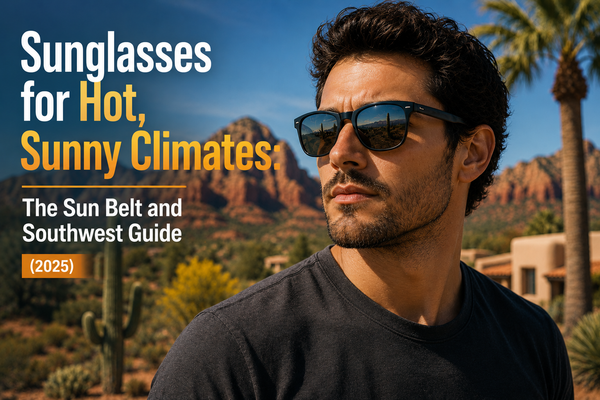

Sunglasses for Hot, Sunny Climates: The Sun Belt and Southwest Guide
If you live in Phoenix, Tucson, Las Vegas, Miami, Houston, San Antonio, or anywhere across the US Sun Belt and Southwest desert, you live in one of the highest UV environments on Earth. Not just in the US — on Earth. The combination of low latitude, minimal cloud cover, dry desert air with low UV-scattering humidity, and relentless sunshine produces UV Index values that reach the extreme category (11+) regularly from April through September, and remain in the moderate-to-high range year-round.
This means your sunglass specification is different from what most general sunglass advice recommends. Category 2 is the all-conditions US default — but it is insufficient for sustained outdoor activity in Sun Belt and Southwest UV conditions. The lens category, tint, coating, and wearing habits appropriate for your climate are specific, and this guide covers all of them.
This is a C21 Geography & Climate supporting post. It links back to the cluster pillar atsunglasses by climate and geography: the complete US regional guide.
Quick Answer
Category 3 UV400 polarized for daily outdoor use in the Sun Belt and Southwest. Category 4 for extended summer outdoor activity at peak UV times (10am–2pm, April–September). Gray polarized for driving. Amber or copper polarized for outdoor recreation, hiking, and water activities. Anti-saltwater coating for all coastal Gulf Coast and Florida use. Year-round UV400 use — winter UV in Phoenix and Miami is still in the moderate range and is chronically underestimated.

Table of Contents
Part 1: Why the Sun Belt and Southwest Are Different
Three factors combine in the Sun Belt and Southwest to produce UV conditions that outpace the rest of the continental US:
Part 2: UV Index Data for Major Sun Belt and Southwest Cities
|
City |
Latitude |
July Noon UV Index |
January UV Index |
Annual Sunny Days |
|
Phoenix, AZ |
33°N |
11–13 (extreme) |
4–5 (moderate) |
~299 |
|
Tucson, AZ |
32°N |
11–13 (extreme) |
4–5 (moderate) |
~350 |
|
Las Vegas, NV |
36°N |
11–12 (extreme) |
3–4 (moderate) |
~294 |
|
Albuquerque, NM |
35°N |
10–11 (very high–extreme) |
3–4 (moderate) |
~278 |
|
El Paso, TX |
31°N |
11–12 (extreme) |
4–5 (moderate) |
~297 |
|
Miami, FL |
25°N |
10–11 (very high–extreme) |
5–6 (moderate–high) |
~248 |
|
Tampa, FL |
27°N |
10–11 (very high–extreme) |
5–6 (moderate–high) |
~233 |
|
Houston, TX |
29°N |
9–10 (very high) |
3–4 (moderate) |
~204 |
|
San Antonio, TX |
29°N |
9–10 (very high) |
3–4 (moderate) |
~220 |
|
New Orleans, LA |
29°N |
9–10 (very high) |
3–4 (moderate) |
~204 |
Part 3: The Dry Desert UV Amplifier — Why Arizona Is Different From Florida
Arizona and Florida share similar latitude ranges (25–35°N) but produce different UV profiles because of humidity. The Gulf of Mexico and Atlantic moisture that keeps Florida’s air humid provides a modest but real UV-scattering effect. Arizona and Nevada’s desert air has almost no comparable moisture.
The practical difference: at the same sun angle and latitude, Tucson in July produces UV Index 11–13 while Miami in July produces UV Index 10–11. Both are in the very high to extreme range, and both demand Cat 3 UV400 protection. But the additional UV in the desert environment means that Cat 3 at its darker end (closer to 8% VLT) is more appropriate for desert hiking and sustained outdoor activity than the lighter end of Cat 3 (18% VLT).
The other desert modifier is surface reflection. Desert sand and exposed rock surfaces reflect 15–25% of UV upward, adding reflected UV from below to direct UV from above. Hikers and outdoor workers in the desert receive direct UV plus reflected UV from the terrain surface simultaneously.
Part 4: Year-Round UV — The Winter Underestimation Problem
The most consistent UV protection error in Sun Belt and Southwest states is the winter underestimation problem. When temperatures drop to comfortable levels in November through February, many residents stop wearing sunglasses because it “doesn’t feel like summer.”
The UV Index data does not support this behavioral adjustment. Phoenix in January averages UV Index 4–5 on clear days. Miami in January averages UV Index 5–6. These values are in the moderate-to-high range where the WHO recommends UV eye protection. A Phoenix resident who wears UV400 from April through October but goes unprotected from November through March is missing four to five months of meaningful UV exposure.
The cumulative ocular UV dose from November through March at Phoenix UV Index 4–5 over 20 years of unprotected winter outdoor time is substantial. Cataract formation risk and AMD risk are cumulative — each unprotected outdoor session adds to a running lifetime total. Year-round UV400 use is the correct practice for all Sun Belt and Southwest residents, not just summer UV400 use.

Part 5: The Surface Reflection Factor in Hot Climates
Hot-climate environments produce specific high-UV surface reflection scenarios:
Part 6: Category 3 vs Category 2 — What Changes
Category 2 lenses transmit 18–43% of visible light. Category 3 transmits 8–18%. The practical difference in Sun Belt and Southwest conditions:
|
Property |
Category 2 (18–43% VLT) |
Category 3 (8–18% VLT) |
|
UV protection |
Complete (UV400) |
Complete (UV400) |
|
Brightness reduction |
Moderate — comfortable in moderate sun |
Strong — appropriate for sustained high-UV conditions |
|
Glare management |
Good |
Excellent — further reduces direct solar disk glare |
|
Squinting load at UV Index 9–11 |
Reduced but some squinting likely |
Comfortable — adequate for extreme UV conditions |
|
Visual performance in high UV |
Adequate |
Better — reduced visual fatigue accumulation |
|
Tunnel / shaded transition |
Comfortable |
Possible over-darkening in rapid light transitions |
|
Best for Sun Belt use |
Variable conditions; driving; cloudy days |
Sustained outdoor use; hiking; beach; extended outdoor activity |
The correct rotation for Sun Belt and Southwest residents: Cat 3 UV400 polarized as the primary outdoor pair for all sustained outdoor activity, with Cat 2 UV400 polarized for driving in mixed traffic and for the variable-light situations (outdoor dining, brief outdoor errands, transitional use) where Cat 3 may over-darken rapid transitions.
Part 7: When to Use Category 4
Category 4 lenses (3–8% VLT) are for the most extreme UV conditions. In the Sun Belt and Southwest context, these include:
Category 4 is specifically excluded from driving use in most jurisdictions because of its effect on perception of traffic signals and adaptation in variable light. Cat 4 should only be used in sustained open-outdoor high-UV contexts without rapid transitions to lower light environments.
Part 8: Tint Choice for Hot Climate Outdoor Use
Gray Polarized — The Urban and Driving Standard
Gray polarized UV400 Category 3 is the primary daily pair for Sun Belt and Southwest urban residents. The Phoenix metro area, Greater Miami, greater Houston, and the Las Vegas Valley are all driving-dependent environments where traffic signal color accuracy is the primary visual safety requirement. Gray’s neutral tint preserves traffic signal accuracy while Cat 3 darkness manages the extreme brightness of midday desert and Sun Belt conditions. Polarization eliminates the road surface reflection that dominates the driving glare environment.
Amber Polarized — Desert Recreation and Hiking
Amber polarized UV400 Category 3 is the desert recreation and hiking choice. Desert terrain — sandstone, sandy washes, scrubby vegetation — is a relatively low-contrast environment where amber’s blue-scatter filtering provides genuine contrast enhancement for trail features, rock surfaces, and hazard detection. The amber tint also enhances the reddish tones of canyon rock, providing a visually vivid and aesthetically appropriate view of desert landscapes.
Copper Polarized — Gulf Coast and Florida Water
Copper polarized UV400 Category 3 for Gulf Coast and Florida fishing, boating, and coastal activities. Copper’s wavelength transmission is specifically optimized for sub-surface water visibility — it reduces the surface reflection that obscures the water below while enhancing the contrast of features under the surface. For the extensive fishing and boating culture of Florida, the Gulf Coast, and the Intracoastal Waterway, copper polarized is the working lens.
Part 9: Driving in the Sun Belt — The Specific Commute Issues
The Sun Belt commute has specific UV and glare characteristics driven by the region’s built environment:
✨ NAVI EYEWEAR — CATEGORY 3 UV400 POLARIZED FOR EXTREME UV.UV400 polycarbonate. Gray polarized Cat 3 for Sun Belt driving. Amber polarized for desert recreation. Anti-saltwater coating for Gulf Coast and Florida coastal use. TR90. Stainless hinges. Buy 1, Get Any 3 Pairs Free — $119 for four pairs (~$30 each). Free shipping. Free replacements. |
Part 10: Coastal and Gulf Coast Specifications
Florida and Gulf Coast residents face the combination of very high UV plus water surface reflection plus salt air. The specific requirements this combination creates:
Part 11: Anti-Saltwater Coating — Why It Matters on the Gulf Coast
Standard oleophobic coatings are designed to repel oil and finger smudges. They are not optimized for the salt-water environment of Gulf Coast and Florida coastal living. Repeated exposure to salt spray, salt air, and beach use without a specific anti-saltwater coating causes progressive coating degradation that produces haze, reduced optical clarity, and visible surface damage.
Anti-saltwater coating is a specific lens surface treatment that provides improved resistance to salt crystal deposition and the corrosive effect of salt water on coating adhesion. For any sunglass used regularly within a mile of the Gulf or Atlantic coastline — including beach walks, outdoor dining on the water, boating, fishing, kayaking, and coastal driving with windows down — anti-saltwater coating is appropriate protective investment.
Navi’s polarized lenses include anti-saltwater coating as a standard feature, making them appropriate for Gulf Coast and Florida coastal use without the coating degradation concerns that affect standard lenses in these environments.
Part 12: Hiking and Desert Recreation
Desert hiking and recreation in the Southwest presents some of the most demanding UV conditions for outdoor users:
Part 13: Outdoor Work in Extreme UV Climates
The Sun Belt and Southwest have significant outdoor work populations: construction workers across Phoenix and Las Vegas metro growth corridors, agricultural workers across the Central Valley, Texas, and Florida, landscaping and maintenance workers, and outdoor sports and recreation staff in major resort markets.
For outdoor workers in these climates, the UV exposure is not recreational — it is occupational. A construction worker in Phoenix accumulates UV exposure across 8–10 hours of outdoor work daily, 5–6 days a week, over a working career. The lifetime cumulative UV dose from occupational outdoor work in the Southwest and Sun Belt is among the highest any occupational group accumulates.
UV400 Cat 3 polarized sunglasses for outdoor work in these climates are an occupational health intervention, not a personal comfort choice. Employers with outdoor work populations in the Sun Belt and Southwest providing UV400 Cat 3 eye protection as standard PPE is the evidence-based approach. The Navi four-pair purchase model at $30 per pair makes this accessible at any scale.
Part 14: Comparison Table — Sun Belt and Southwest Scenarios
|
Scenario |
UV Risk |
Recommended Lens |
Key Feature |
|
Phoenix/Tucson summer hiking |
Extreme (UV 11–13 + sand reflection) |
Amber polarized Cat 3 |
Contrast enhancement + maximum UV darkness |
|
Miami/Tampa beach outdoor |
Very high (UV 10–11 + water reflection) |
Gray or copper polarized Cat 3 |
Glare elimination + anti-saltwater coating |
|
Sun Belt daily driving (commute) |
High to very high |
Gray polarized Cat 3 |
Color accuracy + road surface glare elimination |
|
Las Vegas outdoor summer |
Extreme (UV 11–12, desert + urban reflection) |
Gray polarized Cat 3 |
Maximum brightness management |
|
Gulf Coast fishing / boating |
Very high + water reflection |
Copper polarized Cat 3 |
Sub-surface visibility + anti-saltwater |
|
Desert canyon hiking (Grand Canyon) |
Extreme + lateral wall reflection |
Amber polarized Cat 3–4 |
Maximum UV + contrast for terrain |
|
Phoenix winter outdoor |
Moderate (UV 4–5) |
Gray or amber polarized Cat 2 |
Still requires UV400; Cat 2 adequate |
|
Gulf Coast driving (daily) |
High to very high |
Gray polarized Cat 2–3 |
Color accuracy + wet/humid road glare |
|
Outdoor construction work (SW) |
Extreme occupational |
Any UV400 Cat 3 |
Occupational UV protection minimum |
|
Florida Keys / open water sailing |
Very high + extreme water reflection |
Copper or gray polarized Cat 3–4 |
Sub-surface + maximum glare elimination |
Part 15: Best For
Gray Polarized UV400 Category 3 — Best For:
Amber Polarized UV400 Category 3 — Best For:
Copper Polarized UV400 Category 3 — Best For:
Part 16: Common Mistakes
Bottom Line
The Sun Belt and Southwest are not general sunglass environments. They are extreme UV environments that demand a specific, upgraded specification: Category 3 UV400 polarized for daily outdoor use, with Category 4 for peak summer outdoor activity, anti-saltwater coating for all coastal Gulf Coast and Florida use, and year-round wearing habits that do not suspend UV protection because winter temperatures are pleasant.
The two-pair rotation that covers the Sun Belt and Southwest resident:gray polarized UV400 Cat 3 for driving and urban daily use, amber polarized UV400 Cat 3 for desert recreation and outdoor activity. The Navi four-pair $119 purchase accommodates this rotation and provides backup pairs for the high-use outdoor lifestyle of Sun Belt and Southwest residents.
Browse UV400 polarized options atnavieyewear.com/collections/polarized. Add 4 pairs — Buy 1, Get Any 3 Free auto-applies. Free shipping. Free replacements.
Frequently Asked Questions
What lens category do I need in Arizona or Nevada?
Category 3 UV400 polarized for most outdoor use. Arizona and Nevada regularly reach UV Index 11–13 in summer — the extreme category. Category 2 is inadequate for sustained outdoor activity at these UV levels. Year-round UV400 use is appropriate since winter UV Index still reaches 4–5 in Phoenix and Las Vegas.
Do I need sunglasses year-round in Florida?
Yes. Florida’s UV Index reaches 10–11 in summer and remains at 5–6 even in January. UV Index 5–6 in January is in the moderate-to-high range where the WHO recommends eye protection. Florida residents who stop wearing UV400 in winter are missing months of meaningful UV exposure accumulation. Year-round Category 2–3 UV400 use is the correct protocol.
What is the best sunglass tint for desert hiking?
Amber polarized UV400 Category 3. Amber’s blue-scatter filtering enhances the contrast of desert terrain features against sand and rock backgrounds, improving trail legibility and hazard detection. Category 3 provides adequate darkness for the extreme UV Index of desert midday conditions. Polarization eliminates surface glare from sand, rock, and water.
Why do I need anti-saltwater coating for Gulf Coast sunglasses?
Salt spray and salt air deposit salt crystals on lens surfaces that progressively erode standard coatings over time. Anti-saltwater coating provides improved resistance to this erosion, extending optical clarity and lens life for coastal regular use. Without it, standard lenses used near the Gulf of Mexico or Atlantic coast degrade noticeably within a season of regular outdoor use.
What sunglasses should I use for driving in Phoenix or Miami?
Gray polarized UV400 Category 3. Gray for traffic signal color accuracy (essential in sprawling metro environments). Polarized for road surface glare elimination. Category 3 for the extreme brightness of desert and tropical sun conditions. The Sun Belt driving environment is one of the highest UV-load driving contexts in the US.
Should I use Category 4 sunglasses in the Southwest?
Category 4 is appropriate for extended outdoor non-driving activity in peak summer UV (10am–2pm, July–August) in desert environments. Not appropriate for driving, tunnel entry, or any activity with rapid light-level transitions. Most Sun Belt and Southwest residents are adequately served by Cat 3 for most conditions, using Cat 4 selectively for peak-UV sustained outdoor activity.
How does humidity affect sunglasses needs in Texas vs Arizona?
Texas Gulf Coast humidity provides modest UV scattering versus the dry desert of Arizona, resulting in slightly lower UV Index at the same latitude (Houston UV Index 9–10 vs Phoenix 11–13 in July). Both are in the very-high-to-extreme range requiring Cat 3 UV400. The practical difference: Arizona desert demands year-round Cat 3 for any sustained outdoor activity; Gulf Coast Texas may use Cat 2 for overcast days and moderate conditions more comfortably.
Do children need different sunglasses in high-UV climates?
Children in Sun Belt and Southwest climates face the same UV environment as adults but with greater vulnerability: children’s crystalline lenses transmit more UV to the retina than adult lenses. UV400 Cat 2–3 sunglasses for children in high-UV climates are the appropriate daily outdoor standard. The WHO estimates that up to 80% of lifetime ocular UV accumulates before age 18, making childhood UV protection in high-UV climates specifically important.
Supporting Articles
CATEGORY 3 UV400. BUILT FOR EXTREME SUN.UV400 polycarbonate. Gray polarized Cat 3 for driving. Amber for desert recreation. Anti-saltwater coating for Gulf Coast and Florida coastal use. Buy 1, Get Any 3 Pairs Free — $119 for four pairs. Free shipping. Free replacements. |
SOURCES & CITATIONS[1] World Health Organization.“Global solar UV index: a practical guide.”WHO/SDE/OEH/02.2, 2002.View source [2] National Oceanic and Atmospheric Administration.“UV index forecast by location.”NOAA Weather Service, 2024.View source [3] Taylor HR, West SK, Rosenthal FS, et al..“Effect of ultraviolet radiation on cataract formation.”New England Journal of Medicine, 1988.View source [4] Sliney DH.“UV radiation ocular exposure dosimetry.”Documenta Ophthalmologica, 1994.View source [5] Dain SJ.“Sunglasses and sunglass standards.”Clinical and Experimental Optometry, 2003.View source [6] American Academy of Ophthalmology.“Sunglasses: choosing the right pair for UV protection.”AAO EyeSmart, 2023.View source |